SEO for Gun Stores and Firearms Retailers
Organic search is the only viable acquisition channel for firearms retailers facing platform bans.

The numbers are not small. The NSSF's 2025 Economic Impact Report puts the industry's economic footprint at $91.7 billion, up from $19.1 billion in 2008. That is a 380% increase in roughly sixteen years — the kind of growth that is less a rising tide and more a flood breaking through a dam. It also means that organic search visibility in this market is not a nice-to-have; it is a fight over a large prize.
But what makes the current moment particularly interesting is who is entering the market. Approximately 3.9 million new gun owners came in during 2024 alone, and between 2020 and 2024 the industry saw roughly 26.2 million first-time buyers. Nearly half of new buyers are women, with African American women representing the fastest-growing segment per NSSF retailer surveys. These are people who began their ownership journey with a Google search, not a referral from a lifelong shooter. They searched "home defense handgun for beginners" or "what caliber for self-defense," rather than "Glock 19 Gen 5 9mm." The content that meets them at the top of those results earns their trust before any competitor's product page enters their field of view.
Online gun and ammunition sales reached $3.4 billion between 2019 and 2024, growing at an 8.8% compound annual rate, per IBIS World. The transaction still requires an FFL transfer. The research, the comparison, the decision: those happen online. The store that wins the search wins the relationship, even when it does not directly ship the product.
One important caveat on the growth story: approximately 16.17 million firearms were purchased in 2024, down roughly 3% year-over-year. The market is still enormous, but it is no longer in the pandemic-era expansion phase. That softening matters for SEO strategy because it indicates that retailers are increasingly competing for share of a more stable demand pool rather than riding a rising tide. In a contracting or stabilizing market, the businesses that own discovery own revenue.
That raises an important question: if the market is this large and the buyer cohort this significant, why do so many gun stores treat SEO as an afterthought? The honest answer is that they have survived without it. But surviving without organic search in 2025 requires accepting near-invisibility, and as we will explore, the alternative acquisition channels available to firearms retailers are shorter than those available to almost any other retail category.
How regulations and platform policies shape what a firearms site can and cannot do
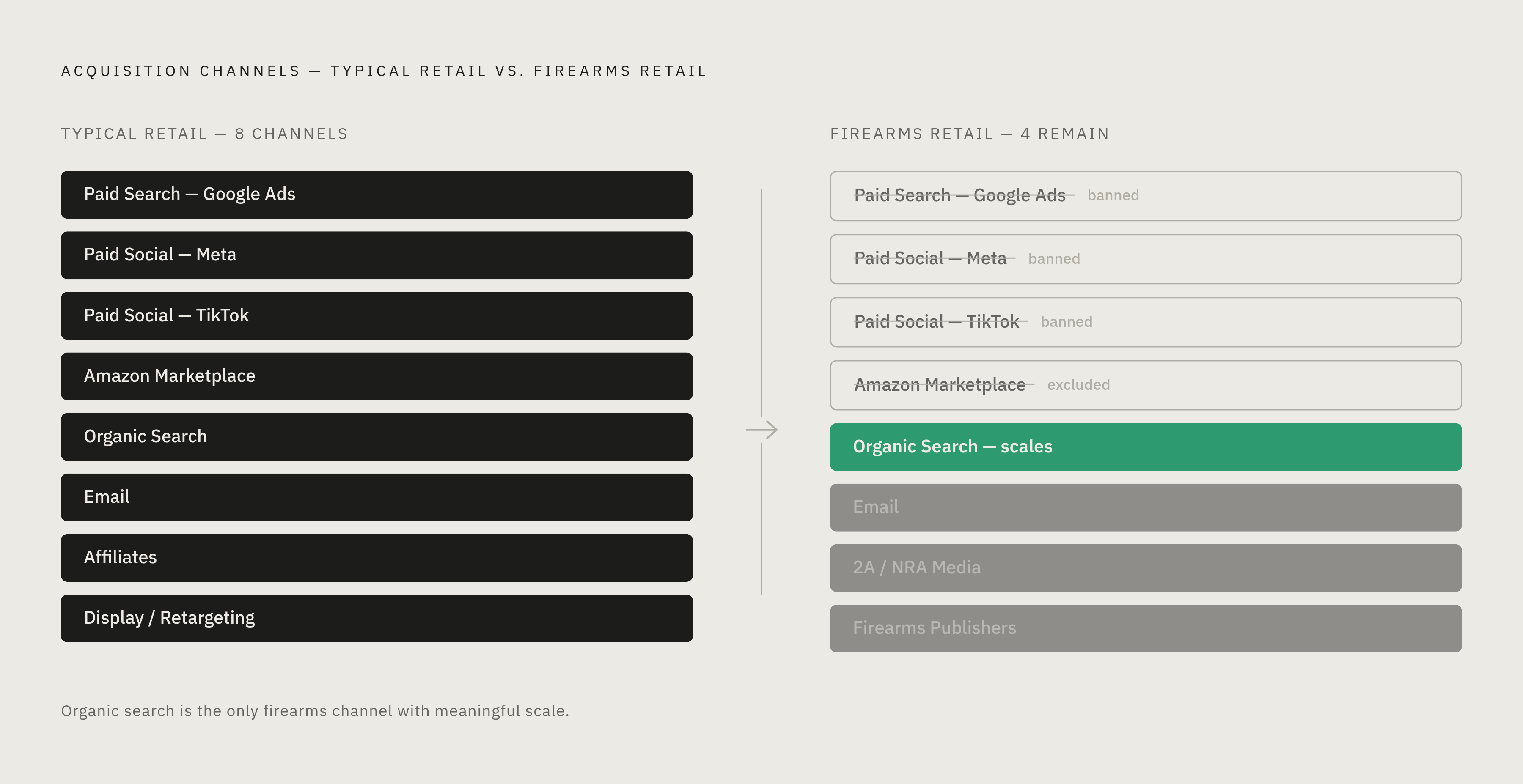
Google Ads bans firearms sales. Meta bans them. TikTok, Amazon, YouTube: each either prohibits firearms content outright or restricts it so aggressively that paid acquisition is effectively unavailable to most retailers. PayPal, Stripe, and Square do not process firearms transactions. Shopify, Wix, and Squarespace restrict firearms content at the platform level.
This is not a minor inconvenience. It is the operating environment.
For most retail categories, a business that underinvests in SEO can compensate with paid search, paid social, or marketplace presence. Firearms retailers lack that fallback. The acquisition channels available to them are organic search, firearms-specific publishers, Second Amendment and NRA-affiliated media, and email. That is roughly the complete list. Retailers who treat SEO as optional are not choosing between channels; they are choosing between organic visibility and near-invisibility.
The regulatory layer compounds the technical challenge. Assault weapons bans are active in California, New York, New Jersey, Massachusetts, Connecticut, Maryland, Washington, Illinois, Delaware, Hawaii, the District of Columbia, and Rhode Island, with Rhode Island's ban effective July 1, 2026. Magazine capacity limits of ten rounds apply in multiple states. Every interstate online handgun sale requires FFL-to-FFL transfer. ATF's eForms 2.0 mandate, enacted in January 2025, made digital Form 4473 and age-verification workflows required for any ecommerce platform handling firearm sales.
The SEO implication of this regulatory environment is underappreciated. Platform choice determines not just commerce capability but indexability and uptime. Building search equity on a platform that can de-list a firearms business without warning is like building a house on a frozen lake — it holds until it doesn't. Purpose-built providers like Gearfire, starting around $149 per month, and AmmoReady exist precisely for this reason, as does BigCommerce Enterprise, whose terms explicitly accommodate properly licensed dealers. Self-hosted WooCommerce is another viable option for retailers who want direct control. Getting platform selection right before investing in content or link building is the precondition for everything else.
It is also worth noting that compliance requirements, frustrating as they are, generate content assets. State-by-state shipping eligibility pages, FFL-finder pages, AWB-compliant variant listings, California-legal configuration pages: these exist because the law requires them, but they rank because buyers search for exactly this information. The regulatory patchwork that creates operational complexity is simultaneously a keyword landscape that less scrupulous or less patient competitors have yet to fully map.
Keyword strategy built around buyer intent, not product specs
The default catalog architecture for a firearms retailer mirrors the distributor catalog: organized by brand, then model, then specification. Glock 19 Gen 5. Smith and Wesson M&P Shield Plus. The SEO logic follows the same structure, with product pages targeting the exact model name.
This is not wrong. It is incomplete, and the incompleteness is expensive.
A buyer searching "Glock 19 Gen 5 9mm" wants more than the product page. They want to know whether it ships to their state, what the FFL transfer process looks like, whether the standard 15-round magazine is legal where they live, and what the total cost is after transfer fees. Each of those subsidiary questions is a content opportunity. More importantly, millions of new buyers do not yet know the model name. They search "best handgun for home defense" or "easy pistol for beginners" or "what gun should I get for self-defense." Product pages organized by specification do not capture that traffic.
Use-case category pages solve this. "Home Defense Handguns," "Concealed Carry Handguns," "Deer Hunting Rifles," "Competition Rifles," "Tactical Shotguns": these pages match the actual search behavior of buyers who are still orienting themselves. They also create a site architecture that serves intent mapping across three axes simultaneously, covering product category, platform type, and buyer stage.
Long-tail queries with high commercial intent deserve particular attention in the FFL context. "FFL transfer near me," "AR-15 optics in stock," "Utah concealed carry class online registration": these are searches with commercial proximity, meaning a searcher is close to an action. Capturing them requires content that addresses the full purchase context, not just the product specification.
But what if the informational content feels like a detour from selling? It is the opposite. The 26-plus million new buyers who entered the market between 2020 and 2024 began their journeys with questions, and the retailer whose content answers those questions earns the subsequent product search. Caliber comparison guides, first-time buyer walkthroughs, state legal guides: these are pipeline assets, not editorial indulgences.
Local SEO for the store that has to complete the transaction in person
Here is something the broader retail SEO conversation rarely acknowledges about firearms: the FFL transfer requirement, widely regarded as a compliance burden, is actually a structural local SEO advantage. A buyer who purchases a firearm online still has to walk into a licensed dealer to complete the transfer. A gun store with strong local search visibility captures foot traffic generated by online sales made entirely on a competitor's website. The requirement that most retailers resent is, for the locally visible store, a customer acquisition mechanism.
The numbers behind local visibility are consequential. According to SEOProfy, businesses appearing in Google's local 3-Pack receive 126% more traffic and 93% more actions, including calls and website clicks, than those ranking in positions four through ten. The gap between appearing in the top three and not is not marginal; it restructures the competitive field.
Google Business Profile completeness and ongoing activity drives roughly 32% of local ranking power, and the nuances of how Google weighs review signals have evolved. Review velocity and the quality of responses now outweigh raw review count. In 2025, keywords within the text of customer reviews influence ranking, because Google extracts them to assess relevance. A customer mentioning that they completed a concealed carry transfer or purchased a hunting rifle contributes signal that a generic five-star rating does not. Prompting customers to describe what they did, rather than just rate the experience, is now useful SEO behavior, not just reputation management.
Roughly 40% of local business queries now trigger Google's AI Overviews. Structured, factual GBP data feeds those summaries. A profile with complete product categories, accurate hours, loaded Q&A sections, and consistent NAP data across Yelp, firearms-specific directories, and chamber of commerce listings is the prerequisite for appearing in AI-generated local summaries.
The practical checklist is not complicated: claim and fully complete the Google Business Profile; maintain NAP consistency across all directories; solicit reviews actively and respond to all of them; build locally relevant content covering range hours, local hunting regulations, state-specific carry laws, and FFL transfer policies.
The urgency of mobile performance in this context is direct: 88% of consumers who conduct a local search on a smartphone visit or call a store within a day. Mobile page speed is not a technical nicety; it is the last barrier between a local search and an in-store visit.
On-page and technical foundations that firearms sites routinely skip
Manufacturer copy is the original sin of firearms ecommerce SEO. A retailer who populates five hundred product pages with descriptions copied directly from the distributor feed has created five hundred pages competing against every other retailer using the same feed, plus the manufacturer's own page, plus every publication that has ever quoted the spec sheet. Unique product descriptions are not optional; they are the primary ranking opportunity on each URL, and wasting them on duplicate content is a choice with compounding costs.
Category pages are the second consistent failure point. A page titled "Handguns" serves internal catalog logic, not search intent. "9mm Handguns for Concealed Carry" is a page that can rank, that signals relevance to a buyer's actual query, and that earns a click because the title answers the question before the searcher even arrives.
Structured data implementation in firearms retail has specific requirements that generalist SEO advice misses. Product schema surfaces specs, pricing where legally appropriate, and availability directly in search results. FAQPage schema addresses the compliance questions buyers type into search: shipping restrictions, the FFL transfer process, age requirements. LocalBusiness schema reinforces local presence signals. HowTo and Course schema applies to training classes, concealed carry courses, and cleaning guides. Each schema type serves a different query class, and together they create the machine-readable layer that feeds both traditional search results and AI Overviews.
The compliance pages discussed earlier deserve reiteration as technical assets. State-by-state shipping eligibility pages, AWB-compliant product variant pages with California-legal configurations listed explicitly, find-an-FFL tools with transfer fee context, FFL-eligible-state pages organized by product category: these are simultaneously legal necessities and ranking pages, because buyers search for exactly this information before completing a purchase.
One operational detail that frequently gets implemented incorrectly: geoblocking that respects state AWBs and magazine capacity restrictions must operate at the platform level. A product page that ranks in California for a banned configuration drives traffic that converts to nothing and erodes trust in the retailer's competence. The technical implementation of compliance is inseparable from the SEO implementation.
Core Web Vitals matter everywhere. In firearms retail, they matter slightly more, because a buyer navigating state restrictions, FFL requirements, and payment processing limitations is already tolerating friction. A slow checkout or a mobile usability failure is the last straw that ends the session.
Content and link building within a restricted ecosystem
The same platform restrictions that eliminate paid acquisition also constrain content distribution. Social amplification on Meta and TikTok is restricted. YouTube demonetizes firearms content. Mainstream publications are reluctant to link to firearms retailers. The distribution ecosystem for firearms content is narrow.
But here is where the constraint becomes, counterintuitively, an asset. The firearms content ecosystem is largely self-referential, meaning links from firearms-specific publishers, Second Amendment advocacy organizations, hunting and shooting sport associations, and NSSF-affiliated outlets carry genuine topical authority in this niche. The scarcity of mainstream linking partners makes specialized linking partners more valuable, not less. A link from a credible 2A publication or a state hunting association is more relevant to a firearms retailer's authority profile than a link from a generic lifestyle magazine.
Content types that earn links in this ecosystem follow a predictable pattern. State-specific legal guides covering carry laws, AWB summaries, and suppressor regulations are useful resources that forums and advocacy groups cite repeatedly. Caliber and ammunition comparison content answers research-phase questions for buyers who do not yet have strong brand preferences. Training and safety content connects to range operations and earns links from instructors and sporting associations. First-time buyer guides capture the large new-owner demographic that is actively searching for orientation content.
Community forums, including Reddit's r/guns, The Firing Line, and Arfcom, are high-traffic referral sources even when the links they generate are nofollow. Traffic from topically relevant communities signals authority to search engines even when it does not pass link equity directly. Participating in those communities, or producing content that earns organic citation within them, is a distribution strategy with real SEO upside.
Local link building deserves its own emphasis: partnerships with ranges, hunting clubs, sporting goods associations, and local media covering hunting seasons or safety events are simultaneously local SEO signals and evidence of genuine community presence. These are not manufactured relationships; they are the digital documentation of a business that is actually embedded in the community it serves.
What to avoid is equally specific. Link schemes and generic guest post networks are algorithmic risks in any niche. In firearms, they carry the added problem of associating a retailer's authority profile with low-quality sites in a category that Google evaluates under YMYL, Your Money or Your Life, standards, meaning accuracy and responsibility are assessed more stringently than in less consequential niches. Content that over-promises on legal gray areas, suppressor workarounds, private sale ambiguities, is not just a compliance risk; it is an algorithmic trust risk with lasting consequences.
Putting the tactics together into a prioritized starting point
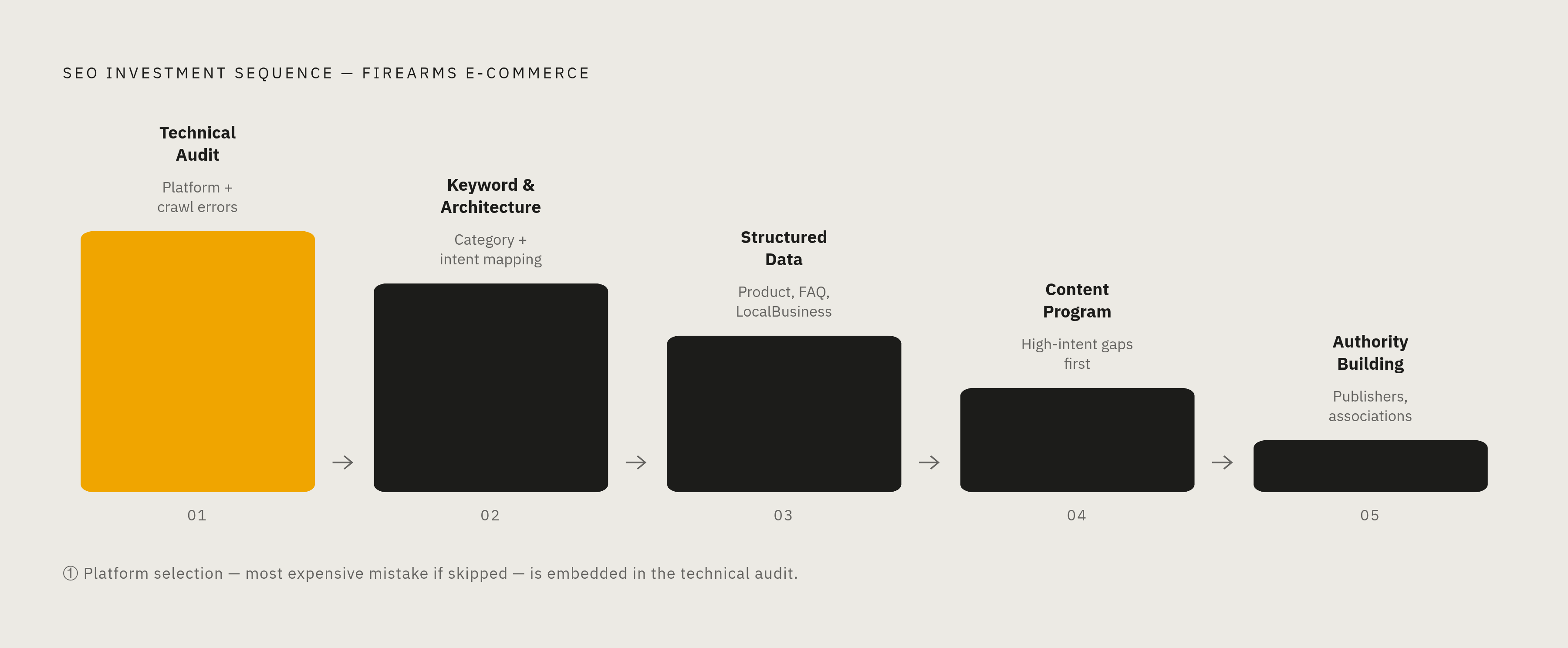
The sequence matters because not everything can be done simultaneously, and the wrong starting point wastes resources that compound slowly.
A brick-and-mortar FFL dealer with no ecommerce presence has different first priorities than an online retailer shipping nationally. For the local store, Google Business Profile optimization and NAP consistency across directories deliver the fastest measurable lift. Pair those with active review solicitation, responses to all reviews, and a technically sound, mobile-fast site, and the local visibility improvement is both fast and durable.
For the ecommerce retailer, platform selection is the foundational decision and must precede content or link investment. Building search equity on a platform that can de-list a firearms business without warning is the most common and most expensive mistake in this category.
The shared sequence for both retailer types runs as follows. Begin with a technical audit covering crawl errors, mobile usability, page speed, and duplicate manufacturer copy. Move to keyword and content architecture, building use-case category pages, intent-mapped product pages, and state-level compliance content. Implement structured data: Product, FAQPage, and LocalBusiness schema at minimum, with HowTo and Course schema for training content. Then build the content program, starting with high-intent informational gaps, state legal guides, first-time buyer content, caliber comparisons, before investing in volume. Authority building through firearms publishers, associations, and local partnerships comes last in sequence but compounds longest in value.
The through-line across all of this is the same insight that frames the entire challenge. The constraints that make firearms SEO harder than general retail SEO — no paid fallback, platform risk, state-by-state legal complexity — are exactly what make organic authority so durable once it is built. Over 52,000 Type 01 dealer licenses were active in 2024, per ATF data, and the competitive field in organic search runs into hundreds of thousands of URLs when manufacturers, forums, news outlets, and advocacy sites are included. Most of those competitors cannot buy their way to the top of organic results any more than a single retailer can. The business that builds search authority early, and builds it correctly, creates a compounding advantage that late entrants cannot quickly close.
That is not a guarantee. It is a window. And like most windows in competitive markets, it is open longer for the people who notice it first.


