Email Marketing for Firearms Businesses
Email marketing is, at this point, a survival skill for firearms businesses. That framing sounds dramatic until you tally what these brands actually cannot do: run paid ads on Google, Meta, YouTube, or most major cable networks. Those restrictions are not federal law. Firearms advertising is federally legal. The restrictions are platform policy, and they are tightening, not loosening. Nothing in the current trajectory of major tech platforms suggests a reversal is coming.
The practical consequence is that firearms brands are structurally locked out of the paid acquisition infrastructure that most consumer businesses treat as ambient oxygen. And that exclusion has arrived at a bad moment. Per Gearfire's RetailBI Firearm Sales Index, same-store new firearm unit sales declined roughly 13% in 2025 from 2024 levels. A contracting market with shrinking paid reach means that brands which depended on acquisition volume during boom years are now confronting a compounding problem. The companies that built owned channels during the good years are better positioned. The ones that didn't are discovering, a little too late, that owned channels take time to build.
That's the context. What follows is an attempt to think through what a well-built firearms email program actually looks like, from the platform choices to the compliance infrastructure to the automation logic that makes it pay out.
Email Has Become the Irreplaceable Channel, and the Reasons Are Structural
Among the owned channels available to firearms brands, email is the only one that delivers content directly to a subscriber without algorithmic filtering, platform gatekeeping, or policy risk on delivery. A social media following is not truly owned; reach on those platforms is still governed by algorithm and acceptable-use policy. An email list, built on first-party permission, belongs to the business. No platform decision next quarter can deactivate it. Think of it like land versus a lease: social media gives you a storefront in someone else's building, but your email list is property you own outright.
The receptivity argument is also worth taking seriously. Hobby-category emails, which includes shooting sports, average a 27.35% open rate per Mailchimp benchmarks. That is a meaningfully engaged audience. NSSF webinar data from 2023 cites email ROI of up to 25 times investment, which outperforms most other marketing channels available to a brand operating in this category. Internet firearms sales grew from 26% to 33.5% of retailer volume between 2018 and 2022, per NSSF's 2023 Firearms Retailer Survey. The customer relationship increasingly begins and continues online, and email is where that online relationship lives in a format the brand controls.
SEO, niche platforms, and influencer programs fill the same gap partially. None of them deliver content directly to a named individual who has asked to hear from you, without an intermediary making policy decisions about whether your content qualifies. Email does that.
The Federal Floor Is Not Complicated, But Ignoring It Is Expensive
The governing federal law for commercial email is the CAN-SPAM Act, and its requirements are, bluntly, not that onerous. From headers must accurately identify the sender. Subject lines must be honest. The message must be identifiable as an advertisement. Every message must carry a valid physical postal address. A functioning opt-out mechanism is required, and opt-out requests must be honored promptly; the mechanism itself must remain active for at least 30 days after send. If a third-party sender is involved, legal responsibility is shared between the brand and the sender. It cannot be contracted away.
The penalties are real. As of 2025, per FTC figures cited by Shopify, non-compliance runs up to $53,088 per email. Enforcement can come from the FTC, the DOJ, or state attorneys general. That last category is increasingly relevant.
CAN-SPAM does not require opt-in consent to add someone to a list. Legally, you can email people who haven't subscribed. Practically, you should not. Scraped or harvested lists produce deliverability problems, complaint rates that damage sender reputation, and a list that doesn't actually want to hear from you. Permission-based list-building produces lists that perform.
The state layer is not static. California's AB 2571 restricts marketing of firearms to minors. New York's General Business Law Section 898 enables civil action for unlawful marketing practices, and the Second Circuit upheld its constitutionality in July 2025. These laws are not uniform across states, and the legal landscape is actively diverging. A firearms email program built entirely around federal CAN-SPAM compliance and nothing else is already behind.
The Compliance Requirements That Are Actually Harder Than CAN-SPAM
Federal email law is a floor. The compliance work that is particularly difficult in firearms email is the layer above it.
Age gating is the most obvious example. Only individuals meeting legal age requirements should receive firearms offers. The operational question is where that verification happens and how it propagates through the system. It must be built into list acquisition logic and into every automation flow that surfaces product offers, not assumed to exist because someone checked a box at signup. The age-gate is a list attribute, and it needs to follow the subscriber.
Geo-suppression is equally critical, and significantly more complex. Product legality varies by state. Sending a suppressor promotion to a California subscriber is not just wasted spend; it is a compliance exposure. Automated flows should incorporate state-level logic to suppress illegal SKUs by recipient location. That requires clean, maintained address data on the list. Address data on email lists is frequently incomplete or outdated, which means geo-suppression logic is only as reliable as the underlying data quality.
Content language is a third dimension. The sensitivity of the category means that hyperbolic or misleading copy creates legal and reputational risk that goes beyond what a non-industry brand would face. Factual and informative is the appropriate register; exaggerated claims in firearms email advertising draw scrutiny that most categories simply don't attract.
These three requirements — age gating, geo-suppression, and content standards — cannot function as afterthoughts bolted onto a generic email program. They require compliance infrastructure embedded in list management and automation logic from the beginning. With third-party cookie deprecation advancing, the quality of first-party data — specifically its consent depth, accuracy, and segmentation granularity — directly determines how well that compliance logic can function. A list built with sloppy data practices cannot support the suppression logic a firearms program requires.
The Platform Problem: Which Tools Will Actually Serve This Industry
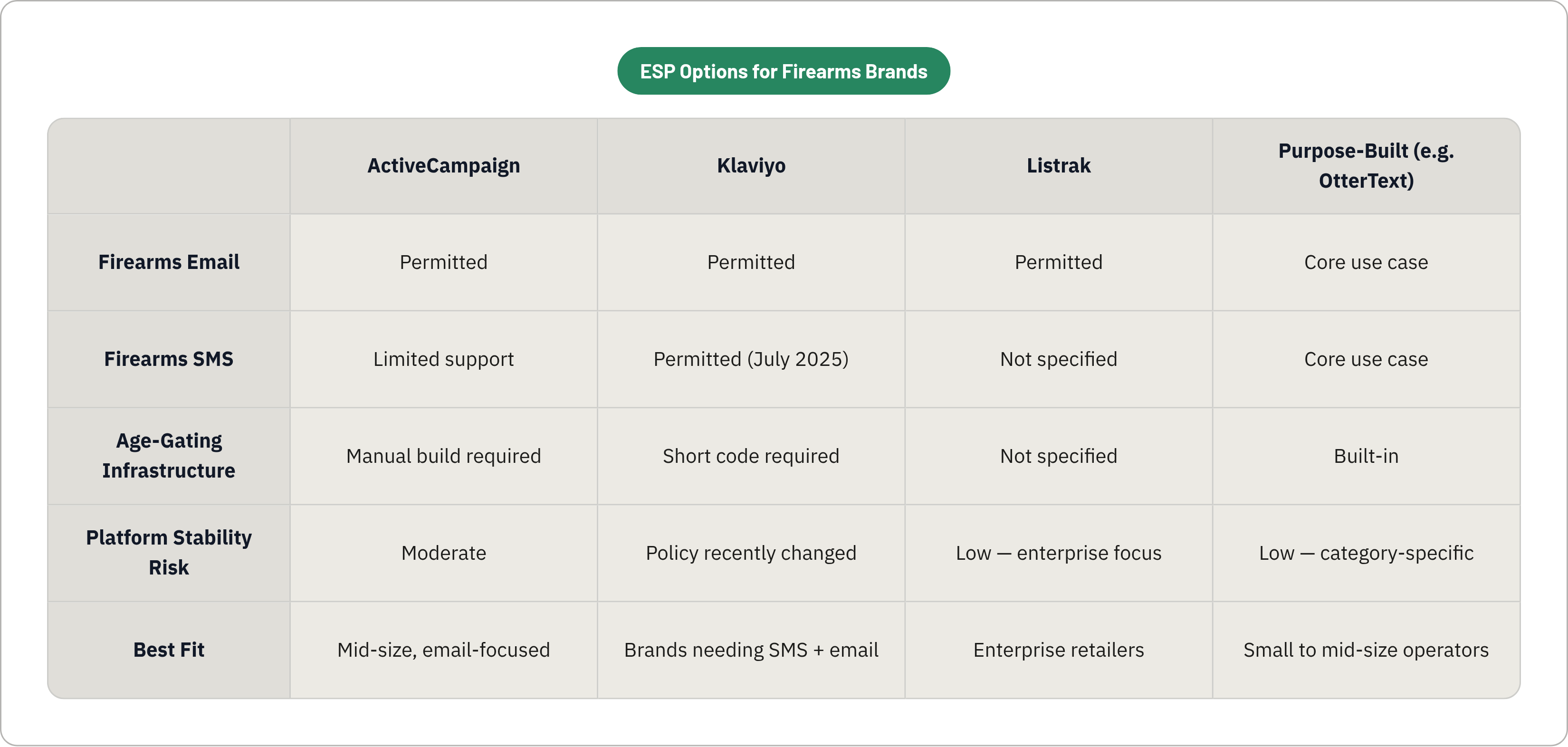
This is where the absurdity of the situation becomes most visible. The primary constraint on firearms email is not federal law. It is the acceptable use policies of private email service providers. Some of the most capable and widely used ESPs in the market simply will not work with firearms businesses, or will, until they decide not to.
Mailchimp is widely used by small businesses and has become unreliable for firearms brands. Account deactivations without warning have been common enough that building a core business channel on it represents a genuine operational risk. Constant Contact has been used by some firearm brands but carries similar risk of deactivation and offers limited capabilities that make it difficult to recommend seriously.
ActiveCampaign is more permissive. It allows firearms businesses to use its email features and has robust automation capabilities, making it a viable option for email-focused strategies, though its SMS support is limited. Klaviyo made a significant shift: after four years of refusing to work with firearms businesses, it updated its policy in July 2025 to explicitly support SMS marketing for firearm companies via age-gating. The mechanics matter here. Klaviyo requires a short code configured for 21-plus audiences rather than a toll-free number for U.S. firearms SMS, and short code provisioning typically takes eight to twelve weeks after carrier submission. Additionally, certain carriers maintain their own restrictions; SMS cannot be used to market firearms or parts that are not legal in all 50 states, which means geo-suppression logic applies at the carrier layer, not just the platform layer.
Listrak openly works with firearm retailers and brands and has strong capabilities, but its price point targets enterprise budgets and excludes most small and mid-size operators. Sendlane, Postscript, and Attentive prohibit firearms content and are not viable options for this industry.
The GoHighLevel situation is instructive and a little embarrassing for everyone involved. It has been white-labeled and actively marketed to firearms businesses by several resellers. The underlying SMS infrastructure runs through Twilio, which prohibits firearms-related texting. Some resellers have attributed the resulting SMS failures to carriers rather than the platform. Businesses that built SMS programs on GoHighLevel have discovered the problem after the fact, which is exactly the kind of discovery nobody wants to make at scale.
Purpose-built options exist. OtterText describes itself as built specifically for firearms businesses. Rapid Gun Systems integrates email with inventory management for firearms retailers. These tools trade breadth for reliability in a category where mainstream platforms have repeatedly demonstrated they cannot be trusted to stay.
Klaviyo's July 2025 policy change is the most significant recent development in the firearms email and SMS space. But the history of Podium, Birdeye, and others — platforms that welcomed firearms clients around 2020 and banned them shortly after — suggests that publicly traded platforms shift with investor sentiment. Policy reversals happen, and they happen quickly. Any firearms business selecting an ESP should document that platform's current policy, understand the infrastructure layer below it, and have a contingency plan ready.
List-Building and Segmentation: Volume Is Not the Point
Why exactly does a large list fail to produce proportionate revenue? Because volume without relevance trains subscribers to ignore you, and ignored emails do not convert. A bloated, unsegmented list is like a shotgun aimed at a keyhole: a lot of energy, almost no precision.
The segmentation case is straightforward. At the point of signup, interest-based checkboxes — hunting, concealed carry, competitive shooting, law enforcement — allow subscribers to self-select into relevant content tracks. HubSpot data shows that 63% of email recipients agree or strongly agree that most marketing emails they receive contain no content relevant to them. Irrelevance is the primary driver of disengagement. Sending hunting promotions to concealed carry subscribers depresses engagement metrics across the list and trains subscribers to tune out everything you send, including the promotions that would have been relevant.
Segmentation by lifecycle stage compounds this. A first-time buyer, a repeat customer, and a lapsed buyer are in categorically different relationships with the brand and warrant fundamentally different messaging. First-time buyers need education and confidence-building. Repeat customers respond to loyalty recognition and early access. Lapsed buyers need a reason to return that is specific enough to cut through inertia.
Geo-segmentation operates at two levels simultaneously: compliance (suppression of illegal SKUs by recipient location) and revenue (regional inventory, local events, state-specific offers). Age-verified segments should be maintained as explicit list attributes, particularly as SMS programs come online and require that data at the carrier layer. List hygiene — specifically the regular suppression of hard bounces, unengaged contacts, and unsubscribes — keeps complaint rates low and deliverability intact. An unclean list actively damages sender reputation for the engaged portion of the list.
The Automations That Actually Move Revenue
Welcome series, abandoned cart recovery, post-purchase nurture, win-back campaigns: these are the four workflows that do the most work in a firearms retail email program, roughly in that order of infrastructure priority.
The welcome series sets expectations and begins segmenting by interest signal. For first-time gun buyers specifically, educational content about safety and training outperforms product-first messaging. That's not a values statement; it is a behavioral observation. First-time buyers are frequently anxious about competence, and addressing that directly earns trust faster than leading with a catalog.
Abandoned cart recovery, per advice from Guns.com's digital marketing director shared at an NSSF webinar in May 2024, is among the highest-ROI automations a firearms retailer can deploy. An automated cart abandonment email sent within a few hours of exit captures intent that is otherwise lost. The timing matters; urgency decays quickly.
Post-purchase nurture extends lifetime value without additional acquisition cost, which in a contracting market becomes increasingly important. Accessories, maintenance products, and training resources are logical next purchases tied to what the customer just bought. Win-back campaigns for lapsed customers operate on the same logic: reactivation is more cost-effective than acquisition, and in a declining market, that math becomes harder to ignore.
Personalization amplifies all of these. Personalized emails — meaning emails that use purchase history and interest data to tailor content — deliver substantially higher transaction rates than generic sends.
Compliance logic must be embedded at the automation level, not the list-acquisition level alone. Geo-suppression and age-gate checks need to run within the flow, not just at signup. A subscriber who was correctly age-gated at acquisition and whose address data has since lapsed into a state with different product restrictions represents exactly the kind of compliance gap that gets discovered at the worst possible moment.
SMS: High Engagement, Genuine Complications
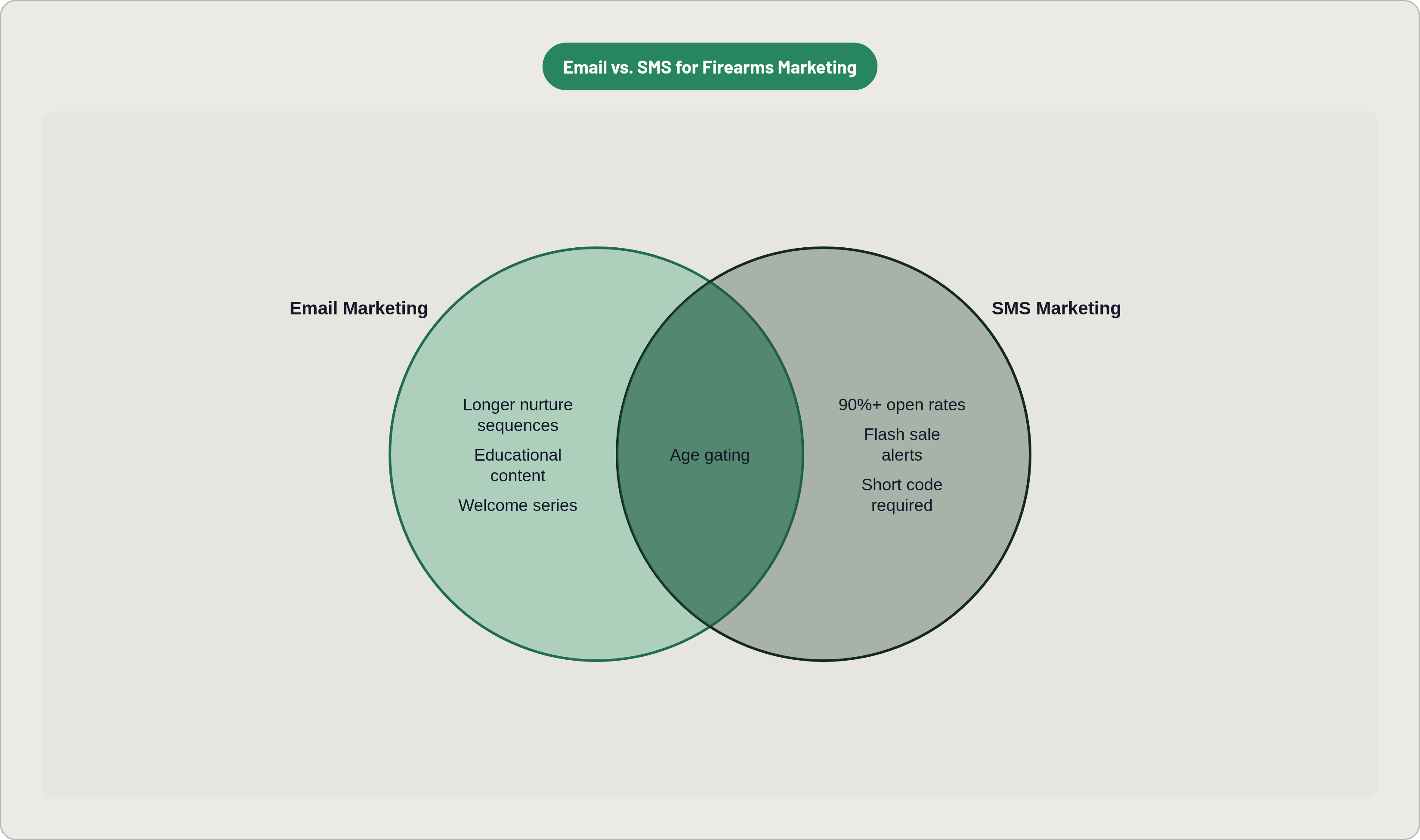
SMS open rates exceed 90%. For time-sensitive communications — restock alerts, flash sales, launch announcements, limited-time offers — no channel competes with it for immediacy. The case for pairing SMS with email is a case for specialization: email handles longer content, nurture sequences, and educational material; SMS handles urgency. Both channels become more effective when they share list data, audiences, and automation logic.
But the channel restrictions in firearms SMS are real, layered, and not fully resolved.
Klaviyo's July 2025 policy update represents the first mainstream ESP to explicitly support firearms SMS with age-gating infrastructure. The short code requirement for 21-plus audiences rather than toll-free numbers is not optional; it is the mechanism by which age-gating is enforced at the carrier level. The eight-to-twelve-week provisioning timeline for new short codes means that a brand deciding to launch firearms SMS today cannot expect that capability to be active next month.
The carrier restriction on products not legal in all 50 states has direct implications for suppressor dealers, SBR retailers, and anyone selling products whose legality varies significantly by jurisdiction. Geo-suppression logic that operates in the email program must also operate in the SMS program at a carrier-compatible level of specificity.
Platform instability remains the real risk. The history of Podium, Birdeye, and GoHighLevel's reseller ecosystem demonstrates that welcome shifts can reverse without warning. Any business building an SMS program should understand the platform layer, understand the carrier layer beneath it, document current policy in writing, and maintain a contingency plan. The GoHighLevel case — specifically the pattern of resellers marketing the platform as firearms-friendly when the underlying Twilio infrastructure prohibited firearms SMS — is a useful cautionary example of what happens when businesses don't interrogate the infrastructure layer beneath the platform they're buying.
Deliverability Is Not a Technical Problem. It Is a Business-Critical One.
Deliverability is sender reputation made operational. It is built through consistent sending, low complaint rates, high engagement, and clean lists. It degrades through the reverse of each of those.
Firearms brands carry an additional reputational risk that standard senders do not: if a prior email account was deactivated by a platform, the associated domain and IP history can carry negative signals into future sending. A brand that has been deactivated once and migrates to a new platform does not start with a clean slate by default.
The authentication basics — SPF, DKIM, and DMARC records correctly configured — are table stakes. Major inbox providers use engagement signals to make inbox placement decisions; sending to unengaged subscribers suppresses deliverability for the entire list, including the engaged portion that would otherwise receive the message. This is the mechanism by which a bloated, unclean list actively harms the business.
Language is a less obvious deliverability factor. Certain words and constructions common in firearms marketing can trigger spam filters. Subject lines and body copy should be tested before broad deployment, particularly when introducing new content types or promotional language.
Sending volume and cadence also matter. Sudden spikes in volume damage sender reputation; ramp-up schedules are necessary when migrating to a new platform or launching a new list. The operational implication is that a firearms business that loses access to its ESP and scrambles to a new platform cannot simply resume sending at full volume. It must rebuild its sender reputation from scratch, during exactly the period when it can least afford to be invisible.
That is the compounding risk that makes platform selection and deliverability maintenance existentially important for this category. A list that cannot reach inboxes is an asset that has been quietly destroyed while the business assumed it was intact.
The plain conclusion is that firearms email marketing is more demanding than standard email marketing, not because the fundamentals differ, but because the margin for error is smaller. Platform risk, compliance complexity, deliverability fragility, and a contracting market all operate simultaneously. The brands that navigate it well do so by treating the email program as infrastructure, not as a campaign tactic. The ones that treat it as an afterthought tend to discover the consequences at the worst possible time.