Gun Range Marketing on a Regional Budget
First-time gun owners are searching online—and most ranges aren't findable.
Start with the audience, because it has shifted considerably from five years ago, and the difference is not subtle.
Between 2020 and 2024, approximately 26.2 million Americans became first-time firearm owners, per the National Shooting Sports Foundation. That is not a niche recreational trend; it is a structural reorientation of who owns firearms in this country and, by extension, who is searching for ranges, classes, and training. Among new owners between 2021 and 2024, 46.3% were women, per a peer-reviewed survey published in the Annals of Internal Medicine. The same survey found new owners were more racially diverse than the existing base, with roughly 20% identifying as Black non-Hispanic and 20% as Hispanic. Female firearm ownership has climbed an estimated 177% since 1993, per data from ShotPro Network published in early 2026; the underlying methodology has not been publicly documented, so this figure warrants verification against primary sources before being cited as established fact.
That raises an immediate question for any range operator: does your marketing infrastructure actually reflect this audience, or is it still architected for a customer who represents a shrinking share of new demand?
A 2025 survey by A Girl & A Gun found that available training opportunities had become the strongest driver of firearm ownership among women, ranking above equipment, cost, and peer influence. That is a direct signal for ranges with class programs. This audience is not looking for a place to shoot. They are looking for a place to learn, from people who will make them feel capable rather than embarrassed for asking basic questions.
These new owners are not calling a friend who has been shooting for thirty years. They are searching. "CCW class near me." "Beginner shooting lessons [city]." "First-time shooter range [zip code]." The ranges that appear for those queries hold a measurable advantage. The ones that do not are functionally invisible to the largest growth segment in their addressable market.
Why Local SEO Is the Highest-Leverage Channel for a Range With a Limited Budget
Local SEO is, at its core, the practice of making your business findable when someone nearby searches for what you offer. According to Google's own research, 46% of all Google searches have local intent. That behavior is already happening at scale. The question is whether a given range appears in it, or whether a competitor does instead.
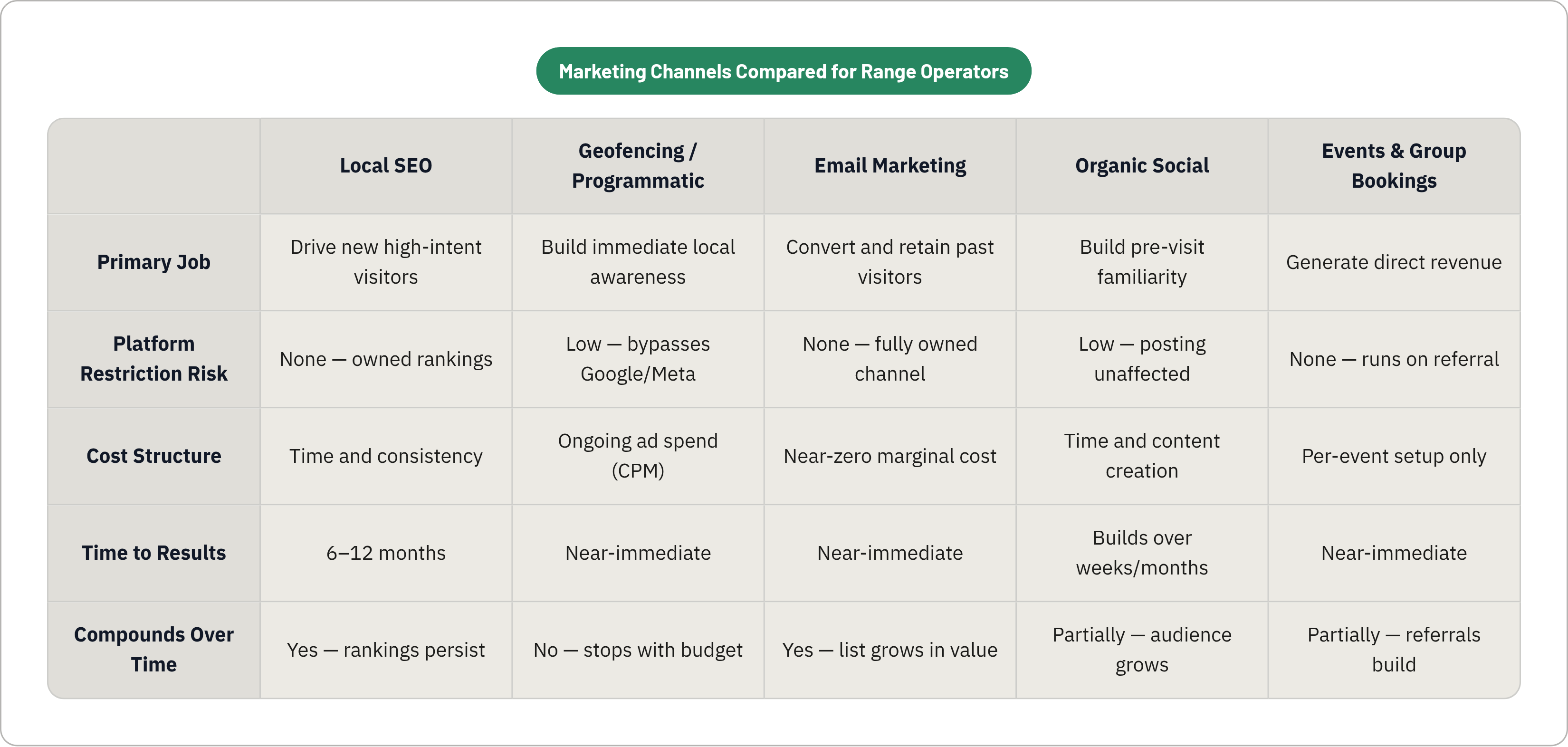
The structural appeal for a range operating under platform restrictions is this: local SEO's primary cost is time and consistency, not ad spend. It cannot be suspended because a platform updated its firearms policy on a Thursday afternoon. And it compounds. A page that ranks well this month ranks well next month, unlike a paid campaign that exists only as long as the budget does.
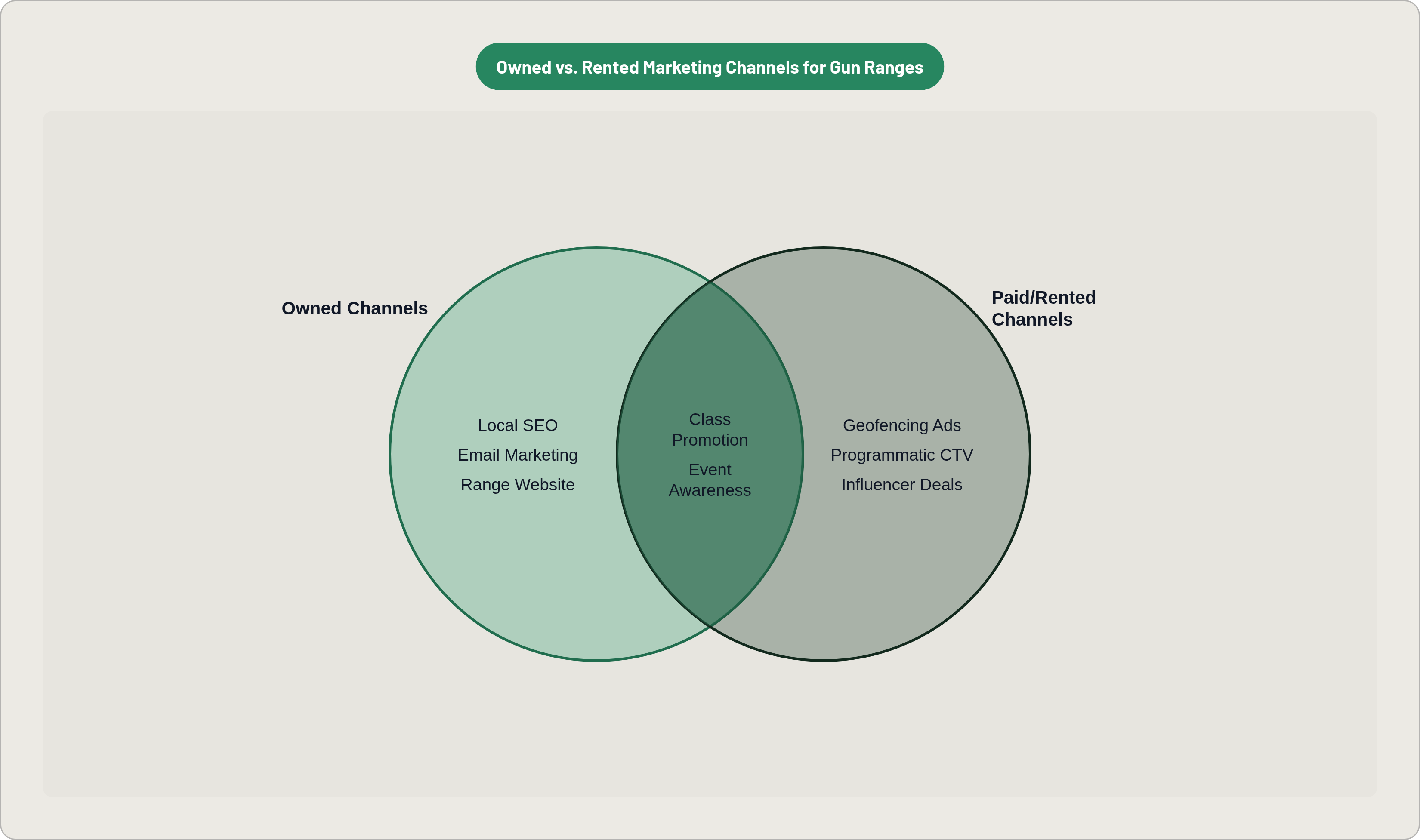
One reasonable argument against this approach is that local SEO is slow, and that paid channels, even restricted ones, deliver results faster. That is true in most categories. But when the paid foundation is fragile by design, a slower but more durable alternative becomes considerably more attractive. The analogy is not building versus renting; it is more like building on land you own versus a lot where the landlord can change the lease without notice.
The Range 702 in Las Vegas reportedly saw a 44% increase in CCW class signups from Q1 2024 to Q1 2025 following an SEO-focused overhaul, per reporting from Advertising for Small Businesses in April 2026. Las Vegas is not a forgiving market. That result, if accurate, came from building a more complete and authoritative local search presence, not from outspending anyone on paid inventory.
What local SEO actually encompasses for a range: a fully optimized Google Business Profile as the anchor; keyword-focused landing pages for specific services; NAP consistency, meaning Name, Address, and Phone number, across every directory and citation source; and review velocity as a ranking signal. Mismatched NAP data across directories is not a minor administrative oversight. It is a structural error that silently suppresses visibility, and it is remarkably common among operators who built a web presence incrementally and never audited it.
Ranking competitively for local terms typically takes six to twelve months of consistent effort. Ranges that treat local SEO like a paid campaign and expect results in week three will almost certainly abandon it before it pays off. The ones that treat it as infrastructure end up owning map pack positions for queries their competitors are not even contesting.
How to Actually Optimize a Google Business Profile for a Gun Range
The Google Business Profile is the most visible local ranking asset a range directly controls. It determines whether the business appears in the map pack, how many directions requests it generates, and whether a user clicks through before ever reaching the range's own website. It is also, perplexingly, one of the most neglected pieces of digital infrastructure in the range industry.
Photos illustrate the neglect most clearly. Businesses with photos receive 42% more directions requests and 35% more website clicks than those without, per Marketwake research from April 2025. For a range, the relevant photography is not a logo and a stock image of a pistol. It is the facility itself: lanes in use, classes in session, the retail area, staff members who look approachable. Show the physical environment, because a first-time visitor is evaluating whether the place feels welcoming before they ever step inside. That evaluation is happening on a phone screen, often at 10pm, before they commit to driving anywhere.
A common and counterproductive mistake: keyword-stuffing the business name field. Listing a range as "City Gun Range and CCW Training Center" when the legal name is something else violates Google's guidelines, and Google has been actively suspending profiles that do it, per BrandHopper reporting from April 2026. The name field should reflect the actual business name. Keywords belong in the services section, the description, and on the website.
On reviews: 97% of consumers read online reviews for local businesses, per BrightLocal's Local Consumer Review Survey. For a range trying to reach first-time firearm owners who are already somewhat uncertain about the category, a strong review profile is not merely a ranking signal; it is a conversion asset. The target is a 4.5-star average with at least twenty recent reviews, weighted toward recency. A review from three years ago carries less algorithmic weight than one from last month. Build the ask into standard operations through a text or email follow-up with a direct link. Make it frictionless, because friction is where good intentions die.
One counterintuitive nuance worth noting: a perfect 5.0 rating can trigger skepticism in Google's AI filters. A few honest three-star reviews from people who found parking difficult are, oddly, more credible than an unblemished record. Imperfection, in this case, signals authenticity.
The Q&A section is consistently underused. Populate it proactively with questions customers actually ask: hours, lane rental pricing, whether beginners are welcome, what identification is required. If the range leaves this section empty, Google will pull answers from wherever it can find them, including user-generated content no one on staff has reviewed or approved.
GBP posts function as indexed announcements. Upcoming classes, events, promotions, instructor introductions: these keep the profile active and signal to Google that the business is current. Connect the profile to service-specific landing pages on the website, not just the homepage. Google uses that link structure to understand what the business actually offers, and it should not have to guess.
Building the Website Pages That Capture High-Intent Local Searches
A homepage alone cannot rank for every service a range offers. Google needs dedicated, specific pages to match specific queries, and many range websites get this wrong because the site was built by someone optimizing for visual appeal rather than search architecture. Both can coexist; the problem is when one is treated as though it obviates the other.
The URL structure for service pages should be deliberate: /classes/ccw/, /classes/beginner/, /services/gunsmithing/, /lane-rental/. Each page targets a distinct keyword cluster. Each should carry the city and region in the page title, H1, and first paragraph, written naturally rather than jammed in for effect. Each should include a description of the service, approximate pricing (users who cannot find pricing will leave and will not call to ask), a booking or contact call-to-action above the fold, and schema markup for local business so Google can parse the page correctly.
Blog and resource content compounds over time in a way paid advertising cannot. Safety guides. "What to bring to your first range visit." State-specific CCW requirements. These pages capture informational searches from new gun owners who are precisely the audience identified at the outset. They arrive via search, they read, and they associate the range with competence and approachability before anyone on staff has spoken a word to them.
Site speed deserves mention not because it is exciting but because it is quietly punishing when neglected. A slow site loses both the Google ranking and the visitor who bounces in the first three seconds. It is the kind of infrastructure problem that is easy to defer until you look at your bounce rate and wonder why it is catastrophic.
This is also where the distinction between owned and rented infrastructure becomes concrete. The range owns its website. It controls the content. It cannot be de-platformed by a policy update made in a conference room the range has no access to. A well-ranked website page does not share the structural vulnerability of a social profile that can be suppressed or restricted without appeal.
Email Marketing as the Direct Line to Repeat Visitors When Paid Channels Are Closed Off
Platform restrictions make paid retargeting largely unavailable for a range. Email fills that structural gap. It reaches people who have already visited, enrolled, or purchased, without requiring permission from Google or Meta. It is the only direct communication channel a range fully owns, which makes it worth protecting.
Emails in hobby-related categories average a 27.35% open rate per Mailchimp benchmark data, considerably higher than most industries. That figure reflects something intuitive: people who opted in to hear from a range they enjoy visiting are generally interested in what that range has to say. The list is pre-qualified in a way a cold paid audience is not.
List-building should be embedded into operations rather than treated as a separate initiative. Collect email at lane rental check-in, class registration, and retail checkout. Let new subscribers self-select interest areas at signup: hunting, competitive shooting, CCW, home defense. That segmentation, built from day one, enables targeted communication rather than a single undifferentiated blast to everyone. Geography-based segmentation matters too, because state-specific regulations vary, and a message appropriate for one subscriber is actively problematic for another.
What to send is fairly straightforward: upcoming class schedules, event announcements before they go to social, membership renewal reminders, and member-only promotions that give the list a tangible reason to stay subscribed. A list that receives no exclusive value will atrophy. Rebuilding a lapsed list is considerably harder than maintaining an active one, and the operator who learns that lesson usually learns it expensively.
A list of two thousand local subscribers reached for near-zero marginal cost is more efficient and more defensible than a paid campaign targeting the same two thousand people at standard CPM rates. It also does not disappear when a platform revises its firearms advertising policy.
How Geofencing and Programmatic Ads Work Around the Major Platform Bans
Geofencing routes around platform restrictions by placing ads through programmatic networks rather than Google or Meta directly. The ads appear on news sites, within mobile apps, as pre-roll video, and as CTV spots on connected televisions. The audience is the same. The delivery surface is different. It is not a workaround in the sense of gaming policy; it is simply using infrastructure that does not carry the same categorical restrictions.
The NSSF described geofencing in December 2024 as analogous to finding an alternate route when a primary road is closed. The destination has not changed. Only the path has.
Pricing is meaningful but manageable on a regional budget. Industry CPM for mobile and desktop geofencing display runs roughly $3.50 to $15. CTV geofencing runs $20 to $50 CPM, per GroundTruth's current rate card. Geofencing campaigns deliver approximately twice the click-through rate of standard mobile advertising per GroundTruth benchmark data, and 53% of consumers visit a retailer after receiving a location-triggered message near that store, per the same source.
The targeting options are where geofencing becomes genuinely useful for a range. Competitor geofencing places ads in front of people currently at or near a competing range, which is aggressive but legal. Complementary location targeting reaches audiences at gun shops, hunting supply stores, and sporting goods retailers. Manufacturer co-op programs represent a largely untapped traffic source that most ranges ignore: some major firearm manufacturers will geofence a partner range's location as part of their own campaigns, generating incremental visibility at no cost to the range's own budget. That is free media, and the fact that it goes unclaimed is puzzling.
Firearms-specific platforms including Topple and Armanet have emerged as additional inventory options beyond the general programmatic ecosystem, particularly useful for reaching demographics outside the traditional firearms audience.
But geofencing is still a paid channel. A range that relies on it as a primary strategy remains exposed to budget fluctuations and vendor relationships in a way that owned rankings are not. It works best as a complement to the organic foundation built through local SEO, driving immediate awareness while longer-term search rankings develop. The risk of inverting that relationship is that the moment the budget contracts, so does the visibility.
What Organic Social and Content Can Realistically Do for a Range
Here is a distinction that gets conflated constantly: organic posting on Instagram, Facebook, and YouTube is largely unaffected by platform ad restrictions. A range can build a meaningful presence on all three without running a single paid ad. The restrictions apply to paid promotion, not to posting content. That distinction is obvious once stated and yet routinely missed by operators who assume the ad restrictions contaminate the entire platform relationship.
At the 2024 NSSF Marketing and Leadership Summit, Landon DePasquale made the point directly: stop trying to sell on platforms that restrict sales; lead with content instead. And avoid building your business on rented ground. Organic social is most valuable when it builds awareness and familiarity, not when it is treated as a direct revenue channel with a measurable weekly return. The operators who get frustrated with organic social are often the ones measuring it against the wrong benchmark.
What organic social is actually good for at a range: showing what the facility looks and feels like before a first visit; promoting upcoming classes and events to an audience that has already opted in; making the business feel approachable to the first-time shooter audience. For a new gun owner who is uncertain about walking into a range for the first time, a few weeks of scrolling through friendly, professional, welcoming content does real persuasive work before any sales conversation begins. That pre-visit familiarity lowers the threshold for the first visit in a way that no coupon or ad can fully replicate.
Video is the highest-performing format across platforms right now, and it does not require a production budget. Instagram Reels and YouTube Shorts drive disproportionate engagement relative to their cost. Safety walkthroughs, class previews, range tours, staff introductions: a phone and a well-lit facility are sufficient. The barrier is not equipment; it is the willingness to show up consistently.
Shooting Industry Magazine noted in May 2026, drawing from a multi-location Texas retailer, that large-following "gun influencer" accounts are showing diminishing effectiveness for regional marketing. Smaller, locally engaged creators with genuine community ties drive more local action than national personalities with diffuse audiences spread across many states. A nano-influencer in your metro who also happens to be a CCW instructor is likely worth more to a regional range than a partnership with someone who has a million followers who will never drive to your parking lot.
One honest ceiling to acknowledge: organic social builds awareness but rarely closes the sale on its own. It feeds the top of the funnel. Local SEO and email handle the conversion. Understanding which channel does which job, and resisting the urge to blame the wrong tool for failing at a job it was never designed for, is most of the strategic work.
Events and Group Bookings as a Direct Revenue Channel That Bypasses Digital Restrictions Entirely
Events are the cleanest structural alternative to the platform problem, because they require no paid digital advertising whatsoever. A group booking made through a phone call, a website form, or a referral generates revenue without a single impression purchased on a restricted platform. There is something almost pleasingly retro about it.
The industry has demonstrated this model repeatedly. Gun For Hire in New Jersey, Top Gun Range in Houston, C2 Tactical in the Scottsdale and Phoenix markets, and Strip Gun Club in Las Vegas all run structured group packages accommodating thirty or more guests. Birthday parties, bachelor and bachelorette events, corporate team-building outings, private group sessions: these formats are proven, repeatable, and largely insulated from platform risk because they run on direct human referral and word of mouth.
C2 Tactical takes the model further than most, offering corporate meetings, mixers, social events, and a shooting range wedding venue with an ordained minister on staff. Whether that specific offering travels to a regional market is a question each operator is positioned to answer for themselves. But the underlying principle is sound: the "group experience" category has considerably more ceiling than most range operators have actually tested. The ceiling has not been hit; it has been assumed.
A single booked corporate outing can equal dozens of individual lane rentals in revenue, with comparatively low incremental marketing cost. The conversion is a phone call or a form submission, with no campaign requiring creative, targeting, optimization, and reporting overhead running in the background. The margin profile is attractive.
It is also worth considering what events generate beyond the immediate revenue. The group outing becomes the photo and video content for social media and the website. The attendees, many of them first-time visitors, become email list subscribers. The positive experience produces Google reviews from people who would never have found the range organically. One well-executed event feeds multiple channels simultaneously, which is a level of marketing efficiency most paid campaigns struggle to approach.
Community engagement events operate on the same logic. Charity days, free safety classes, and law enforcement partnerships drive foot traffic while shaping public perception. A range visibly embedded in its local community is building a reputation that neither a national chain nor a platform algorithm can easily replicate or take away.
Memberships and Loyalty Programs as the Retention Layer That Makes All Other Marketing More Efficient
Every channel discussed here operates more efficiently when the customer base underneath it is stable. Local SEO rankings drive new visitors. Email converts them. Events introduce them. But the range that converts a first-time visitor into a monthly member has fundamentally changed the economics of everything that came before it.
Retention is structurally cheaper than acquisition. That holds across essentially every service business, and it holds with particular force for a range operating under advertising restrictions. When paid acquisition is constrained, the effective cost of each new customer the organic channels produce is higher. Retaining that customer carries proportionally more value.
Membership programs at ranges typically follow a tiered model: basic unlimited range access at the entry level, advancing to priority lane booking, equipment access, and discounted class enrollment at higher tiers. The specific tiers matter less than the design principle. Each tier should offer a benefit the member actually values, not merely a price discount. Pure discount programs train customers to seek discounts rather than to value the relationship. Value-based programs create genuine behavioral attachment.
Loyalty programs compound this further. A customer accumulating points toward a free class, a range bag, or a guest pass has an ongoing material reason to choose that range over a competitor, even when pricing is similar. Someone who has accumulated value they would forfeit by switching is considerably more resistant to competitive offers than someone who has not. Switching costs built from positive experiences are more durable than switching costs built from contractual friction.
Email pairs naturally with membership. Renewal reminders, tier upgrade notifications, loyalty milestone acknowledgments, and member-only early access to class registration are low-cost, high-relevance communications that drive revenue without any incremental ad spend.
But what if the membership program is poorly designed? What if the benefits feel generic, the communication is infrequent, and the member forgets they enrolled? Then the retention layer fails, and every dollar spent upstream acquiring that customer leaks out the bottom. The most common failure mode is failing to launch a program at all; the second most common is launching one and treating it as finished. Memberships require the same ongoing attention as any other channel, without the dramatic feedback loops that paid advertising provides. The decay is quiet, which makes it easy to miss until it is expensive to fix.
Every dollar spent on acquisition, whether through local SEO, geofencing, events, or organic social, returns more when the customer base it builds is stable. Memberships are not a separate program running in parallel to everything else. They are the condition under which the rest of the marketing actually compounds rather than simply leaks.


