AI Content Tools for Local Business SEO
AI Overviews and entity-first ranking are reshaping local SEO fundamentals and citation strategy.
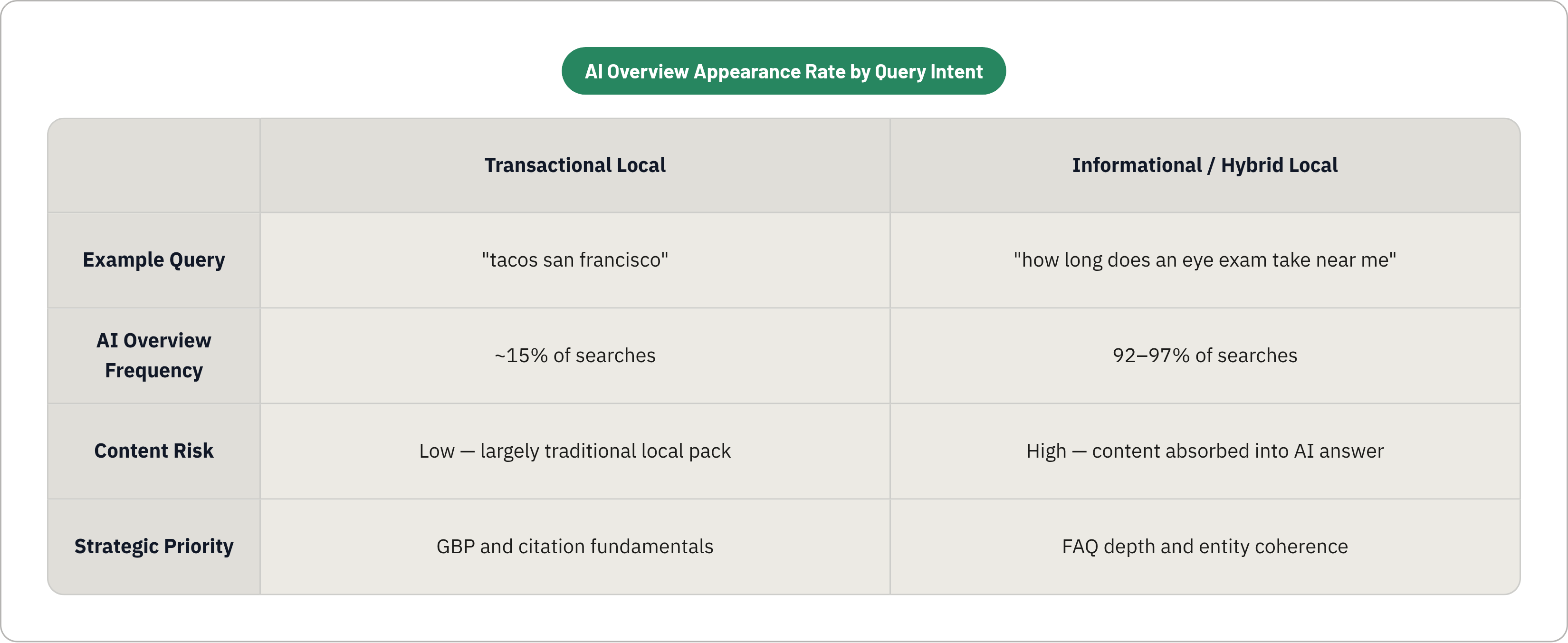
AI Overviews now reach more than one billion people across 200+ countries. A Whitespark study from Q2 2025 found they appeared for roughly 68% of local searches, which sounds alarming until you look at the intent breakdown. For simple transactional queries like "tacos san francisco," AI Overviews appeared just 15% of the time. For informational and hybrid-intent queries like "how long does an eye exam take near me," that figure jumped to somewhere between 92% and 97%.
Transactional local queries still behave largely like traditional local pack results. Informational local content — the FAQs, service explainers, and neighborhood guides local SEOs have been producing for years — now faces the steepest AI Overview competition. The content category that was easiest to generate at scale is now the one most likely to get absorbed into an AI answer and never clicked.
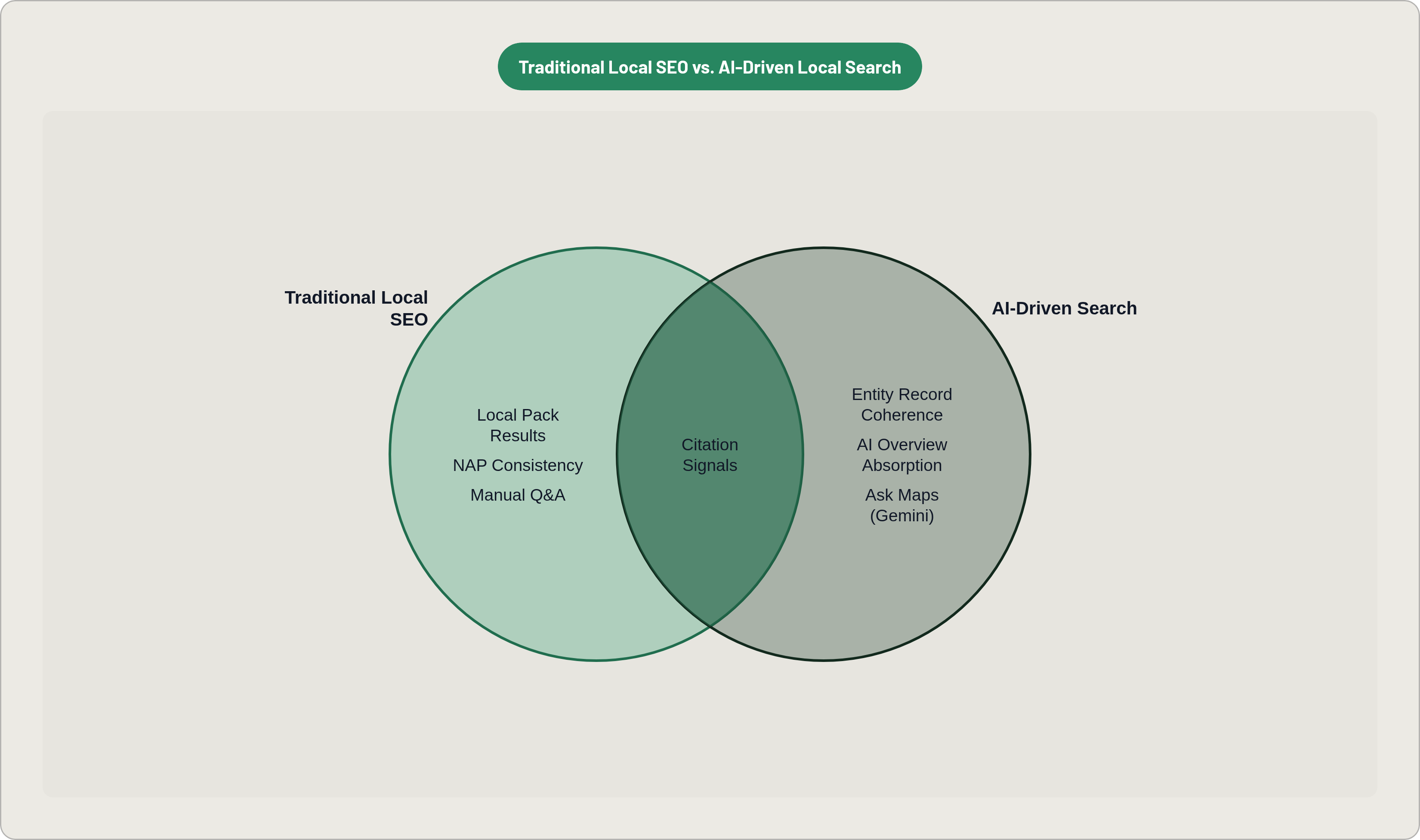
But what if the AI Overview story is actually the secondary disruption? Industry analyst Mike Blumenthal has argued the more fundamental shift is this: "Google isn't ranking websites anymore. They're ranking entities." Gemini now processes Google Business Profile data, website content, reviews, citations, and social mentions as a single unified data stream about one business. Gaps or inconsistencies in that record don't just hurt individual signals; they give Google's AI a cleaner reason to surface a competitor whose entity record is more coherent.
The Whitespark 2026 Local Search Ranking Factors report bears this out. Three of the top five AI search visibility factors are citation-based: expert-curated "best of" mentions, unstructured mentions in news or blog content, and overall mention volume. Citation work, long treated by practitioners as tedious maintenance, is now directly tied to AI inclusion.
It is also worth considering what the adoption curve actually looks like before writing off traditional search. As of August 2025, Sparktoro data shows 95% of Americans still use Google monthly, compared to roughly 20% using AI tools ten or more times per month. At the same time, 45% of consumers now use ChatGPT or other AI tools for local business recommendations, up from 6% the prior year. That's not a gradual drift. That's the kind of year-over-year jump that looks obvious in hindsight and underestimated in the moment.
The practical read: the fundamentals — GBP optimization, citation consistency, location-specific content — now determine visibility across a wider set of channels than they did two years ago.
What Google Business Profile Signals Actually Control in Local Rankings
GBP signals represent the single largest Local Pack ranking factor category, accounting for roughly 32% of ranking weight, per Moz. Primary category selection alone drives approximately 32% of relevance ranking — the single biggest control lever available to a local business, requiring no AI tool to operate correctly, just enough self-awareness to pick the right category from a finite list. Plenty of businesses leave it misconfigured anyway.
Review signals carry 16% ranking weight. Consumer expectations around those reviews have tightened sharply: 31% of consumers now require a minimum 4.5-star rating before choosing a local business, up from 17% the prior year, per BrightLocal's 2026 Local Consumer Review Survey. Forty-one percent read reviews before making a local business decision in most cases, up from 29% in 2025. Each new Google review correlates with approximately 80 website visits, 63 direction requests, and 16 phone calls.
The photo and posting data reinforce the same principle. Profiles with 100 or more photos generate 520% more calls than profiles with fewer than 10. Roughly 30 days of posting silence is associated with measurable visibility loss; two to three GBP posts per month is the documented threshold for maintaining cadence.
Then there's Ask Maps. As of late 2025, Google replaced the manual Q&A feature with an AI-generated interface. Gemini now answers user questions by scanning the business profile, website content, and reviews. The quality of that content determines what gets surfaced. Profiles with FAQ content rank approximately 23% more often in voice search results, per BrightLocal and Search Engine Journal data. If you don't write the answers, Gemini writes them for you, using whatever scraps it can find.
Search Engine Journal called GBP "generative AI's most critical source of verified local data" and described full optimization as a "non-negotiable gatekeeper for inclusion in AI Mode" (December 2025). GBP is now both a traditional local ranking signal and an AI training source.
Where AI Content Tools Fit Into Local SEO Work: The Five Task Categories Worth Your Attention
Most AI tool marketing promises acceleration without specifying what's being accelerated. The more useful question is where, exactly, AI tools produce gains that survive contact with actual ranking mechanics.
Five local SEO workflows hold up under that scrutiny: local keyword and intent discovery, GBP content optimization, location-specific page production, rank and citation monitoring, and reputation management.
Keyword Research and Intent Discovery
Semrush, priced from $199 per month as of 2026, includes a dedicated AI Visibility Toolkit alongside traditional keyword tools. The relevant function here isn't volume estimates; it's identifying which queries are triggering AI Overviews versus traditional local pack results. Given the intent-based pattern described above, that distinction directly determines where content production effort is worth deploying. Ahrefs and Semrush's Keyword Intent AI both help segment queries by commercial versus informational intent.
GBP Content Generation
ChatGPT is practical for maintaining posting cadence and drafting FAQ content. Gemini is worth considering specifically for GBP work, given its integration with Google's own data interpretation pipeline, a point Fast Company noted in January 2026. The logic is simple enough: the AI that reads your GBP is the same AI that can help you write for it, as long as you're supplying actual service details rather than generic category prompts.
Location-Specific Content Production
Jasper, priced at $59 per month on an annual plan as of 2026, includes Brand Voice training, a feature particularly relevant for multi-location businesses that need content consistent in voice but locally distinct in substance. Writesonic, starting at $99 per month, includes GEO tracking and an AI Article Writer. Frase optimizes for both traditional SEO and AI platform visibility, tracking performance across ChatGPT, Perplexity, Claude, and AI Overviews simultaneously.
Rank Tracking and Citation Management
BrightLocal and Moz Local handle map-pack ranking by ZIP code and citation management across directories. Yext provides real-time synchronization of business information across Google, Apple Maps, and social networks. Given that citation signals now appear among the top five AI search visibility factors per Whitespark's 2026 report, these tools are doing more strategic work than their traditional "maintenance" framing implies.
Reputation Management
Birdeye AI and ChatGPT can analyze reviews across platforms, automate response drafts, and surface recurring service complaints before they become entrenched reputation problems. Review response rate functions as both a ranking signal and a consumer trust signal. An unanswered review is visible evidence that no one is paying attention.
What AI-Assisted Content Can Realistically Deliver for Local Pages and GBP, with Evidence
A 2025 Ahrefs study of more than 600,000 URLs found no correlation between AI-generated text and lower search rankings. Approximately 86% of high-ranking pages included at least some AI-generated content. That finding requires careful reading: it doesn't mean AI content ranks; it means quality content ranks, and AI is now involved in producing a large share of it.
An SE Ranking experiment tracked six AI-assisted articles on a live blog from June 2024 through July 2025. Those articles generated nearly 555,000 impressions and more than 2,300 clicks, with three of the six ranking in organic top ten. Narrow sample, but a documented outcome rather than a vendor case study.
Content Marketing Institute's 2025 data indicates that companies using AI-assisted workflows publish 2.3 times more content on average. For local businesses without in-house SEO bandwidth, that multiplier addresses a real constraint. Maintaining two to three GBP posts per month, generating location page depth across multiple service areas, and responding to reviews consistently is a workload that typically requires either a dedicated specialist or the quiet acceptance that most of it won't get done. AI compresses that timeline.
The practical framing is this: AI tools handle production tasks that previously required either a specialist or a willingness to let things slip — drafting GBP updates, generating first drafts of location-specific pages, responding to reviews, identifying competitor gaps in the local pack. These are production tasks, not strategic outputs. Treating them accordingly — and reserving human judgment for strategy and genuine local specificity — is where the productivity gain is real.
The Specific Gotchas That Cause AI-Generated Local Content to Underperform
The structural problem with most AI content tools in a local SEO context is that they treat local SEO like national SEO with a city name appended. Slapping a location tag on generic content produces something that reads as location-aware but misses the signals Google uses to establish genuine local relevance, a distinction Search Engine Land documented in September 2025. AI tools cannot determine proximity. They cannot resolve "near me" context. They produce content that looks local and isn't.
There are signals these tools routinely miss or cannot address independently: LocalBusiness schema markup, NAP (name, address, phone) consistency across directories, and the question-answer content structures that AI Overviews extract and synthesize. A 1,200-word location page with no schema and inconsistent NAP data across 40 directories will underperform a thinner page from a business whose entity record is clean.
The thin-content risk is real but frequently misattributed. A 2025 Originality.ai audit of 500,000 AI-generated pages found approximately 31% showed thin-content signals. The cause wasn't AI authorship; it was workflows that stopped at the draft stage, producing loosely researched content with unverifiable references that no human reviewed before publication. The problem is the process, not the technology.
Surfer SEO presents a specific, documented gotcha for local work. Without manually excluding directories and local listing pages from its SERP analysis, Surfer will recommend word counts based on thin directory pages, sometimes producing 400-word recommendations when the competitive content is closer to 1,200 words. Diggity Marketing documented this in August 2025. The tool isn't wrong in its logic; it's analyzing the wrong sample.
That raises an important question about what AI content tools are actually drawing on when they generate local content. AI models aggregate structured data from platforms like Google, Yelp, and TripAdvisor. They do not generate original local knowledge. What differentiates a location page is genuine specificity: neighborhood references, local landmarks, staff names, service area details. None of that exists in any AI's training data unless a human supplies it. Lily Ray has noted that Google's AI Mode cites GBP links far more frequently than external websites, which reinforces that the listing infrastructure, not just the content layer, determines AI visibility.
Google's Actual Policy on AI Content and What It Means in Practice
Google's 2025 guidance is explicit. The risk Google identifies is using automation to publish large volumes of low-value or manipulative pages. Whether AI was involved in production is not the issue.
The practical read: producing 50 nearly identical city pages that swap a location name is the behavior Google targets. Producing well-researched, locally specific pages faster because AI handled the first draft is not. The Ahrefs 600,000-URL study reinforces this. Ranking performance correlates with content quality signals, not production method.
The question a local business or their agency should ask isn't "did AI write this?" It's "does this page give someone searching locally a useful answer?" If yes, the production method is irrelevant. If no, the production method is also irrelevant, for different reasons.
One reading of Google's guidance is that it is deliberately ambiguous enough to give itself cover to penalize AI content selectively. That's a reasonable suspicion. But the documented pattern in available data doesn't support a conclusion that AI content is penalized categorically. What gets penalized is thin, undifferentiated, low-effort content, which humans have been producing at scale for considerably longer than AI tools have existed.
How to Scope AI Tools to Local SEO Fundamentals Rather Than Volume for Its Own Sake
Start with the ranking signals that matter most: GBP completeness, citation consistency, review cadence, and location page depth. Use AI tools to address those specifically.
For GBP content, use ChatGPT or Gemini to maintain the two-to-three-post monthly cadence and draft FAQ content. Feed the AI your actual service details, not generic prompts about your industry category. Treat Ask Maps as a content brief: the questions Gemini is currently answering from your profile are the gaps worth filling with real specifics before a competitor's cleaner profile fills them instead.
For location pages, let AI generate structure and handle repeatable elements, then have a human supply the neighborhood-specific details, local landmarks, and service nuances that distinguish one location page from another. Filter Surfer SEO's SERP analysis to exclude directory pages before setting word count targets.
For citations, BrightLocal or Moz Local handle accuracy audits; Yext handles real-time synchronization. Given that citation signals are now among the top five AI search visibility factors per Whitespark 2026, this is infrastructure work, not maintenance. It determines whether the entity record Gemini reads about your business is coherent or full of conflicting information.
For review responses, AI drafts, a human reviews before posting. The consistent response rate signals engagement to Google's ranking systems and to the 41% of consumers who read reviews before choosing a local business.
The connective tissue across all of this is consistency and coverage, not volume. AI tools make it feasible for a local business without a dedicated SEO team to sustain the activity levels that ranking signals reward: posting cadence, review responses, location content, citation accuracy. Generating content faster than your quality control can absorb it is a different kind of neglect.


