Google Business Profile Optimization for B2B Companies
Google's hidden address and category choices drive whether B2B buyers find you in local search.

To understand why GBP matters this much, you have to look at how local search actually works, which is different from how most B2B teams imagine it.
GBP signals account for roughly a third of local pack ranking weight, per Whitespark research, making it one of the largest factors in the algorithm. Google's three official ranking criteria are Relevance, Distance, and Prominence, and they're worth defining plainly because their mechanics get routinely misunderstood.
Relevance is how closely the profile matches the searcher's intent. Distance is proximity to the searcher; for service area businesses, it's calculated from the hidden physical address on file, not from whatever service areas are listed. That distinction has real consequences for firms that assume listing a city is the same as ranking in it. Prominence is the aggregate of reviews, rating, review velocity, and ongoing activity. Google has described weighting engagement signals — including clicks, post engagement, and profile activity — as factors in ranking. The profile is not a passive listing; it functions as a behavioral signal.
Local Pack positions capture a high share of click-through rate compared to organic results below the pack, where attention drops sharply. GBP is therefore where a query like "managed IT provider Omaha" is largely won or lost.
The Category Decision That Determines What Searches Your Profile Can Win
If there is one lever in GBP optimization that is most consequential and most consistently mishandled, it's primary category selection. And because it's the first decision made, the damage from getting it wrong compounds quietly from the beginning.
Google allows one primary category and up to nine additional. As of late 2024, there were over 4,000 available categories, and Google updates category availability regularly. That is not a stable taxonomy. It requires active management, which most B2B firms are not doing.
Two traps show up reliably. The first is the more-is-better assumption: that stacking categories extends reach. A competitor with two tightly relevant categories will often outrank a profile with ten loosely relevant ones. One primary, one or two closely relevant secondaries is the configuration most practitioners recommend.
The second trap is consumer-intent contamination. Adding "Computer repair service" to a managed IT firm's profile because it technically applies will attract break-fix consumer traffic, not buyers evaluating a managed services contract. The buyer intent is wrong, conversion is near zero, and the signal it sends Google about what your business actually is can work against you in the searches that matter.
But what if your firm spans execution, advisory, implementation, and strategy, and different buyers search under different labels? This is the taxonomy mismatch endemic to professional services. The answer is not to solve it through categories. The Services section exists precisely for this. Let categories define what you are; let Services describe what you do.
Audit the primary category quarterly. Google's list changes frequently enough that a previously accurate option may have been deprecated, or a more accurate one may have appeared.
Every Profile Field That Affects Whether a Buyer Trusts What They're Seeing
A fully populated, verified profile surfaces more often in search than incomplete or unverified listings, per a 2025 Birdeye study. Despite that, many businesses haven't fully completed their profiles. Missing hours, no description, absent photos, blank service sections: these gaps are common, and they are costly in ways B2B teams consistently underestimate.
Google's own documentation notes that complete profiles help customers find relevant information about a business. Completeness is itself a credibility signal, separate from anything the profile actually says.
The business description is simultaneously a ranking gap and a trust gap. Many profiles still lack one entirely. The description should contain specifics: years in business, geographic coverage, outcomes delivered for clients. Generic positioning language does very little work here. A procurement manager, or an AI summarizing vendors on their behalf, wants to know what you actually do and for whom.
Hours seem mundane until they're wrong. Missing or inconsistent hours introduce doubt at the exact moment a buyer is deciding whether to reach out. The Services section is the primary vehicle for capturing service breadth without diluting category relevance; list each offering in the language buyers actually search, not the language your internal team uses.
Photos signal that a business is operational. Team photos and work-environment imagery carry particular weight in B2B contexts, where a buying committee is vetting organizational credibility alongside capability. Stale or absent photos introduce ambient doubt: nothing egregious, just a quiet accumulation of reasons not to go further.
NAP consistency — the alignment of name, address, and phone number across all listings — yields a meaningful SEO lift. Research from BrightLocal has found that a majority of consumers report they would avoid a business if they found incorrect information online. For multi-location businesses, an NAP audit is among the highest-return activities available, usually undone by the mundane reality of acquired locations, rebrands, and decentralized marketing teams who all had slightly different ideas about how to spell the suite number.
Finally, verification. Unverified profiles are increasingly excluded from high-intent search moments. Verification is not optional infrastructure. It is the floor.
How Service Area Businesses Should Configure GBP When There's No Customer-Facing Storefront
Most B2B service firms are Service Area Businesses. They go to clients; they don't receive them. This is not a minor technical distinction: it changes how distance is calculated, what geographic rank is achievable, and what profile configuration makes sense.
For SABs with hidden addresses, Google calculates distance from the actual physical address on file, not from the listed service areas. A firm headquartered in suburban Dallas that lists Houston as a service area does not automatically rank well in Houston. Prominence must compensate for distance, and prominence takes time to build.
That raises an important question: if listing service areas doesn't directly drive rank, what does it actually do? It tells Google where you want to appear. Whether you appear there depends on whether your prominence signals are strong enough to overcome the distance calculation.
Listing 20 service areas does not solve the problem. Geographic reach in search is supported by topical authority: review volume and velocity, website location pages that are substantive rather than thin, and citation consistency across the local web.
Google still requires a real, verifiable physical address even when it's hidden from the public listing. P.O. boxes, UPS Store addresses, and virtual offices through services like Regus or WeWork are prohibited per Google's guidelines. These are among the most common triggers for profile suspension.
The practical configuration: use the 20-area limit strategically. Prioritize the cities and zip codes where ideal-fit clients are actually concentrated. A tighter, credible footprint tends to outperform a sprawling, thin one.
Reviews as a Ranking Input and a Buying Committee Credibility Check
Review signals account for a meaningful share of local pack ranking factors, per Whitespark research. The mechanics of how that weight is applied run counter to how most teams intuitively approach it.
Velocity matters alongside volume. A business receiving consistent recent reviews will typically outperform a competitor with many total reviews and nothing recent. Google weights recency as a signal of current demand. A large review count accumulated years ago and then abandoned may signal a business that used to be active rather than one that currently is. The review strategy needs to be a continuous motion, not a campaign with a start and end date.
Reviews are not just ranking inputs. They are buying committee due diligence material. B2B procurement committees triangulate across sources, and a thin or stagnant review profile introduces doubt at precisely the moment when confidence is the purchase-enabling condition. Per BrightLocal research, the proportion of consumers who will only use a business with a 4.5-star rating or higher has increased in recent years.
Response consistency has become a purchasing signal, not a courtesy gesture. Ignoring a negative review doesn't make it disappear; it makes you look indifferent to accountability.
For B2B specifically, both the ask moment and the review content require deliberate attention. Ask at project milestones or post-delivery moments, not generically at year end. Brief clients on what to include: specific outcomes, services used, context. A review that says "great to work with" is nearly useless. A review describing a specific engagement, the challenge solved, and a measurable result is credible to a human reader and, increasingly, legible to an AI summarizing your firm to a prospective buyer.
How AI Overviews and Generative Search Are Changing What GBP Content Needs to Say
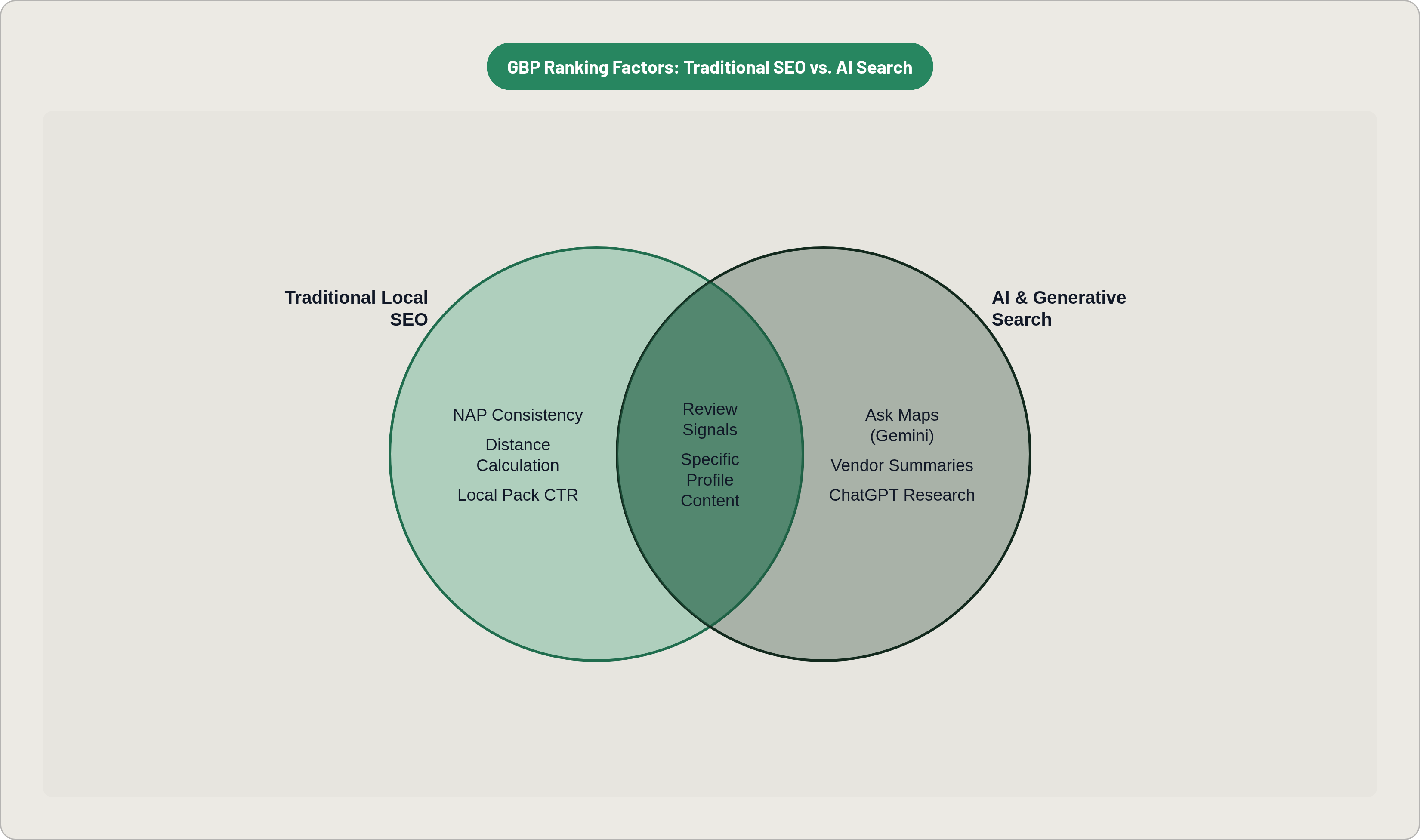
AI Overviews appear in a growing share of searches and can pull citations from businesses with strong review signals and specific profile content. Every B2B buyer I've watched research vendors uses tools like ChatGPT or Gemini to augment their process at some point. These sessions happen outside any marketing attribution stack. You cannot measure them directly and you cannot intercept them. You can only ensure your profile is substantive enough to be cited when they occur.
GBP descriptions containing concrete numbers — including years in business, response times, coverage radius, and measurable client outcomes — are more likely to be cited by Google AI Overviews than descriptions containing only general claims. "We deliver managed IT solutions to growing businesses" does essentially nothing. "We've managed IT infrastructure for over 200 regional businesses across the Midwest for 14 years, with a four-hour response SLA" gives an AI model something to extract and cite. Specificity serves the same function keyword density once did.
Google has introduced "Ask Maps," where Gemini scans the profile, website, and reviews to generate conversational answers to user queries. If the profile content is vague, incomplete, or inconsistent with the website, Gemini may fill those gaps with unverified web sources or generate summaries that are inaccurate. The profile, in this environment, also functions as a prompt. Write it accordingly.
Generic praise creates a weaker signal for AI citation than a review that reads like a brief case study. "They were responsive and professional" tells Gemini almost nothing. A review that names the service, the problem, and the outcome gives the model something to work with when it's assembling a vendor summary for someone who hasn't started talking to you yet.
Ongoing Profile Activity as a Ranking and Trust Signal, Not a One-Time Setup Task
Most profiles are static after initial setup. Every agency I know that inherits a client's GBP finds it untouched since the day it was claimed. It does not run itself.
Google's ranking documentation notes that activity and engagement on a profile are considered signals of relevance. A profile that generates engagement tends to get shown more; a profile that gets shown more generates more engagement. The static profile opts out of that loop entirely.
Post types that earn their place for B2B include service announcements and case study summaries, which signal active delivery; team or project updates, which build credibility with buying committees vetting culture alongside capability; and content relevant to the B2B calendar, including budget season, contract renewals, and industry events. These feel performative to a firm whose clients don't find them through Google. But the buyer running a competitive vendor check may encounter them, often without anyone at the incumbent firm ever knowing it happened.
The quarterly audit is the discipline that prevents drift. Categories change. Services evolve. New attributes become available. A quarterly review of the live profile against the current Google category list and the actual service mix is the maintenance work that keeps an optimized profile optimized.
Each review, each post, each photo update, each responded review accumulates into a prominence signal. No single action is decisive. The aggregate is what earns and holds a Local Pack position over time. The profile's job is straightforward: be present, be credible, and be competitive at the exact moment a buyer runs the generic search that opens their vendor shortlist. Whether your profile makes that shortlist is a question being answered right now, in a search session you'll never see.