Google Local Services Ads for HVAC Contractors

Not every service category belongs on LSAs. Some trades have low average job values, long sales cycles, or demand patterns that fail to suit a direct-call mechanic. HVAC has the opposite problem: it fits almost too well, and the contractors who recognize that early get very comfortable very fast.
Start with the emergency dynamic. A homeowner with no air conditioning in July is not comparison shopping. They are calling whoever picks up. The intent signal on a search like "AC repair near me" at 4 p.m. on a Tuesday in August is about as pure as residential search intent gets. LSAs are purpose-built for that moment: the ad connects directly to a call, no intervening website, no decision page, no friction. That alignment between platform mechanic and customer psychology is not accidental, and it is not equally available in every trade.
Then there is the job value question. HVAC leads on LSAs currently run roughly $51 to $120 depending on market and data source. Against a $12,000 system replacement, the acquisition math is almost embarrassingly favorable — like fishing with a net in a full pond. Gross-margin analysis for replacement-focused operations puts the theoretical break-even on a single acquired lead near $690. The market rate is nowhere close to that ceiling. So why do some contractors still hesitate?
Part of the hesitation, I suspect, comes from evaluating the lead cost against the first job rather than the relationship it opens. A new installation becomes a maintenance contract. A maintenance contract becomes a replacement referral several years out. The cost-per-lead figure you are looking at on day one is the least favorable version of the number. It only gets better from there, assuming you run the account well enough to deserve repeat business, which is its own conversation.
It is also worth considering the emerging opportunity in heat pump installation. Searches in that category, driven by federal tax credits and efficiency rebates, represent one of the fastest-growing HVAC search segments entering 2026. The category is still underpenetrated on LSAs by many contractors. These windows close without formal announcement. Most operators notice the opportunity only after someone else has already captured it.
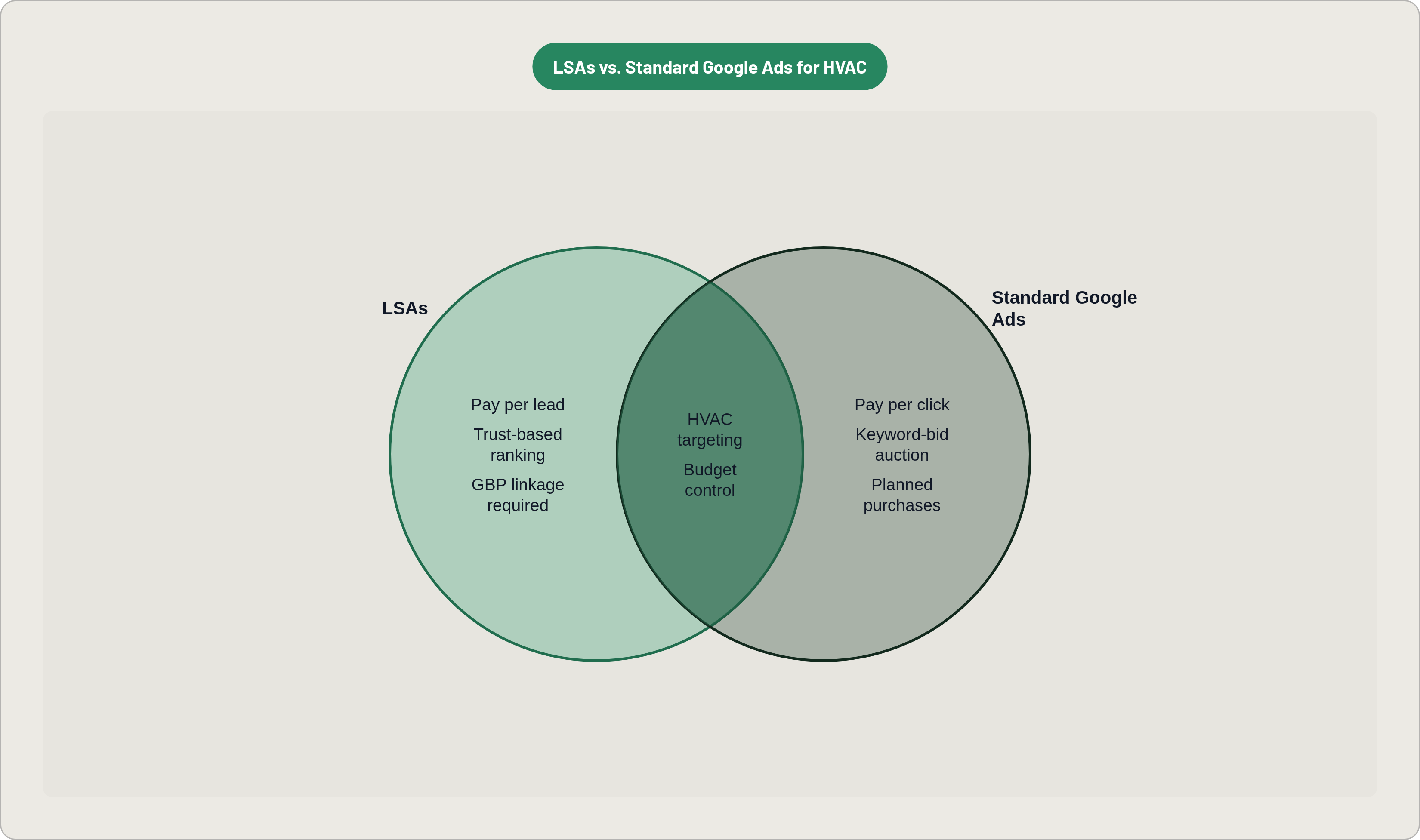
One distinction worth establishing before moving forward: LSAs and standard Google Ads are not interchangeable formats, and treating them as such causes contractors to mismanage both. Standard Google Ads operate on a keyword-bid auction; you pay per click, regardless of outcome. LSAs charge per lead. The ranking mechanism is trust-based, not bid-based. A missed call on LSAs costs you the lead fee, the job, and a measurable ranking penalty. A missed call in standard Google Ads costs only the click. That asymmetry changes the entire operational posture the platform requires. It is not a detail.
What Google Actually Requires Before You Can Run LSAs
The eligibility process exists to keep unqualified contractors off the platform. That simultaneously serves as consumer protection and a competitive moat for contractors who clear it, which is a reasonably elegant design if you are on the right side of it.
HVAC is eligible in most U.S. regions and a limited set of international markets including Canada, the UK, Germany, and France. If you operate across multiple trades, each service line requires a separate application. There is no combined submission.
Licensing comes first: all applicable state, county, or city HVAC licenses must be current and submitted for verification. Insurance is second; general liability coverage at Google's minimum thresholds, typically around $1 million, must be demonstrated. Some categories require additional coverage beyond general liability.
Background checks are where contractors most reliably get surprised. The business owner and all customer-facing employees must pass checks through Google's verification partner, Evident. Each check runs $50 to $100 per person and takes five to seven business days. For a five-person field team, that is a real time and cost line item. Budget it before the application begins, not after.
Since November 2024, Google Business Profile linkage has been mandatory. Your GBP and LSA profile must be connected and must match exactly. Mismatches suppress ad delivery, frequently without any clear notification. The standalone LSA mobile app some contractors had been using for account management was retired in January 2025; everything now runs through the Google Ads platform.
The total verification timeline, assuming documentation is ready at the start, runs one to two weeks. Gather business licenses, insurance certificates, and workers' compensation records before beginning the application. Waiting for the platform to ask for them adds delays that compound during peak season in ways that cannot be recovered.
One administrative reality that catches people off guard: if your insurance or licensure lapses at any point after approval, Google pauses your ads immediately. Annual renewal is required, and enforcement is swift and unsympathetic.
The Profile Work That Should Happen Before You Apply
There is a common instinct to apply first and optimize the profile later. That instinct is expensive, and I have watched it cost contractors entire peak seasons.
The LSA algorithm begins evaluating your account from the moment it goes live. A thin profile does not get graded on a curve; it underperforms immediately, and early underperformance creates ranking inertia that takes weeks to correct. The opportunity cost of a slow start during peak cooling season is not recoverable on a trailing basis.
Start with NAP consistency: business name, address, and phone number must be identical across your Google Business Profile, your LSA profile, and every directory where your business appears. Any discrepancy is a suppression risk. Google's systems are cross-referencing these data points continuously, and they are unforgiving about it.
Photos get less attention than they deserve. Upload 15 to 20 high-quality images of completed work before launch. According to data from Blue Grid Media's managed account base, accounts that added eight or more new job photos in 2026 saw lead volume lift of 12 to 18% compared to accounts with stale photo sets. Photos are a ranking input. They are not decoration.
Reviews are where most contractors arrive underprepared. Aim for at least 25 before going live; 50 or more to compete seriously in a contested market. If you lack those reviews yet, the time to build them is before the application goes in, not after. The platform does not reward contractors for intent.
Complete every available profile section: services offered, service area, business hours, every applicable attribute. On service categories specifically, enable every service you actually provide. "AC repair" and "furnace installation" are obvious. Duct cleaning, mini-split installation, heating maintenance, and heat pump servicing are not always checked, and unchecked categories hand those searches to competitors who bothered.
Finally, respond to every existing review before launch. The algorithm evaluates review responsiveness as a proxy for customer engagement. A backlog of unanswered feedback is a ranking liability before you have spent a dollar.
The Badge That Changed and What It Actually Signals Now
The Google Guaranteed badge was once a reasonably useful consumer-facing trust signal. A green checkmark, a money-back guarantee backed by Google, a verification process that filtered out unqualified contractors. Searchers understood what it meant, at least approximately. That was the arrangement.
That arrangement no longer exists. In October 2025, Google replaced the "Google Guaranteed" and "Google Screened" designations with a unified blue Google Verified checkmark. The consumer-facing guarantee program was discontinued on November 7, 2025.
That raises an important question: if the guarantee is gone, what is the badge actually communicating?
Google's own documentation states the checkmark appears "when predicted to aid decision making." That is not a precise commitment. The badge does not display uniformly on all verified listings; it appears dynamically, which means contractors cannot rely on it as a persistent visual differentiator. The phrase "predicted to aid decision making" is doing a lot of work there, and Google has not elaborated on what the prediction model considers.
The practical implication is a shift in where the badge's value actually sits. Pre-2025, it was a consumer persuasion tool, a visible signal with a direct line to conversion preference. Post-2025, it functions primarily as an eligibility filter. Verified contractors get in; unverified ones do not. The requirements behind the badge remain intact. The consumer shortcut it used to provide does not.
Contractors who were banking on badge recognition to close skeptical searchers are working with an outdated model. The trust signals that actually drive click decisions now are star ratings, review volume, and the responsiveness indicators Google surfaces on listings. The badge keeps a ceiling on the competitive pool. It no longer closes the deal.
What You Will Actually Pay Per Lead and How to Budget Sensibly
The pay-per-lead model is conceptually clean: set a weekly budget, get charged for calls or messages that come through the platform. No impressions, no clicks, just contacts. Whether those contacts convert is entirely up to you.
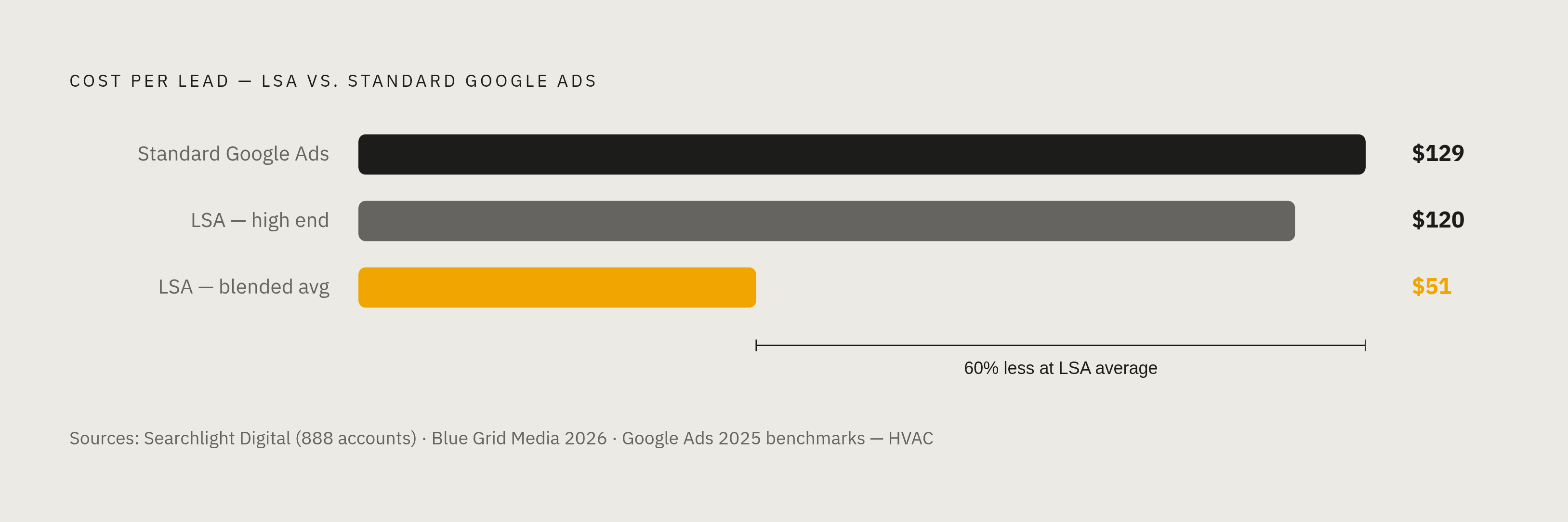
What that costs varies by market. Searchlight Digital, observing $6.72 million in spend across 888 contractor accounts, found a blended contractor cost per lead of $53, with HVAC coming in around $51. The Media Captain's analysis of more than 100 clients in August 2025 found HVAC averaging $80. Blue Grid Media's 2026 managed account data puts HVAC between $60 and $120. Major metro markets typically run $45 to $80; mid-size markets often fall between $28 and $45. Emergency AC calls in peak summer can spike above $100.
For comparison, standard Google Ads for HVAC averaged approximately $129 per lead in 2025 benchmarks. LSAs, even at the high end of current estimates, come in at roughly one-third to two-thirds of that. The cost efficiency argument holds up.
For contractors starting out, the "Maximize Leads" bidding strategy is the appropriate default. In most mid-size U.S. markets, a weekly budget of $400 to $800 will generate roughly 10 to 15 leads per week at expected cost-per-lead rates. Adjust seasonally: push budget up heading into peak cooling and heating months, pull back in shoulder seasons. A flat annual budget is simultaneously money left on the table in high-demand months and money wasted in slow ones.
One offset worth knowing: contractors typically recover around 6 to 7% of total LSA spend in credits for clearly unqualified leads, per The Media Captain's 2025 data. Real, but modest. More on how that credit system works below.
One operational reality that reframes the entire cost-per-lead discussion: more than 90% of LSA leads arrive via phone call. Every dollar you spend on LSAs is ultimately evaluated by how well your team answers the phone. The platform cannot compensate for that gap, and it does not try.
How Google Actually Decides Who Ranks at the Top
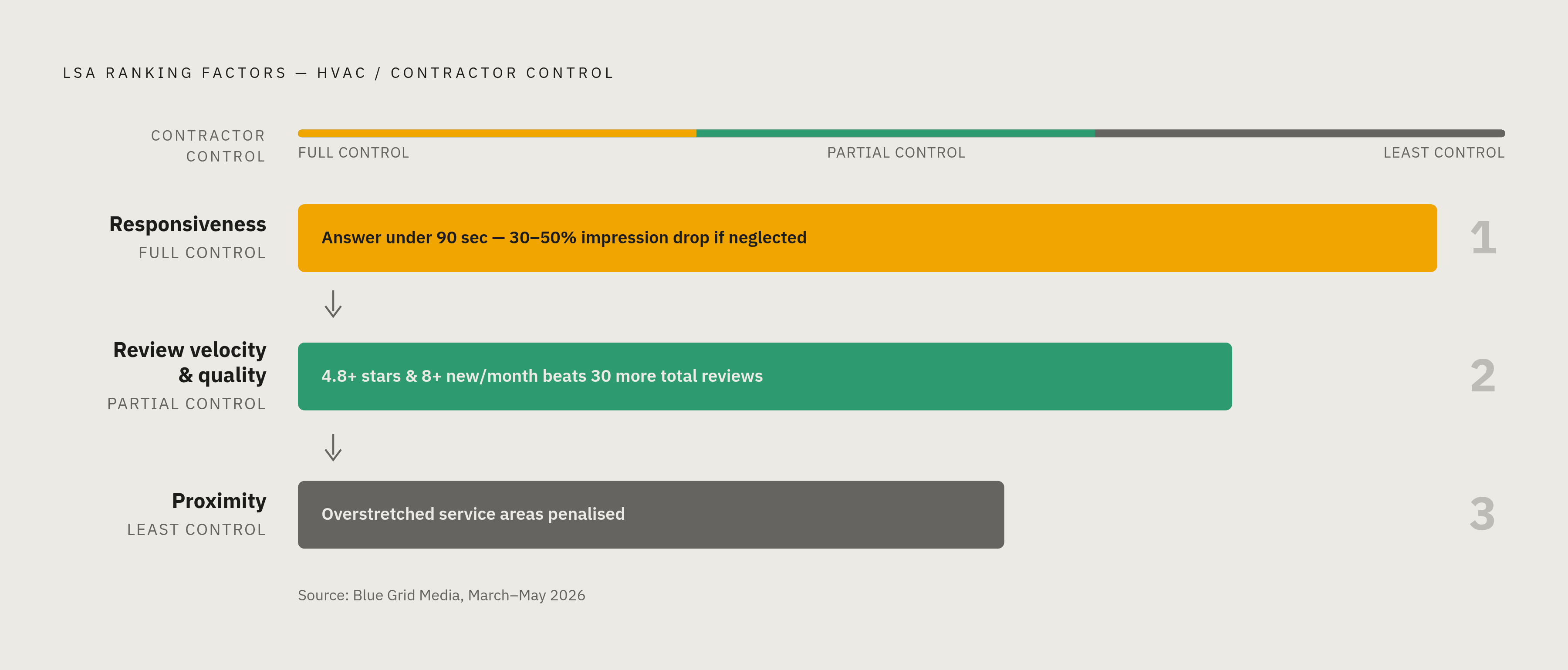
LSA ranking is not an auction. You cannot outbid your way to the top position the way you can in standard Google Ads. The platform rewards demonstrated reliability, which is a fundamentally different optimization problem. Most contractors understand this intellectually. Fewer act on it, probably because it requires operational change rather than budget adjustment.
Responsiveness is the most controllable factor and the most punished when neglected. Google tracks answer rate and speed directly. Accounts averaging more than 90 seconds to answer saw impression share drops of 30 to 50% across HVAC, plumbing, and electrical verticals from March through May 2026, according to Blue Grid Media's account data. Google also displays "Typically responds in a few minutes" on fast-responding listings, a visible trust signal that improves click-through rates independently of ranking position. Beyond that, Google's systems analyze call recordings routed through the platform; consistent patterns of turning leads away or mismatched call outcomes redirect volume toward competitors. The platform is paying close attention.
Review quality and velocity come second. The algorithm considers quantity, recency, quality, and response rate. An unofficial industry benchmark of 4.8 stars or above is the threshold for reliably appearing in top-three positions; businesses below that threshold rarely crack the top regardless of other factors. Velocity outweighs total count: operators adding eight or more reviews per month have outranked competitors with 30 more total reviews but fewer than two monthly additions, per Blue Grid Media's 2026 data. Since mid-2025, all LSA reviews route through Google Business Profile. There is no separate LSA review link. GBP review strategy and LSA strategy are now the same strategy.
Proximity is the third factor: how close the contractor's listed location is to the searcher. Less controllable than the first two, but relevant when defining service area boundaries. Claiming a service area that stretches well beyond where you realistically operate is a proximity disadvantage on every search outside your core geography. The platform knows where you actually work.
The Dispute System After Google's 2024 Overhaul
In mid-2024, Google eliminated manual LSA lead disputes. The previous system, where a contractor could flag an individual lead and receive a credit decision within 48 hours, is gone. What replaced it is automated: Google reviews every charged lead and applies credits for clear invalids, spam calls, robocalls, and disconnected calls, typically within 72 hours, with the credit posting within 30 days.
The "Rate this lead" tool in the dashboard still matters. Marking a lead "Very dissatisfied" with a specific reason attached triggers a credit review. That is the remaining human input point in a system that has otherwise been automated entirely.
What Google no longer credits is equally important to understand. "Job type not serviced" and "geo not serviced" disputes were eliminated in 2025. If a homeowner calls about a refrigeration system you do not work on, Google will not credit that lead. The only remedy is profile precision: tighten service categories and service area boundaries on the front end so that mismatched leads do not generate in the first place.
But what if the system is working against you in ways that are harder to document? A 2025 survey found 67% of contractors reported a decline in LSA lead quality over the prior 18 months, with common complaints including price shoppers, out-of-area callers despite geo-targeting, and wrong numbers. Local SEO researcher Darren Shaw noted in February 2025 that the removal of manual dispute ability coincided with an increase in out-of-area and out-of-industry leads. The timing is difficult to ignore, even if the causal relationship is unprovable.
The practical posture is to budget for a percentage of poor-quality leads that the automated system will leave uncharged. Profile precision is the primary defense. Lead rating is the secondary lever. Automated credits are the floor, and depending on the market, that floor can feel lower than advertised.
The Habits That Actually Separate Good Accounts from Average Ones
Optimization on LSAs is less glamorous than most people expect. It mostly comes down to answering calls, generating reviews consistently, and keeping the profile accurate. The contractors who outperform are rarely doing anything exotic; they are doing the fundamentals without letting them erode, which turns out to be the harder part.
Answer every call. Build the protocol before going live: after-hours forwarding, an answering service for nights and weekends, a system that ensures no call goes to voicemail during business hours. A missed call on LSAs is a lost lead fee, a lost job, and a ranking signal working against you on the next search. The platform records it and remembers.
Treat review generation as a system, not a periodic campaign. Ask every satisfied customer immediately after the job; recency is weighted. Target eight or more new reviews per month. Respond to every review, including negative ones. The algorithm watches response rate, and so do the searchers reading those reviews before they decide whether to call.
Audit service categories quarterly. Heat pump installation is currently underpenetrated by many HVAC LSA accounts. If you do that work, the category should be enabled. Remove any categories you no longer service to avoid leads you cannot convert and credits you will not receive.
Refresh photos regularly. New completed-job photos uploaded several times per year signal an active, current operation. Stale photo sets are a quiet drag on lead volume that most contractors fail to notice because the penalty is gradual rather than sudden.
Rate leads in the dashboard consistently. This provides the data Google's automated credit system uses and, over time, signals your target lead profile to the algorithm. It takes thirty seconds. Most operators skip it.
One consideration that gets dismissed too quickly: run LSAs alongside standard Google Ads, rather than instead of them. LSAs are purpose-built for emergency and immediate-intent searches. Standard Google Ads handle planned-purchase searches better — the homeowner getting quotes for a system replacement next month. The two formats serve different intent moments and complement each other, the way a thermostat and a furnace each do their own job but only keep you warm together. Choosing one over the other because managing both feels like too much overhead is a real cost; it just does not show up on any report.
Monitor your GBP linkage as a standing maintenance item. Since the two profiles are now tied, any issue with your Google Business Profile, a suspension, a flagged listing, an incomplete section, directly affects LSA delivery. GBP maintenance is LSA maintenance. They are the same thing now, and the contractors who have yet to internalize that will figure it out the hard way.