CBD Brand Website Design for Compliance and Conversion
Navigating federal bans and state rules actually makes CBD sites more trustworthy and profitable.

There is something absurd about the fact that selling a topical cream derived from a plant requires more legal infrastructure than selling a firearm online. Yet here we are. Nearly 60% of American adults have tried CBD, the market was valued at $10.35 billion in 2025, and the brands serving that demand are navigating platform bans, processor freezes, and enforcement letters that no general e-commerce operator ever encounters. The irony worth sitting with: the constraints that make CBD so operationally difficult are also, if you build around them correctly, the same forces that make a compliant site convert better than a non-compliant one. Think of it like a river forced through a narrow canyon — the pressure that builds up is exactly what gives it power. That is the argument this piece develops, and it is worth stress-testing rather than simply asserting.
Federal Rules Set the Floor, Not the Ceiling, and They Apply to Everything
The 2018 Farm Bill federally legalized hemp cultivation and removed hemp-derived CBD from the Controlled Substances Act. That is the good news. The complicated news is that it did not create a clean regulatory runway. The FDA has not approved CBD as a dietary supplement, has not established a clear regulatory pathway for it as a food additive, and has continued to enforce against companies making unsubstantiated therapeutic claims. FTC Endorsement Guides, fully in effect since July 2023, apply to every review, testimonial, and influencer post a brand touches. And enforcement is not theoretical: FDA fines for unverified claims run up to $100,000, and a California retailer was fined $50,000 in 2024 for precisely this.
What does this mean practically for a product page? No health claims. Not on the page. Not in the meta description. Not in the blog post that links to the product. "Cures anxiety" and "treats inflammation" are off-limits regardless of how the sentence is constructed. Required label elements, including THC content, serving size, and ingredients, must appear on packaging and be faithfully represented in digital product listings. These rules apply to organic content, paid content, and every indexable page on the site equally.
But what remains ambiguous is the line between a wellness benefit and a health claim. That ambiguity is not a gap to exploit; it is a live wire that affects every copy decision a brand makes. The FDA's current enforcement posture has concentrated on delta-8 "copycat" products and companies making overtly therapeutic claims, which offers some relief for mainstream CBD brands. It does not offer immunity. The practical posture, then, is not to build a compliance checklist and stop there. Federal rules set the floor. States build the walls above it, and those walls are not uniform.
Why a Single Product Catalog Cannot Serve All States Cleanly
Idaho bans hemp-derived CBD sales outright. California permits food and beverage CBD with manufacturing registration, testing, and labeling requirements under AB-45. New York mandates QR-linked certificates of analysis, age limits, and serving caps. Texas requires QR-code COAs and retail registration. Louisiana caps THC in edibles at 5mg per serving. Florida's 2025 enforcement sweep removed thousands of non-compliant products and established age 21-plus for hemp THC products, enforceable at point of sale. Joint FTC/FDA cease-and-desist letters in 2024 and 2025 specifically cited packaging whose appearance attracts minors, which is relevant not just to physical packaging but to product imagery displayed on the website.
Why does this fragment the site architecture so severely? Because a product that ships legally to thirty states cannot ship legally to all of them, and the rules governing what must appear on the product page, what COA documentation is required, and what age verification must occur before purchase all vary by destination. These are not edge cases. They are the operating conditions.
The implication is structural: per-state catalog rules, shipping restrictions, and documentation requirements need to be built into the architecture from the start, not retrofitted after the site is live. Which raises an uncomfortable question: what platform can actually support that?
The Platform Decision Is a Compliance Decision
Platform choice is not a preference question, a matter of developer familiarity or theme availability. After spending time watching brands rebuild their entire stores from scratch because a mainstream platform suspended their accounts without warning, I'd push back on that pretty firmly.
Shopify allows some hemp-derived CBD in certain regions. Its rules on this have changed without notice and have been inconsistently enforced. A brand that builds its store, its customer data, and its order history on a platform that can unilaterally remove access for terms violations is not running a business; it is renting one. WooCommerce, being open-source, cannot suspend a store for platform-terms violations, which is the structural advantage, not any particular feature set. Multi-state operators with complex per-state catalog requirements frequently end up on headless builds because no off-the-shelf platform handles geo-conditional catalog rules cleanly.
The same logic extends to hosting. A hosting provider can suspend an account. Hosting selection is therefore part of the compliance stack. This means the platform and hosting decision has to happen before wireframes are drawn, because those decisions determine what is architecturally possible at every subsequent layer: age gating, geo-fencing, per-state catalog display, COA linking, payment integration. Choosing a platform last is like choosing a foundation after the house is framed.
Payment Processing Is Infrastructure, Not a Vendor Relationship
Stripe and PayPal classify CBD as high-risk. Their CBD-specific programs have been rescinded and reinstated multiple times. Treating either as a primary processor is an operational gamble that has cost brands real revenue. CBD-specific gateways, such as Bankful, support cards, wallets, and payment methods that mainstream processors routinely decline; they are the stable foundation, not the fallback option.
The conversion argument here is less obvious but equally important. Chargeback rates in CBD run around 2%, costing $15 to $50 per dispute. One retailer cut chargebacks 30% after switching to a compliant gateway with clear billing descriptors. That matters because the leading driver of CBD chargebacks is customer confusion, specifically, an unfamiliar corporate name appearing on a bank statement instead of a recognizable brand name. A clear descriptor like "CBD Wellness Co." rather than an opaque legal entity name reduces confusion. Reducing confusion reduces chargebacks. Reducing chargebacks reduces a direct conversion loss.
A backup payment gateway, running in parallel or available as a failover, is standard practice for anyone who has been through a sudden processor change. Single-processor dependency is not a cost-saving measure; it is an unpriced operational risk.
The Age Gate Is the First Brand Impression
Florida's 2025 legislation illustrates where the regulatory baseline is moving: pop-up disclaimers and checkbox confirmations are insufficient. The age gate must be a real interstitial that blocks content, not a dismissable banner that a determined user skips in one click.
The technical requirements are not complicated, but they are specific. The gate must block content access entirely. It should set a session cookie so returning users are not re-challenged on every page load. And it should support a second-stage date-of-birth verification at checkout where state law requires it. The industry direction is toward automated third-party identity proofing, geofencing of prohibited addresses, adult signatures on delivery, and defensible recordkeeping; the visible gate is the surface layer of a deeper verification stack that is becoming the regulatory norm.
Here is where the design opportunity opens up: this is the first thing a new visitor sees. Branded imagery, clean typography, and a well-phrased question about age can communicate quality and seriousness before the user has encountered a single product. A gate that looks like it was designed in 2009 communicates exactly that. A gate that reflects the brand's visual identity communicates that this is a company that cares about the details.
Geo-fencing pairs naturally with the gate. An IP-based location check at page load, combined with a ZIP-code field at checkout, catches out-of-state purchases for THC products before they become a fulfillment problem. Communicating shipping restrictions early, rather than at the cart stage, reduces abandonment. And if a user's location is a restricted state, collecting their email and notifying them when availability changes turns a compliance block into a list-building moment. That is not spin. It is a better user experience than a dead end.
Compliant Copy Converts Better Than Claim-Heavy Copy
The prohibition is clear: no therapeutic or medical claims on any page the site publishes, paid or organic. "Cures anxiety" and "treats inflammation" are not merely risky phrasing; they are prohibited, and enforcement has been explicit on this point.
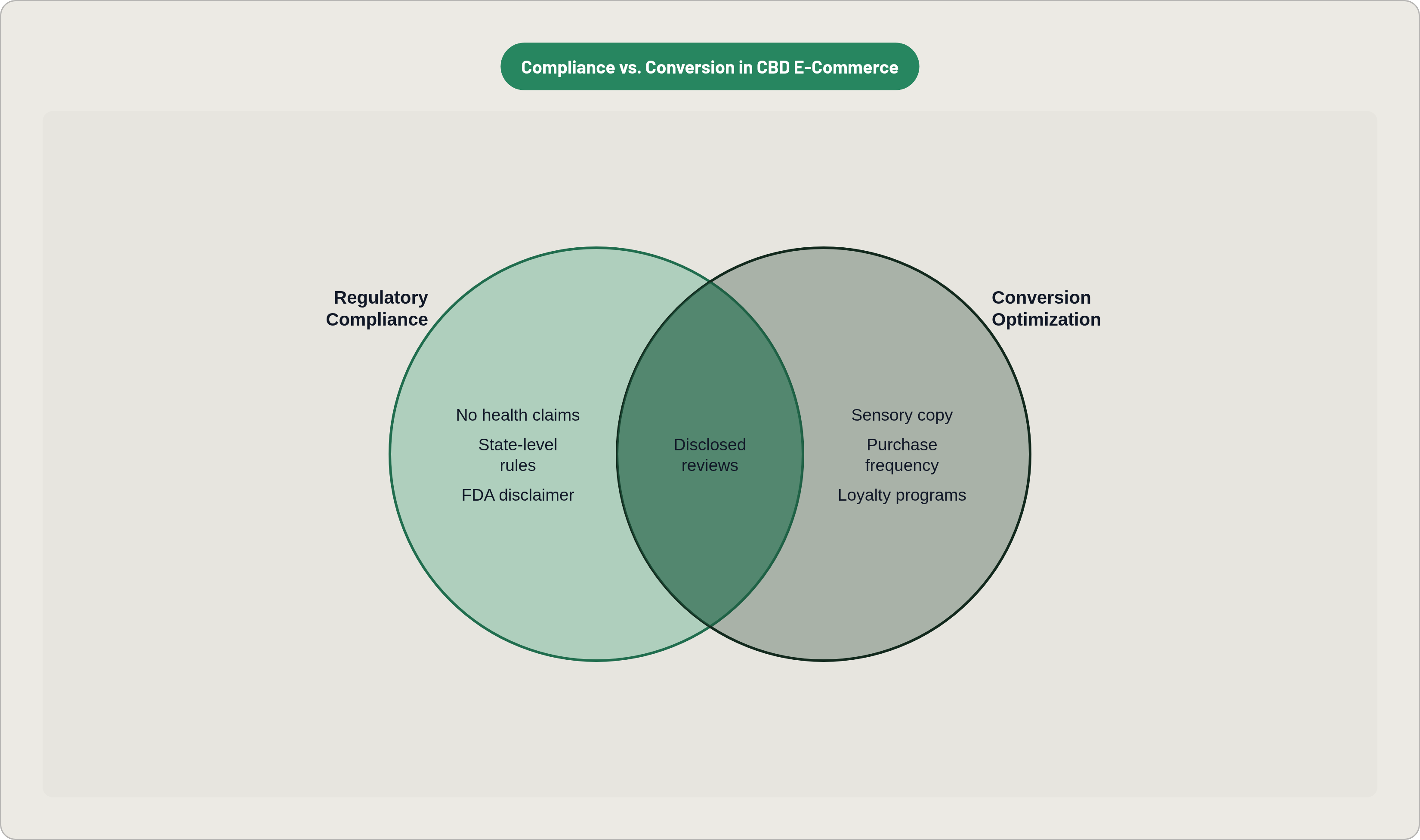
But the prohibition is actually a copywriting improvement. Health claims in product copy are vague, unverifiable from the buyer's perspective, and they produce buyers who expect outcomes the product cannot guarantee, which drives returns and disputes. Sensory and experiential language, words like "soothing," "calming," "supportive," "moisturizing," carries specific meaning without crossing into medical claim territory. A buyer who understands what a product actually does is less likely to be disappointed, less likely to file a chargeback, and more likely to return.
The workflow implication is worth stating explicitly: claim restrictions need to be built into the CMS template and editorial process, not reviewed after copy is written. A product page template that flags prohibited terms before content is published is part of the compliance infrastructure. It is also part of the quality control infrastructure. License numbers belong in the footer, on the About page, and in cart confirmation emails, visible and accessible rather than buried. A clearly written privacy policy, placed where buyers can find it, reduces friction for users who are cautious about sharing data with a brand they do not yet know.
The COA Is Doing the Work a Health Claim Cannot Legally Do
Every product page needs a prominent FDA disclaimer and a direct link to the third-party certificate of analysis for the specific batch. Not a PDF the brand uploaded and controls. A link hosted by the testing laboratory, retrievable and verifiable independently. cbdMD's implementation offers a useful model: ISO-accredited lab testing for every batch, COA linked on individual product pages, QR code on physical labels resolving to the same COA, so the digital and physical trust chains are unified.
New York now requires QR-linked COAs at the regulatory level. Other states are moving in the same direction. What is currently a best practice will become a legal floor in more jurisdictions as the market grows.
The conversion argument is direct: a buyer who can verify batch-specific lab results before purchasing has one fewer reason to hesitate. The COA is answering the question that the product page cannot legally answer. It is not a transparency gesture; it is a sales tool.
CBD also falls into Google's YMYL category, Your Money or Your Life, which means the site's organic performance is influenced by E-E-A-T signals: author credentials, sourcing transparency, and precisely the kind of lab documentation that compliance requires. The same design decisions that satisfy regulators also improve search rankings, which are also the decisions that reduce buyer hesitation. It is worth pausing on how often that convergence appears throughout this build.
Disclosed Reviews Are More Credible Than Undisclosed Ones
Displaying purchase frequency and volume near the add-to-cart button produced a documented 15% conversion increase in one A/B test, with a measurable lift across the site. Reviews are among the highest-converting trust signals in this category. That is not a contested point.
The FTC complication is this: any review collected from a comped product, a paid relationship, or an incentivized loyalty program requires a clear and conspicuous disclosure. Not a footnote. Not a buried hashtag. The disclosure has to be visible, in context, before the reader relies on the review to make a decision.
This disclosure requirement does not depress conversion. Consider what an undisclosed review actually communicates to a sophisticated buyer who notices it is undisclosed: that this brand is not being straight with them. A disclosed review gives the buyer the information they need to assess it and decide to trust it anyway. That is a more durable form of trust than manufactured unanimity. In CBD, transparency isn't just policy — it's the whole product.
Flowhub data indicates that loyalty members are five times more likely to try new products than non-members. Social proof and loyalty programs are part of the same conversion system, which means review display, loyalty program terms, and FTC disclosure language need to be designed together. Manipulative checkout flows, hidden recurring fees, and opaque privacy policies have been specifically cited in FTC enforcement actions against health platforms. They also erode every trust signal the rest of the page is working to establish.
Compliance-First Design Is a Competitive Position, Not a Cost
The U.S. CBD consumer health market is projected to reach $38.21 billion by 2035, growing at a CAGR of roughly 13.95%. A market expanding at that pace attracts more regulatory scrutiny as it scales, not less. E-commerce accounts for roughly 40% of CBD sales; the brands that own that channel will be the ones whose infrastructure was built to survive platform changes, processor shifts, and state-level rule updates without emergency rebuilds.
The brands that bolt compliance on after launch face a structurally different problem: every platform migration, every processor switch, every state expansion is a retrofit project, and retrofit projects carry compounding cost and risk. The brands that built compliance in, by contrast, have already absorbed those decisions. State expansions are configuration changes, not architectural projects.
It is also worth considering where margins in CBD are actually made. Not in first-time purchases. In repeat purchases. In the buyer who trusts the brand enough to try a second product, a third, a higher price point. The trust signals that compliance-first design produces, visible COAs, honest copy, disclosed reviews, clean checkout, are also the signals that produce repeat buyers. That alignment between regulatory requirement and commercial outcome is not a coincidence. It is the through-line this piece has been following from the start.
A CBD site does not have to choose between satisfying regulators and converting buyers. The same decisions serve both. That is the argument, and the build that demonstrates it is the competitive position.