Email Marketing Compliance for CBD Businesses
Federal legality doesn't mean your emails won't trigger FDA, FTC, or state enforcement actions.

The 2018 Farm Bill removed hemp-derived CBD from the Controlled Substances Act, provided the product contains less than 0.3% delta-9 THC on a dry-weight basis. Brands took that provision as a green light. Many still do. That's the expensive part.
The regulatory environment isn't stabilizing; it's tightening. Amendments included in the Continuing Appropriations Act for 2026 redefine hemp by restricting total THC, including THCA, to 0.3% on a dry-weight basis, and explicitly exclude synthetic cannabinoids, including delta-8 THC and THCA, from the definition of hemp even when derived from otherwise-legal plants. These provisions take effect November 12, 2026. That's a short runway for any brand whose current portfolio includes those compounds.
But why does any of this matter specifically to an email marketer? Because product legality and marketing legality are distinct questions, typically enforced by different agencies. Federal legality under the Farm Bill does not resolve the FDA question. The FDA retains enforcement authority over how products are marketed, regardless of whether selling them is legal. And state law adds yet another layer: a nationally deployed email campaign that clears every federal threshold can still violate the marketing statutes of specific states represented in the subscriber list.
"Federally legal" is not a synonym for "unregulated." It is the beginning of a compliance analysis, not the end of one. Treating it as the latter is where the expensive mistakes originate.
What CAN-SPAM requires and where CBD brands specifically go wrong
CAN-SPAM, passed in 2003 and enforced by the FTC, is the federal baseline for commercial email sent to US recipients. It applies to every CBD email sent, regardless of product type or sender's state. Clearing it is necessary but not sufficient.
The requirement that most frequently trips up newer CBD marketers is also the most structurally consequential: CAN-SPAM is an opt-out law, not an opt-in law. Sending to a person who has not subscribed is legal until they ask you to stop. Brands who learned email compliance through a GDPR or CASL lens sometimes miscalibrate their US programs because of this distinction, and the miscalibration runs in both directions: either they're overly cautious in ways that constrain list growth, or they assume the same permissiveness extends to jurisdictions where it doesn't.
The core requirements aren't complicated. Accurate header information in "From," "To," and "Reply-To" fields. Subject lines that accurately reflect the email's content. A valid physical postal address in every commercial message. A functional opt-out mechanism for at least 30 days post-send. Unsubscribe requests honored within 10 business days, through a process requiring no fee, no additional personal information, and no more than a single action.
Where CBD brands specifically go wrong: deceptive subject lines used to obscure the product category, broken or deliberately sluggish unsubscribe flows, and a fundamental misunderstanding of shared liability. That last point deserves attention. Both the brand whose product is being promoted and the company physically sending the email can be held legally responsible for a CAN-SPAM violation. Outsourcing execution to an agency does not outsource liability. Fines reach up to $51,744 per individual violating email, and at any meaningful send volume, non-compliance becomes financially catastrophic with arithmetic speed.
FDA and FTC content rules and what they prohibit in email copy
If CAN-SPAM governs the infrastructure of an email, the FDA and FTC govern what is written inside it. This is where the preponderance of CBD email violations actually originate, in the body copy itself.
The FDA's position is unambiguous and consistently applied: CBD products that claim to prevent, diagnose, treat, or cure diseases violate the Federal Food, Drug, and Cosmetic Act. The agency has issued warning letters on exactly this basis, including as recently as April 2025 against Bailey's Wellness, Holista, and House of Alchemy/Hamet & Love. The operative distinction is between a disease claim and a structure/function or general wellness claim.
Consider the difference: "Our CBD gummies cure anxiety and insomnia" is a disease claim, prohibited. "Our CBD gummies are crafted to support relaxation and restful nights" is a wellness claim, permissible. The semantic gap between those two sentences is, in practice, the difference between operating normally and receiving a federal warning letter. Every email a CBD brand deploys should include disclaimer language confirming that products are not intended to diagnose, treat, cure, or prevent any disease, and that the FDA has not evaluated the claims.
The FTC Endorsement Guides, fully operative as of July 2023, add a layer many brands underestimate. All material connections between a brand and an endorser or influencer, including payment, free product, and business relationships, must be clearly and conspicuously disclosed. More consequentially, brands are liable for unsubstantiated claims made by their influencers, not just their own copy. When an email features customer testimonials or affiliate endorsements, the brand assumes responsibility for the veracity and presentation of those endorsements. The copy you didn't write is still your legal exposure.
Joint FTC/FDA cease-and-desist activity in 2024 and 2025 has explicitly targeted products whose packaging and marketing attract children, including gummies and baked goods designed to mimic children's snacks. Imagery and visual framing used in emails fall within that enforcement scope. Before any email deploys, three questions: Does it make a disease claim? Does it feature testimonials or affiliate copy without proper disclosure? Does any imagery or framing appeal to minors?
If the answer to any of those is unclear, that is itself an answer.
How GDPR and CCPA change what CBD brands can do with their subscriber data
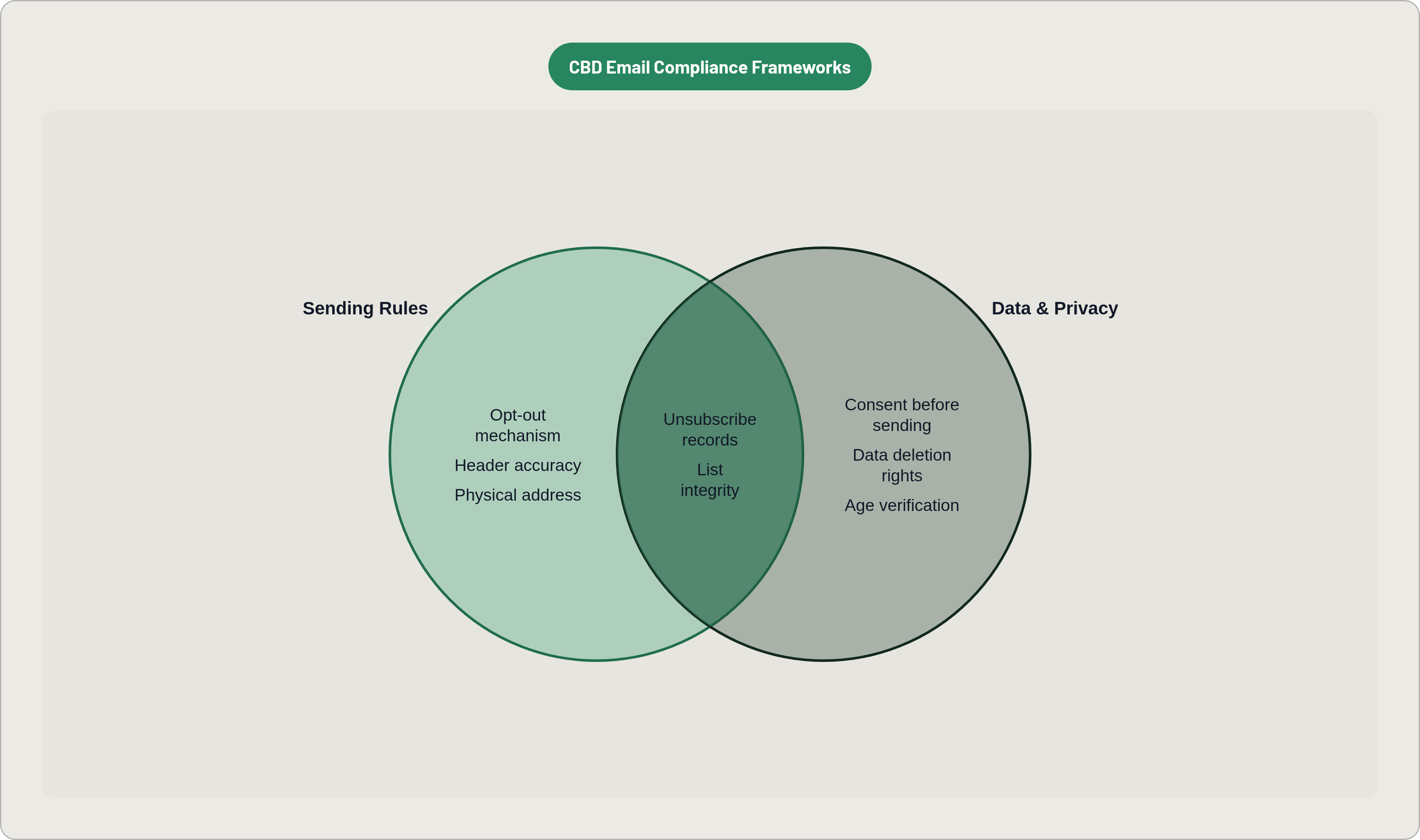
CAN-SPAM governs the act of sending. GDPR and CCPA govern the data that makes sending possible. They operate on different dimensions of the same program, and treating them as separate compliance workstreams is an organizational error that surfaces at the worst possible moment.
GDPR applies when a CBD brand's list includes EU residents. Unlike CAN-SPAM, it requires explicit, freely given consent before any marketing email is sent, and it grants subscribers the right to request complete data erasure at any time. Penalties reach up to €20 million or 4% of global annual revenue, whichever is higher. Any eCommerce operation with meaningful EU traffic needs a consent capture and data handling process that meets this standard, even if the brand's primary market is domestic.
CCPA and its successor, CPRA, apply to California residents. This is not technically an email law, but email addresses and engagement data, including opens and clicks, qualify as personal information under the statute's definition. California subscribers must be able to access a "Do Not Sell or Share My Personal Information" mechanism. Data requests must be answered within 45 days. Deletion requests require removal not just of the email address but of associated engagement data.
As of January 1, 2025, the California Privacy Protection Agency eliminated the 30-day cure period. Violations now trigger immediate penalties, ranging from $2,663 per unintentional violation to $7,988 per intentional violation.
Purchased lists are not a reasonable shortcut for a nascent brand trying to build audience quickly. Recipients on a purchased list had no opportunity to consent to hear from the purchasing business, which violates GDPR's consent standard, creates CCPA exposure, and degrades deliverability through elevated spam complaint rates. The risk is simultaneously legal and operational, which is a particularly unpleasant combination.
Consent capture, data handling policies, and deletion workflows are not adjacent to the email marketing program. They are constitutive of it.
Age verification in email consent flows and why it mirrors what the website already does
CBD brands that run age gates on their websites often fail to apply equivalent controls to their email list signup. The regulatory logic for doing so is identical. Why does this inconsistency persist?
Probably because website age gates are driven by front-end visibility and, frequently, by payment processor requirements, while consent flows feel like a back-end marketing detail. That framing is wrong, and it creates risk that compounds quietly until it doesn't.
Age verification at the consent stage is operationally straightforward. Signup forms and landing page widgets should verify that recipients meet the applicable age threshold, 21+ for cannabis products or 18+ for hemp-derived CBD depending on state law, before they are added to the list. A date-of-birth field or a simple age confirmation checkbox at the point of signup, accompanied by a clear disclosure of why it is required, is typically sufficient. Critically, this data should be stored as part of the subscriber record, not discarded after validation.
The FTC/FDA enforcement trend targeting minor-appealing packaging and marketing makes age verification at list entry a proactive defense. Consider what happens without it: a subscriber who should not have been added to the list subsequently receives content that also violates FDA content rules, and the brand's records reflect neither valid consent nor an age-verified subscriber. Multiple compliance layers fail simultaneously from a single gap in the intake process. That is the mechanism by which routine enforcement inquiries become serious ones.
The mechanics here are straightforward. The difficult part is the principle: recognizing that age-gating belongs in the consent flow for exactly the same reasons it belongs on the product page.
Choosing an ESP that will actually host a CBD email program
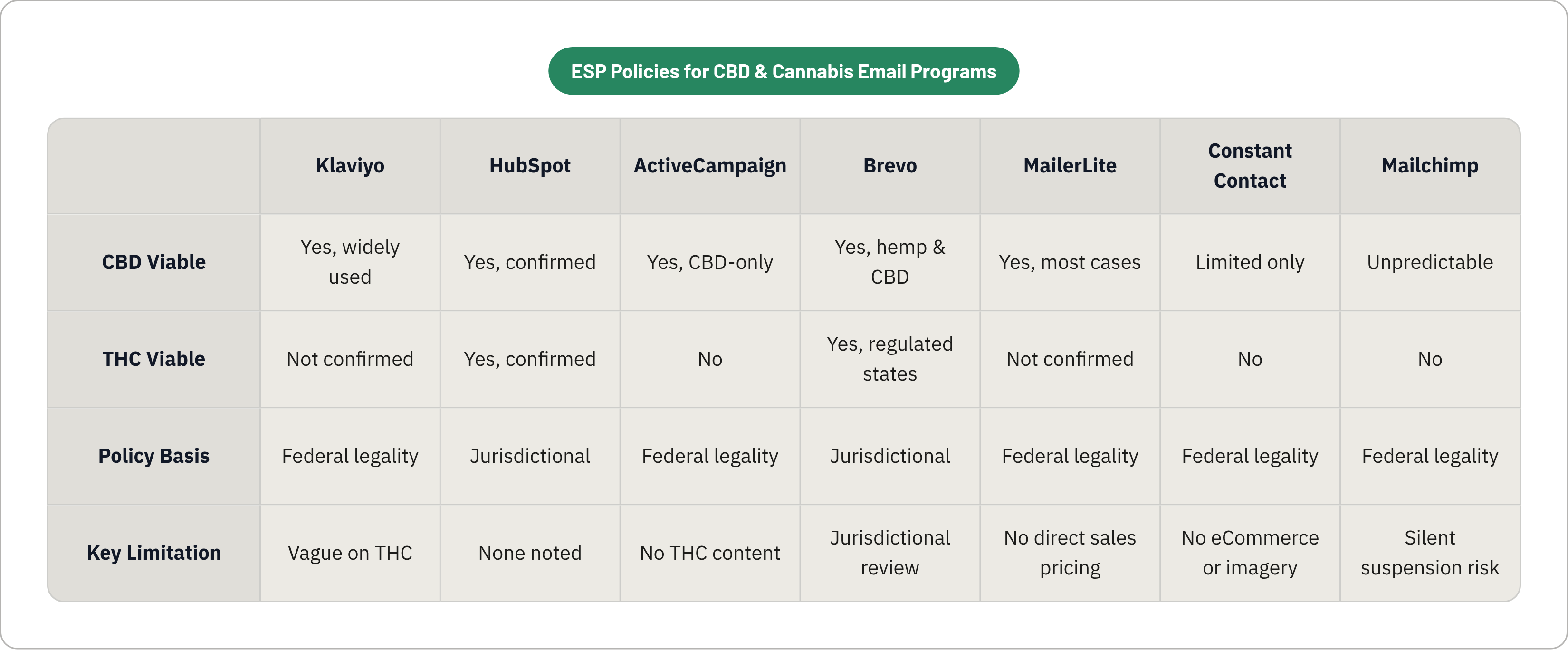
ESP selection is a compliance decision first and a features decision second. Brands that invert that priority discover the correct order of operations when their account is suspended and their automations, their list, and the revenue those flows generate disappear simultaneously, often with little warning and no coherent appeals process.
Platform policies vary significantly and are not always clearly documented. What follows reflects available public reporting and direct confirmation where noted.
Klaviyo is widely used by CBD direct-to-consumer brands. Its terms restrict illegal products, but hemp and CBD brands operate on the platform regularly, and its integrations with Shopify and WooCommerce make it the functional standard for eCommerce-oriented CBD senders. HubSpot has the broadest confirmed acceptance among major platforms; a HubSpot representative confirmed the platform supports cannabis clients, inclusive of THC and CBD. ActiveCampaign confirmed it cannot work with companies promoting THC but is viable for CBD-only businesses.
Brevo, formerly Sendinblue, is reported as cannabis-tolerant for hemp and CBD; its terms focus on legality within the sender's jurisdiction rather than applying a blanket federal prohibition, which makes it more viable for legal cannabis businesses in regulated states. MailerLite permits hemp and CBD content in most cases, though promoting direct cannabis sales with pricing or inventory draws scrutiny. A Constant Contact representative confirmed that promoting a physical location is permitted, but eCommerce, product images, and cannabis imagery are not, which renders it effectively unusable for most CBD email programs. Mailchimp's policy does not distinguish between CBD and THC; that vagueness makes account suspension risk real and difficult to predict.
Beyond initial policy language, four factors warrant serious evaluation. First, whether the ESP's terms are predicated on federal law, which tends toward blanket prohibition, or jurisdictional legality, which tends toward more flexibility. Second, whether the platform has a history of account suspensions for CBD brands or a structured review process for cannabis businesses. Third, whether the platform can handle the behavioral triggers and segmentation a DTC CBD program actually requires; compliance-friendliness is worth little if the tool cannot execute the program. Fourth, whether the ESP has a documented escalation process for account concerns rather than a policy of silent suspension.
The cost of choosing wrong is not merely inconvenience. Rebuilding automations, re-exporting lists, and re-warming a sending domain on a new platform can cost weeks of revenue, with deliverability degrading through the entire transition.
Building a list that holds up to scrutiny across all these frameworks simultaneously
Every compliance layer examined here touches the list at its origin point. CAN-SPAM requires a valid opt-out mechanism from the first send. GDPR requires affirmative consent before that send. CCPA governs what happens to the data afterward. Age-gating requirements control who should be on the list at all. The list is not downstream of compliance; it is where compliance either holds or breaks.
One argument holds that most of these requirements can be addressed retroactively, auditing an existing list and remediating it against these frameworks after the fact. That's partially true. But it misses the structural point. A list built with adequate consent capture, age verification, a clear data handling disclosure, and a compliant unsubscribe mechanism from the start doesn't require the same remediation and doesn't carry the same exposure going into that audit. Retroactive audits find problems; properly constructed consent flows prevent them.
That raises an important question about why more brands don't simply build this way from the start. Per Cannascale's 2025 industry reporting, CBD agency clients often see between 40 and 55 percent of total revenue attributed to email, compared to roughly 20 to 30 percent for mainstream DTC eCommerce. That revenue dependence is what makes losing access to the channel an existential risk, not a bad quarter. And the alternative channels are largely closed: Google prohibits CBD in display and shopping campaigns, Meta requires LegitScript certification and prior written approval, TikTok maintains a complete ban on CBD content as of 2025, and SMS platforms impose restrictions often tighter than email. For many CBD brands, email is not a preferred channel. It is effectively the only high-performance owned channel for direct customer communication that remains consistently accessible.
Which means the compliance work is not a cost center. It is the operational precondition for staying in the channel at all.
Build the list with explicit consent. Capture and store age verification at the consent stage. Implement and test the unsubscribe flow before the first send. Establish a data deletion workflow before a CCPA request arrives. Review email copy against FDA disease claim standards and FTC endorsement requirements before deployment. Select an ESP whose tolerance for CBD is documented, not inferred, and whose infrastructure can support the program's behavioral complexity.
The brands that do this retain access to a channel their competitors frequently lose. That's the actual competitive advantage, and it has nothing to do with subject lines.


