CBD Marketing Restrictions on Google and Meta
Google and Meta's narrow CBD ad rules block most brands from either platform.
The U.S. CBD market was valued at approximately $6.26 billion in 2024. Analysts project it will reach $47.31 billion by 2032, a compound annual growth rate of 37.72%. Those numbers attract serious capital. They also make the following fact particularly maddening: the two platforms commanding the largest share of digital ad inventory operate under rules so conditional, so geography-locked, and so product-type-specific that a significant portion of CBD brands cannot legally run a single paid ad on either one.
Online and e-commerce channels account for roughly 30.7% of global CBD distribution as of 2025. Digital advertising is the category's natural growth engine, and the engine is half-assembled for most of the brands trying to use it.
Before January 2023, Google treated CBD the same way it treated unapproved pharmaceuticals: full stop, no exceptions. Then, on January 20, 2023, Google updated its Dangerous Products and Healthcare and Medicines policies to permit promotion of FDA-approved pharmaceutical CBD and topical, hemp-derived CBD with THC content at or below 0.3%. The pilot launched in California, Colorado, and Puerto Rico.
By mid-to-late 2024, Oregon and New Mexico joined the approved geography list. That is not nothing. But it is also a trend line that shows no sign of pointing toward imminent liberalization. Google has explicitly characterized this as a limited pilot, with no announced timeline for broader rollout.
That raises an important question: what does removing CBD from Google's Unapproved Pharmaceuticals list actually signal? A changed regulatory posture, not an open market. A brand interpreting incremental policy loosening as evidence of inevitable full access is making a projection, not a strategy. Google's history here is one of slow, conditional concessions. Plan around the current rules, not the ones you hope are coming.
Exactly What Google Allows and Prohibits by Product Type and Geography
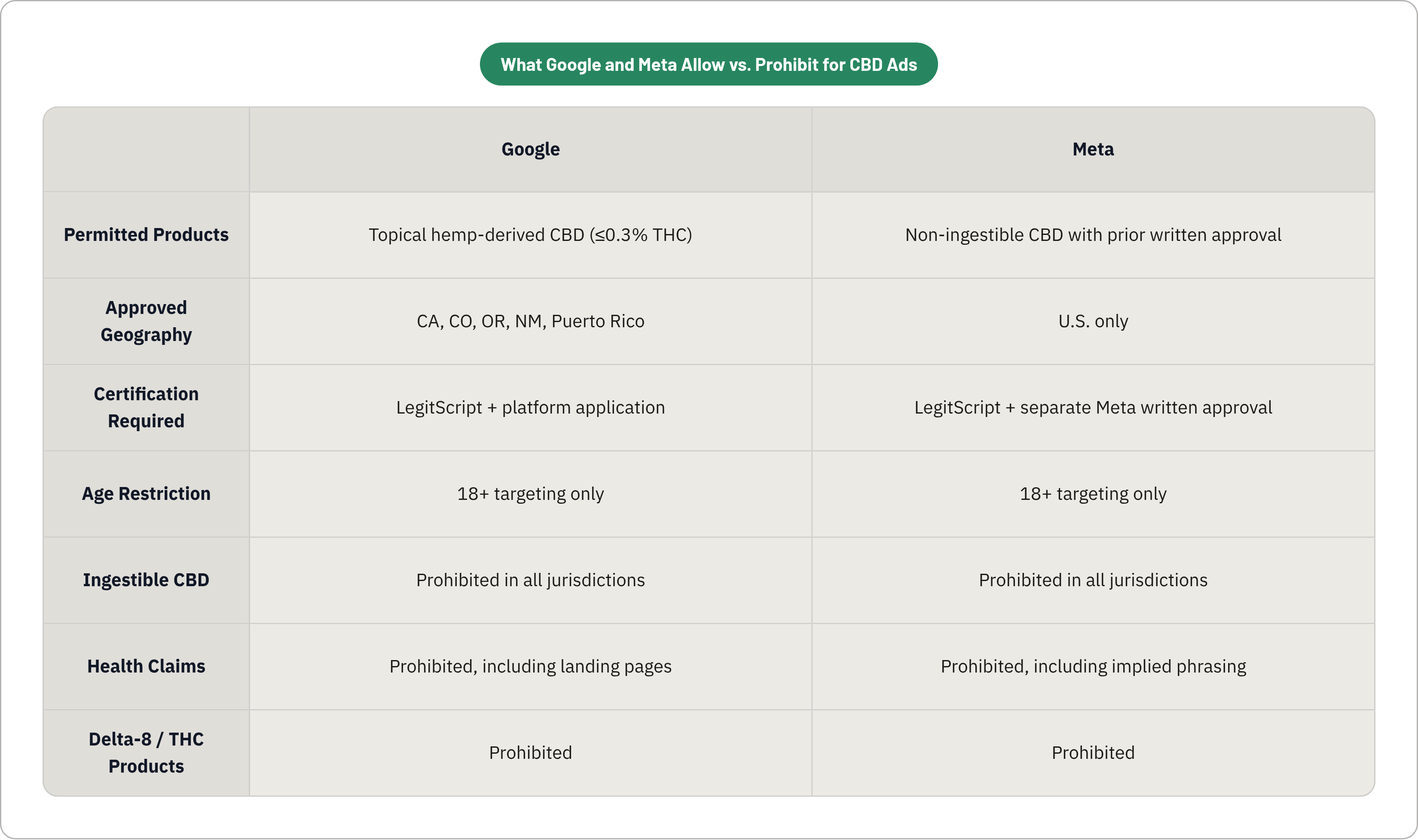
In the approved jurisdictions, Google permits topical, hemp-derived CBD products with THC content at or below 0.3%, targeted exclusively to users 18 and older. That is a narrow aperture, and everything outside it is prohibited regardless of certification status, creative quality, or how well-intentioned your compliance team is.
Prohibited regardless of geography: ingestible CBD in any form, including oils, tinctures, gummies, edibles, capsules, and beverages. Inhalants. Ads making health claims. Ads targeting users under 18. There is no workaround for these; they are structural exclusions, not gray areas.
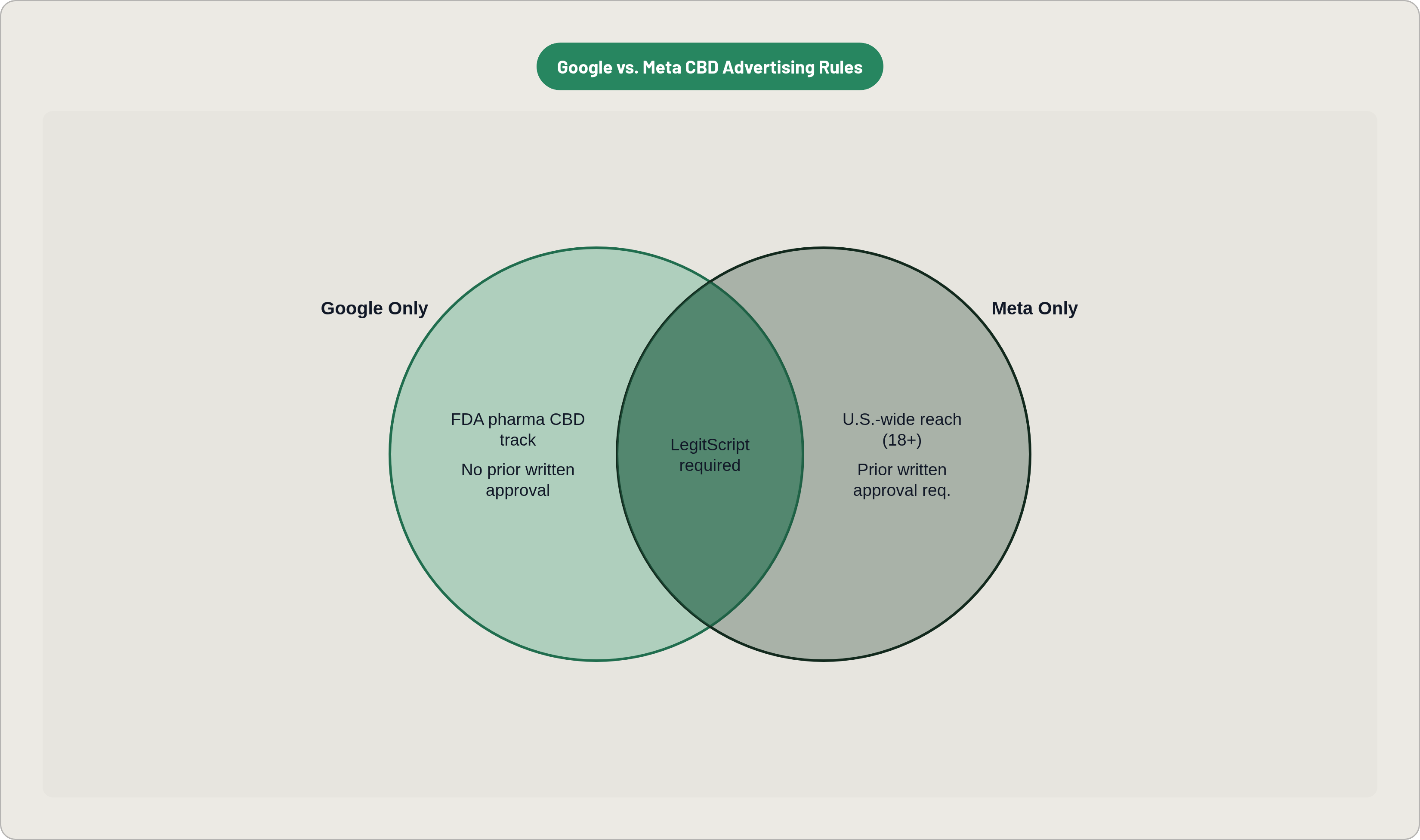
FDA-approved pharmaceutical CBD, Epidiolex being the clearest example, operates on a separate track. Advertisers pursuing this route must apply independently, and the approved geography is narrower still: California, Colorado, and Puerto Rico only.
One operational detail that catches brands off guard: Google's automated systems and human reviewers scrutinize landing pages, not just ad copy. A page that goes deep on CBD product benefits can trigger disapproval even when the ad text is scrupulously clean. Some brands route paid traffic to a general wellness or lifestyle destination rather than a CBD-specific product page. It's a legitimate workaround, but an imperfect one that adds friction to the conversion funnel.
One more enforcement note worth taking seriously. Google issues a warning at least seven days before any account suspension. That window can create a false sense of security. A permanent ban is a permanent ban. The asymmetry between a short-term impression gain and losing an account entirely makes loophole-chasing a structurally irrational choice.
How Meta's 2023 Policy Update Changed the Rules for Facebook and Instagram CBD Ads
Meta rebranded its "Hemp & Related Products" policy to "CBD & Related Products" in 2023 and began allowing "legally permissible, non-ingestible CBD" advertising in the U.S. with restrictions. The rename is worth acknowledging; the conditions are what matter.
What Meta actually permits: non-ingestible CBD ads, but only with prior written permission from Meta, active LegitScript certification, U.S.-only geographic targeting, an 18-plus age gate, and full legal compliance. Topical hemp products, lotions, balms, skincare, are allowed without mentioning CBD or THC anywhere in ad copy, images, or landing pages. Educational or public service content about CBD is permitted as long as it does not offer prohibited products for sale. Non-ingestible hemp products such as fiber and seeds can now run without prior written approval in the U.S., Canada, and Mexico, which is a meaningful simplification for hemp-adjacent brands that don't touch cannabinoids directly.
What remains prohibited: any ad promoting THC, psychoactive cannabis, or delta-8 products. Ingestible CBD in any form. Health or therapeutic claims, and this is a hard line with no ambiguity. Even phrases like "CBD for sleep" or "helps with anxiety" trigger disapproval. Geographic targeting outside the U.S. for CBD specifically.
It is also worth noting a structural difference that separates Meta from Google: prior written permission is a hard prerequisite on Meta, not an option for edge cases. LegitScript certification alone is insufficient. You must apply to Meta separately and receive explicit approval before running any CBD ad. Many brands learn this the hard way, after building a certified product lineup and assuming certification was the only gate they needed to clear.
LegitScript Certification: The Mandatory Step Both Platforms Require Before Any CBD Ad Goes Live
Both Google and Meta formally require LegitScript certification before a CBD brand can run paid ads. Not advisory. Not recommended. Required.
LegitScript certifies cosmetics, soaps, topicals, and other products compliant with USDA, FDA, FTC, and DEA regulations, as well as applicable state laws. What it explicitly does not certify: edible and ingestible CBD products. The FDA currently treats CBD as an impermissible ingredient in foods and dietary supplements, and LegitScript mirrors that position precisely.
The certification process requires a Certificate of Analysis confirming the CBD in the final product complies with federal hemp cultivation and processing law. It requires unexpired, random product samples submitted to a LegitScript-approved testing facility. Products must contain the advertised amount of hemp-derived compounds. The applicant or manufacturer must not have a history of significant or repeated regulatory violations or disciplinary sanctions.
Certification is available per-product and per-website. Only LegitScript-certified domains that exclusively retail individually certified CBD products are eligible to advertise. Ongoing monitoring is mandatory; this is a continuing obligation, not a one-time approval you obtain and file away.
Why does this matter for budget planning? Registration fees are non-trivial and have risen over time. Brands that calculate ROAS expectations without accounting for certification and monitoring costs are working with incomplete math. The investment needs to be in the model before the first campaign goes live.
LegitScript has indicated it is tracking FDA regulatory developments, and if the FDA's position on ingestible CBD shifts, the certification scope will expand accordingly. But that is not the current state. Building a marketing strategy around a regulatory outcome that hasn't happened yet is a bet, not a plan.
The Federal Regulatory Layer That Governs What CBD Ads Can Actually Say
Regulatory exposure for CBD advertising operates on two tracks simultaneously, and brands that conflate them make expensive mistakes. The FDA governs claims in product labeling. The FTC governs claims in advertising. Both apply at once, and passing one gate does not clear the other.
The FTC's enforcement series targeting deceptive CBD marketing continued through 2023 and beyond. In July 2024, the FTC and FDA jointly issued cease-and-desist letters to sellers of copycat delta-8 snack products, specifically targeting packaging designed to appeal to children or mimic established food brands. In August 2025, the FDA issued a warning to a company marketing homeopathic CBD eye drops, a reminder that product novelty does not create regulatory exemption.
Health claims are the live wire. No quantity of fine print protects an unsubstantiated therapeutic claim. Federal enforcement has targeted sellers claiming CBD can treat cancer, heart disease, hypertension, and Alzheimer's. These are unambiguous cases with public dockets attached, not gray areas.
The practical line for ad copy is narrower than most brands initially assume. Factual descriptions of a product's ingredients and composition are generally safer than any language implying physiological effect. "Topical CBD balm" versus "CBD balm for pain relief" is the meaningful distinction, and it is not a subtle one.
A campaign can pass Google's automated review entirely and still attract FTC scrutiny if the landing page makes unsubstantiated claims. Platform disapproval and federal enforcement are separate risk vectors.
The Categories of CBD Products That Remain Completely Off-Limits for Paid Ads on Both Platforms
Some categories are simply off the table. No amount of certification, geographic targeting, or creative refinement changes this.
Universally blocked on both Google and Meta: all ingestible CBD, including oils, tinctures, gummies, edibles, beverages, and capsules. Inhalable CBD products. Any product with THC content above 0.3%. Delta-8 THC and other psychoactive cannabinoid products. Any ad making health or therapeutic claims, including pain relief, anxiety, sleep, or disease treatment. Direct e-commerce links for ingestible products.
The logic here is regulatory, not arbitrary. The FDA's current position that CBD is an impermissible food or supplement ingredient drives LegitScript's exclusion of ingestibles from its certification scope, which drives both platforms' prohibition. The chain of causation is clear, and until something breaks in that chain at the federal level, the prohibition holds.
For brands with diverse product lines, the practical implication is significant. A company selling both CBD topicals and CBD tinctures cannot advertise its full catalog on either platform. Paid ads are available only for the topical portion of the range, and that constraint affects positioning strategy as much as media strategy. How do you tell a coherent brand story when half your product line is invisible to paid audiences? That is the question most brands in this space are quietly working around.
Where Paid Ads Can Actually Run, and What Compliant Campaigns Look Like in Practice
On Google, topical CBD ads can run in California, Colorado, Oregon, New Mexico, and Puerto Rico. A brand headquartered outside these states can still target these markets, provided it ships there and holds certified products. That is worth noting for brands that have prematurely dismissed Google as irrelevant to their geography.
On Meta, approved CBD advertisers can reach U.S. users 18 and older on Facebook and Instagram, a broader geographic footprint than Google's pilot. But broader reach does not eliminate the gating; it just makes the gating worth the effort for more brands.
Ad copy rules that apply across both platforms: no health claims, implied or explicit; no mention of CBD or hemp in ad copy for topical hemp products on Meta unless explicitly permitted through the CBD-specific ad track; no targeting under 18; no geographic targeting outside approved regions.
Landing page alignment is non-negotiable. The certified domain must match the domain in the ad. The landing page must not feature uncertified products or impermissible claims. And a brand's full site must be clean, not just the specific page the ad points to. Reviewers follow links. They scroll.
One documented approach in the market: keyword targeting around terms like "herbal balm for joint support" or "natural recovery cream," avoiding the word "CBD" in ads and landing pages entirely, to reach relevant audiences while reducing disapproval risk. This is less a loophole than a positioning choice with compliance benefits. Whether that positioning accurately represents the brand is a separate conversation worth having internally.
Organic and Owned Channels That CBD Brands Use When Paid Ads Reach Their Limits
SEO, for a CBD brand navigating these restrictions, is a structural advantage that paid ads cannot replicate — not a fallback. Unlike a campaign that stops the moment a budget pauses or a policy changes, SEO-driven content compounds. It is unrestricted by product type, geography, or certification status.
The same keyword logic that works in paid campaigns translates directly into SEO content strategy. The difference is that organic rankings don't disappear when a platform updates its policy.
Email marketing is the highest-leverage owned channel for brands in this category. It is not subject to platform ad policies, drives repeat purchases, and builds customer lifetime value without the disapproval risk that paid placements carry. For a category where paid access is conditional and fragile, owning a customer's inbox is a durable asset in a way that a certified ad account simply is not.
Influencer marketing through micro-influencers with engaged audiences can reach prospective customers organically. But it is not a regulatory escape hatch. Sponsored CBD content must clearly disclose the commercial relationship, and the same FTC rules that apply to ads apply to influencer posts.
Cannabis-specific advertising platforms, including Leafly and Weedmaps, operate outside Google's and Meta's policy frameworks and are worth evaluating for brands that carry THC products or serve markets where platform restrictions make paid ads impractical. X, since its 2023 policy update, allows some CBD topical ads with pre-approval, a minimum age gate of 21, and no health claims. The audience scale and targeting depth are meaningfully smaller than Google or Meta, but it is a real option, not a theoretical one.
The conditional nature of platform access — where a policy update, a failed certification renewal, or an account suspension can eliminate a channel overnight — makes paid ads a fragile foundation. The brands building durable positions in CBD are the ones who built audiences that require no one else's permission to reach, not the ones who simply figured out how to run the most ads.