SEO Strategy for CBD and Hemp Brands

Start with scale, because it reframes what follows. The global CBD market was valued at approximately $7.7 billion in 2023 and is projected to reach $47.2 billion by 2033, per Precedence Research. North America holds the largest regional share. A 2023 Forbes Health survey found roughly 60% of American adults have tried CBD, primarily for pain, anxiety, and sleep. This is not a fringe wellness category nursing ambitions of legitimacy. It is a mainstream consumer market with mainstream purchase volumes and mainstream competitive dynamics, operating inside a regulatory environment that still treats it with considerable suspicion.
E-commerce leads CBD distribution. Grand View Research identified online retail as the leading channel as of 2023, meaning a substantial portion of category revenue flows directly through DTC sites, through exactly the search traffic that SEO generates. A ranking shift is not an abstraction here; it is a revenue event with a measurable dollar figure attached.
The competitor set reflects that reality. Well-capitalized incumbents with full content teams, compliance infrastructure, and years of compounded domain authority are already occupying the top of these SERPs. A brand entering this space is not scrapping against other newcomers navigating the same obstacles. It is competing against companies that finished this particular homework years ago, and have since moved on to harder problems.
That context shapes what "succeeding at SEO" actually requires, and how long it realistically takes.
How Google Classifies CBD Content, and Why That Classification Changes Everything
Google places CBD content under "Your Money or Your Life," abbreviated YMYL. The category covers content that meaningfully affects a user's health, safety, or financial wellbeing. A supplement people are consuming to manage pain, sleep, or anxiety qualifies without much deliberation.
Why does this matter? Because YMYL content is not evaluated the way a recipe blog or travel guide is evaluated. Google's quality raters, the human reviewers assessing whether algorithmic rankings are producing useful results, examine the editorial process behind the content, not just the content itself. The framework they use is E-E-A-T: Experience, Expertise, Authoritativeness, Trustworthiness, documented in Google's publicly available Search Quality Evaluator Guidelines.
Here is what most brand teams tend to underestimate: a polished product description with no demonstrated author credentials will lose to a less polished page with a credentialed reviewer attached. Prose quality is not the primary variable. Trust infrastructure is.
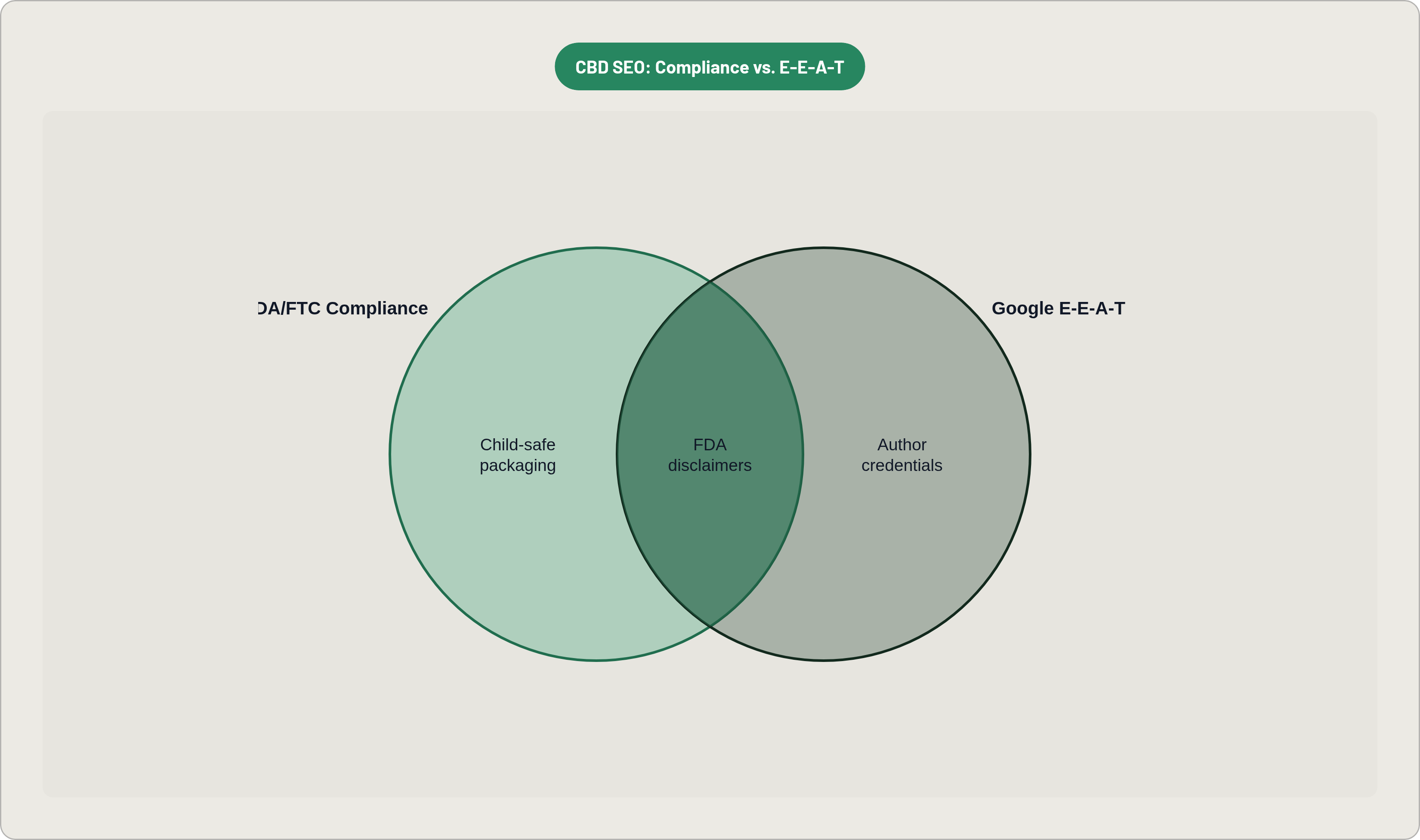
That raises a question about compliance, specifically whether FDA compliance is a legal problem or an SEO problem. Inconveniently, the answer is both, and they are inseparable. A page making unauthorized disease claims violates FDA guidance. That same page signals low trustworthiness to Google's quality raters. The two risks compound. Brands that treat compliance and E-E-A-T as distinct workstreams tend to discover, around month nine, that they have been solving the same problem twice from different ends.
This is why the six-to-twelve-month timeline most practitioners cite is not conservative hand-waving. It reflects how long it actually takes to build the trust infrastructure YMYL scrutiny demands. The algorithm is not being obstinate. It is waiting for evidence.
What FDA and FTC Compliance Actually Requires of CBD Content
The FDA has issued warning letters to companies making disease claims for CBD products, targeting everything from standard ingestibles to a CBD eye drop claiming to protect against macular degeneration. The warning letter database is publicly available at fda.gov and is worth reading before finalizing a single line of product copy.
The practical content boundary is not conceptually complicated, though staying inside it requires genuine discipline. Phrases like "supports wellness" are permissible as general structure/function claims. Stating that CBD treats anxiety, pain, or sleep disorders is not. The FTC holds health-related claims to a standard of "competent and reliable scientific evidence" as stated in the FTC Act and associated enforcement policy, a bar the vast majority of CBD brands cannot clear for their specific products.
Joint FTC and FDA enforcement actions have also targeted products with packaging that appeals to children, which extends the compliance surface beyond copywriting into product design and site presentation. Worth knowing before the packaging is finalized, not after.
What does this mean for content infrastructure? Every product page needs a prominent FDA disclaimer and a direct link to the third-party Certificate of Analysis for the relevant batch. State-specific availability language is required; legal status and permissible copy differ by jurisdiction, and the distinctions between Delta-8, Delta-9, and THCa must be mapped correctly at the page level, not managed with a single blanket footnote.
It is also worth considering what these compliance elements do for SEO. COA documentation and FDA disclaimers function simultaneously as regulatory checkboxes and trust signals that users and crawlers register. A brand that treats them as bureaucratic obligations and buries them in a footer is forfeiting legal protection and ranking potential simultaneously.
Building E-E-A-T Into the Site Before Writing a Single Article
The most consistent mistake I see CBD brands make is treating E-E-A-T as a content feature rather than a site architecture feature. They publish twenty articles, add author names in small text at the bottom, and wait for rankings that do not arrive. Then they commission twenty more articles and wonder if the problem is volume.
It is not volume.
Author bylines with credentials are not cosmetic. Every piece of content on a YMYL topic needs a clear author bio demonstrating relevant expertise: a pharmacist, a registered dietitian, a compliance specialist. "Medically Reviewed By" signatures from qualified professionals are functional components of trust architecture, not marketing garnish. Without a formalized review workflow, even technically accurate content loses to competitors who have one, because the signal to Google's quality raters is categorically different.
Beyond individual content pieces, the organization itself must demonstrate legitimacy. A substantive About page. A physical address. Named leadership. A clear return and refund policy. Verifiable business credentials. These are the signals, to users and to Google's quality assessment process, that a real, accountable organization stands behind the content and can be held responsible for it.
Third-party lab transparency deserves particular attention. COA links belong on every product page, directly accessible, not nested three clicks into an FAQ. In a category where consumer trust is perpetually provisional, transparency about product composition is a competitive differentiator. Brands that treat it as a compliance formality are misreading what it actually does for them.
The sequencing matters. Brands that attempt to build content volume before establishing this trust infrastructure are building on sand. Content is what you produce once the foundation earns the right to support it.
Keyword Strategy for a Category Where Head Terms Are Out of Reach
Competing for "CBD" or "CBD oil" as standalone terms is, for most brands entering this space, a resource allocation error. Those SERPs are occupied by major health publishers and well-funded incumbents with years of compounded authority. The question is not how to displace them on those terms. The question is where actual opportunity lives.
Long-tail keyword clusters are the answer. Not a consolation prize; a strategically superior target for brands trying to capture specific purchase intent from users who have already done their research.
Commercial intent clusters follow a predictable structure: product type plus format plus attribute. "Broad spectrum CBD oil 1000mg." "Vegan CBD gummies THC-free." Modifiers signaling purchase readiness, including strength, spectrum type, and product attributes, attract visitors who are close to a decision and looking for confirmation, not education.
Mid-funnel educational terms capture earlier-stage demand: "how to use CBD," "CBD dosage basics," "full spectrum vs. broad spectrum." These queries are not directly transactional, but they introduce the brand to users who will become buyers. Ignoring this layer means ceding the research phase to competitors who will be there when the purchase decision actually arrives.
State-by-state keyword mapping is essential for brands operating across multiple markets. Delta-8, Delta-9, and THCa keyword intent must be matched to legal status and permissible copy in each jurisdiction. A national keyword strategy that ignores state-level legal variation creates compliance exposure and traffic mismatch at the same time.
Why Topical Authority Is the Content Model That Works for CBD
A handful of strong product pages does not constitute a content strategy in a YMYL category. Google's algorithm evaluates whether a site demonstrates comprehensive understanding of its subject domain, not merely keyword presence. Topical authority captures this: the algorithm's recognition that a site is the most thorough and credible resource within a defined subject area.
Topical authority is earned incrementally. A single pillar page cannot achieve it; the supporting cluster is what signals depth.
The structural approach is hub-and-spoke architecture. A centralized pillar page covers a broad topic with genuine depth, say, a comprehensive CBD wellness guide. Spoke articles target specific questions branching from that pillar, each linking back to concentrate authority. Internal linking between spoke articles reinforces the topical cluster signal further.
But what if the content strategy drifts toward establishing CBD's clinical efficacy? That is a path to FDA warning letters and YMYL trust penalties. The goal is to become the most authoritative resource on the lifestyle, science, compliance, and consumer experience of CBD. Educational authority, not medical authority. The distinction matters enormously, and collapsing it is one of the more expensive content mistakes a brand can make.
A 2025 case study documented by InterAmplify describes a UK CBD brand that grew from under one thousand monthly organic visitors to a first six-figure revenue year, with a reported 557% traffic increase attributed to compliance-first SEO and hub-and-spoke content architecture. One data point, but a directionally useful one.
Content investment in this category should be planned as a multi-year program. Not a campaign. Authority compounds, but only if the structure is maintained and the commitment holds past month three, when someone in a quarterly review asks why rankings haven't moved yet.
The Link-Building Problem Specific to CBD, and How Brands Work Around It
Backlinks remain the primary currency of authority in SEO. For CBD brands, acquiring them is structurally harder than in almost any other e-commerce category, and it is worth being honest about why.
Many high-authority publishers, news outlets, health sites, finance publications, maintain blanket editorial policies against linking to cannabis-adjacent domains. This is not an outreach problem a persuasive pitch can solve. The more productive posture is to accept that constraint and redirect resources toward approaches that actually produce links.
Data-driven content designed to earn citations from non-cannabis sites is one such approach. A piece on consumer trends in non-psychoactive cannabinoids, or the economic impact of hemp farming in a specific agricultural region, positions the brand as an industry analyst rather than a product seller. Sites that would decline to link to a product page will sometimes link to credible industry data, particularly when that data is available nowhere else.
Cannabis-adjacent publishers represent a more direct path: wellness blogs, agricultural publications, legal and compliance newsletters. These outlets cover the space without mainstream blanket prohibitions. Newsletter sponsorships with cannabis-friendly publications offer brand mentions and indirect link opportunities that do not require editorial policy exceptions. PR around third-party lab results, certifications, or regulatory milestones creates newsworthy angles that justify coverage from outlets that would otherwise pass.
Links acquired this way tend to carry lower average domain authority than what a mainstream consumer brand acquires through general media coverage. That is a genuine limitation. The alternative is to keep pushing against editorial policies that rarely move, which is rarely the better use of resources.
Technical SEO Requirements That Carry More Weight in a YMYL Category
Technical SEO problems are rarely purely cosmetic, but in a YMYL category, they carry additional consequence. Site speed and security affect E-E-A-T assessment directly. A slow-loading product page or an expired security certificate is not just a performance issue; in a category where trust is already difficult to establish, it is a trust signal failure at the moment it is most costly.
Core Web Vitals metrics, LCP, CLS, INP, must pass Google's thresholds as documented in Google Search Central guidance. Clean URL structures should mirror the hub-and-spoke content architecture: /cbd-oil/, /cbd-gummies/, /learn/cbd-dosage/. Structured data across Product, FAQ, Organization, and LocalBusiness schema opens additional ranking surfaces: rich results, knowledge panels, the local pack for brands with physical presence.
Age-gate implementation requires particular care. Gates that block crawlers from accessing indexable content, a common technical mistake, can effectively deindex product pages. The gate must verify user age without preventing search engines from evaluating the content behind it.
XML sitemaps, robots.txt, and canonical tags prevent index bloat as content volume grows across hub-and-spoke clusters. HTTPS is essential; a browser security warning in this category is a trust-destroying event at exactly the wrong moment.
One structural reality elevates the stakes here beyond what applies to most e-commerce categories: Amazon, eBay, and Etsy prohibit CBD product sales, as stated in their respective seller policies. The brand's own DTC site is not one channel among several. It is the most durable sales channel available. A technical failure on that site has no backstop.
How to Sequence the Work and Set Realistic Expectations for Results
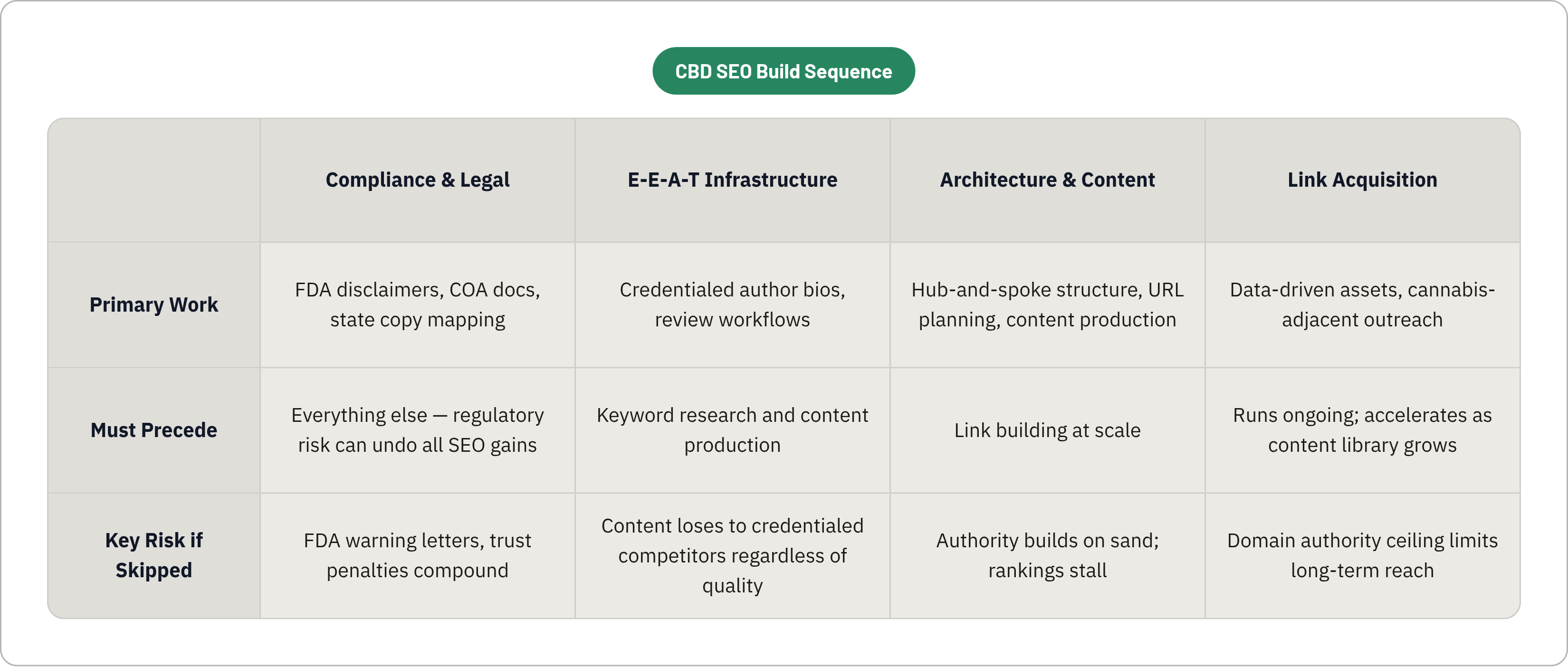
The six-to-twelve-month timeline for meaningful organic revenue lift is not a hedge. It is an accurate description of how long the prerequisites take, and which prerequisites must precede which.
Compliance and legal infrastructure comes first: FDA disclaimers, COA documentation, state-specific copy mapping, legal review of all health-adjacent language. Attempting to build content authority before this is in place creates real risk. Regulatory action can undo SEO work entirely.
E-E-A-T infrastructure comes next: author bios with credentials, review workflows, organization-level trust signals, COA links on every product page. Then keyword research and site architecture, with the hub-and-spoke structure mapped out, URLs planned, and internal linking logic defined before content production begins. Content production follows the architecture. Not the other way around.
Technical SEO audit and remediation runs in parallel, but critical issues discovered, particularly those affecting crawlability or security, must be resolved before content is published at scale. Link acquisition is an ongoing workstream that accelerates as the content library grows and creates more linkable assets.
Why does this take so long? Because Google's trust in a YMYL site is earned by the consistent, observable pattern of expertise, transparency, and user-serving content over time, and no single action can substitute for that pattern. The algorithm is watching to see whether the brand behaves like a credible, accountable information source before it sends users there.
That is not an unreasonable standard. It is just an inconvenient one for brands accustomed to faster feedback loops, and one that rewards the relatively rare combination of patience and sound architecture. The brands that build correctly and wait out the compounding period are the ones that tend to dominate the organic channel. In a market where that channel is the primary channel, and where Amazon is not an option, dominating it is not a nice-to-have. It is the strategy.