Home Care Agency Marketing Strategy
Trust—not service features—is what families actually buy when choosing home care.
Start with who is actually searching. The primary decision-maker in a home care purchase is an adult child in their 50s or 60s, managing a parent's decline from a distance, often under significant time pressure and emotional weight. They are not shopping the way someone shops for a plumber. They are asking something far more consequential: can I trust a stranger with my parent's safety, dignity, and daily life?
That threshold is higher than for almost any other local service category. Over 52 million Google searches related to senior care occur each year. Families are doing substantial research before making contact. They are reading, comparing, doubting, and reading again. An agency website that leads with a bulleted service list and stock photography of a smiling elderly couple is answering the wrong question. Families already know what home care is. What they do not know yet is whether you are the kind of agency they can trust with their mother.
That distinction reorients the entire marketing strategy. Every channel, whether SEO, reviews, social media, or referrals, should be building credibility before it generates a phone call. Credibility is the product. The phone call is just the output.
Local SEO and the Google Business Profile Are the Foundation, Not a Feature
More than 15,500 online searches per hour occur for senior care. The volume is not the problem. The only question is whether your agency appears when those searches happen near your service area.
Local SEO for home care rests on three mechanics. Location-specific keywords embedded in title tags, headings, and page content. Dedicated service area pages for each community the agency actually serves. And consistent name, address, and phone number across every directory, social profile, and listing. That last one gets ignored constantly. Inconsistency is not a cosmetic problem; it is a trust signal to Google's algorithm that the business is not reliably managed.
The Google Business Profile sits above all of this. It controls what appears in map results when a family in your zip code searches "home care near me." It is the single highest-leverage local SEO asset an agency has. A surprising number of agencies have claimed their profile, added a phone number, and called it done. That is roughly equivalent to opening a restaurant, putting a sign on the door, and then being confused about the empty dining room.
One argument holds that paid advertising is the faster path to visibility. That is not wrong, exactly; it is just incomplete. Paid search buys visibility immediately. SEO compounds over time, expanding your organic pipeline without proportionally increasing spend. An agency that builds both, using paid ads while SEO matures, is playing a smarter long game than one that commits exclusively to either.
Online Reputation Functions as Both a Search Ranking Signal and a Trust Signal
Here is something most agency operators know intellectually but do not act on operationally: reviews are not separate from SEO. They are part of the same system.
Google's share of total online reviews grew from 79% in 2023 to 81% in 2024, per Birdeye's State of Online Reviews 2025. Google factors both the volume and quality of reviews into local search ranking. More reviews from satisfied families does not just make the agency look credible; it literally changes where the agency appears when the next family searches.
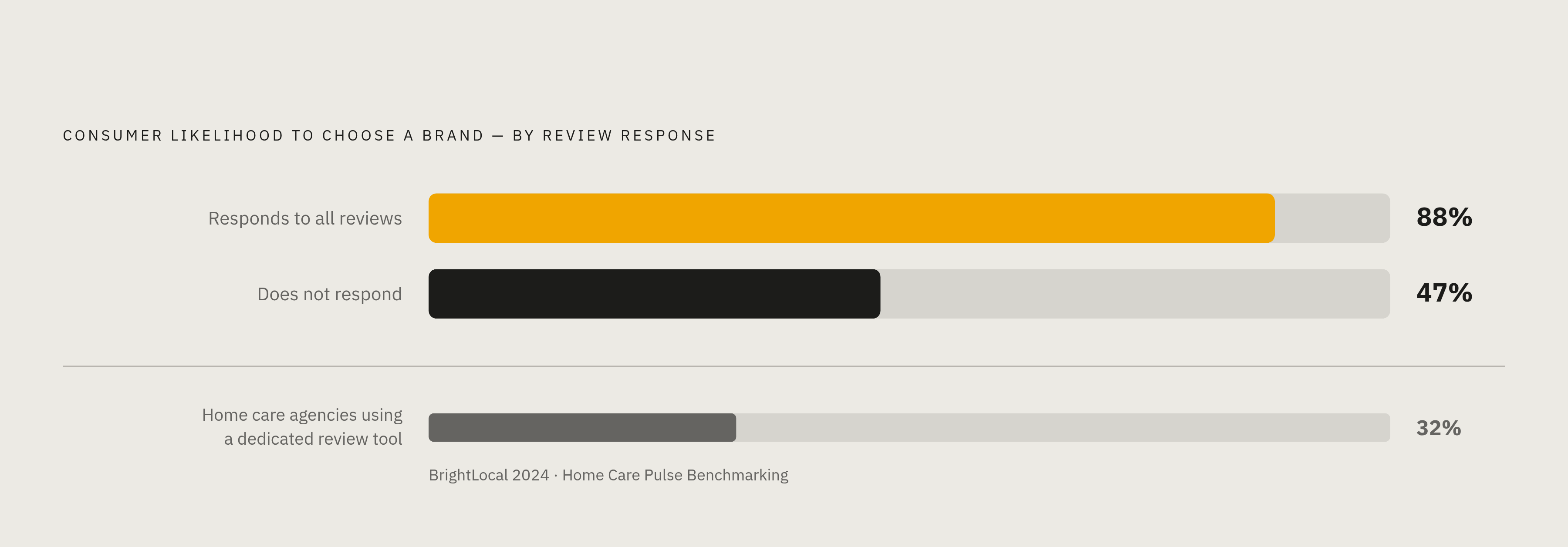
The trust signal function is equally measurable. BrightLocal's 2024 research found that 88% of consumers say they are likely to choose a brand that responds to all of its reviews, versus 47% for brands that do not respond. That gap is not a rounding error. Response behavior signals to families that the agency is attentive and accountable, which happens to be the precise quality they are evaluating before they call.
Despite this, Home Care Pulse Benchmarking data suggests only 32% of agencies use a dedicated tool to manage reviews. Walk through that gap. Build a systematic prompt for satisfied clients and families to leave reviews after positive interactions, respond to every review promptly, and monitor across Google, Yelp, Care.com, and Glassdoor. That last one matters for caregiver recruitment, which we will return to shortly.
What a High-Performing Home Care Website Actually Does (and What Most Agency Sites Get Wrong)
It is worth considering what the website is actually being asked to do. It is not a brochure. It is a digital intake engine serving two very different audiences: prospective client families making an emotionally charged decision, and referral partners, specifically hospital discharge planners and physicians, who are vetting the agency before they stake their professional reputation on a recommendation.
Most agency sites fail the first audience within seconds. Generic stock photography. No clear service area. No social proof above the fold. Slow load times on mobile, which matters because adult children searching during a hospital visit are almost certainly on their phones, not a desktop.
Why does this happen? Partly because home care operators are, reasonably, focused on care delivery. Partly because whoever designed the site optimized for what the agency wanted to say rather than what the visitor actually needs to know. The result is sites that answer questions nobody asked.
A high-performing site does specific things differently. Service pages target individual care conditions: dementia care, post-surgery recovery, companionship, palliative support. These pages rank for specific searches and serve visitors who already know what they need. Blog content addresses real family questions, the kind typed into Google at 11 PM when someone is trying to understand what is happening to their parent. Caregiver spotlights and client testimonials appear where families are making trust assessments, not buried three clicks deep in an "About" section.
The referral partner audience requires a separate, deliberate element: a dedicated professional referral page. Discharge planners visit agency websites before making referrals. If they land on a consumer-facing homepage and cannot quickly find information relevant to their workflow, they move on. That page does not need to be elaborate. It needs to exist.
Referral Relationships Generate the Highest-Quality Clients, but Only If You Build Them Systematically
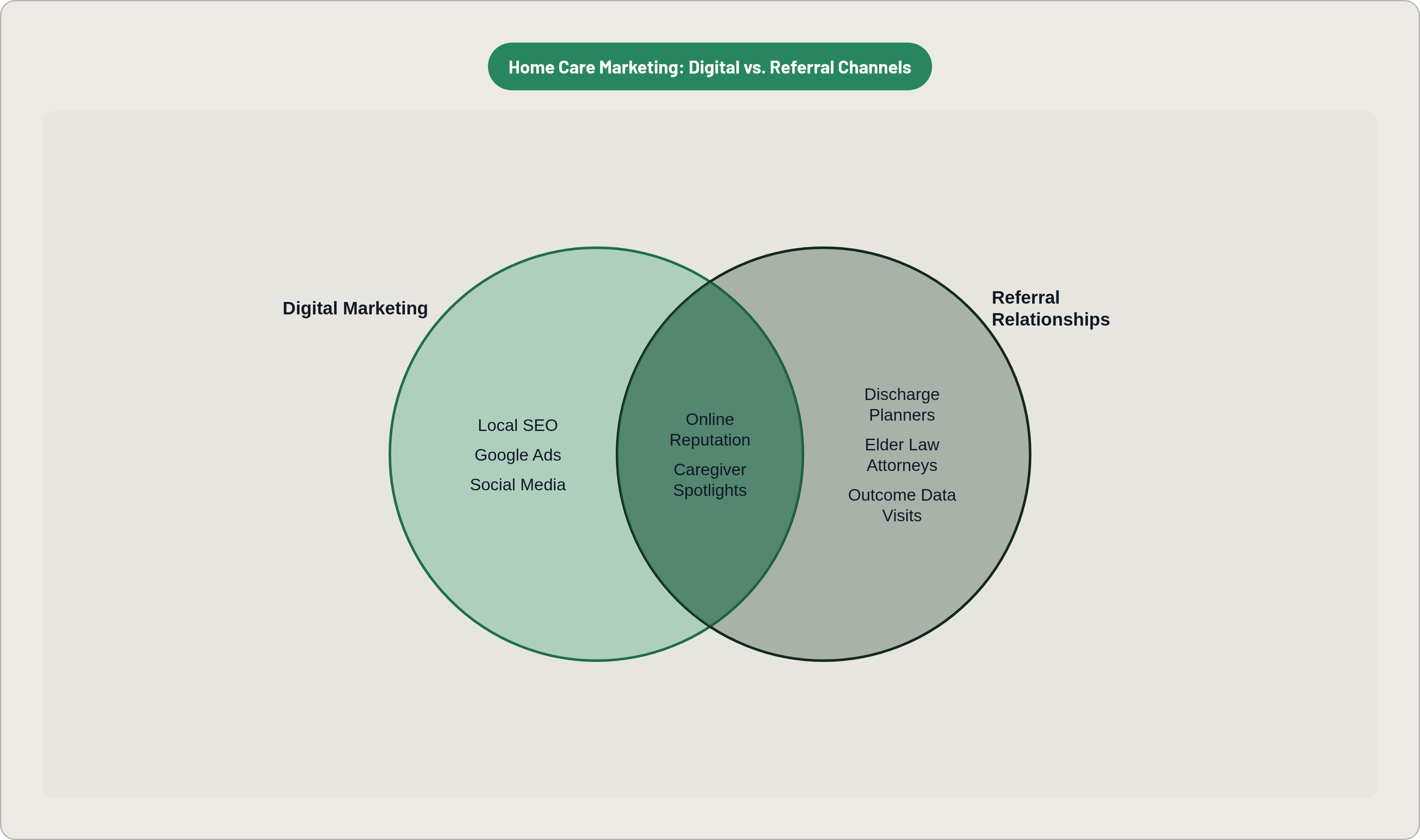
Client referrals account for approximately 73% of annual revenue at many agencies. No single digital channel comes close to that share. And yet most agencies treat referral development as an informal, relationship-dependent activity rather than a structured business process.
But what if the best marketing asset an agency has is not its website or its Google ranking, but its existing client outcomes? Per the 2020 Home Care Benchmarking Study, current and past clients are the top referral source. Client experience is not separate from the marketing function; it is the marketing function. Agencies that deliver consistently good care are generating referral pipeline whether they know it or not. The ones that win make that pipeline visible and manageable.
In 2024, 31% of home health referrals originated from hospitals. Discharge planners are not making random selections. They send patients to agencies they trust, have met, and can hold accountable if something goes wrong. The systematic approach is not complicated: regular in-person visits with discharge planners, social workers, geriatric physicians, occupational therapists, and elder law attorneys, bringing documented outcome data rather than a brochure and goodwill.
That last detail matters. Only one in four providers can prove their quality outcomes with data. An agency that walks into a discharge planner's office with documented outcomes is not just building a relationship; it is differentiating itself from the three other agencies that showed up empty-handed.
Social Media Builds the Familiarity That Makes Families Comfortable Enough to Call
Familiarity is an underrated conversion factor. A family that has absorbed your agency's content over several months before a care need arises is in a fundamentally different psychological position than one encountering you for the first time during a crisis. One of those families calls with questions. The other calls with their defenses up.
Platform priorities differ by audience. Facebook reaches adult children in their 50s and 60s most effectively, particularly through local community groups where organic reach still exists in ways it has largely vanished from the main feed. Instagram accommodates visual storytelling: caregiver profiles, behind-the-scenes content, the kind of human detail that makes an agency feel like a collection of real people rather than a corporate entity. LinkedIn is worth the investment specifically for reaching referral partners; discharge planners and healthcare social workers use it professionally.
Content that works is not complicated. "Day in the life" caregiver stories reduce the anxiety families feel about inviting a stranger into their parent's home. Family Q&A posts address concerns families are already carrying. Community involvement content signals that the agency is embedded locally, not just operating there.
Posting two to three times per week maintains presence without requiring unsustainable content production. Volume matters less than consistency. An inactive social profile creates doubt at exactly the moment a family is deciding whether to trust you.
Paid Advertising Fills Gaps in the Pipeline; It Does Not Replace the Foundation
Google Ads capture families actively searching for care. High-intent keywords, terms like "24-hour home care," "in-home dementia care," and "post-surgery home help," reach people at the moment of decision, which is the most valuable moment to be visible.
Paid advertising is most useful in two specific scenarios. First, when an agency is new and SEO has not yet built organic visibility. Second, during peak demand periods, particularly in the weeks after the winter holidays, when adult children return home, observe a parent's decline, and begin making care decisions they had been deferring. If you work in this industry long enough, January starts to feel like a different kind of fiscal new year.
Retargeting deserves particular attention. Given how long families research before contacting an agency, many visitors leave a website without converting and do not return. Retargeting keeps the agency visible during that consideration window, which can extend weeks or months in high-stakes decisions.
What paid advertising requires, and what many agencies resist, is disciplined weekly performance monitoring: cost per inquiry, cost per booked assessment. Without that discipline, it is genuinely difficult to distinguish campaigns that are working from campaigns that are consuming budget quietly and producing nothing. Traditional media, including local print and direct mail, retains relevance in smaller markets where the target audience's media habits simply do not conform to digital-first assumptions. The audience should dictate the channel.
Caregiver Recruitment Is a Marketing Function, Not an HR Problem
In 2025, 59% of home care agencies reported operating with insufficient staff. A meaningful portion of the industry is actively generating client demand it cannot fulfill. No marketing strategy survives that contradiction for long.
Annual caregiver turnover reached 75.0% at the median in 2024, per the Home Care Pulse Benchmarking Report, with approximately 57% of that turnover occurring within the first 90 days. That figure should reframe how agencies think about recruitment. It is not a periodic effort triggered by a staffing shortage. It is a continuous operational function running in parallel with client acquisition. Treating it otherwise is like bailing a boat and calling it a plumbing solution.
Word-of-mouth is the highest-quality recruitment channel. Agencies that list word of mouth as their top recruitment source see meaningfully lower caregiver turnover than the industry median, per the 2025 Activated Insights Benchmarking Report, and a mean caregiver acquisition cost of $520. The implication is worth sitting with: agencies that treat their caregivers well enough to generate referrals are simultaneously reducing turnover and lowering recruitment costs. The economics compound in their favor.
The infrastructure required is not exotic. A dedicated careers page. Active profiles on Glassdoor and Care.com. A clearly articulated employee value proposition that defines what the agency offers that competitors do not. Scheduling consistency, recognition, communication quality; these are actual differentiators in a labor market where caregivers have real options and know it.
The social media presence built for client acquisition serves caregiver recruitment simultaneously. Caregiver spotlights build client trust and signal to prospective employees what the work culture looks like. Different audience, shared content investment.
Tracking and CRM Turn a Collection of Tactics Into a Measurable System
That raises an important question: how does an agency know which of these efforts is actually driving client acquisition? Without measurement infrastructure, the answer is "approximately" at best and "not at all" at worst.
Providers who track every inquiry see better ROI than those who track selectively. That finding is almost tautological, yet the gap in practice is real and persistent. Call-tracking software attributes phone inquiries to specific campaigns. Google Analytics identifies which channels are driving traffic and inquiry volume. Periodic client intake surveys asking how families found the agency close the attribution loop that digital tools miss, particularly for referral relationships that originate entirely offline.
Only one in four providers can prove their quality-of-care outcomes with data, a figure mentioned earlier in the context of referral relationships. That same capability is the foundation of a credible measurement system. Agencies that build it differentiate themselves with referral partners and make cleaner internal decisions about where to invest next.
A CRM that tracks every referral source interaction, schedules follow-ups, logs referred clients, and ties outcomes to channels is the connective tissue between everything described above. Without it, a referral relationship is a conversation that either produced a client or did not. With it, that relationship has a documented history, a measurable output, and a defensible reason to keep investing in it.
The agencies that build this system, from local SEO and a high-performing website at the foundation, through reputation management and referral relationships as the growth engine, to paid advertising and social media filling specific gaps, and with tracking holding it all together, are not just doing more marketing. They are building a durable acquisition infrastructure. In a market with 79.2% client turnover, more than 11,500 competitors, and 10,000 new potential clients turning 65 every single day, durable is the only kind of system worth building.