Local SEO for Service Area Businesses Without a Storefront
Google hides service businesses' addresses but ranks them partly on reviews instead of proximity.

There is something quietly absurd about the situation service area businesses find themselves in. A plumber shows up at your house, fixes the problem, hands you a receipt, and drives away. The entire transaction happened at your address. Yet the machinery of local search, built largely around storefront discovery, keeps asking: but where are you located?
Google's own definition acknowledges the model directly: a service area business travels to its customers and does not serve them at its own address. Plumbers, electricians, landscapers, mobile groomers, mobile pet groomers, HVAC technicians. The customer's location is the job site. There are also hybrid businesses, worth identifying clearly before going further: a garage that also offers roadside service, a shop that also delivers and installs. Hybrids can carry both a storefront address and a service area, and those businesses are playing a slightly different game. If that describes you, some of what follows applies in part; most of it still applies.
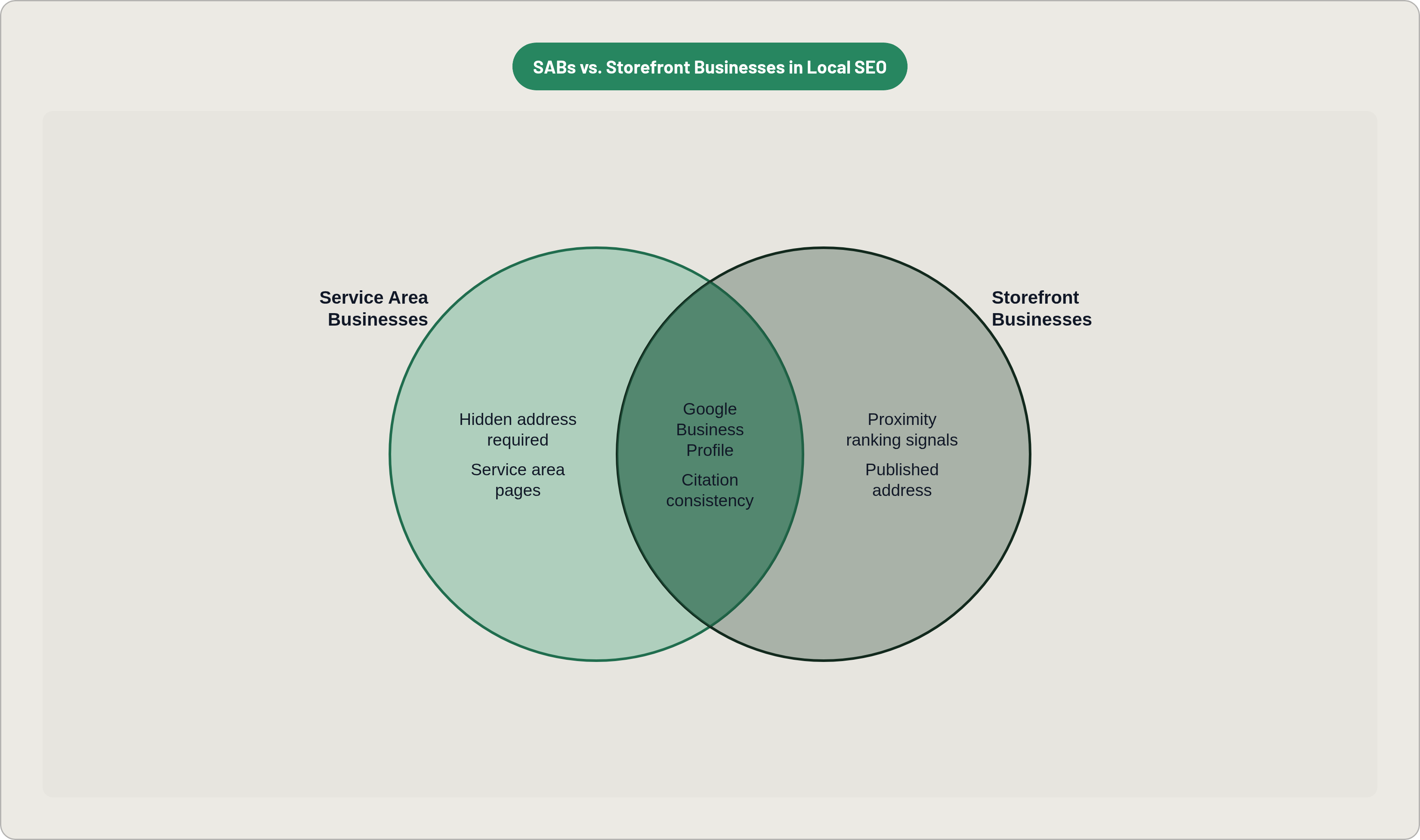
The rule that shapes everything else for pure SABs: Google requires them to hide their physical address on their Google Business Profile. Compliance is not optional. And it costs them something real. Sterling Sky's 2025 research confirms what practitioners have observed for years: hiding the address measurably suppresses map rankings. Google has never formally acknowledged this trade-off. It exists anyway. The implication is foundational and worth sitting with before moving forward: SABs are not playing the same game as storefront businesses. They are playing a harder version, structurally prohibited from using one of the signals that most directly influences where a listing appears. Every tactic discussed below is, in some way, compensation for that deficit.
The Opportunity Is Larger Than the Competition Suggests
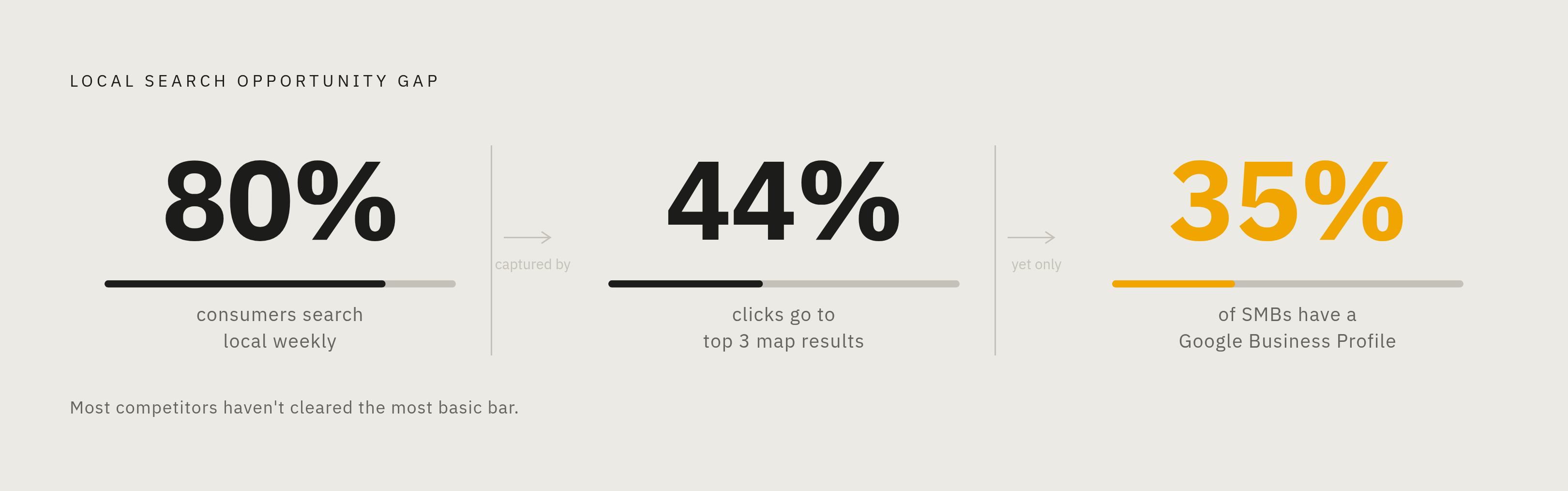
Start with the demand side. According to the SOCi Consumer Behavior Index from 2024, 80% of U.S. consumers search online for local businesses weekly, with 32% doing so daily. Roughly 46% of all Google searches carry local intent, and "near me" queries run into the billions monthly. The top three results in the local map pack capture 44% of all clicks for local-intent queries. That concentration is striking. Ranking fourth is not a consolation prize; it is close to invisibility.
Now look at the supply side. BrightLocal's 2025 SMB Marketing Report found that only 35% of small and medium businesses have a Google Business Profile at all. That number is worth reading twice. The majority of potential competitors have not cleared the most basic bar. The gap between what the opportunity offers and how few businesses are positioned to capture it is, in a sense, the entire argument for getting the fundamentals right.
There is also a trust dimension that compounds the ranking value. Customers are 2.7x more likely to consider a business reputable when they find a complete GBP. Completeness alone shifts perception before a single review is read or a single page is loaded. For a service business asking someone to let a stranger into their home, that initial credibility signal matters more than it might for a coffee shop.
Setting Up and Configuring a GBP Correctly When You Have No Public Address
One profile. One verification address. That address should be wherever the business is genuinely based, even if it is a home address. After verification, hide it per Google's requirements. This sequence matters because the verification address is what anchors the listing geographically, and it remains the address that most influences where the listing ranks in proximity-based results.
Here is the part that trips people up most often: the service area fields in GBP do not directly affect ranking. Sterling Sky's 2025 findings are clear on this. The service area fields are visual. They tell users where you work; they do not tell the algorithm where to show you. This is not intuitive, and it leads to a predictable mistake. People pad their service area aggressively, extending the radius across distant counties or into neighboring states, operating under the assumption that more coverage equals more visibility. It does not. It creates suspension risk by signaling misrepresentation.
The practical guideline: do not extend the service area farther than roughly a two-hour drive from the base location. Up to 20 service areas are allowed; be specific rather than expansive. A tightly defined area with genuine service evidence outranks a sprawling one with none.
Multi-location SABs should create one profile per location only when there are genuinely separate staff and separate service areas operating out of each location. This is not a coverage workaround. Virtual offices are also not permitted unless they are staffed during business hours, a rule Google has been enforcing more aggressively in 2025.
One platform note worth flagging: Apple Maps currently requires a published address, which means SABs cannot get full listings there. Apple Business Connect offers a partial alternative through limited branding display, but it is not a complete solution. The point is simply that the GBP problem does not have a clean parallel fix elsewhere.
Primary category selection is the single most important relevance signal in GBP. It defines which queries trigger the listing. Choose the most precise category available, not the broadest. "HVAC Contractor" beats "Contractor." "Emergency Plumber" beats "Plumber" if emergency service is the core offering. Businesses with photos receive 42% more direction requests and 35% more website clicks; use geotagged images on a regular cadence rather than a single upload. Link the GBP to a dedicated landing page, not the homepage. Thin homepages undercut relevance.
Why Reviews Do More Work for SABs Than for Most Other Business Types
Google's local ranking framework rests on three pillars: relevance, distance, and prominence. Reviews are a core prominence signal. That much is well established. But the specific weight they carry for SABs, relative to storefront businesses, deserves examination.
A storefront business benefits from proximity signals in a way an SAB cannot. A user searching for "plumber near me" in a neighborhood where the plumber has no physical presence will not receive proximity credit. What the SAB has instead, or what it can build, is a body of reviews that demonstrate presence and quality in specific geographic areas. Businesses with 50 or more Google reviews earn meaningfully more leads than those with fewer than 10; the volume threshold matters, not just the average rating. Ratings below 3.9 stars measurably reduce local pack visibility; the functional target is 4.2 stars and above.
But here is the detail most businesses miss: review velocity matters as much as review count. A consistent cadence of recent reviews outperforms a large but stale body. The algorithm interprets ongoing reviews as ongoing activity. A business that collected 80 reviews three years ago and has received none since is not signaling the same thing as a business with 40 reviews spread across the last six months.
Geographic specificity in review text is where things get genuinely interesting. Asking customers to mention both the service and the neighborhood in their review creates semantic alignment. It ties the listing to a micro-location even without a physical address there. A review that reads "fixed our boiler in Frisco on a Sunday morning" does something a generic five-star rating does not. It places the business in a specific place at a specific time, in the language a local searcher might use.
Photo-rich reviews carry additional weight in current practitioner experience. Encouraging customers to include a project photo when leaving a review is worth building into the post-service workflow. For an SAB that cannot rely on proximity signals in the far reaches of its service area, location-specific, detail-rich reviews are among the few mechanisms available to build relevance in those zones.
Citation Consistency When There Is No Address to Put on the Listing
Citations are one of Google's primary verification mechanisms for businesses it cannot physically confirm. The more authoritative sources that confirm the same business details, the more confident Google is in surfacing the listing. The logic is simple; the execution is tedious.
Core platforms to establish first: Google Business Profile and Bing Places, then Yelp, Angi, HomeAdvisor, the Better Business Bureau, and Facebook. These are the high-authority directories Google actively cross-references. After those, industry-specific directories and regional platforms.
The address paradox for SABs: the address is hidden on GBP, but consistent business information still needs to exist across trusted directories. The name, phone number, and website must match exactly. Exactly means exactly. "St." and "Street" are not interchangeable. "LLC" included in one listing and omitted in another introduces noise. These are not aesthetic preferences; they are signals in an entity resolution system that decides whether multiple listings describe the same business or different ones.
The goal is not more listings. It is zero contradictions. Conflicting name-address-phone data across authoritative sources suppresses rather than builds trust. Before building any new citations, audit what already exists: search the business name and phone number to surface every current listing, then correct or claim each one before adding anything new. Building on a contradictory foundation compounds the problem.
Building Service Area Pages That Rank Without a Physical Presence in a City
Service area pages are not location pages. That distinction is worth establishing early, because the content strategy differs. A location page represents a business's physical presence in a city. A service area page represents the customers' city as the place where work gets done. Google interprets them differently, and content that would be appropriate for one can look thin or manipulative on the other.
URL structure should include both the city and the core service. Something like "/ac-repair-plano" or "/emergency-plumber-boulder," not a generic city slug. The specificity signals intent and aligns with how people actually search.
The content standard that distinguishes useful pages from empty ones: roughly 60 to 70% of each page's content should be unique and location-specific, not city-name swaps on a shared template. What does unique mean in practice? Climate or environmental factors relevant to the service in that city, freeze risk, humidity, soil type. Real project examples or job references from that specific area. Customer testimonials from residents in that city. Response time or pricing data specific to that market. These details cannot be populated with find-and-replace logic. They require actual knowledge of the market, which is, conveniently, something a business that works there already has.
Schema markup should implement LocalBusiness schema with the serviceArea property, connecting the page to the verified GBP and telling Google where services are delivered even without a physical address in that city. Service schema adds another layer of specificity.
Site architecture matters more than most practitioners give it credit for. Use a service areas hub page as the parent. Link from the footer to the hub, then from the hub to individual city pages. Do not list all cities in the footer directly. The flat link pattern, every city on every page, is closely associated with doorway page sets and draws the kind of algorithmic scrutiny that makes everything harder.
Publish new pages in measured batches, five to ten per week, not all at once. A sudden large set of location-based pages triggers Google's helpful content classifier as a doorway risk. The pace of publication is itself a signal.
The Doorway Page Line and How to Stay on the Right Side of It
Google's definition of doorway page abuse is specific: pages created to rank for similar queries that funnel users to a destination less useful than the final page itself. Multiple pages targeting specific locations with near-identical copy is the canonical example. This is not a theoretical risk. A regional HVAC company built hundreds of suburb-level pages using minor location swaps; after the March 2024 Core Update, those pages lost rankings, and analytics showed a 63% drop in organic traffic within 30 days. Recovery required consolidating into genuinely unique, location-specific pages. The pattern is consistent enough that Google's own John Mueller has stated publicly that 1,300 location-based landing pages would likely be treated as doorway pages. Scale alone is a risk signal.
The practical ceiling worth internalizing: focus on 15 to 20 key service areas rather than every suburb in the region. Depth beats breadth, not only as a philosophical preference, but as a measurable outcome.
The test for each page is simple to state and genuinely useful to apply: does this page serve as the final, helpful destination for a visitor, or does it exist only to intercept a search query? Pages that pass are defensible. Pages that fail are vulnerable regardless of technical optimization. Each page should be able to stand alone as genuinely useful: real project context, real local detail, real customer voice. If removing the city name from the page would make it effectively identical to every other page on the site, it fails the test.
Local Backlinks and Off-Site Signals That Reinforce Geographic Relevance
Links from local organizations and publishers carry geographic authority that national directory links cannot replicate. A mention in a regional newspaper or a link from the Chamber of Commerce website does something that an Angi profile does not: it establishes that the business is embedded in the community rather than merely claiming to serve it.
Practical sources SABs can realistically pursue include regional Chamber of Commerce membership and directory listings, sponsorships of youth sports teams or neighborhood events, partnerships with complementary local businesses such as real estate agents, property managers, and general contractors, and features in local news or annual "best of" roundups. These are not exotic tactics. They are the ordinary civic and commercial relationships that businesses in any market already have the infrastructure to form.
Why exactly does this matter beyond the link itself? Because the off-site signal profile tells Google something that on-site optimization cannot fake: that other entities in the local ecosystem recognize this business as part of it. Service area pages can claim geographic relevance. A sponsorship link from a little league team's website demonstrates it. The distinction is not subtle in Google's weighting of authority.
In smaller and mid-sized markets, Chamber and civic sponsorship links are often under-pursued. That creates a meaningful differentiator for the business willing to show up.
Mobile Experience and Site Speed as Ranking Prerequisites, Not Enhancements
Local searches are disproportionately mobile, and not for casual browsing reasons. Someone searching for a plumber is often at the location with the problem, on their phone, needing a response within the hour. The 2025 data point is worth naming directly: 78% of local mobile searches result in an offline purchase within 24 hours. The mobile experience is not pre-sale research. It is the final decision point.
The core requirements follow from that: fast load time, a click-to-call phone number visible above the fold, and no friction between landing and contacting. Every additional step in that sequence loses a percentage of users who have already decided they need help.
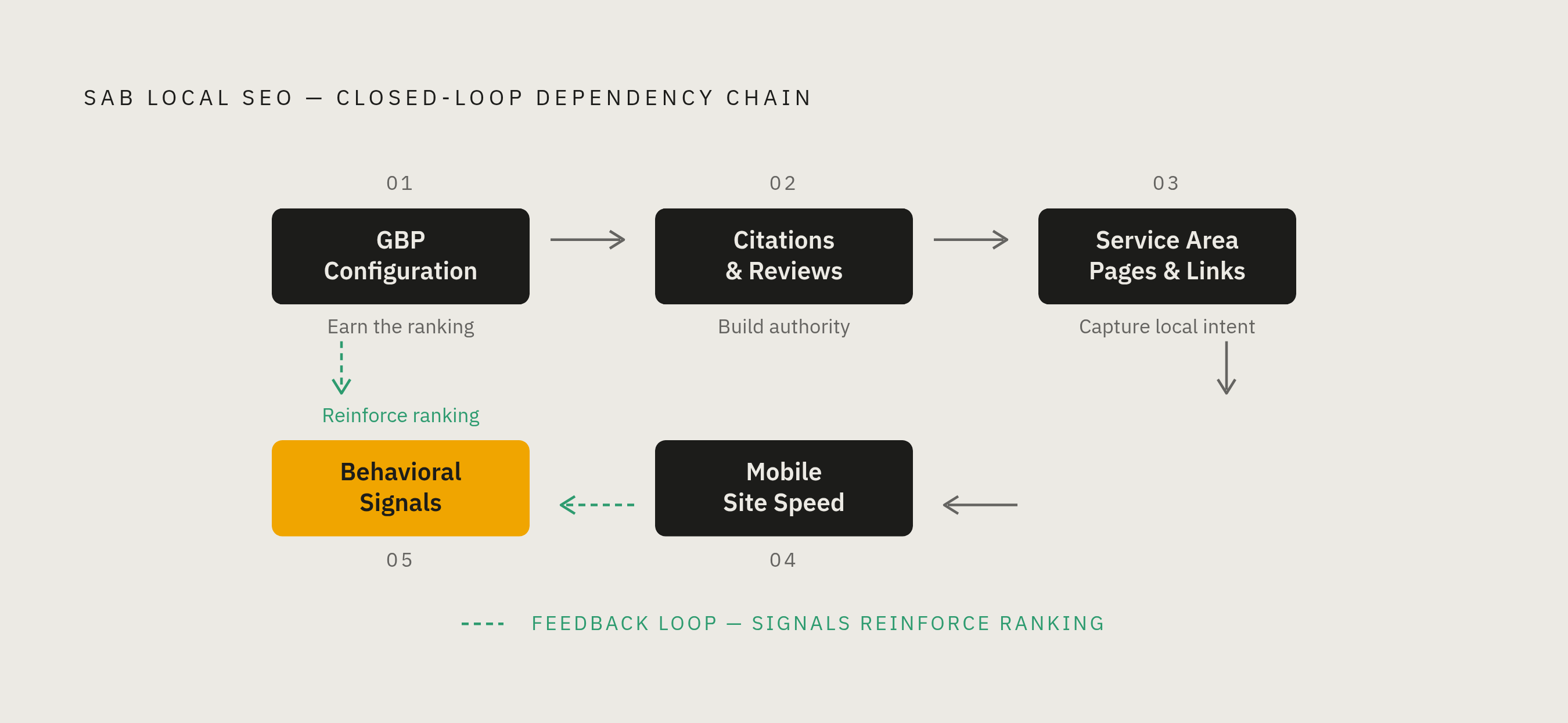
It is also worth considering how this connects back to ranking, not just conversion. GBP behavioral signals, clicks, calls, direction requests, dwell time, feed back into local ranking. A slow or broken mobile experience suppresses those signals directly. A user who bounces in two seconds from a slow-loading page generates a negative behavioral signal. A user who calls from the page generates a positive one. Site speed is a ranking factor and a conversion factor at the same time, and for SABs, the two are not separable.
The full chain: earn the ranking through GBP configuration, citations, service area pages, and local links; capture the click with a mobile-ready site; convert with a fast, frictionless contact path; the resulting behavioral signals reinforce the ranking. Each component depends on the others. Optimizing one while neglecting another is, at minimum, inefficient, and in some cases actively counterproductive.
That is the honest picture of what SAB local SEO requires. It is more structurally constrained than storefront SEO, and it asks for genuine effort at every level: profile configuration, review strategy, citation hygiene, page quality, link relationships, and site performance. But the structural constraint cuts both ways. Most of the competition has not done any of it.