Payment Processing Options for CBD E-Commerce
Legal gray area and algorithmic enforcement create a matching problem, not a processor ranking.
The absurdity of CBD payment processing is worth acknowledging upfront. Hemp, a plant with roughly ten thousand documented industrial applications, legal at the federal level since 2018, sold openly in gas stations and grocery stores across most of the country, cannot reliably process a Visa transaction. The plant is less regulated than the mechanism by which you pay for it. That tension is not incidental to this article; it is the whole problem.
Online sales account for roughly 66% of all U.S. CBD revenue, per Vector Payments (2026). That figure means payment infrastructure is not a back-office detail for most CBD brands. It is the business. When a processor freezes an account, the brand does not have a bad week; it loses its primary channel, often without warning, and sometimes without recourse.
The goal here is not to name a single best processor, because that framing is wrong. This is a matching problem. The right processor depends on sales volume, product type, chargeback history, and risk tolerance, and the answer changes as each of those variables changes. What follows is an attempt to map the ecosystem honestly, so merchants can make that match themselves.
The Regulatory Ground CBD Merchants Are Standing on in 2026
To understand why processors behave the way they do, you have to understand what they think is going to happen to the regulatory environment, and right now, no one agrees.
The 2018 Farm Bill federally legalized hemp-derived CBD at or below 0.3% Delta-9 THC on a dry weight basis. That threshold became the operational baseline for most merchants and, for a few years, provided enough legal clarity that banks were willing to at least consider the category. Then Section 781 of the November 2025 Continuing Resolution reclassified many hemp-derived CBD products back toward Schedule I, reversing parts of the Farm Bill framework and creating new compliance exposure not just for sellers, but for any bank or investor doing business with hemp companies.
That is worth sitting with. The products did not change. The plants did not change. The legal ground shifted under an established industry, mid-operation.
The Hemp Planting Predictability Act, introduced in January 2026 with bipartisan Senate support, would defer that reclassification's effective date to November 2028. But as of 2026, it has not passed. Merchants are operating in the gap between a law that restricts their product and a bill that might eventually soften that restriction.
The FDA has not approved CBD as a food additive or dietary supplement. FinCEN actively monitors compliance activity in the space. California's AB-45 imposes rigorous testing and labeling requirements. Idaho bans CBD sales outright. Roughly half of states impose age restrictions or licensing requirements of some kind.
Processors read all of this. The fee premiums and reserve structures discussed later in this piece are not arbitrary; they are a direct pricing of this regulatory uncertainty. A merchant who understands that is better positioned to negotiate. A merchant who treats elevated fees as simple exploitation will negotiate poorly.
One practical implication worth naming early: given how volatile the legislative picture remains, locking into a long-term processing contract with punishing early termination fees carries risk that would be unusual in more stable commercial categories. That clause deserves more attention in 2026 than it might have in 2022.
What Happens When Merchants Use Stripe, PayPal, or Square for CBD
This section could be titled "what not to do," but the more useful framing is: why do merchants try this, and what exactly happens when they do?
The appeal is obvious. Stripe and Square offer fast onboarding, clean integrations, and rates that CBD specialist processors cannot match. For a founder launching a new brand, the path of least resistance is to start with infrastructure they already know.
The problem is categorical, not incidental. Stripe, PayPal, Square, Shopify Payments, Venmo, and Cash App all explicitly prohibit CBD in their acceptable use policies. This is not ambiguous fine print. It is not a gray area awaiting legal review. It is a categorical ban, enforced algorithmically.
Aggregators pool all merchants under a single master account. There is no individual underwriting; automated systems flag "CBD," "hemp," "Delta-9," or anomalous transaction patterns without human review. Detection is not a matter of whether. It is a matter of when.
The sequence after detection is largely consistent: account frozen without warning, funds held for 90 to 180 days to cover potential chargebacks, and, in the worst cases, placement on the MATCH list.
That last consequence deserves specific attention because most merchants underestimate it. The MATCH list, maintained across acquiring banks, can block a merchant from obtaining processing accounts for up to five years, per Vector Payments (2026). A merchant who tests a mainstream aggregator and gets terminated does not simply lose that account. They may lose access to the specialist processors they actually needed, precisely because their MATCH history signals prior termination for policy violations.
The irony is complete: attempting to avoid the complexity of high-risk processing can result in being locked out of it entirely.
WooPayments explicitly documents that CBD cannot be sold through its gateway, directing merchants to alternative solutions. MONEI, a Spain-based processor, does support CBD payments, which is useful context for internationally operating merchants but offers no domestic U.S. solution. The mainstream aggregator category is, for practical purposes, closed.
The Three Processor Types That Actually Serve CBD Merchants
That raises an important question: what does the available ecosystem actually look like?
Three structural models exist for CBD merchants. Understanding them as models, rather than as a ranked list of providers, makes evaluation considerably less confusing.
High-Risk Domestic Merchant Accounts
These are individual merchant accounts, underwritten by specialist acquiring banks that have specifically accepted the CBD category into their risk appetite. Approval is slower and documentation-intensive: lab certifications, business registration, product descriptions, and processing history all typically enter the underwriting review. The tradeoff is stability. A properly underwritten domestic account operates under familiar U.S. card network rules, with established dispute and compliance processes, and a direct relationship with the acquiring bank rather than a broker standing between them.
For established merchants with documentation in order, this is generally the most durable long-term structure.
Offshore and E-Money Solutions
Non-U.S. acquirers and electronic money institutions sometimes approve CBD accounts that domestic banks decline, and sometimes faster. The tradeoff is complexity: payout logistics, currency conversion costs, cross-border compliance obligations, and elevated regulatory uncertainty when the merchant's customer base is predominantly U.S.-based. These accounts are a legitimate option in specific circumstances, not a workaround to default to when domestic approval feels difficult.
Gateway Plus Acquiring Partner Combinations
Payment gateways like Authorize.Net and NMI handle the technical routing of transactions; they do not themselves underwrite CBD businesses. This is a widely misunderstood distinction. Per VERIFIED Credit Card Processing (2025), a merchant cannot obtain a Authorize.Net account and assume the CBD approval is implicit. The acquiring bank relationship must be established separately, with the gateway sitting on top.
The structural advantage of this model is flexibility. If the acquiring relationship needs to change, the technical integration does not. A merchant can switch banking relationships without rebuilding their checkout infrastructure, which matters more than it sounds in a category where bank risk appetites can shift.
Several specialist providers have built differentiated positions within this ecosystem. PaymentCloud operates a multi-bank network designed to improve approval rates for complex business models, using a hands-on underwriting approach (Cathedral Payments, 2025). Paybotic brings deep vertical experience in hemp and CBD specifically, bundling POS hardware, e-commerce gateway, and chargeback monitoring (KORONA POS, 2026). eMerchant Broker offers fast approvals with access to both domestic and offshore accounts depending on product type, plus fraud tools (KORONA POS, 2026). Easy Pay Direct targets high-volume e-commerce, using load balancing across multiple acquiring banks to reduce decline rates (KORONA POS, 2026). PayKings markets explicitly to CBD businesses through a network of more than twenty banks and PSPs (BigCommerce, 2026).
It is also worth considering LegitScript certification. Some processors require it for compliance-sensitive advertising access, particularly for Google and Meta. Some brokers can facilitate discounted annual fees on certification. For merchants who depend on paid acquisition, this is not a consideration to overlook.
What Specialist Processing Actually Costs, and What the Reserve Structure Means for Cash Flow
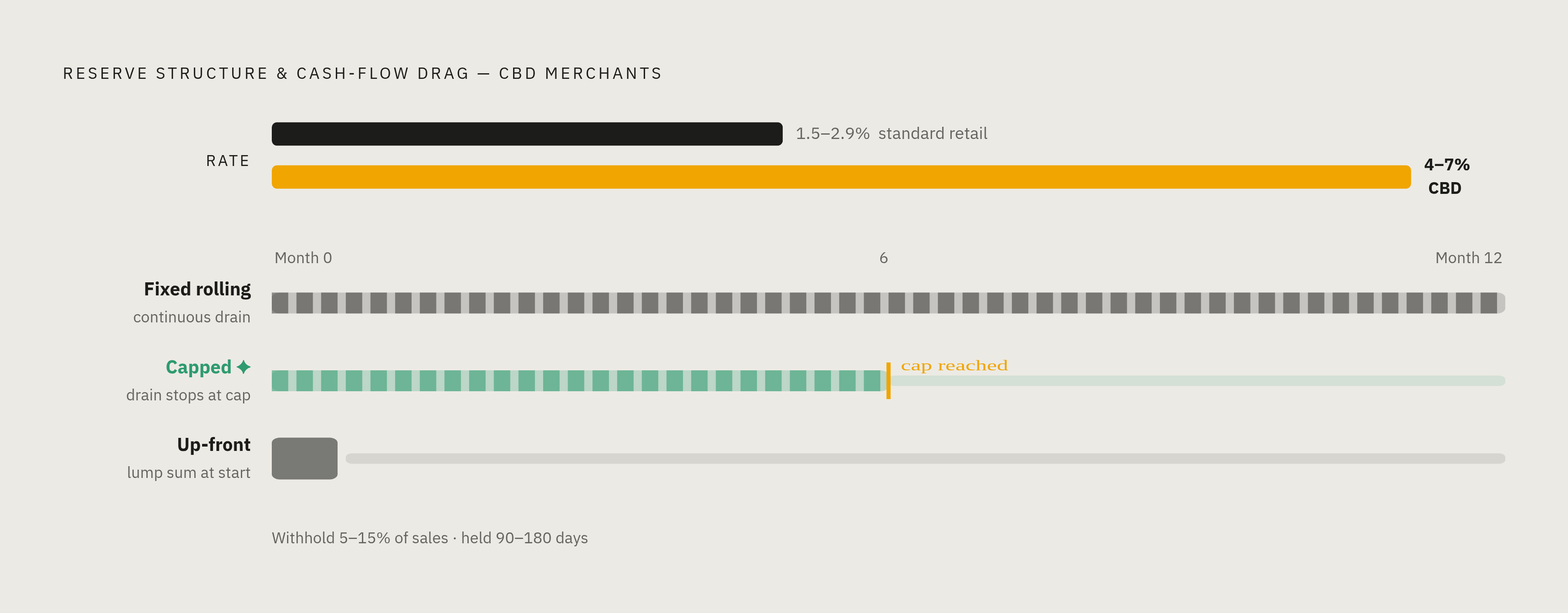
CBD merchants typically pay 4 to 7% per transaction, compared to 1.5 to 2.9% for standard retail, per KORONA POS (2026). That premium is real. It must be modeled explicitly against margin before selecting a processor, not discovered as a surprise after month one of processing.
The less visible cost is the rolling reserve.
Processors typically withhold 5 to 15% of sales, held for 90 to 180 days, per 2Accept citing EMS Ltd. (2026). For a high-volume seller, this means a material fraction of earned revenue is inaccessible for months at a time, affecting inventory purchasing, payroll, and reinvestment capacity. It is essentially a perpetual loan the merchant extends to the processor as collateral.
Three reserve structures carry meaningfully different cash-flow implications. A fixed rolling reserve withholds a set percentage regardless of volume; it is predictable, but at scale it continuously depletes working capital. A capped reserve stops withholding once a maximum balance is reached; it is better for growing merchants once that cap is hit, because the drag on cash flow eventually stops. An up-front reserve requires a lump-sum deposit before processing begins; it is the highest initial barrier, but it does not create an ongoing drain on operating cash.
Why exactly does this matter as a structural question, rather than just a cost one? Because a low-volume startup and a high-volume established brand face opposite problems. The startup needs a processor willing to approve them at all; the established brand needs a reserve structure that does not strangle growth capital. Selecting a processor based on brand recognition rather than these matching variables is how merchants end up in contracts that technically work but practically constrain them.
Reserve rates are negotiable. Six to twelve months of consistent processing with low chargeback ratios typically gives a merchant standing to renegotiate the withholding percentage downward. The negotiation is not a certainty, but it is a real lever, and merchants who do not know it exists do not use it.
How Chargeback Rules Work Against CBD Merchants Specifically, and What Changed in 2025
E-commerce chargebacks surged 222% between Q1 2023 and Q1 2024, per KORONA POS (2026). CBD sits inside that broader trend with additional product-specific exposure that compounds the risk.
The category-specific chargeback drivers are worth naming precisely because they are mostly preventable. Customer expectations set by benefit testimonials, whether on the product page or in testimonial marketing, create disputes when the product does not consistently deliver the implied outcome. Subscription billing generates disputes when customers forget they enrolled, a common pattern with wellness products. Billing descriptor mismatches, where the name on a customer's bank statement does not match the store name, increase dispute rates even when the customer made the purchase intentionally.
None of those drivers are inherent to CBD. They are operational failures that CBD merchants experience at higher rates because the category attracts less sophisticated operators and more aggressive marketing claims.
That raises an important question about 2025's regulatory change: how does it affect the financial exposure?
Visa replaced its legacy dispute programs with the Visa Acquirer Monitoring Program (VAMP), effective October 1, 2025. Fraud reports and standard disputes now fold into a single ratio measured against total sales; a card flagged as fraudulent counts identically to a straightforward return dispute. Through March 2026, the "excessive" threshold is 2.2% with a floor of 1,500 disputes; from April 2026, that ceiling drops to 1.5%. Mastercard's Excessive Chargeback Program imposes escalating fines of $5,000 to $25,000 per month for persistent violators, per Orderpin (2026).
Card network thresholds sit around 1% of transactions before account reviews begin, which means a merchant can be in active negotiation with their processor over account status before they are anywhere near the network fine thresholds.
Chargeback management, in this context, is not optional post-launch maintenance. It is the ongoing condition on which the processing relationship exists. Specialist processors often build monitoring tools into their service for exactly this reason; a CBD merchant who evaluates processors on approval speed alone and ignores chargeback monitoring infrastructure is optimizing for the wrong variable.
Where ACH, eCheck, and Alternative Rails Fit Into a CBD Payment Stack
One might argue that if card processing is so structurally fraught for CBD merchants, the solution is simply to move away from it. That argument has surface appeal and real limits.
Card processing remains the primary rail for standard retail checkout. Removing it increases cart abandonment in ways that are difficult to compensate for with alternative payment methods. Consumer behavior is not easily redirected, and a checkout that does not accept cards is a checkout that loses customers.
But that does not mean card networks should be the only rail in the stack.
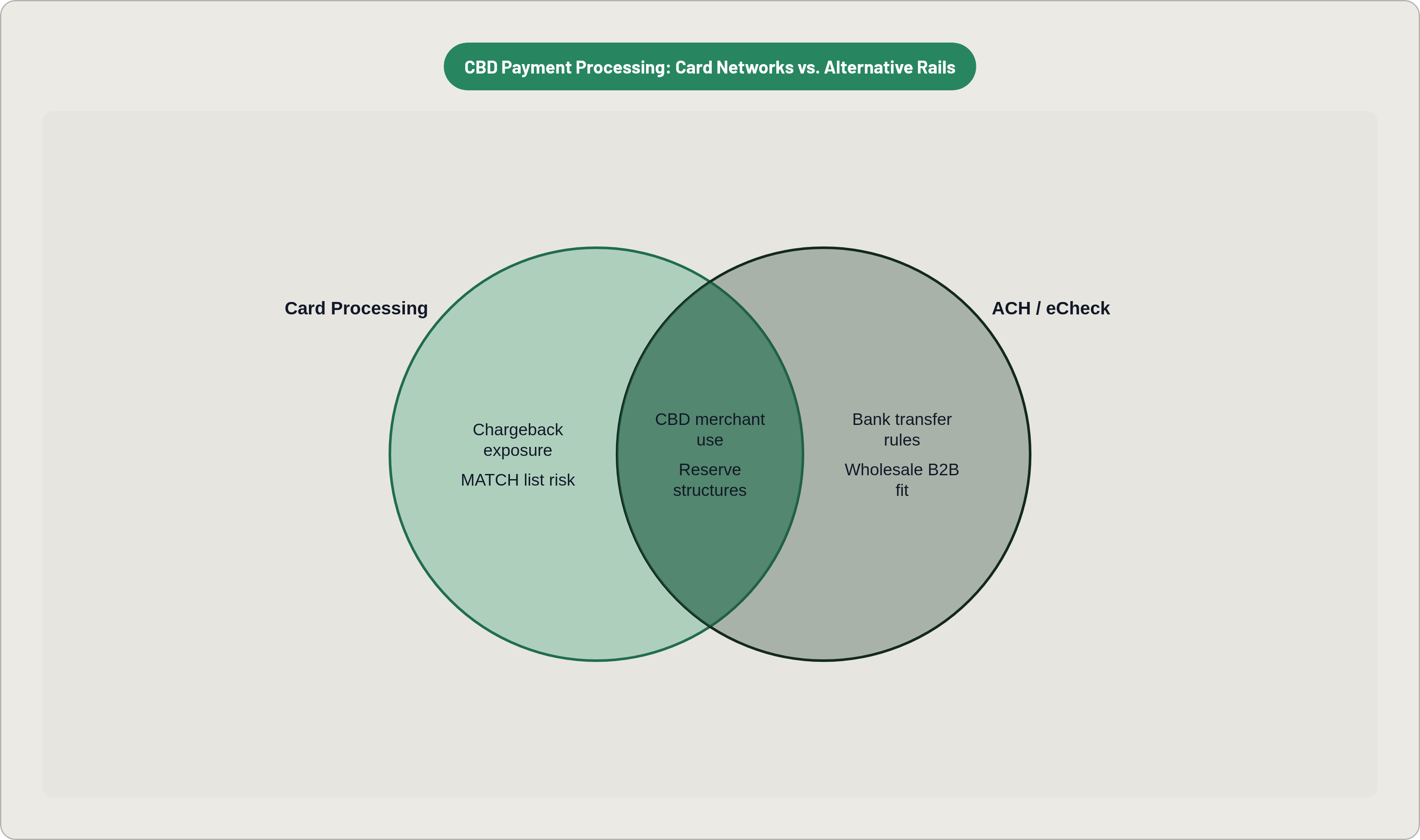
ACH and eCheck offer meaningful complementary utility. Same Day ACH has expanded with higher per-payment limits, which matters for larger average order values and B2B wholesale accounts. Transaction costs are lower than card processing. Critically, ACH operates outside card network chargeback rules, which means disputes are governed by different processes and timelines, and the structural exposure that makes CBD card processing so sensitive does not apply in the same way.
The practical segmentation is relatively clean. High-AOV orders and wholesale accounts are natural fits for ACH or eCheck: the customer relationship is established, the order size justifies a bank transfer, and the processing cost savings are meaningful. Subscription and recurring billing benefit from direct debit via ACH because it provides reliability that processors may throttle on card rails when chargeback ratios increase. Standard retail checkout stays on cards because that is where customers are.
Cryptocurrency is present in the ecosystem and occasionally marketed as a CBD payment solution. Its consumer adoption in standard DTC e-commerce remains too niche to substitute for card or ACH infrastructure at any real scale.
The correct framing for alternative rails is not that they are a fallback for merchants who cannot get card processing. They are a risk-distribution strategy for merchants who already have it. Dependence on any single payment channel is a vulnerability that ACH meaningfully reduces, particularly in a category where card processor relationships can be disrupted by regulatory shifts that have nothing to do with merchant behavior.
How to Evaluate a Processor Against a Specific CBD Operation
By this point, the pattern should be fairly clear: the right processor is not the one with the best marketing, the fastest approval promise, or the most recognizable name. It is the one whose structure matches the merchant's actual risk profile and operational needs.
The matching variables are specific and assessable before a merchant contacts anyone.
Sales volume and growth trajectory determine which problems need solving. Low-volume startups need accessible approvals; high-volume sellers need load balancing and negotiable reserve structures. Average order value and order mix determine whether ACH capability matters, and how much. Product category within CBD carries different risk profiles: topicals are generally viewed more favorably than ingestibles, and any product making food or supplement claims faces elevated regulatory scrutiny that processors price into underwriting decisions.
Current chargeback ratio may be the most important variable. A merchant already above 0.5% who selects a processor without built-in chargeback monitoring has prioritized approval over stability, and will likely lose the account before the relationship provides value. State-by-state sales geography matters as well; a merchant shipping to states with CBD restrictions or age verification requirements needs a processor experienced in geographic compliance filtering, not one that will simply route those transactions and leave regulatory exposure to the merchant.
Documentation requirements for specialist processors follow a reasonably consistent pattern: a Certificate of Analysis from a third-party lab confirming THC levels, business registration and bank statements, product descriptions and website review, and processing history showing chargeback ratios if it exists. Merchants who prepare this documentation before beginning processor conversations will move through underwriting faster.
Contract terms deserve more scrutiny than most merchants give them. Reserve type, whether fixed, capped, or up-front, determines cash-flow exposure over time. Early termination fees are particularly consequential in 2026 given the volatile legislative environment; a processing relationship that made sense under the 2018 Farm Bill framework may need to be reconsidered if Section 781 enforcement firms up or the Hemp Planting Predictability Act passes. Whether the processor owns its own acquiring relationship or is brokering to a third-party bank determines how much visibility and negotiating leverage the merchant actually has.
That last point is worth ending on. A broker between a merchant and a bank adds a layer of abstraction that can be useful during initial approval and costly during a dispute or a renegotiation. The more directly a merchant can understand who is actually holding their money and on what terms, the better positioned they are when conditions change.
And in this category, conditions change.


