Social Media Presence for Gun Stores Without Account Bans
Legitimate gun dealers face algorithm bans while illegal sellers slip through Meta's enforcement.
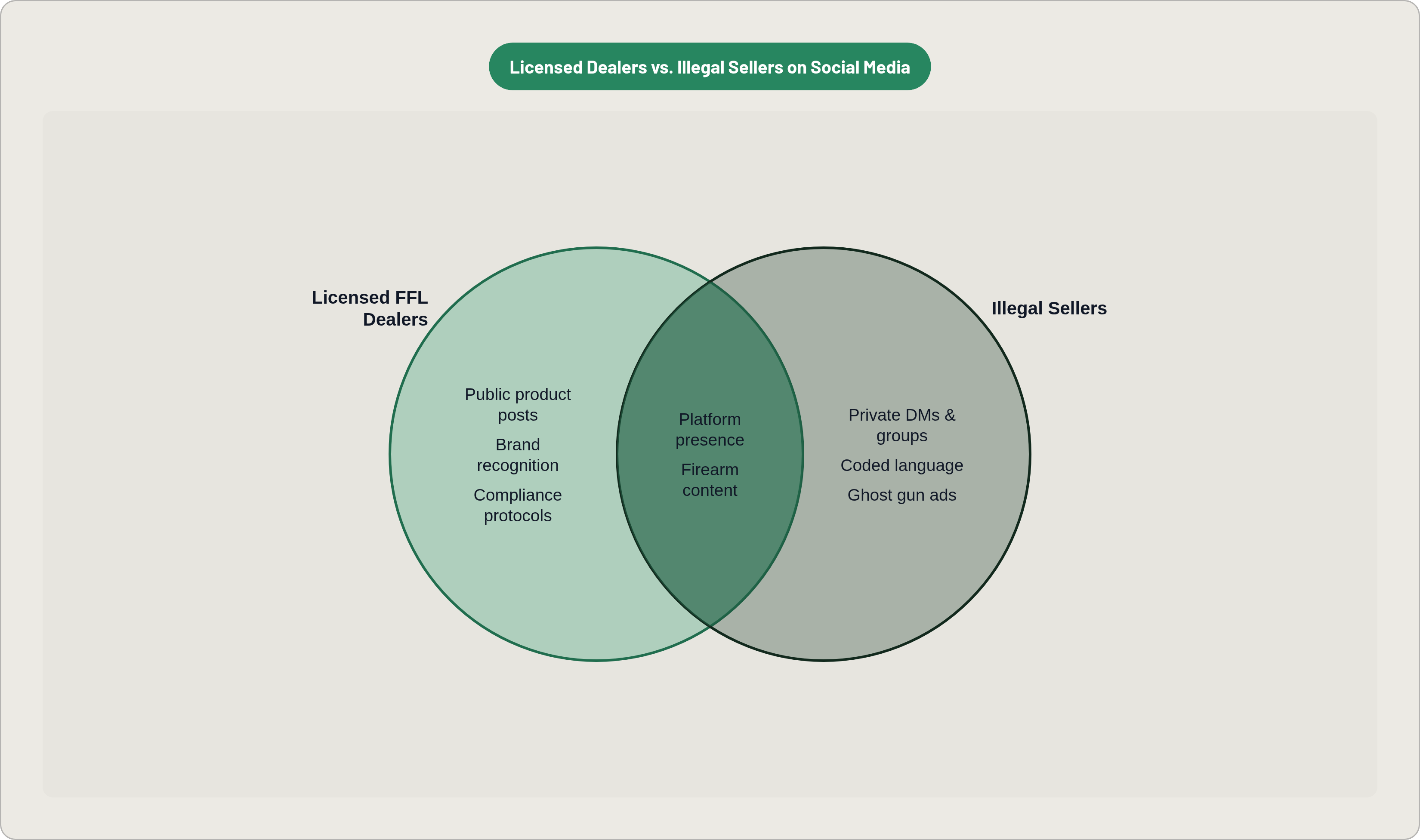
There is a version of this problem that sounds like a punch line. A federally licensed firearms dealer, one who has passed ATF background checks, maintains a bound book, and follows compliance protocols that would make a tax attorney wince, gets banned from Facebook for posting a photo of a shotgun. Meanwhile, somewhere in the same algorithm's blind spot, an illegal seller is quietly offering ghost guns and auto-conversion switches to anyone who knows the right coded phrase. The compliant dealer is gone. The criminal is still there.
Call it the compliance paradox: the more carefully you follow the rules, the more visible you are to the system designed to catch people who break them.
That is not a hypothetical. It is roughly what a 2024 Tech Transparency Project investigation documented, and it is the central absurdity around which any serious social media strategy for a gun store has to be built.
Before we get into what to do about it, it is worth spending a moment with what the platforms actually allow, because the rules are more granular than most store owners realize, and the differences between platforms are significant enough to matter strategically.
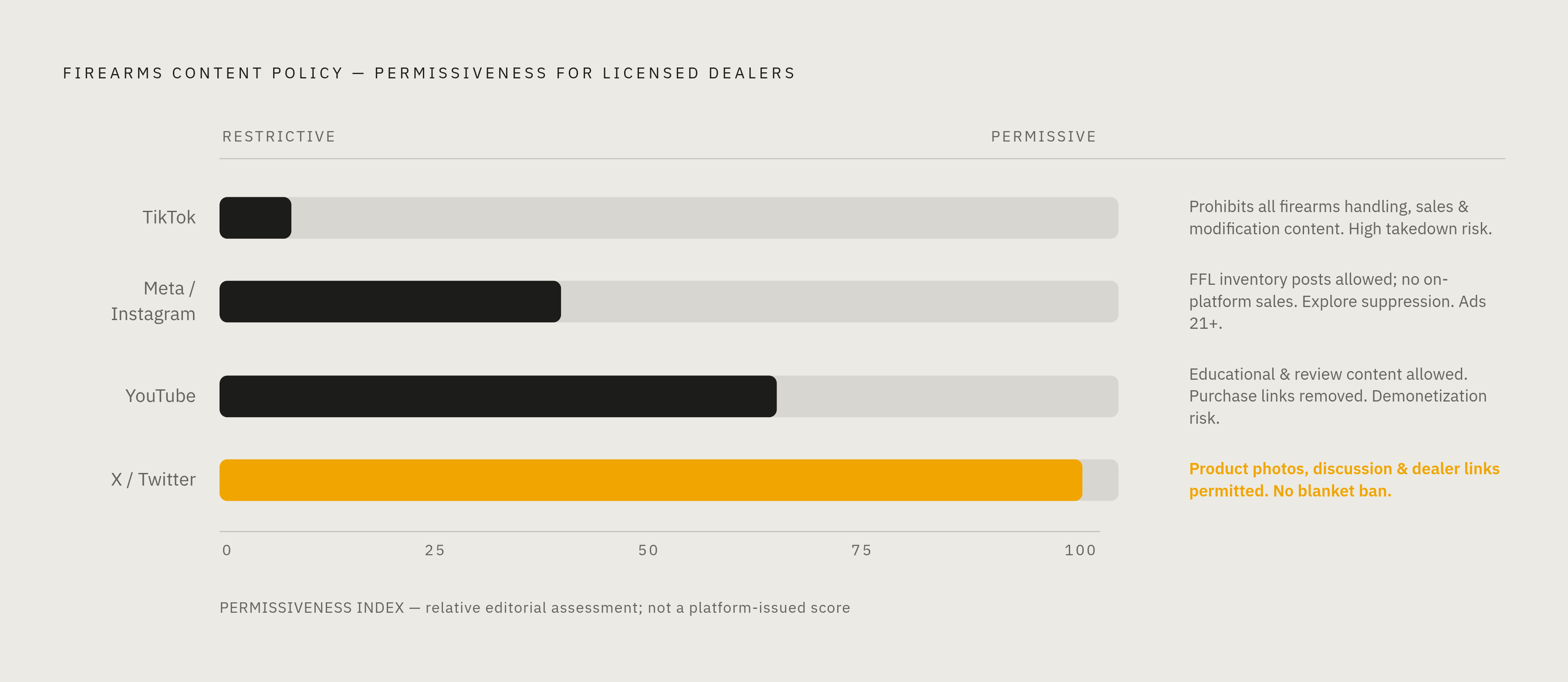
Meta (Facebook and Instagram) permits verified brick-and-mortar FFLs to post about inventory, but no on-platform transactions, no price-as-purchase-prompt. Advertising is allowed for physical retailers when sales occur off-platform, targeted to users 21 and older. Accessories, safety courses, and licensing content get somewhat wider latitude, with an 18-plus audience threshold. Instagram adds its own wrinkle: firearms content is frequently labeled "sensitive" and quietly filtered out of Explore, meaning reach is suppressed even when the post is technically compliant. YouTube allows educational content, reviews, and demonstrations, but removes direct links to firearm-purchase websites, and demonetizes many compliant videos, making it useful for brand awareness but not reliable revenue. X (formerly Twitter) is the most permissive of the major platforms: product photos, gun discussion, and links to a dealer's own site are generally permitted, with no blanket firearms ban comparable to Meta's. TikTok sits at the opposite end; it prohibits firearms handling, sales, and modification content, and takedown risk remains persistently high even for cautious creators.
The practical upshot: a post that is perfectly acceptable on X can get a Facebook page suspended. The rules are platform-specific, they are granular, and they change without announcement.
Why Compliant Accounts Still Get Banned
That raises an important question. If Meta's policy explicitly permits licensed dealers to post about inventory, why are compliant accounts disappearing?
The gap between written policy and actual enforcement is wide, and it is worth giving that gap some faces. In November 2024, Smith & Wesson's Facebook page was indefinitely suspended for posts Meta later acknowledged were removed "in error." The account was restored only after the suspension announcement went viral and generated enough external pressure to prompt a manual review. Smith & Wesson, one of the most recognizable firearms brands in American history, had to go public with its suspension to get a human being to look at its case.
Bryan Mumford, a firearm safety instructor running PDX Arsenal, reported to Fox News and Shooting News Weekly that November that posts which once generated 150 to 200 comments and hundreds of likes had been reduced to single-digit engagement after Meta's restrictions took hold. Platforms he once considered revenue-generating had become, in his words, "a dead avenue." Bob Croumlich of Wild West Guns and Ammo described posting identical-style photos on consecutive days; one earned strong engagement, the next earned a seven-day ban. His summary of the experience: "I don't know what I'm allowed to post and not post."
These are not operators gaming the system. These are people trying to follow the rules and getting punished anyway.
The mechanism is not mysterious. Meta's chief global affairs officer Joel Kaplan acknowledged in early 2025 that automated systems had "resulted in too many mistakes" and were responsible for "the vast majority of the censorship" on Meta platforms. Automated flagging reads visual signals (a gun in the frame) and text signals (certain keywords). It does not read context. A photo of a Glock in a holster on a store shelf triggers the same classifier as a photo of a Glock being sold illegally. The algorithm does not distinguish between them, and policy compliance does not always register as a mitigating factor. Think of it as a smoke detector that cannot tell the difference between a house fire and someone burning toast — it goes off either way, and the person cooking breakfast is the one standing outside in the cold.
It is also worth considering Zuckerberg's announced 2025 pivot toward "free expression" and reduced reliance on automated tools. That sounds promising. But as of early 2025, Meta's Weapons, Ammunition, and Explosives commerce policy page remained unchanged, and no guidance had been issued on how firearms content specifically would be treated under the new posture. Announcements and policy updates are different things. Until the policy page changes, the operative rules remain the ones that got Smith & Wesson suspended.
The practical implication is straightforward: even when the policy is on your side, enforcement is inconsistent enough that any compliant account should be treated as temporarily operational, not permanent infrastructure.
The Irony That Shapes This Environment: Bad Actors Slip Through While Licensed Dealers Get Hit
One observation is that Meta is simply erring on the side of caution in a sensitive category, and that the collateral damage to compliant dealers is an unfortunate but reasonable trade-off for keeping illegal gun sales off the platform.
That argument collapses quickly against the evidence. The same 2024 Tech Transparency Project investigation that documented suspended legitimate accounts also found more than 230 ads on Meta platforms actively offering Glock pistols, assault weapons, untraceable ghost guns, and illegal switches that convert semi-automatic firearms to fully automatic. These were not buried in private groups. They were running as paid advertisements.
Meta's counterpoint, to its credit, comes with actual numbers: between April and June 2024, the company took action on 1.9 million pieces of firearm content on Facebook and 242,000 on Instagram, claiming over 99 percent was caught before user reports. That is a substantial enforcement operation. It is also, notably, a figure that does not include advertisements. And it does not resolve the structural asymmetry at the core of the problem.
To understand why this works the way it does, consider who gets caught and who does not. Legitimate dealers post publicly. They use recognizable product imagery. They name the brands they carry. They do exactly what the algorithm is designed to find. Illegal sellers, by contrast, operate in private messages and closed groups, use coded language, and rely on terminology that automated classifiers are not trained to catch. The FFL posting a photo of a Mossberg on a gun rack is maximally visible to the algorithm. The person selling an auto-conversion switch in a private DM is invisible to it.
This is not a conspiracy. It is a predictable consequence of how blunt instruments work. The gun store owner who follows the rules is, structurally, more exposed than the person who breaks them. Why did the licensed dealer get banned? Because he was too easy to find.
Why does this matter for strategy? Because it means the enforcement environment is being pulled in opposite directions simultaneously: by regulators and advocacy groups who argue Meta is not doing enough, and by industry voices who argue it is doing too much to the wrong people. That tension is unlikely to resolve cleanly, and any strategy built on the assumption that the rules will stabilize soon is a fragile one.
What to Post on Mainstream Platforms to Stay Visible Without Triggering a Ban
The operating principle is simpler than it sounds: sell the lifestyle and the community, not the transaction.
Content that consistently performs well on Meta without triggering flags is informational or communal in framing. Store news, class announcements, range tips, safety how-tos, and community events do not look like sales to an automated classifier. Neither does behind-the-scenes content: shop tours, product unboxings framed as demonstrations, team introductions. These posts humanize the business without using transaction language. User-generated content is another low-risk, high-leverage format: encouraging customers to share range photos with a branded hashtag builds community visibility without the store bearing all the algorithmic risk. Live video on Facebook Pages is particularly useful; the format receives preferential algorithmic treatment and works well for safety Q&As or event announcements.
For product content, accessories and non-restricted items (holsters, cleaning kits, safes, tactical gear) carry less flagging risk than firearms themselves. Framed in lifestyle imagery tied to hunting, camping, or sporting contexts, they can generate meaningful reach without the suppression that firearms images routinely encounter.
Language discipline matters as much as content selection. Listing a price alongside "message us to buy" reads as a transaction attempt even for licensed dealers. "Buy now," "DM to purchase," and catalog-style posts with pricing are reliable triggers. The framing should be educational or community-oriented, not promotional. That distinction sounds subtle. It is not subtle to the algorithm.
After any ban or strike, practitioners advise refraining from posting links for at least 30 days. The account is under elevated scrutiny during that window, and another flag during that period can result in a permanent restriction rather than a temporary one.
For Meta advertising specifically, the safer approach is to advertise the ecosystem rather than the firearm: safety courses, accessories, events. Better still, run ads designed to capture email addresses rather than to sell directly. That moves the relationship off-platform entirely, which is where it should ultimately live.
Building a Channel Mix So One Ban Does Not Take the Business Offline
No single platform should be the only way customers can find or follow a gun store. That is not a bold claim; it is a basic risk management principle that the firearms industry has learned the hard way over the past several years.
X is the most practical lower-friction primary channel available right now. Product photos, links to the store site, and direct firearms discussion are generally permitted, making it the closest thing to a mainstream platform where compliant dealers can operate without constant uncertainty about the next post.
Beyond the mainstream platforms, a tier of 2A-aligned alternatives is worth understanding. MeWe, Rumble, Truth Social, and PublicSq explicitly welcome firearms content. GunBroker and Full30 cater specifically to firearm enthusiasts and allow sales and advertising content that Meta prohibits. The trade-off is reach: these platforms have smaller audiences, and they work better as retention channels for existing customers than as acquisition channels for new ones. That is a real limitation, not a minor one. But for communicating with an established customer base without risking suppression or suspension, they are meaningfully more reliable.
For paid advertising, firearms-specific networks fill a gap that Meta's restrictions create. Topple and Armanet are purpose-built for the industry, allowing firearm and outdoor brands to run compliant display and video ads on mainstream websites with targeting built for lawful firearms audiences. The NSSF has noted Armanet's positioning as the ad platform built specifically for the industry's needs. Geofencing is another practical tactic for brick-and-mortar locations: drawing a virtual boundary around the store, nearby competitors, and local gun shows allows devices entering that zone to receive targeted ads, with store-visit lift as a measurable outcome.
The portfolio logic is not complicated. Mainstream platforms (Meta, YouTube) provide broad reach and brand awareness; alternative platforms and networks handle audience retention and direct sales messaging; owned channels carry anything the store cannot afford to lose to a ban overnight.
Why Email and SMS Are the Most Ban-Proof Channels a Gun Store Can Build
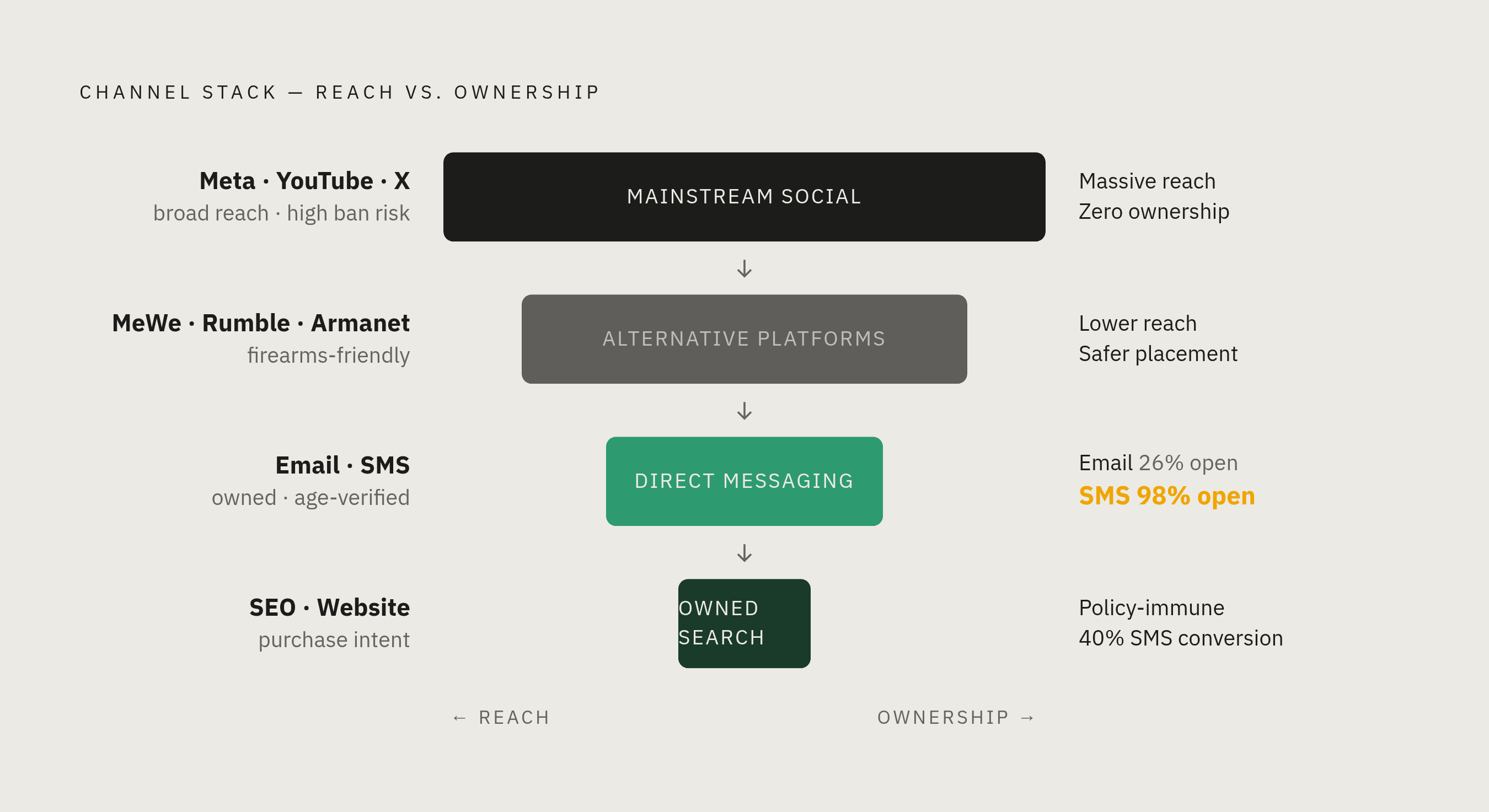
Social platforms can suspend an account overnight. An email list and an SMS subscriber base belong to the business. That distinction is not rhetorical. It is the difference between renting an audience and owning one.
The performance data for these channels is difficult to argue with. SMS open rates average around 98 percent, with conversion rates commonly between 21 and 40 percent, according to Concealed Carry Marketing's August 2025 analysis. That is categorically different from the reach a suppressed Instagram post delivers. Email open rates in the same period averaged 25 to 26 percent: lower than SMS, but still a reliable channel when social reach is throttled. For a business that has watched its Facebook engagement collapse to single digits, these numbers represent a meaningful operational alternative.
That said, neither channel is friction-free. SMS compliance requires carriers to implement a 21-plus age gate and a disclosure that firearms not legal in all 50 states will not be marketed via SMS; the SHAFT compliance framework is the operational standard for approved firearm businesses. Even with proper registration, in early 2025, major carriers began quietly blocking firearm-related messages. Links to sites containing certain firearms terminology were automatically rejected. The problem was resolved after roughly 90 days of industry advocacy, but the episode is worth filing as a reminder that even owned channels have dependencies.
Email platform selection is equally non-trivial. Mailchimp has removed enough firearms business accounts to make it an unreliable choice for the industry. Listrak is among the few providers that openly works with firearm retailers, though at a higher cost point, per OtterText's July 2025 analysis. The cost is a real consideration. So is the alternative.
The strategic loop that ties this together: use compliant social content to drive sign-ups to the email and SMS lists. Once someone is on those lists, the store communicates outside platform moderation entirely. New inventory, product promotions, direct calls to action: the content that would trigger a ban on Facebook can live in an email to a consenting, age-verified subscriber without asking anyone's permission.
How SEO Compounds Everything Else in This Strategy
A gun store's website ranking for local search terms is immune to platform policy changes. No algorithm update suspends an organic ranking the way Meta suspends a page. That is not a minor advantage; it is a structural one.
The relationship between social and search is complementary rather than redundant. Social channels build brand awareness and drive traffic; SEO captures demand from people already searching for what the store sells. Together, they cover both ends of the acquisition funnel.
For gun stores specifically, local SEO fundamentals are straightforward but frequently neglected. A Google Business Profile with accurate hours, services, and actively managed reviews is the first thing a local buyer sees when they search. Location-specific pages targeting searches like "FFL dealer [city]" or "concealed carry class [city]" capture intent that social media cannot. Service pages for each revenue line, transfers, consignments, training, gunsmithing, give the site content depth and pull in search traffic that would otherwise go to a competitor with a better-organized site.
Content strategy on the store's own domain is where the education-first approach pays its largest dividends. Safety guides, state-specific legal explainers, maintenance how-tos: the kind of content that Meta allows in attenuated form can be published in full on a store's own website, building topical authority and attracting inbound links over time. The platform cannot suppress it. No policy change can take it down. It compounds.
But what if a store does everything right on its own site and still loses the social accounts? The email list is still there. The SMS subscribers are still there. The search rankings are still there. The business can communicate with its audience, capture new customers from organic search, and operate its digital presence without depending on a platform that might suspend it for posting a photo of a shotgun.
That is the through-line of the whole strategy: understand exactly where each platform draws the line, operate inside it, but treat social media as the top of a funnel that leads to owned channels and organic search. The goal is not to find a clever workaround that keeps a store one step ahead of the next policy change. The goal is to build a business that does not need one.