Content Marketing for Firearms Dealers
Paid ads are banned, so dealers must build audience through search and education instead.

There is a version of this problem that is almost funny. The firearms industry generated $91.7 billion in total economic impact in 2024, up from $19.1 billion in 2008, a 379% increase in roughly sixteen years. More than 135,000 FFL holders are competing for that market. Online gun and ammunition sales reached $3.4 billion, growing at an 8.8% compound annual rate between 2019 and 2024. The buyers are clearly online, the market is clearly growing, and the dealers are clearly numerous.
And yet, the standard playbook for reaching online buyers is almost entirely unavailable. No Google Ads. No Meta campaigns. Limited YouTube. The industry that has outgrown every retail category you can name operates, from a digital marketing standpoint, as if it is still 2009. It is like a river that keeps rising while the bridges stay closed — the water finds a way through, but not every boat is positioned to move with it.
That's the constraint. And it is worth sitting with, because the dealers who internalize it early stop waiting for the rules to change and start building around the rules that exist. The ones who treat it as a temporary inconvenience keep deferring the infrastructure work that their competitors are quietly completing.
Platform Rules in Plain English: What's Banned, What Isn't, and Why the Gray Zone Is a Trap
Google has prohibited the sale of firearms, ammunition, and most accessories through Google Ads since 2014. Meta prohibits ads promoting websites that sell firearms or ammunition; even indirect links to a purchase page can trigger removal. TikTok restricts firearms content broadly. YouTube has increasingly demonetized and penalized creators with strikes, even for content that falls within platform guidelines on paper.
That raises an important question: is any paid social possible at all?
The answer, as of 2025, is narrowly yes. Google and Meta both relaxed restrictions on firearm-adjacent accessories, meaning holsters, optics, and apparel can now be promoted through paid channels if a dealer manages product catalog feeds correctly. Facebook still permits ads promoting gun blogs or community content, provided no link in the ad chain leads, directly or indirectly, to a purchase page. Educational content can move through paid social in limited ways.
But here is where dealers get themselves into trouble: enforcement is inconsistent. Some accounts run compliant campaigns for months without issue; others are suspended without warning or clear explanation. The unpredictability itself is the problem. A channel that works fine until it suddenly doesn't is not a foundation. It is a liability that feels like an asset — or, put plainly, it's a trap door disguised as solid ground.
The 2025 accessory exception is real and worth capturing. It does not restore paid advertising as a general-purpose acquisition channel. Treat it as a tactical supplement, not a strategic pivot.
The Legal Layer That Most Dealers Don't Think About Until It's Too Late
Platform restrictions and legal restrictions are two separate problems. Conflating them is a common mistake, and it causes dealers to miss genuine exposure.
California's AB2571 prohibits firearm advertising that appears to target minors, with fines up to $25,000 per incident and civil lawsuit exposure. New York's GBL §898 enables civil actions against dealers for business practices deemed to create a public nuisance; the Second Circuit upheld its constitutionality in July 2025. Neither of these is a platform policy. A dealer can be fully compliant with Meta's terms and still be in legal jeopardy.
Cross-state advertising creates specific risk that many dealers underestimate. Advertising or selling products that are legal in the dealer's home state but prohibited in another state opens real enforcement exposure. A Florida dealer pair paid a combined $325,000 in penalties for advertising large-capacity magazines to New Jersey residents. The dealer almost certainly did not intend to violate New Jersey law. Intent is not the standard.
FTC endorsement guidelines require clear disclosure of paid partnerships, gifted products, and affiliate arrangements in influencer content. This applies in firearms the same as any other category.
It is also worth considering what this legal landscape implies for content strategy. Responsible ownership, safety education, regulatory compliance, and training content are the categories that stay consistently on the right side of both platform and legal lines. This isn't about being timid or overly cautious. It's about identifying which content categories are structurally durable and which carry removal or liability risk. The former compound in value over time. The latter can disappear overnight, along with the audience built around them.
The Buyer Has Changed, and Most Dealers Are Still Writing for the Wrong Person
Between 2021 and 2024, an estimated 29.8 million U.S. adults acquired firearms, including 11.2 million first-time gun owners. Among recent new owners, 46.3% were women. The demographic composition was notably more racially diverse than the existing owner base, with Black non-Hispanic and Hispanic buyers each representing roughly 20% of recent acquirers.
Women's firearm ownership increased 13.6% between 2017 and 2023. Hispanic ownership increased 33.3% in the same period. In 2025, 61% of women surveyed by A Girl & A Gun identified as completely new to firearms, up from 53% in 2020, and training availability had replaced event-driven motivations as the primary driver of ownership.
Why does this matter for content? Because a first-time buyer's information needs are categorically different from an experienced shooter's. They need safety basics, legal guidance, storage information, maintenance instruction, and help understanding what questions to ask. They are not looking for ammunition ballistics comparisons or 1911 variant deep-dives. They are looking for a trustworthy, accessible starting point, and they are looking for it online. A first-time buyer approaching a content library built for experts is like someone learning to cook who walks into a kitchen stocked only with advanced techniques and no recipes — the ingredients are there, but nothing speaks to where they actually are.
Content that addresses experienced buyers in traditional firearms language is not wrong. It just increasingly misses the largest growth segment in the market. NSSF's own marketing guidance has explicitly encouraged brands to evolve messaging to resonate with new owners. This is not audience research as a theoretical exercise. It is industry-level direction.
The implication is pointed: educational content isn't just a workaround for restricted ad channels. It's actually what the current buyer pool needs and responds to. The constraint and the opportunity are the same thing.
SEO Is Not a Tactic. For Firearms Dealers, It Is the Infrastructure.
When paid advertising is unavailable, a buyer who searches "best 9mm for home defense" or "FFL dealer near me" can only find a dealer through organic results. The search demand exists whether or not a given dealer shows up for it. Someone else will capture that traffic. The only variable is who.
There are more licensed gun stores in the United States than McDonald's and Starbucks locations combined. Local SEO competition is significant, and the dealers who invest in it early accumulate domain authority, inbound links, and content depth that competitors cannot quickly replicate. Organic authority compounds. Paid exposure stops the moment the budget stops.
Long-tail keyword strategy is the appropriate frame here. Generic terms like "handguns" or "gun store" carry enormous competition and weak purchase intent. Queries like "concealed carry laws in Nebraska 2025" or "first handgun for women" signal a specific need and convert at higher rates precisely because the searcher knows what they are looking for. Liberty Safe has built a content library targeting hundreds of these queries, driving substantial organic traffic monthly. The approach is not complicated. It is consistent.
Local SEO is the highest-leverage play for dealers with physical storefronts. A maintained Google Business Profile is free and directly surfaces in local search results. Consistent business information across directories, managed reviews, and accurate hours are foundational requirements. First-time buyers, specifically, search locally: trust and proximity matter when someone is new to a category and uncertain about what they need.
The dealers who build this infrastructure now are accumulating something their competitors cannot buy. And the dealers who keep waiting for paid policy changes to open the channel back up are not standing still. They are falling behind.
The Content That Actually Moves Buyers Through the Funnel
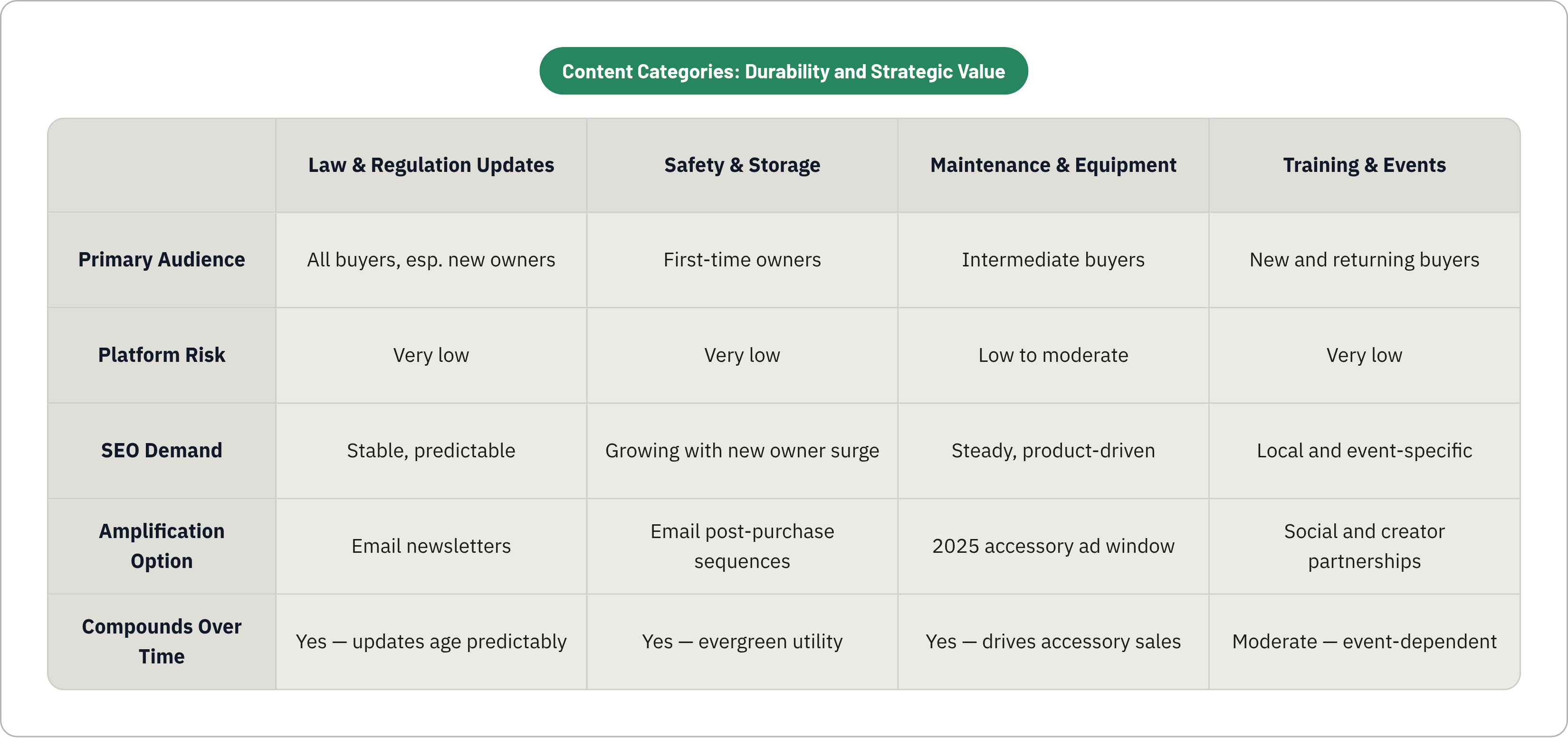
The organizing principle is straightforward: content should answer real questions buyers are already asking, stay within platform and legal safe zones, and build the dealer's authority over time.
Law and regulation updates are perennially high-value: state-specific concealed carry law summaries, permit processes, restriction changes. The search demand is stable, the content ages predictably, and it positions the dealer as a knowledgeable local resource in exactly the way a first-time buyer needs.
Safety and storage content serves the first-time buyer cohort directly: safe handling basics, storage options, household safety with children present. This is not ancillary content. For 11.2 million recent first-time owners, it is primary content.
Maintenance and equipment guides, cleaning walkthroughs, ammunition selection by use case, and optics or holster comparisons are product-adjacent content that drives accessory consideration without promoting a direct sale. This is also the category where the 2025 accessory advertising relaxation creates a narrow amplification opportunity.
Training and event coverage, FAQ content addressing common permit and legal questions, and video formats including safety tip series and range event walkthroughs all serve different points in the buyer journey. The common thread is genuine utility.
One thing worth noting: as AI tools begin answering generic search queries directly in results, the content that survives and ranks will be the content that has genuine depth, local specificity, and demonstrable expertise. Generic output at scale is becoming less viable. Specific, authoritative, human-written content is becoming more competitive. For dealers who actually know their local markets and their customers, this is an advantage, not a problem.
Email Is Not a Backup Plan. It Is the Only Audience Asset You Actually Own.
The framing that has stuck with me, attributed to remarks at the 2024 NSSF Marketing and Leadership Summit: "Don't build your business on rented ground." Organic social followings, even strong ones, are subject to algorithm changes, policy shifts, and platform decisions that a dealer has no influence over. Email is not.
A dealer's email list is the one audience asset no platform can remove, demonetize, or suppress. This is not a rhetorical point. It is a structural fact with real strategic implications.
The use cases specific to firearms dealers are concrete. New inventory announcements to opted-in buyers represent purchase intent that has already been established. State-specific regulatory updates to subscribers in relevant jurisdictions carry high perceived value and position the dealer as an ongoing resource rather than a transaction. Event invitations for range days, safety courses, and training workshops drive in-store traffic and build community loyalty. Post-purchase sequences with maintenance tips, accessory recommendations, and storage guidance serve the first-time buyer cohort specifically and drive repeat visits.
The list-building mechanism closes the loop on the broader content strategy. Blog readers and video viewers who found the dealer through organic search and received value from educational content are the natural candidates to subscribe. SEO-driven content brings new buyers into the funnel; email keeps them in the dealer's orbit regardless of what any platform decides next.
Dealers who have built a direct audience relationship are structurally less exposed to the policy volatility that has repeatedly disrupted firearms businesses on social platforms. That structural resilience is worth building for its own sake, separate from any individual campaign outcome.
Influencer Partnerships: Legitimate Channel, Real Exposure If Managed Carelessly
Firearms creators on YouTube, podcasts, and niche platforms have built audiences that paid advertising cannot reach. Creator partnerships are a legitimate amplification channel, and dismissing them because the category feels complicated leaves reach on the table.
But the compliance exposure is real and requires deliberate management.
FTC endorsement guidelines require clear disclosure of gifted products, paid partnerships, and affiliate arrangements. This is not a firearms-specific rule. It applies across all categories, and the FTC has demonstrated willingness to enforce it.
Creator selection matters more in this category than in most others. Creators with a track record of responsible, safety-forward content carry less association risk. Creators whose audience demographics align with the dealer's growth segments, particularly first-time buyers and women, offer more strategic fit than legacy channels built primarily around experienced shooters. Creators who understand platform rules and produce consistently compliant content protect the dealer from downstream association with removed or flagged material.
There is a content compounding effect worth capturing: reviews, walkthroughs, and safety tutorials produced through creator partnerships can live on owned channels after the partnership concludes, adding to the dealer's permanent content library and contributing to SEO authority. The partnership generates an asset, not just an impression.
The 2025 accessory advertising relaxation makes it more viable to amplify creator content around holsters, optics, and apparel with modest paid budgets on Google and Meta, for dealers with properly managed product feeds. It is a narrow window. It is also real.
What the Whole System Looks Like When It's Actually Working
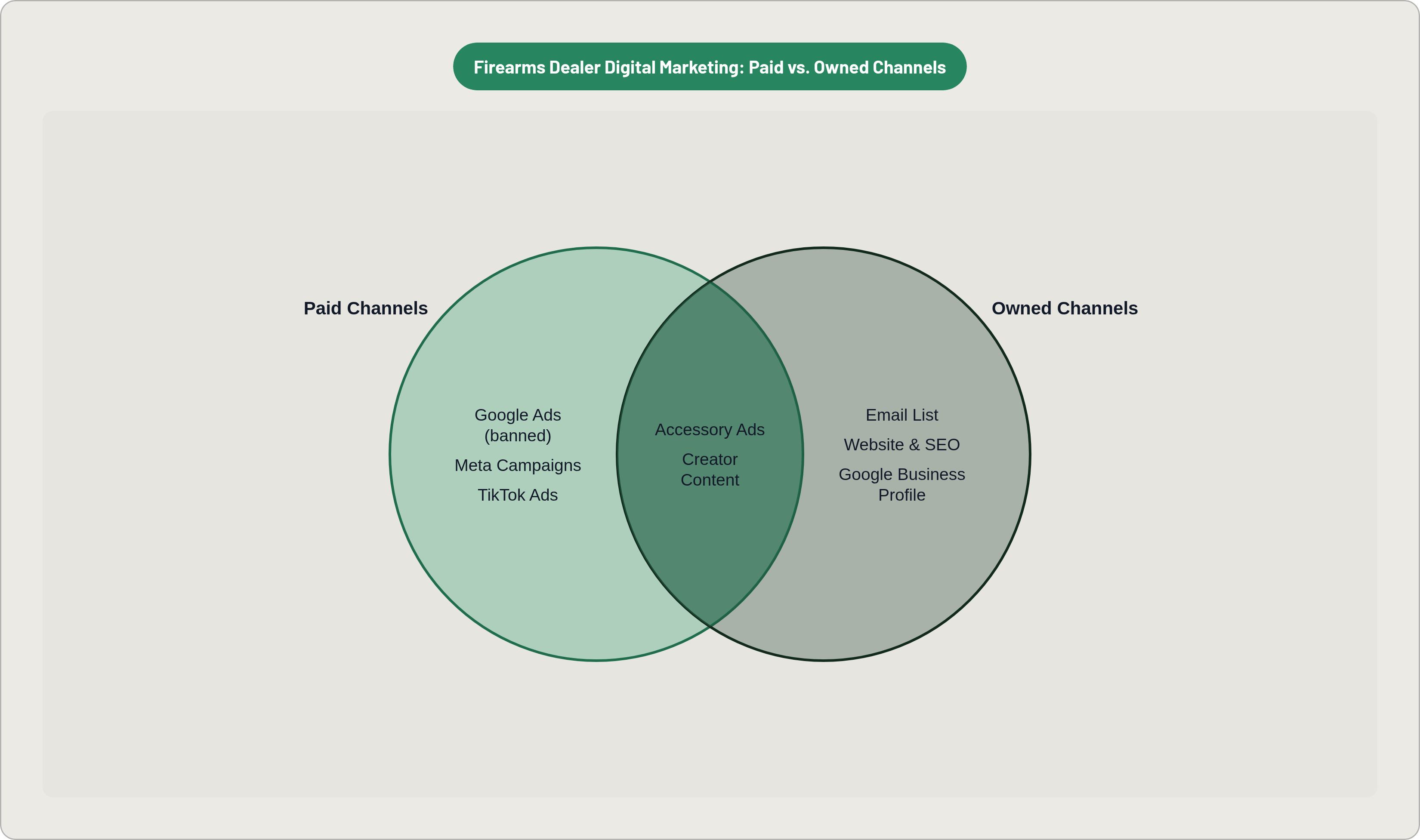
The model has a clear hierarchy: owned media, meaning the website and email list, sits at the center. SEO-driven content is the primary acquisition engine. Social and creator partnerships are distribution amplifiers, not foundations. Anything that can be removed by a platform decision is infrastructure you do not control. Build accordingly.
Content production does not need to be high-volume to be effective. Consistent, specific, locally relevant content outperforms generic output at scale, and it will do so increasingly as AI tools commoditize the generic tier. The dealer who has published a well-researched article on concealed carry law changes in their state, updated it annually, and paired it with a local Google Business Profile has built something durable.
Consider the first-time buyer journey as a template. A buyer searches a specific question, something like "how to store a handgun safely in Nebraska," and finds the dealer's article in organic results. The article answers the question and establishes expertise. The dealer offers email signup for law updates or upcoming safety courses. The buyer subscribes, attends a training event, makes a first purchase, and becomes a repeat customer through an ongoing email relationship. No paid advertising involved at any step.
The 3.9 million new gun owners who entered the market in 2024, per NSSF data, did not find dealers through paid ads. They used search. They asked questions. They looked for local resources. The dealer who had answered those questions in writing was the one they found.
Platform policies will continue to evolve. Some restrictions will loosen; others will tighten. An organic search footprint, a maintained email list, and a reputation for genuinely useful information are assets that compound regardless of what Google or Meta decide next. For most industries, content marketing is one channel among several. For firearms dealers, it is the channel. The sooner that distinction is treated as a design constraint rather than a complaint, the better the strategic infrastructure that gets built around it.


