Automating Lead Follow-Up for Service Businesses
Automation closes the gap between when leads arrive and when salespeople can respond.
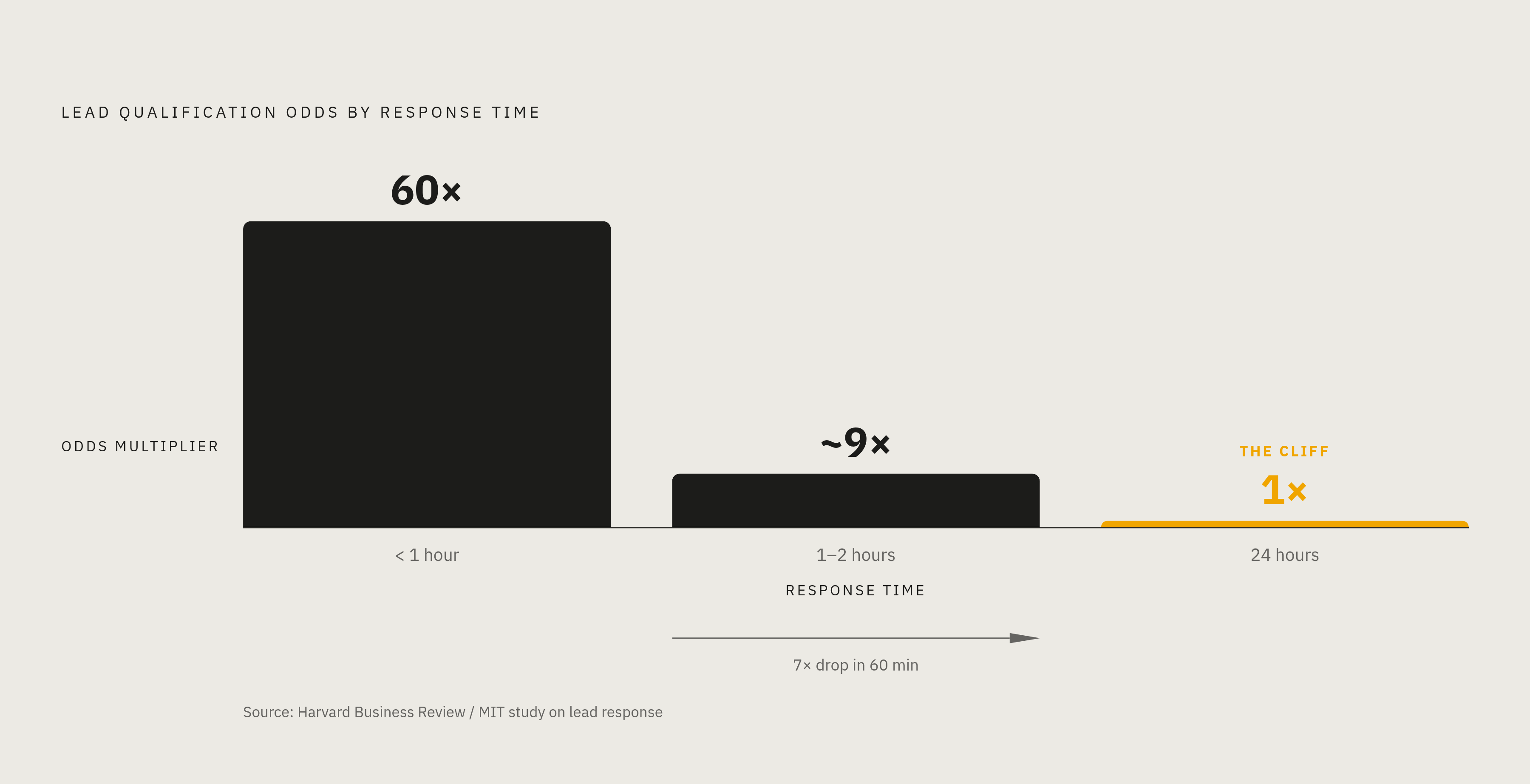
A Harvard Business Review analysis of 2.24 million sales leads found that firms responding within one hour were nearly seven times more likely to qualify a lead than those that waited even 60 minutes longer. Wait 24 hours and the odds fall by a factor of 60. Not a gradual erosion. A cliff.
The mechanism isn't mysterious, just inconvenient to sit with. The lead is almost never evaluating only one provider. HomeAdvisor's 2025 data shows homeowners submit service requests to three or four companies simultaneously. The first business to respond wins the job 78% of the time. By the time your manual follow-up arrives, the customer has frequently already booked, and your call lands with the mild awkwardness of showing up to a party that ended three hours ago.
The industry average response time sits around 47 hours. ServiceTitan's 2025 benchmark, covering more than 100,000 home service businesses, pegs the sector average at 42 minutes, with 23% of leads receiving no response at all. Even 42 minutes is generous by the standards of what the data actually demands. Speed isn't a competitive differentiator in any conventional sense. It's the threshold requirement for being in the conversation at all.
Why Manual Follow-Up Can't Reliably Meet That Speed Threshold
One argument holds that the fix is simply better discipline: check the inbox more often, set reminders, hold people accountable. That argument collapses under the weight of what it actually asks.
Sales representatives, even those in dedicated sales roles, spend only 28% of their week selling, according to HubSpot's 2024 State of Sales report. The rest disappears into administrative overhead. For service businesses without a dedicated sales function, follow-up doesn't compete with admin; it competes with billable work. The owner running an estimate at 2 p.m. cannot simultaneously respond to a web lead within five minutes. That's not a discipline problem. It's a physics problem.
A substantial share of booked appointments happen outside standard business hours, windows where no human is available regardless of intention. And here's the part nobody wants to say plainly: no amount of accountability fixes an empty office at 9 p.m.
Why exactly does this happen so persistently, even at businesses that know better? Research from the Sales Management Association offers one uncomfortable answer: 44% of sales reps abandon follow-up after a single attempt, even though only 2% of sales close on first contact. The gap between what effective follow-up requires, namely speed, consistency, and persistence, and what manual execution reliably delivers, is structural. The process itself is the problem. Caring more doesn't change its limits.
What an Automated Follow-Up System Actually Does
Automated follow-up is not a marketing broadcast. It is not a mass email campaign. It is a set of workflows triggered by specific lead behaviors, operating without requiring a human to decide to act.
A form submission triggers an immediate SMS acknowledgment. A missed call triggers a text-back within seconds. A quote that's gone quiet for ten days triggers a check-in. None of these require anyone to remember, prioritize, or find time they don't have.
The goal is deliberately narrow: handle the parts of follow-up that don't require judgment. Confirm receipt, set expectations, keep a lead warm while a technician finishes a job, route high-intent leads to a real person faster than manual review ever would. Automation is not trying to close deals. It is preventing leads from dying in the waiting.
That said, it's worth asking whether the coverage argument alone justifies the infrastructure. Companies with 24/7 response capability convert at 2.5 times the rate of businesses running on a standard schedule, according to research published by Drift and SurveyMonkey. For a small service operation, automation is often the only practical path to that coverage. The math is not subtle.
The Five Automations That Cover the Most Common Points Where Leads Go Cold
These aren't features on a software demo slide. They are the specific points in a typical service pipeline where leads reliably disappear without intervention.
Instant Web Lead Acknowledgment
The first automated message has one job: confirm the inquiry was received and set a realistic expectation for what happens next. It does not need to be clever. Podium's 2025 Consumer Expectations Study found that 89% of consumers feel more confident about a business that acknowledges their inquiry immediately, even before any quoting occurs. The acknowledgment buys time for a human to respond properly without the lead feeling ignored, or worse, feeling compelled to call the next company on the list.
Missed-Call Text-Back
Twenty-seven percent of inbound calls to home service businesses go unanswered, according to ServiceTitan's 2025 benchmark data. Most callers never leave a voicemail. Without automation, that call is simply gone: a lead who self-selected into a high-intent channel and received nothing back. A missed-call text-back sends an immediate message, something like "Sorry we missed you, how can we help?" It reopens a conversation that would otherwise have closed permanently, which is a strange thing to voluntarily let happen.
Multi-Step Drip Nurturing for Non-Responders
Leads who don't book immediately are often not lost; they're just not ready yet. A short email sequence, typically two to four messages spaced over days or weeks, keeps the business present without requiring anyone to remember to follow up. Research by the Sales Management Association consistently shows that following up at least five times substantially increases reply rates, yet 44% of reps stop after one attempt. The drip sequence closes that gap without asking anyone to sustain the discipline manually.
Lead Scoring and Routing
Not every lead deserves the same response with the same urgency. Treating them as though they do means the sales effort that should have gone to the high-intent lead who visited the pricing page three times gets allocated equally to someone who skimmed a blog post once. Scoring routes high-intent leads immediately to a human, routes mid-intent leads into a nurture sequence, and routes low-intent leads toward educational content or retargeting. It introduces prioritization where previously there was none, which is the kind of obvious improvement that somehow takes most businesses years to implement.
Quote and Proposal Reactivation
A quote that goes quiet is, in most manual processes, a quote that is forgotten. But many of those leads are delayed, not dead. They are waiting on a spouse's input, comparing bids, or simply procrastinating. An automated check-in at day 7, day 14, or day 30 after a proposal surfaces some of those conversations without anyone having to remember they existed.
How Channel Mix and Sequencing Affect Whether Follow-Up Actually Gets Seen
SMS carries a 98% open rate, with most messages read within minutes, according to data published by SimpleTexting. Sending a follow-up text after initial contact produces a 112.6% increase in converting leads to engagement, per Hatch's 2025 Home Services Engagement study. Those numbers make a case for SMS as a strong first-touch channel in many scenarios, and yet most service businesses still lead with email by default.
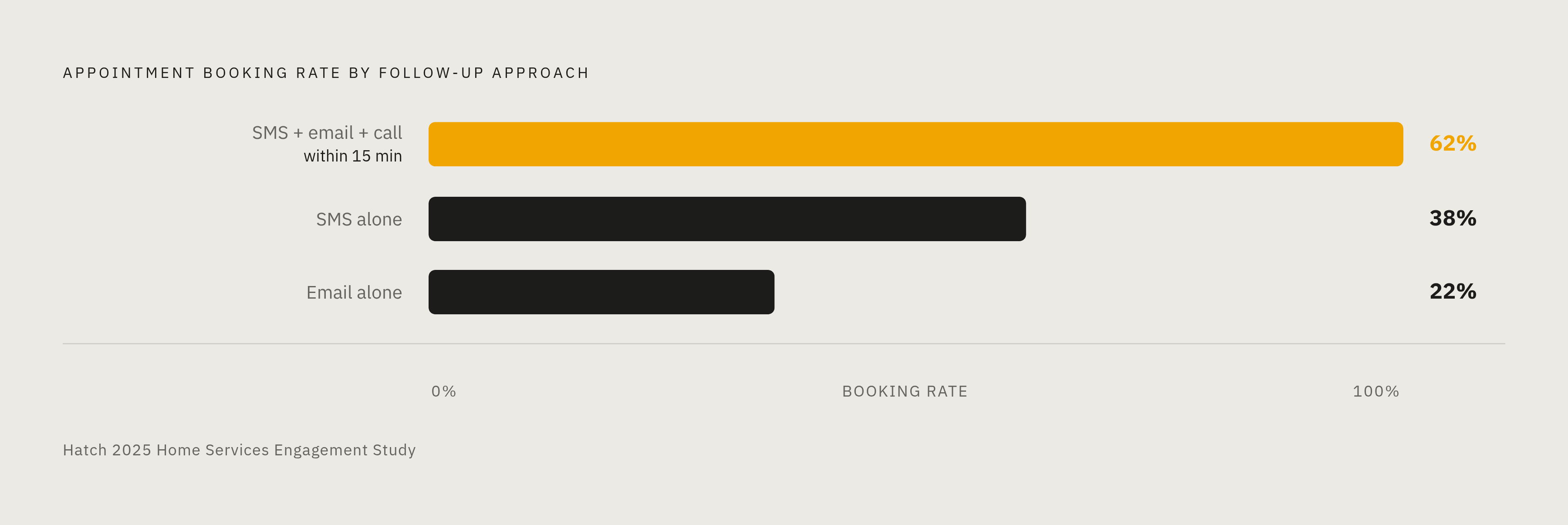
But sequencing is the lever that matters most, more than the channel itself. Hatch's 2025 study found that the combination of an instant SMS acknowledgment, an email follow-up, and a human phone call within 15 minutes of initial contact produces a 62% appointment booking rate. SMS alone produces 38%. Email alone, 22%. The sequence matters more than any single channel in isolation.
The practical framework: SMS handles immediate acknowledgment and quick back-and-forth. Email handles context, detail, and ongoing nurture for leads who didn't respond to the first text. Phone handles complex questions, objection resolution, and high-intent leads who need a human voice to actually commit. Each channel has a lane. Treat every channel as interchangeable and you end up using all of them badly.
Persistence does have a ceiling, and it's lower than most people assume. Belkins' 2024 analysis of 16.5 million cold emails found the highest reply rate, 8.4%, comes from a single email. Sending four or more emails more than triples unsubscribe and spam complaint rates. Past that ceiling, you're not nurturing leads; you're training them to ignore you.
One compliance point worth stating plainly: FCC rules require written consent before sending automated commercial texts. Build that consent into the lead capture stage, not as a legal footnote nobody reads.
The Tools a Service Business Actually Needs to Build This System
The foundation is a CRM with workflow automation. This is where lead data lives, where trigger-based sequences are built, and where the system enforces consistency regardless of who happens to be working that day. HubSpot offers a free tier for businesses starting from scratch. Zoho CRM provides automation across a broader business suite. Pipedrive prioritizes visual pipeline management with minimal setup time. Freshsales incorporates AI-driven lead scoring at pricing accessible to small and mid-sized operations.
On top of a CRM, an SMS automation layer handles text triggers and missed-call text-back. Tools like Kixie and Salesmessage are purpose-built for this, though many CRMs now include native SMS functionality that covers most service business use cases without requiring a separate stack.
For website lead capture, an AI chatbot qualifies leads continuously, routes by score, and eliminates the static form-and-wait model that defines most service business websites. Keep qualification flows to three to five questions. Survicate's data shows completion rates fall from 83% for one to three questions to under 57% for nine or more. Most businesses can deploy a basic chatbot in weeks using no-code or low-code platforms.
It is also worth considering that the real barrier is rarely the software. It's process clarity: knowing what the system should do before expecting software to do it. HubSpot's 2024 research found that sales professionals using a CRM are 79% more likely to report strong team alignment. The software is the easy part. Deciding what a "qualified lead" actually means for your specific business, before the first automation fires, is the part that takes real thought.
Where Automation Should Stop and a Human Should Take Over
The real failure mode in automated follow-up isn't automating too much. It's automating the wrong parts, specifically the parts that require reading a specific person's situation, and failing to insert a human at the moment the conversation actually needs one.
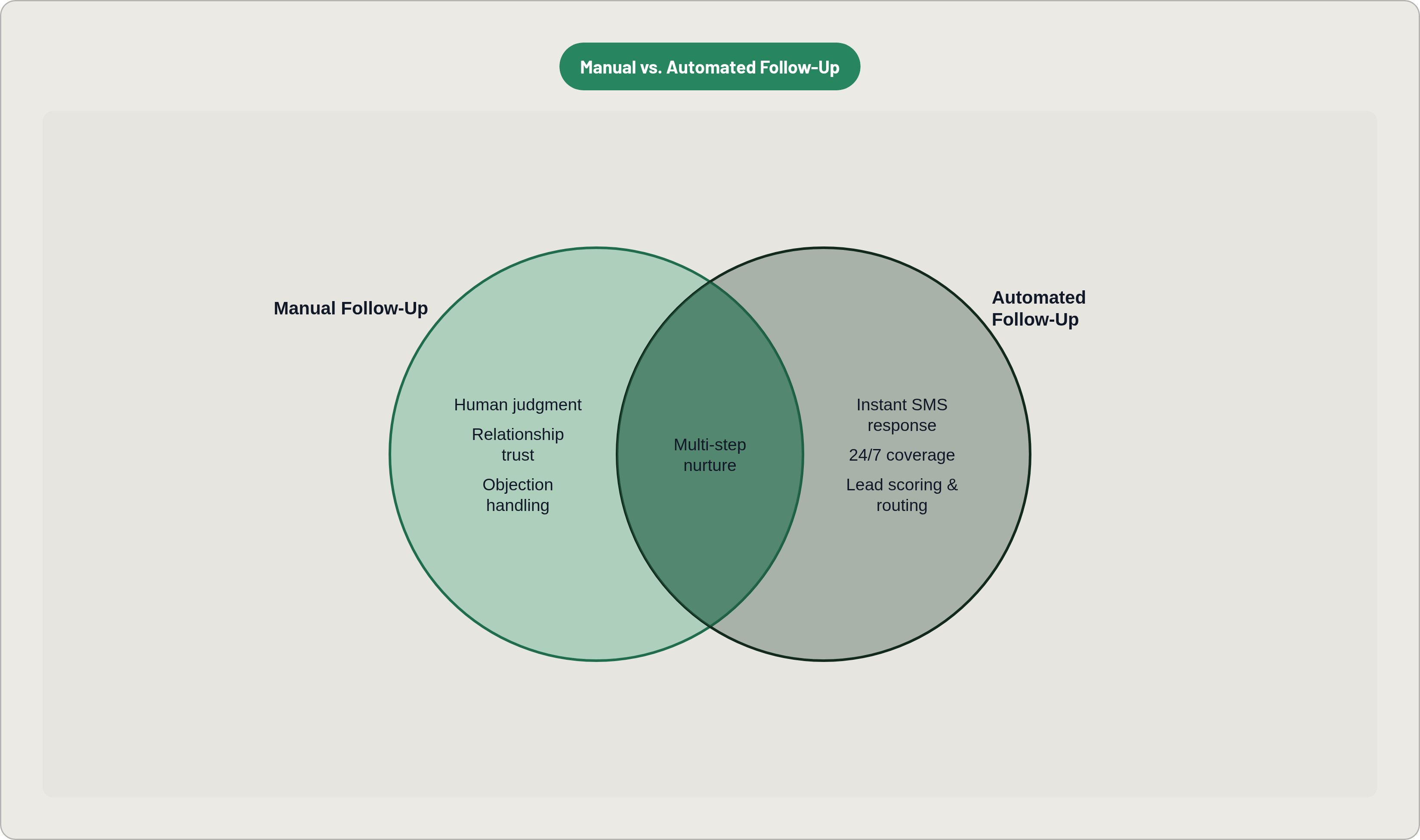
Automation handles acknowledgment, qualification, scheduling, nurture sequences, scoring, and routing. These are tasks that follow logical rules and require no judgment. Humans handle complex estimates, relationship-sensitive conversations, objection handling, and anything that turns on a customer's specific context. A plumber is entering someone's home. A roofer is asking for a significant financial commitment on a repair that matters. Trust is often the deciding variable, and trust is not built by a chatbot, regardless of how well-sequenced its follow-up cadence is.
That raises an important question: at what point does a touchpoint that was meant to feel helpful start to feel automated in the pejorative sense? The answer is usually the moment the customer has a real question and gets a templated non-answer. That's the handoff point. The practical design principle: automate to the point where a human can pick up a warm, informed, pre-qualified lead, then stop. Every touchpoint that is scripted when it should be human erodes the speed advantage the system spent so much effort creating.
A business that automates carelessly enough to feel robotic at the wrong moment can end up worse off than one that never automated at all. It has now efficiently produced a bad impression at scale. Most service businesses are losing leads in the gap between inquiry and first response. That gap is a structural problem. Automation, configured with actual thought, is a structural fix. But the thought has to come first.


