Firearms Marketing Strategy for Independent Dealers
New gun buyers want education, not sales pitch—and most dealers still market to someone else.
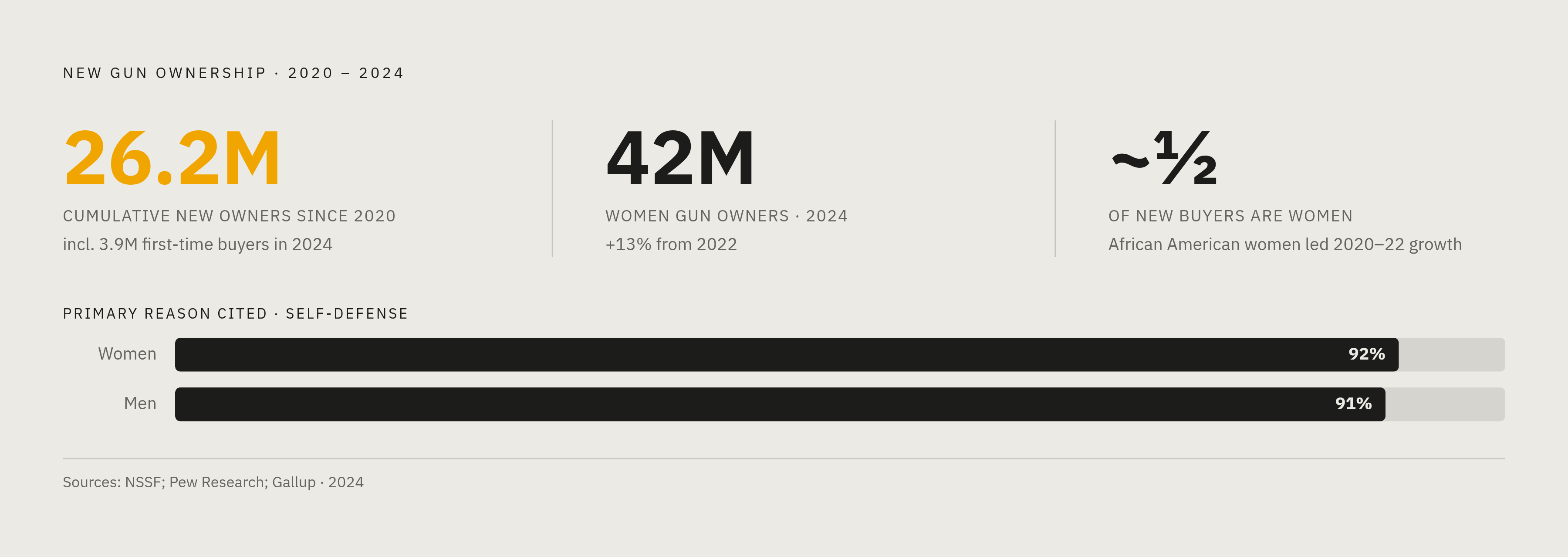
Roughly 3.9 million first-time gun owners entered the market in 2024 alone. Since 2020, the cumulative cohort of new owners has reached approximately 26.2 million. These are not lifelong enthusiasts who grew up cleaning rifles at the kitchen table on Sunday mornings.
Women now account for nearly half of new gun buyers. Approximately 42 million American women owned guns in 2024, a 13% increase from 2022, with African American women representing the fastest-growing demographic during the 2020 to 2022 surge. The motive is consistent across groups: 92% of women and 91% of men cite self-defense as the primary reason for ownership. The urban buyer, the first-generation owner, the Millennial who lives alone and recently started paying attention to the news: these are not fringe profiles. They are the market, full stop.
What does that buyer want from a dealer? Not a transaction. Education, patience, and a place where asking a basic question doesn't feel embarrassing. Think about the last time you walked into any specialty retail environment knowing almost nothing, and the person behind the counter made you feel that ignorance acutely. That's the experience the new gun buyer dreads before they even arrive. Many fail to come back after experiencing it once.
If this is who the customer actually is, why does so much firearms retail marketing still speak to someone else entirely? Spec-heavy content, range-bro aesthetics, and tactical vocabulary are coherent shorthand to a lifelong enthusiast. To a first-time buyer who is nervous and just trying to make a responsible decision, they are alienating. The fastest-growing segment of the market is also the most underserved by how most gun stores present themselves. Whether that's a political observation or a business problem depends on who you ask, but the revenue implications are not ambiguous.
How Platform Restrictions Actually Constrain a Dealer's Marketing Options
Most dealers know that advertising guns online is difficult. Fewer appreciate the full scope of what those restrictions foreclose, or what the legal exposure looks like when someone gets creative around them.
Meta prohibits ads promoting the sale or use of weapons, ammunition, or modification accessories. Google bans ads for firearms and ammo. Bing bans ads for guns and attachable parts. TikTok bans firearms content outright. These are not gray areas open to interpretation. They are categorical prohibitions enforced at the platform level, with no meaningful appeals process and no account rep to call.
Meta does permit ads for firearm safety courses, Second Amendment advocacy, and community groups, provided they do not link to product sales. The workaround is narrow, and dealers who have tried to stretch it have found the margin for error is essentially zero. In 2022, two Florida dealers were successfully sued by the New Jersey Attorney General for advertising large-capacity magazines to New Jersey residents, resulting in combined civil penalties of $325,000. State-level marketing restrictions are now active in California, Colorado, and Connecticut, with more likely to follow. FTC endorsement guidelines require clear disclosure of material connections in influencer arrangements. California's AB 2571 explicitly prohibits targeting minors with firearms marketing.
The legal exposure is real, live, expanding, and has already cost people real money. That's before we get to payment processing, where mainstream processors restrict firearms transactions in ways that create mid-sale disruptions. Nothing accelerates a customer's departure quite like a payment failure at the register.
When paid amplification is broadly unavailable, the channels that remain viable carry disproportionate weight. The only useful question is where that weight goes.
Why Local SEO Is the Highest-Leverage Marketing Investment Available to a Gun Shop
When paid advertising is broadly unavailable, organic search is not a fallback option. It is the primary growth engine. Most dealers are leaving it almost entirely untended, which is somewhere between unfortunate and a genuine competitive opportunity for the ones paying attention.
The Google Maps three-pack, the three local results that surface at the top of location-based searches, receives over 80% of clicks for those queries. For a brick-and-mortar dealer, appearing in that cluster is among the most consequential visibility outcomes available. It is also routinely ignored by independent dealers who are busy actually running a shop.
What drives those rankings? Google Business Profile completeness: hours, categories, photos, services, active Q&A responses. Review velocity, meaning not just star count but a consistent cadence of new reviews that signals ongoing relevance to the algorithm. Citation consistency, the exact matching of name, address, and phone number across directories and data aggregators, matters considerably and is almost universally neglected. A fully optimized profile costs nothing but time and compounds until a competitor outworks you. That's a low bar, given current industry norms.
Beyond the map pack, long-tail keyword targeting is where smaller dealers can realistically compete against larger chains. Generic terms like "firearm dealer" are contested and low-conversion. Specific phrases built around self-defense, first-time ownership, and local context attract higher-intent searchers who are far more likely to actually walk through the door. The keyword strategy should map to how the new buyer searches, not how a lifelong enthusiast would.
Content serves a dual purpose here. A pillar page on home defense setup, training options, or safe storage serves the SEO function and addresses the educational need of the first-time buyer simultaneously. One piece of work, two problems solved. Human-authored, experience-based content increasingly differentiates from the wave of generic AI-generated material flooding search results. Search engines are getting better at detecting the difference, and readers often feel it before they can articulate why.
AI-powered search tools like Perplexity and ChatGPT Shopping are beginning to surface local recommendations in ways that look different from traditional search. Structuring pages with clear headings, summaries, and FAQ sections positions a dealer for those emerging channels. The structural requirements overlap substantially with basic SEO hygiene anyway, so the marginal effort is low and the potential upside is not trivial.
Email Lists and YouTube as the Owned Channels Worth Building
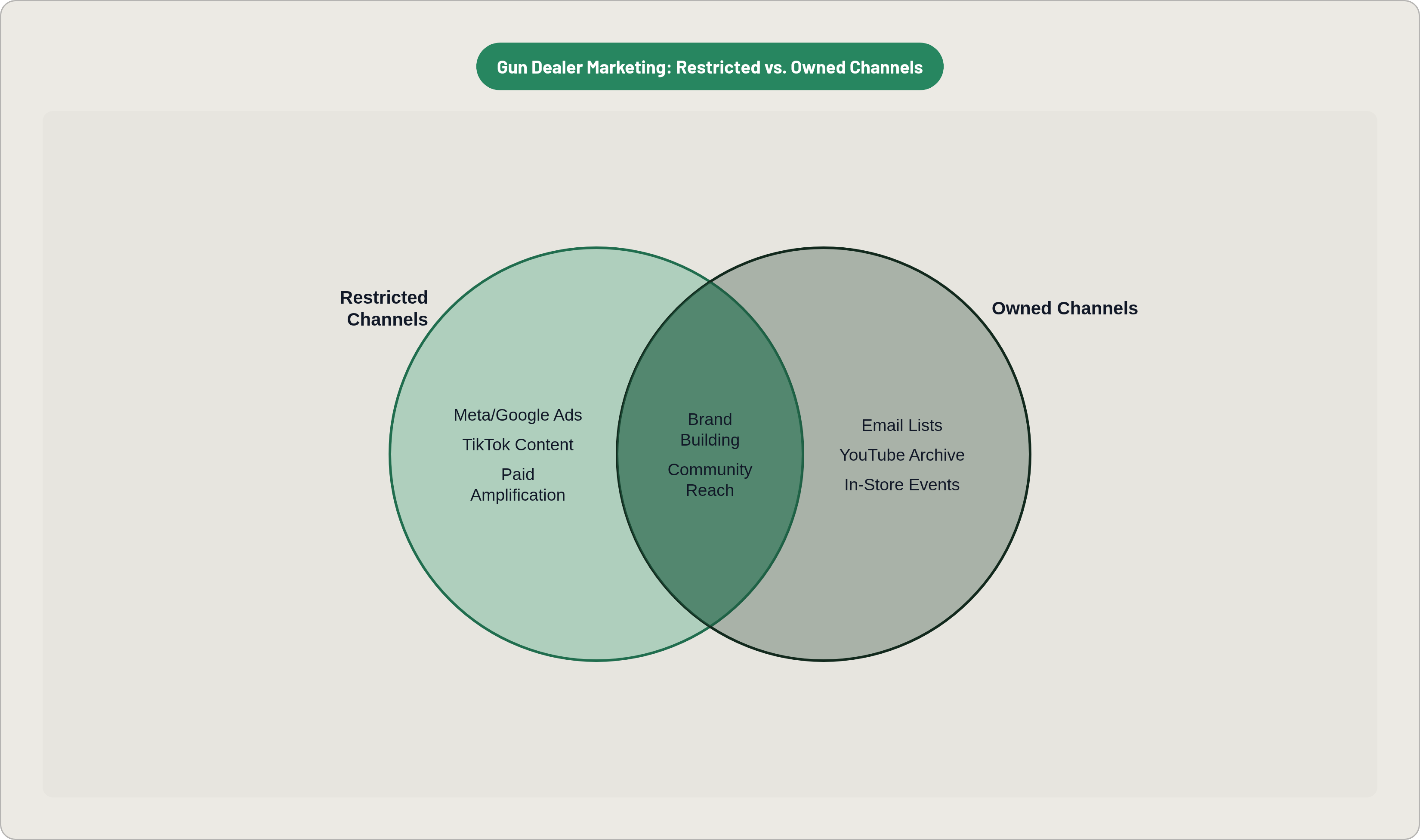
Every channel a platform can revoke overnight is a liability. An email list is an asset. A YouTube archive is an asset. They do not disappear because a platform quietly updates its terms of service on a Tuesday afternoon while you are helping someone pick their first handgun.
Email done properly is segmentation, not broadcast. A dealer who segments between new owners, competitive shooters, training class alumni, and participants in a women's program can speak to each group in a register that reflects where they actually are in their ownership journey, rather than blasting everyone with the same newsletter. The list grows through in-store events, training class signups, and loyalty program enrollment, meaning the digital asset compounds with every in-store interaction. That compounding is the point.
YouTube is the second-largest search engine, and it permits firearms content that most other major platforms prohibit. Product demonstrations, maintenance walkthroughs, range tips, beginner Q&A videos: these serve both SEO and community-building simultaneously, because YouTube videos rank in Google search results. A knowledgeable staff member answering real customer questions on camera builds trust more effectively than most ad creative, and that trust transfers directly to store visits.
But what if the staff member isn't a natural on camera? Good, actually. Authenticity reads better than polish in this context. The buyer who is nervous about walking into a gun store for the first time is looking for someone who will actually help, rather than a production. A slightly awkward but genuine video communicates that more effectively than a slick one.
Both channels reward consistency over volume. The archive of indexed content keeps working after the initial effort is complete. That is the structural opposite of paid media, where traffic stops the moment the budget does.
How Social Media, Influencers, and Niche Ad Networks Fit Into a Restricted Landscape
Social media is not a sales channel for dealers. Given the ad restrictions, it cannot realistically function as one. It is a community and brand channel, and that distinction changes the strategy entirely when you stop trying to make it into something it structurally cannot be.
Since paid advertising is blocked, the value of social presence is organic reach and brand personality: showing who the store is rather than what it sells. User-generated content from satisfied customers carries more credibility than branded posts and sidesteps policy review risk. Firearms-adjacent forums, AR15.com, The High Road, GunBroker, are where enthusiasts actually deliberate purchasing decisions. Reputation built there influences buyers who influence others. That second-order effect is underestimated by most dealers.
Influencer marketing has been a functional channel since roughly 2018. Channels like Hickok45, IV8888, and Warrior Poet Society have built large, loyal audiences with genuine purchase influence. For most independent dealers, though, the better ROI points toward smaller, regionally relevant creators: lower cost, higher engagement rates, more credible to the local audience you are actually trying to reach. A creator with 8,000 followers in your metro area is worth more to you than one with 800,000 nationally. This is not a controversial claim; it's just math applied to geography.
Compliance is mandatory. FTC disclosure requirements apply to every sponsored post, and the dealer bears responsibility for ensuring their influencer partners are actually compliant. That responsibility does not transfer to the creator.
Niche ad networks like Topple and Armanet exist specifically to reach audiences outside mainstream platforms. Podcast sponsorships offer high engagement with a pre-qualified audience. These channels work best as amplifiers layered on top of SEO and email infrastructure, not as standalone strategies. Running them without the foundation underneath is expensive and largely wasted, which is a lesson that is unfortunately available to learn the hard way.
Turning the Physical Store Into a Community Asset That Earns Loyalty Over Time
Training classes. Hands-on guidance. The experience of being shown something rather than sold something.
New and nontraditional owners specifically want competent, patient instruction in an environment that doesn't make them feel stupid for not already knowing things. A dealer who offers beginner courses becomes the trusted resource rather than a point of sale, and that positioning is difficult for an e-commerce platform to replicate. Training attendees are natural email list additions and loyalty program members. The in-store event feeds every owned digital channel; the digital channels drive people back to the store. That loop is the strategy.
Women-focused programming deserves more attention than it typically receives, given what the demographic data actually shows. SIG SAUER's 2024 ROSE Seminar Series, in-store events tailored to women at all skill levels and featuring professional shooter Lena Miculek, is a manufacturer co-op model that independent dealers can adapt and localize. A store that structurally orients itself toward this buyer has a genuine competitive advantage. Not an aspirational one.
Membership and subscription models introduce recurring revenue, which matters when transaction-based unit sales are under pressure. Membership tiers bundling range access, training credits, cleaning services, and priority inventory access smooth the volatility that retail has been experiencing. More visits generate more reviews, more user-generated content, more word-of-mouth referrals, and stronger local SEO signals. Everything compounds, or nothing does.
Dealers who treat the physical experience as entirely separate from the digital presence are leaving compounding returns untouched. The two strategies feed each other, or they should.
Putting the Strategy Together: Where to Start and How to Sequence the Work
The platform restrictions narrow the viable channel set considerably. That narrowing is, somewhat counterintuitively, useful. Fewer viable options means fewer decisions about where to concentrate limited time and resources. Most independent dealers are already stretched thin; clarity about what to skip has real operational value.
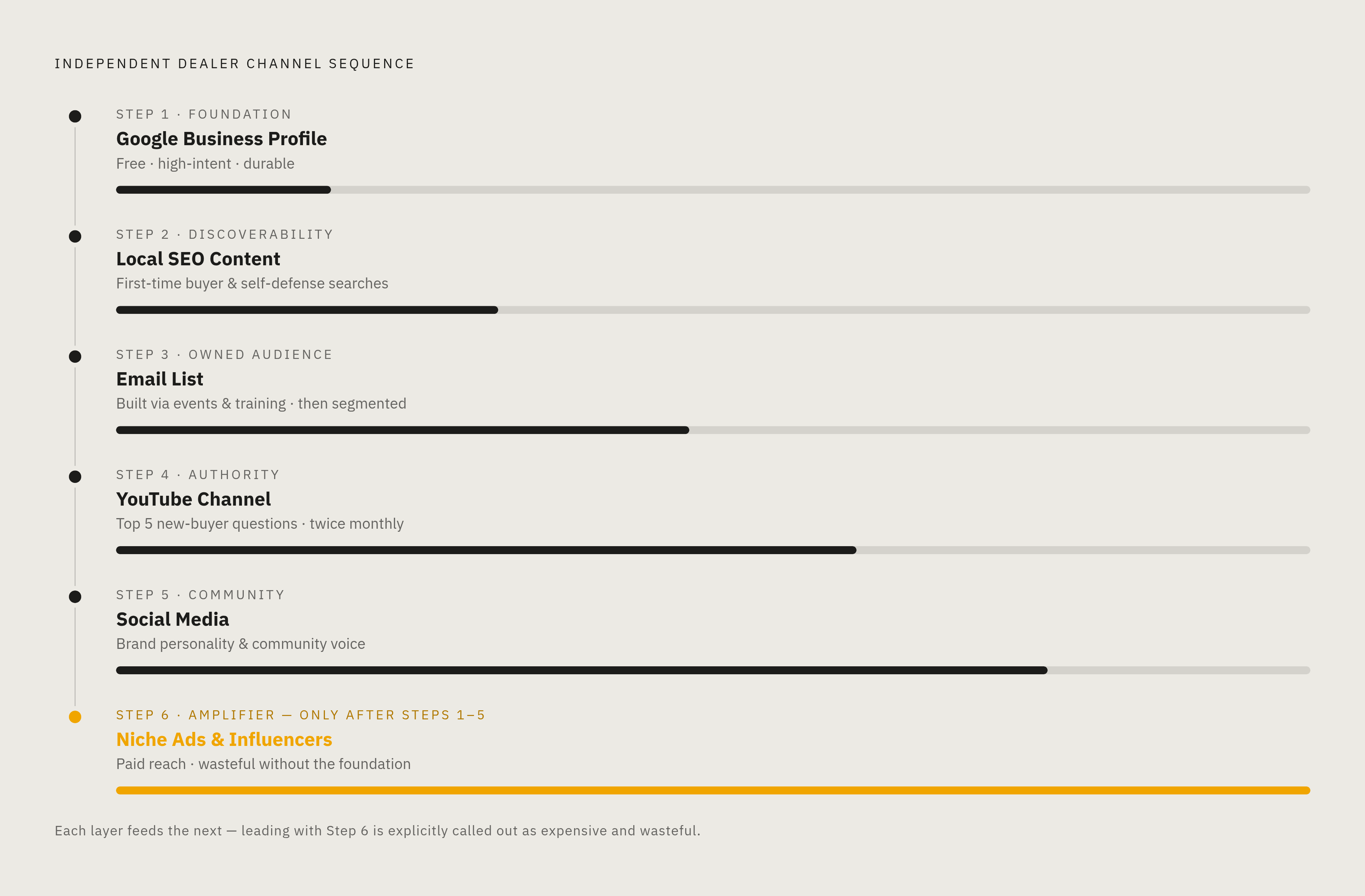
Start with the Google Business Profile. It is free, it is durable, and it reaches buyers at the highest-intent moment in their decision process, when they are actively searching for a dealer near them. Get it fully completed, get reviews flowing consistently, audit citation consistency across directories. It is not glamorous work. It compounds anyway.
Layer local SEO on top of that. Begin with content that maps to how the new buyer actually searches: self-defense, beginner, first-time, safe storage. A few well-researched, useful pages built around real questions grow in value over time in ways that no paid campaign can match, because the paid campaign stops the moment the budget does.
Build the email list through in-store events and training programs, then segment it intentionally. The list is the durable asset; every other effort is ultimately acquisition feeding into it.
Open a YouTube channel. Film a staff member answering the five questions they hear most often from new buyers. Optimize the titles and descriptions. Publish consistently, even if consistently means twice a month, because twice a month sustained over two years produces a real library.
Use social media to show personality and community. Let customers generate content. Participate in forums where buyers actually deliberate purchasing decisions.
Then, once the owned and organic infrastructure is functioning, layer in niche ad networks and influencer partnerships as amplifiers.
The sequence matters because resources are finite. A dealer who leads with influencer spend before building an email list or establishing coherent local SEO is accelerating distribution without having anything durable underneath. It is expensive, and the gains tend to evaporate.
The dealers gaining ground are not the ones who found a platform loophole. They are the ones who made themselves useful to the buyer who just walked in for the first time, a little nervous, with a lot of questions, and no obvious place else to go. That buyer exists in substantial numbers right now. Most gun stores are still not set up to serve them well.