Why Contractors Lose Local Search Rankings to Smaller Competitors
Google's algorithm now rewards constant review activity over decades of past reputation.

Contractors with decades in business, thousands of completed jobs, and reputations built on word of mouth keep losing local search rankings to competitors half their size. The reasons have nothing to do with hustle or scrappy underdogs outworking the establishment. Four specific, measurable gaps exist in how Google reads a business online, gaps that have nothing to do with how good the work is and everything to do with how the digital paperwork gets filed.
The map pack, that three-business box that appears when someone searches "plumber near me," captures 44% of clicks on local searches, while organic results below it get 29%. Businesses that are in the map pack see 126% more traffic and 93% more calls, website clicks, and direction requests than businesses stuck in positions four through ten. For construction businesses specifically, over 60% of contractor leads come from the Google Maps local pack. 97% of consumers research local services online before calling, which makes the map pack function like the front door rather than a nice-to-have.
So why do bigger, more established contractors keep getting passed over for smaller shops with a fraction of their history? The answer sits in four accumulating gaps, and understanding them starts with understanding how Google scores a local business.
How Google scores local businesses: the three-factor model and where large contractors slip
Google's own documentation lays out three ranking factors for local results: relevance (does the business match what someone searched for), distance (how close is it to the searcher), and prominence (how well known it is, based on signals gathered across the web). That's the official framing, tidy and simple. A much messier stack of measurable signals, which local SEO researchers have spent years reverse-engineering, produces the official three-factor model, and the 2026 breakdown gives a clearer picture than the official version does.
Google Business Profile signals account for roughly 32% of local pack ranking weight, the single largest group. On-page signals are around 19%. Review signals are near 20%. Link signals take 15%, behavioral signals 8%, and citation signals 7%. Adding those up, the biggest levers are the ones a business controls directly and can update this afternoon.
The advantages you actually have, brand age, backlinks, physical prominence, only add up to a modest slice of the formula once link signals, behavioral signals, and citations are combined. A well-run Google Business Profile and a steady stream of reviews can outweigh all of it. Longevity is a résumé line. Google wants a profile that gets logged into.
Signal gap one: the abandoned or misconfigured Google Business Profile
Since GBP signals carry more weight than any other category, this is where things go wrong first, and the failure pattern repeats across contractor after contractor. The profile got claimed years ago. Someone picked a broad category at setup. The business description hasn't been touched since. The services section has three bullet points where there should be fifteen, and the photos are all from one upload session back when someone's nephew had a decent camera phone. Then it just sits there. Nobody logs back in.
Category selection affects rankings more than almost any other factor a contractor controls. In the Whitespark Local Search Ranking Factors study, which tracks 187 individual signals, primary business category ranks among the highest-weighted factors examined. Yet plenty of contractors list themselves under "General Contractor" when the specific category, "Plumber," "HVAC Contractor," "Electrical Contractor," would serve them far better. A plumbing business that selects "Plumber" as its primary category holds a real mechanical advantage over a competitor filed under "Contractor" when someone searches "emergency plumber." Google is matching a category field to a search query, and vague inputs produce vague outputs. Choosing "Contractor" over "Plumber" is a little like introducing yourself at a hospital as "a doctor" when you're actually the cardiologist everyone on the third floor is waiting for. Technically true, not remotely useful for triage.
Signal gap two: review velocity, the factor that moved fastest in the 2026 data
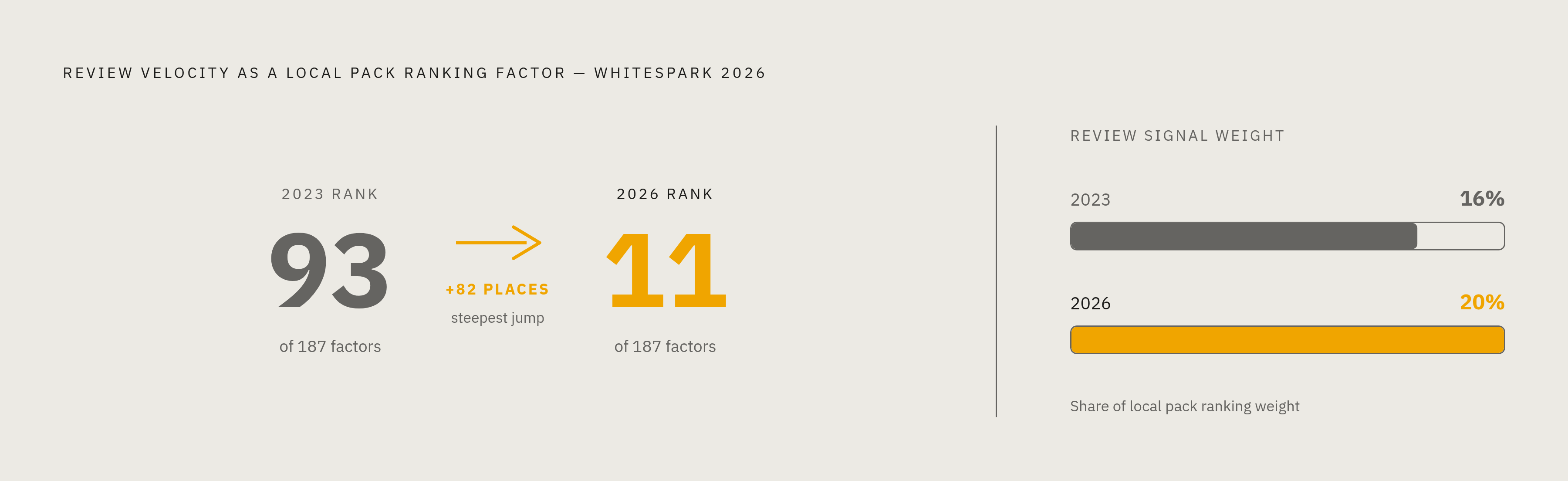
Review velocity measures how often new reviews come in, and it just had a striking leap, climbing from rank 93 to rank 11 out of 187 factors, according to Whitespark's 2026 Local Search Ranking Factors report, which surveyed 47 local SEO practitioners. Google's algorithm apparently decided this mattered a lot more, seemingly overnight, rather than through some gradual climb. Fitting that trend, the review signal category as a whole grew from about 16% of local pack ranking weight in 2023 to roughly 20% by 2026.
A case study from that research makes the point sharply. One contractor, the established player in the market, had 184 reviews and a 4.9-star average. A challenger nearby had 42 reviews and 4.8 stars, a fraction of the volume. Despite the established contractor holding better than a 4-to-1 advantage in total review count, the challenger took over the number-one map pack position after the established contractor went 23 days without a single new review landing.
The audit that produced that finding identified something researchers now call the "Recency Cliff." Once a business passes somewhere around 18 to 21 days without a new review, Google appears to start favoring competitors with active incoming signals, even ones with far less total volume behind them. So what's the point of 300 reviews sitting in a folder nobody's opened in a month? A pile of reviews from three years ago functions like a gym membership nobody's used since February: technically owned, functionally worthless. The contractor with 60 recent reviews and steady monthly additions is doing the online equivalent of showing up. The one with 300 old ones is just admiring a plaque on the wall.
Signal gap three: NAP inconsistency and citation drift accumulating silently over time
NAP stands for name, address, phone number, and citation signals (the consistency of that information across directories, review platforms, trust-and-accreditation sites, and trade-specific listing sites) account for about 7% of local pack ranking weight. That's the smallest of the major categories, but the research keeps landing on the same point: without a clean citation foundation, GBP optimization never delivers its full value. Citations are the foundation under the house. Nobody notices until the walls start cracking.
BrightLocal data shows an estimated 68% of local businesses carry at least one inconsistent NAP listing somewhere online, and businesses with that kind of inconsistency rank an average of 2.3 positions lower in local search. Certain trades carry more exposure than others. Fencing and tree service companies that shift territory frequently accumulate old addresses and disconnected mobile numbers scattered across directories nobody remembers signing up for. Painting and window cleaning businesses often run call-tracking numbers through directory listings, since lead resellers in those trades push hard for it, and end up with a pile of conflicting phone numbers scattered across the web.
Contractors keep building new listings on top of old, broken ones instead of going back to fix what's already out there, which only compounds the mess. Conflicting NAP data signals lower confidence to Google, and that suppresses rankings even when the Google Business Profile itself looks clean and well-kept. It's renovating the kitchen while the basement floods. Looks great from the dinner table.
Signal gap four: service pages that describe work without earning relevance
On-page signals, the actual content on a contractor's website, account for about 19% of local pack ranking weight in 2026, the third-largest category on the list. Google's Helpful Content updates turned thin, generic web copy from a minor annoyance into an active liability. Thin content used to just sit there doing nothing. Now it actively works against the site carrying it.
The pattern appears across contractor websites with almost comic regularity: a homepage promising "quality contracting services" (a phrase that means nothing to a search algorithm or a human being), three service pages with a single short paragraph apiece, and one "Service Areas" page trying to rank for a dozen cities at once by swapping the city name into an otherwise identical block of text, per M.Wolf Media's 2026 contractor SEO guide and Distribb's 2026 guide.
That one-page-per-city approach runs into a basic wall: Google needs an actual reason to rank a specific page for a specific location, and a template with find-and-replace city names hands it nothing to work with. M.Wolf Media's findings show those pages either fail to rank at all or end up competing against each other for the same handful of positions, which helps nobody. What does work, according to those sources, is location-specific detail that a template cannot replicate: genuine local context, internal links tying the page back to the homepage and other service pages, and content that reflects real knowledge of the area being served. A template can copy sentences. It cannot manufacture a permit code specific to one township, and Google, it turns out, notices the difference.
How the gaps interact and why fixing one in isolation rarely moves rankings
The four gaps stop behaving like separate line items once you watch them for a few weeks. They behave like a single feedback loop instead. A well-optimized GBP earns more clicks and profile views. Those clicks and views are behavioral signals, worth about 8% of ranking weight on their own, and they feed back into prominence. Prominence then makes citation consistency more valuable, because Google is cross-referencing a business that's already getting noticed. Clean, consistent citations validate the GBP data Google already leans on. Review velocity feeds two things at once: the behavioral engagement loop, and the review signal category's now-20% weight.
Each gap, left alone, doesn't sit quietly in its own lane. It suppresses part of the loop around it. Fix the GBP category but let reviews go dormant for a month, and the recency cliff still drags the profile down. Clean up citations but leave the service pages thin, and there's no on-page relevance left for the citations to reinforce.
Why are large, established contractors more exposed to this than a five-year-old shop would be? Probably because they usually carry one visible strength, brand recognition, or backlinks accumulated over years, or physical prominence in the market, and that strength masks weakness building up in the categories that actually carry more ranking weight. A stale profile sitting on 300 old reviews looks perfectly fine, right up until a competitor with 60 recent reviews and a clean citation footprint quietly slides past it in the map pack. Nobody at the established company necessarily notices, because nothing about the business itself changed. The ground just moved underneath it.
The speed of that shift matters too. Research from Sequoia Geo finds that stagnant Google Business Profiles can lose roughly a quarter of their visibility within 90 days. Ninety days is one slow season, or one office manager's parental leave, and by the time anyone checks, the visibility ground has already shifted by a meaningful margin. Whatever compounding effect took years to build can unwind in a single fiscal quarter.
A practical audit sequence for contractors who want to close the gaps
None of this requires guessing where to start. The sequence follows the weight of the signals themselves, beginning with what a customer would actually see and moving backward from there.
Start by playing customer. Open an incognito browser window, so no saved login or search history skews the results, search the primary service plus the city name exactly the way an actual customer would type it, and compare the business's own profile against the top three results that come up. Look at review count, how recently those reviews were posted, how many photos sit on the profile, how specific the category selection is, and whether reviews are still trickling in on competitors' listings or whether they've gone quiet too.
Move into the GBP itself next, since that 32% weighting makes it the largest single signal category on the list. Confirm the primary category is the most specific match available for the core service, rather than a broad trade umbrella that technically applies but helps nobody find anything. From there, the logic extends outward: check citation consistency across the directories that matter most in the trade, audit service pages for the kind of neighborhood-specific detail a template can't fake, and put a system in place, even something as basic as a recurring calendar reminder, so reviews keep arriving on a schedule instead of in occasional bursts followed by three weeks of silence.
None of these fixes are complicated on their own. Recognizing that they only work together, that's the part the bigger, more established contractors keep getting wrong.
Sources
- SEO for Contractors That Gets Local Leads in 2026
- 8 Costly SEO Mistakes Contractors Make in 2026 (Fix Now)
- Local SEO for Contractors: A 2026 Guide to More Leads — HearBack
- SEO for Contractors: A Practical Guide | Distribb
- 10 SEO Mistakes That Are Killing Your Local Business Rankings in 2026 | Search Scale AI Blog
- Google's Local Algorithm and Local Ranking Factors - BrightLocal
- Whitespark's Official 2026 Local Search Ranking Factors Report: Your ultimate guide to local SEO success in 2026!
- atlasunchained.com