Google Business Profile Categories and Services for Plumbers
Picking the wrong Google category kills your plumbing leads before reviews or photos matter.

Google Business Profile categories decide which searches a plumbing business appears in, before Google ever looks at reviews, photos, or how complete the profile is. Get the category wrong and none of that other work matters, because the business was never in the running to begin with.
Picture a plumber who's filed under "General Contractor." Great reviews, sharp photos, a fully filled-out profile. Doesn't matter. That business is not eligible for a "plumber near me" search, full stop, because Google filters by category before it weighs anything else. Plumbing SEO Agency's 2026 data shows 55% of plumbing leads come from Google Maps and Business Profile, with another 28% from organic search. That means the profile isn't a nice-to-have marketing extra, it's the primary channel through which the phone rings. The Local 3-Pack, those three map listings that show up above the fold, captures 44% of all clicks on "plumber near me" searches. And a single after-hours emergency call can be worth $400 to $1,500 in revenue. Miss the category, miss the call.
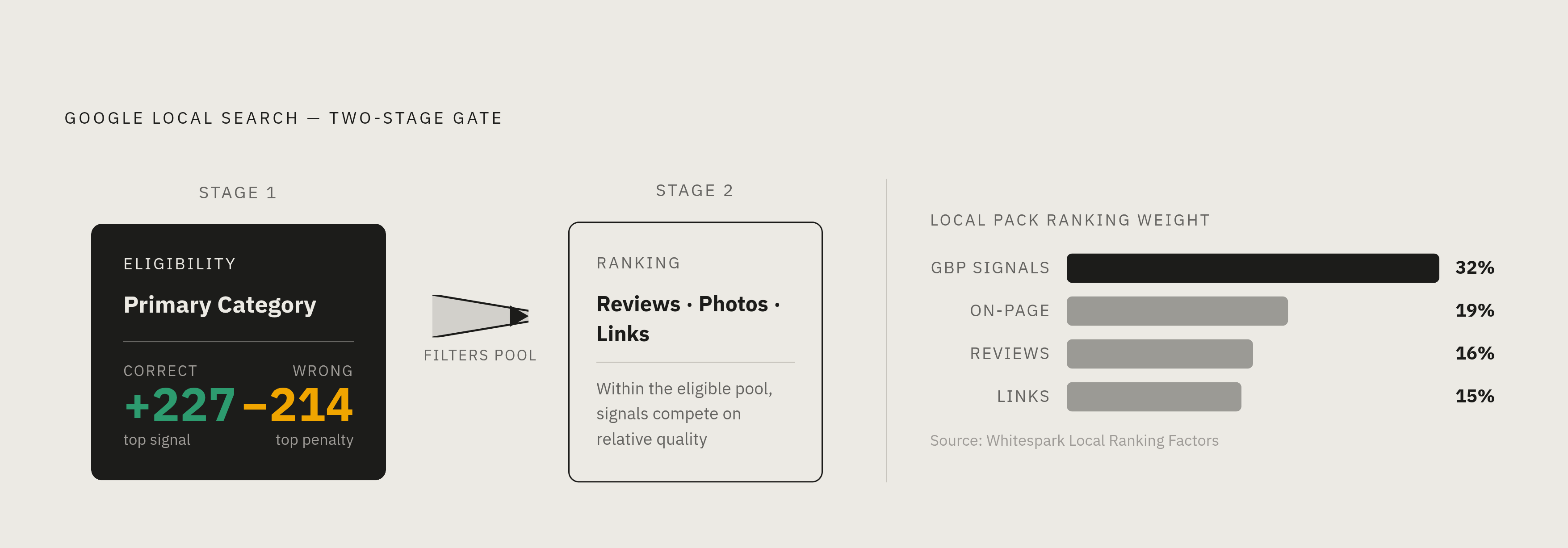
Categories and everything else on the profile do different jobs. Categories determine eligibility, meaning which pool of searches a business can even swim in. Reviews, posts, photos, and the rest determine ranking within that pool, once eligibility is already settled. This piece walks through both halves, but spends most of its time on the first, because that's the part almost nobody gets right on purpose.
Google's category system structure and the ranking data
Every Google Business Profile gets one primary category and can add up to nine secondary ones, for a maximum of ten total. The primary category appears publicly on the profile, visible to anyone who clicks through. Secondary categories stay hidden from the customer's view but remain fully visible to Google's ranking algorithm, which treats them as real signals even though no searcher will ever see the list.
Google's own guidance frames the choice this way: a category should complete the sentence "This business IS a ___." Not what it does, not what it sells. What it is.
The Whitespark 2026 Local Search Ranking Factors report puts numbers behind all of this, and the numbers are blunt. Primary category scores 227, making it the single highest-weighted individual ranking factor Whitespark tracks, ahead of review count, ahead of backlinks, ahead of proximity. An incorrect primary category carries a penalty score of 214, the second-largest negative factor in the whole report. That's not a small tax. A wrong category actively suppresses a listing, and the suppression is nearly as forceful as the boost from getting it right.
Additional GBP secondary categories rank at position 8 overall with a score of 173, up from 134 in 2023. That's not filler data entry. That's a top-10 ranking factor hiding in a field most business owners fill out once and never revisit. Primary category weight itself has climbed 17.6% over three years, from 193 in 2023 to 227 in 2026, which suggests Google is leaning harder on this signal over time, not backing off it.
When zoomed out further, the pattern holds. GBP signals as a group account for 32% of local pack ranking weight, the largest single factor group tracked, ahead of on-page signals at 19%, review signals at 16%, and link signals at 15%. Categories also unlock specific features, like booking buttons, service menus, and product catalogs, depending on what's selected. So there's a practical reason to get this right beyond ranking: pick the wrong category and certain features simply never appear as options.
Choosing the primary category: why "Plumber" is the right answer for virtually every plumbing business
For a general plumbing service business, "Plumber" is the correct primary category. This isn't a nuanced judgment call requiring a marketing consultant and a whiteboard session. A YDOP study of 26,519 US plumbing companies found that 94.21% use "Plumber" as their primary category. The industry has already run the experiment at scale and converged on an answer.
Run it through Google's own test. Ask what the business IS. A plumbing contractor is a plumber. Not a drainage service, not a general contractor, not a handyman who happens to own a pipe wrench. The category should match the plainest, truest description of the business, and for almost every plumbing company that description is one word long.
There's a legitimate exception, though it's narrower than it sounds. A business that operates primarily as a plumbing supply store, selling fixtures and parts rather than performing service calls, would use a category like "Plumbing Supply Store" instead, as ServiceTitan's 2025 guide notes. That's a different business model entirely, not a plumber who also happens to sell a few water heaters off the showroom floor.
Choosing something broader, like "General Contractor," "Contractor," or "Home Services," in hopes of scooping up more search traffic across categories, is the mistake to name directly. It reads like a clever hedge. It's actually the opposite. Broader categories dilute relevance and risk the kind of suppression Whitespark's 214 incorrect-category penalty score reflects. The primary category is one of the only fields in the entire profile-building process where creativity works against the business instead of for it. The obvious answer is also the correct one, backed by data from a large number of companies that already made this choice.
Secondary categories available to plumbers and the confirmed US English list
Beyond the primary "Plumber" designation, Google's US English category list includes several adjacent options. ShiftFlow's category guidance confirms the list includes Drainage service, Septic system service, Gas installation service, Hot water system supplier, Water treatment supplier, and Water softening equipment supplier.
Other guides published across 2025 and 2026 surface additional candidates. Drawbridge Marketing's January 2026 guidance lists Drain Cleaning Service, Water Heater Installation Service, and Emergency Plumber. HumbleHelp Studio's 2026 guide adds Water Heater Repair Service and Emergency Plumbing Service to that list, alongside its own mention of Emergency Plumber. Some 2025–2026 guides surface Bathroom Remodeler and Kitchen Remodeler as options for plumbers who do renovation-adjacent work.
Google updates its category options periodically, and exact naming shifts without much warning, so every category name needs confirming in the live GBP account selector at the moment of publishing or editing. Google updates its category options periodically, and exact naming shifts without much warning. Every category name needs confirming in the live GBP account selector at the moment of publishing or editing, not from a guide written months earlier. The ShiftFlow list above reflects a check performed on a specific date for a reason: this stuff moves.
None of what's listed here is a recommendation yet. These are candidates. Whether a given plumbing business should actually select any of them depends on a test that has nothing to do with what's technically available in the dropdown menu, and everything to do with what the business actually does day to day. That test is the subject of the next section.
The governing rule for secondary categories: operating as vs. being capable of
ShiftFlow's guidance draws the distinction that separates a defensible secondary category from a wishful one: the question was never whether a company can do the work. Most competent plumbers can clear a drain, work on a septic line, or handle a gas connection somewhere in the course of a normal job. The actual question is whether the company also operates as that other business type. Google's "this business IS a ___" framing backs this up directly: categories describe identity, not capability, not inventory.
Run the four most common candidates through that filter.
Drain work is the clearest case. A general plumber who clears sinks, tubs, toilets, and main lines on a weekly basis is doing normal plumbing work, and that work belongs in the Services section, not the category list. "Drainage service" as a secondary category only becomes defensible when the company markets drain and sewer work as its own distinct offer, takes drain-only service calls, owns dedicated equipment like a hydro jetter, and completes a real, sustained volume of that specific work. Occasional drain clearing doesn't clear that bar.
Septic work follows the same logic but with sharper edges, because licensing is often involved. Fixing a line that happens to connect to a septic system isn't the same as running a septic business. "Septic system service" applies when customers hire the company specifically for septic work, the team carries the right equipment and capability, required licenses stay current, and the company's own website honestly represents septic work as something it does. If pumping or tank service gets referred out to another provider, claiming the septic category is a stretch that doesn't hold up.
Gas work carries real regulatory weight. Gas piping or appliance connections that show up inside an ordinary plumbing job belong in Services. "Gas installation service" as a category is warranted only when gas work is a distinct, material line of business, backed by licenses, trained staff, and a clear path for customers to hire that work specifically. And choosing the category doesn't grant permission to do the work. Licensing requirements don't bend to a dropdown menu.
Water treatment and supplier categories work the same way in reverse. Installing a customer-supplied softener or swapping out a water heater is plumbing work. "Hot water system supplier," "Water treatment supplier," or "Water softening equipment supplier" only make sense when the company independently sells and supports those products as something closer to a retail or supply operation, not simply installing units that customers already bought elsewhere.
"Emergency Plumber" deserves its own warning, because it's tempting and easy to misuse. Emergency availability is an operating promise, backed by phone coverage, intake systems, actual hours, and dispatch capability. It's not a category a business claims because it occasionally squeezes in a same-day job. If a call at 2 a.m. goes to voicemail and gets a callback the next morning, that's not an emergency plumbing operation, regardless of what the profile says.
Carry this test into every one of these decisions: if a customer asked what kind of business this is, would the category be a truthful answer on its own, without further explanation? ShiftFlow's conservative method offers a handful of judgment signals to check that against, not Google-published rules but practical evidence: can customers hire that division directly without buying a general plumbing job first, does the company do that work often enough for it to matter, are staff trained and scheduled for it, is the equipment owned or reliably available, are the right licenses in place, and does the website or phone intake actually route customers toward that specific service. None of these signals are individually decisive. Together, they separate an honest category choice from a hopeful one.
How many secondary categories to use and what the expert disagreement means
Google allows up to nine secondary categories. That number is a ceiling, not a target, and current expert guidance splits into three camps on how close to that ceiling a business should actually get.
The focused camp argues for two to three secondary categories, on the theory that ranking weight gets divided across however many categories are selected. A business running six loosely related categories gets roughly a sixth of the relevance signal per category, while a competitor running two focused ones gets proportionally more per selection. The focused camp's guidance lands here: one specific primary category plus two or three genuinely relevant secondaries.
The maximalist camp sees it differently. Each secondary category functions as a doorway for a different kind of searcher, and someone typing "drain cleaning near me" only finds a business if "Drainage service" (or something like it) sits on the profile. LlamaRush's March 2026 guidance takes this position directly: add as many relevant secondary categories as Google allows, because every unclaimed category is a search the business can't be found in.
A middle position splits the difference. RankMeTop recommends limiting the list to three or four categories, aiming to keep relevance signals strong without spreading them thin. Drawbridge Marketing's January 2026 guidance lands close by, suggesting three to five total categories for most businesses.
So which camp is right? Probably neither, exclusively. The focused camp is protecting relevance weight, the maximalist camp is maximizing search eligibility, and both concerns are legitimate on their own terms. The operational test from the previous section applies regardless of any fixed number. The honest number of secondary categories for a given plumbing business is however many categories that business can defend under the "is this a truthful answer on its own" test, and not one more. It's however many categories that business can defend under the "is this a truthful answer on its own" test, and not one more. Given that secondary categories carry a confirmed Whitespark score of 173, good enough for a top-10 ranking factor, this isn't a decision to make on autopilot by just checking every plausible box.
What to put in the Services section and why most plumbers leave it nearly empty
While plumbing companies chase reviews and argue about category counts, the Services section sits there mostly untouched, which makes it one of the most consistently underused parts of the entire profile. It's an easy signal to build and an easy one to ignore, and most businesses do the latter.
The Services section lets a business list individual job types, each with its own description and, optionally, pricing. That structure gives Google's algorithm something concrete to match against specific searches, and it also feeds Google's AI-generated search summaries when someone types a natural-language question like "who does sewer camera inspection in [city]." A generic listing can't answer that question. A structured one can.
The common failure mode is adding one entry called "Plumbing" and calling it done. That's the equivalent of a restaurant menu with a single item labeled "Food." ClicksGeek and ShiftFlow's guidance says a plumbing business should break its work into distinct line items: emergency plumbing, leak detection, leak repair, faucet and fixture repair, fixture installation, pipe repair, pipe repiping, drain cleaning, hydro jetting, water heater repair, water heater installation, tankless water heater installation or conversion, sewer line inspection or sewer camera inspection, sewer line replacement, garbage disposal installation, and toilet repair.
Each of those entries works harder with a short, specific description attached, one that uses the language customers actually search for rather than vague marketing copy. "Tankless water heater installation near me" is a high-intent, long-tail search phrase, and a detailed entry gives the profile something concrete to match against it. Where the business is comfortable doing so, RankMeTop's guidance says adding starting price ranges increases both transparency and keyword relevance.
Two guardrails matter here. First, list only work the business currently accepts and can actually deliver. Aspirational service entries just create mismatched expectations and, worse, mismatched search results. Second, resist the urge to create a separate line item for every symptom, brand name, tank size, or city variation. Combine wording sensibly instead. A list that tries to cover every conceivable phrasing stops reading like a services menu and starts reading like keyword stuffing, which helps no one.
Services and this section get confused constantly, so it's important to be precise about how they relate. Services describe the actual jobs a customer can hire the business to do. Categories describe what type of business it is, structurally, at the identity level. They're complementary fields doing different work, not two ways of saying the same thing. That's why drain cleaning belongs in the Services section for the overwhelming majority of plumbers, rather than being used to justify adding "Drainage service" as a secondary category. One is a job. The other is an identity claim. Confusing the two is how businesses end up with categories they can't actually defend.
The business description field and service-area configuration that complete the profile foundation
The business description field allows up to 750 characters, and it's meant to explain what the company offers, who it serves, which areas it covers, what it specializes in (emergency repairs, for instance), and how long it's been operating. Treated as boilerplate, it's wasted space. Treated intentionally, it's another chance to reinforce exactly the signals the rest of the profile is already sending.
One practical habit: name specific service areas directly in the description. A plumbing business based in one city but regularly working in three or four surrounding towns should say so by name, not just imply it. Naming cities in the description reinforces local relevance in a way that vague phrases like "serving the greater metro area" simply don't.
Configuration also affects how the profile displays, separate from wording. Plumbers who go to the customer's location, rather than running a storefront customers visit, should set up as a service-area business inside the profile settings. That configuration hides the physical address (which usually doesn't need public visibility for a company that never sees walk-in customers) and allows listing up to 20 regions served. Whatever cities show up in that service-area list should also show up in the description and, where relevant, the Services section, so the geographic signal repeats across multiple fields instead of living in just one.
None of these fields work in isolation. Categories, services, description, and service-area settings all feed the same underlying structure Google uses to decide where and for what a business should show up. If one is skipped, the others do less work than they could. For a Midwest plumbing business competing in a market where a lot of competitors still haven't touched half of these fields, getting this foundational structure right is a major edge. It's infrastructure that most of the competition simply hasn't built yet.
Sources
- Plumbing Google Business Profile: Comprehensive Guide [2025]
- Google Business Profile Explained: A Guide for Plumbing Business Owners - Updated 2026
- Best Google Business Profile Categories for Plumbers
- Google Business Profile Categories Explained (2026 Guide)
- Google Business Profile Categories: The Complete 2025-2026 Guide
- Google Business Profile for Plumbers: Get More Calls in 2026
- The Best Google Business Profile Guide For Plumbers (2026)
- clicksgeek.com


