Local SEO for Real Estate Agents in Mid-Size Markets
Organic search leads close eight times faster than outbound calls for real estate agents.

Real estate agents in mid-size markets are sitting on a real advantage right now, and most of them have no idea. The demand is already local, already specific, and already searching, and the only question left is whose name appears when a buyer or seller searches.
Ninety-three percent of homebuyers use local search to find properties, and the phrase "real estate agent near me" has grown 41-fold since 2015, pulling in roughly 14,000 monthly searches. Add in that 76% of real estate searches carry location terms baked right into them ("Omaha condos near downtown," not just "condos"), and the picture gets clearer: buyers aren't casting a wide net. They're searching with geography already built into the query, which means the agent who shows up for that specific geography wins the click before the phone even rings.
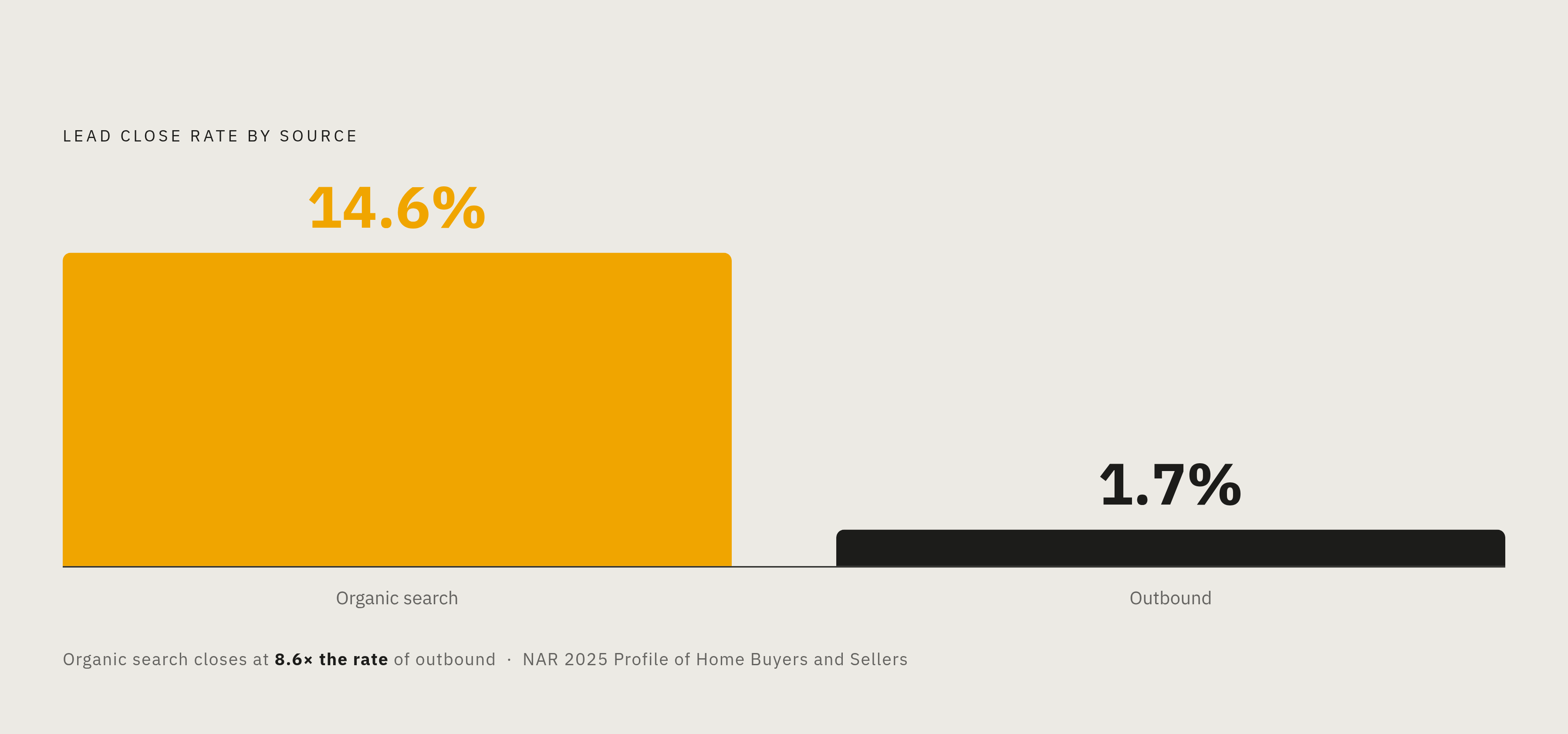
The buyer behind that search has usually done homework. Months of it, in some cases: comparing neighborhoods, reading market reports, checking review counts, narrowing down agents long before they ever fill out a contact form. That's the backdrop for everything that follows. SEO now accounts for roughly 53% of all real estate website traffic, and 54% of real estate professionals rank it as their single most effective marketing channel. Leads that come through organic search close at about 14.6%, more than eight times the 1.7% close rate for outbound leads, according to NAR's 2025 Profile of Home Buyers and Sellers. That's not a marginal gap. Leads through organic search close at about 14.6%, compared to 1.7% for outbound leads.
What makes mid-size markets a structurally different SEO environment
Mid-size markets, defined by Construction Coverage as cities with populations between 150,000 and 349,999, sit in an odd sweet spot. They're big enough to generate real search volume, but small enough that the competitive field hasn't been fully claimed.
National portals, Zillow, Realtor.com, Redfin, own the broad terms in every market, mid-size or not. "Houses for sale" and "real estate agent" belong to platforms with tens of thousands of indexed pages and budgets no independent agent can match. Trying to outrank them on those terms is a bit like challenging a grocery store chain to a price war on eggs. Not the fight worth having.
One level down is where the fight worth having is: neighborhood and locality-specific searches, where the portals thin out and a well-optimized local presence can actually rank. That's where mid-size markets diverge sharply from major metros. In New York, Los Angeles, or Chicago, that neighborhood layer is already saturated with entrenched brokerages and long-established top producers who've spent years building citation profiles and content libraries. In a mid-size market, that same layer often has a handful of agents doing this seriously, if that. Multiple industry sources suggest agents in these markets can realistically break into the Google Local 3-Pack and rank for neighborhood terms within months rather than years, though there's no single verified timeline that applies uniformly across markets, and results depend on local competition, current citation health, and content depth.
There's a financial argument for taking this seriously too. Seller-intent keywords in mid-size markets run $150 to $400 per lead on Google Ads, which isn't cheap. Agents running organic SEO alongside paid search see a combined return of roughly 3.1x, outperforming either channel run alone. This is a case for treating organic search and paid ads together rather than as a binary choice. It's a case for treating organic local search as the foundation and paid search as the accelerant.
Google Business Profile: the asset with the highest immediate impact
If there's one lever that moves the needle faster than anything else, it's the Google Business Profile. Whitespark's 2026 Local Search Ranking Factors survey, which polled 47 local SEO experts, found that GBP signals account for roughly 32% of local pack ranking decisions, more than review signals, on-page SEO, and backlinks combined.
Ninety-three percent of local intent searches trigger a Local Pack, and that pack captures somewhere around 42 to 44% of all local search clicks before a user even scrolls down. GBP is the primary storefront, not a listing agents fill out once and forget. It's the primary storefront.
The gap between a neglected profile and an optimized one is not subtle. Revalto's 2026 analysis found that agents with fully optimized profiles generate six to ten times more leads from Google than those who leave the profile alone, purely from reviews and optimization work, with zero ad spend involved. Most agents pull two to five direct calls a month from GBP. A fully optimized profile in a competitive market can generate 15 to 25, turning GBP from a line item into the business. That's not a rounding error. That's the difference between GBP being a line item and GBP being the business.
Category selection trips up more agents than it should. Solo agents need to select "Real Estate Agent" as their primary category, since "Real Estate Agency" is meant for the brokerage or team entity. Whitespark's 2026 report lists wrong primary category selection as a top negative ranking factor, and the penalty weight attached to it has gotten noticeably heavier since 2023. Secondary categories should reflect only the services actually offered, without padding the list unnecessarily.
Setup is the easy part. What separates a profile that ranks from one that doesn't is the ongoing maintenance nobody wants to do. That means posting 10 to 15 real, local photos (actual faces and actual listings beat stock photography every time), updating the profile weekly with new listings or market notes, and keeping business hours and service areas current. MarketingCharts data found that 59% of users will skip a business entirely if they run into inconsistent information. Fill in the Products section with real service descriptions instead of raw addresses, and don't skip the Q&A section, since it's one of the easiest gaps to close and one of the most commonly ignored.
Agents working out of a home office without a public storefront (Service Area Businesses) can hide their address on GBP and define coverage by city, ZIP, or radius instead. That setup carries a slight ranking disadvantage compared to verified physical locations, but strong relevance and prominence signals, meaning solid reviews and consistent activity, can close most of that gap.
Stuffing keywords into a business name ("John Smith, Real Estate Agent Omaha Luxury Homes for Sale") might bump visibility short-term, but Google's spam filters have tightened against exactly this tactic. Keep the business name as it appears on official documents. It's not worth the risk.
And GBP's reach now extends past the map pack. Whitespark's 2026 report confirmed GBP signals feed directly into Google's AI-generated local results, not just the traditional pack. Google's Gemini models use a feature called Grounding with Google Maps, which reached general availability in 2025 and connects to more than 250 million verified places, treating GBP data as the authoritative source for local answers, according to HousingWire's coverage. Agents with stale profiles aren't just slipping in the map pack anymore. They're becoming invisible to the AI systems doing the recommending.
Reviews: why velocity and specificity matter more than raw count
Nearly half of consumers, 47% according to BrightLocal's survey of 1,002 US consumers, won't even consider a business with fewer than 20 reviews. And 31% will only work with a business rated 4.5 stars or higher, a sharp jump from 17% the year before. The bar for "credible" has moved, and it moved fast.
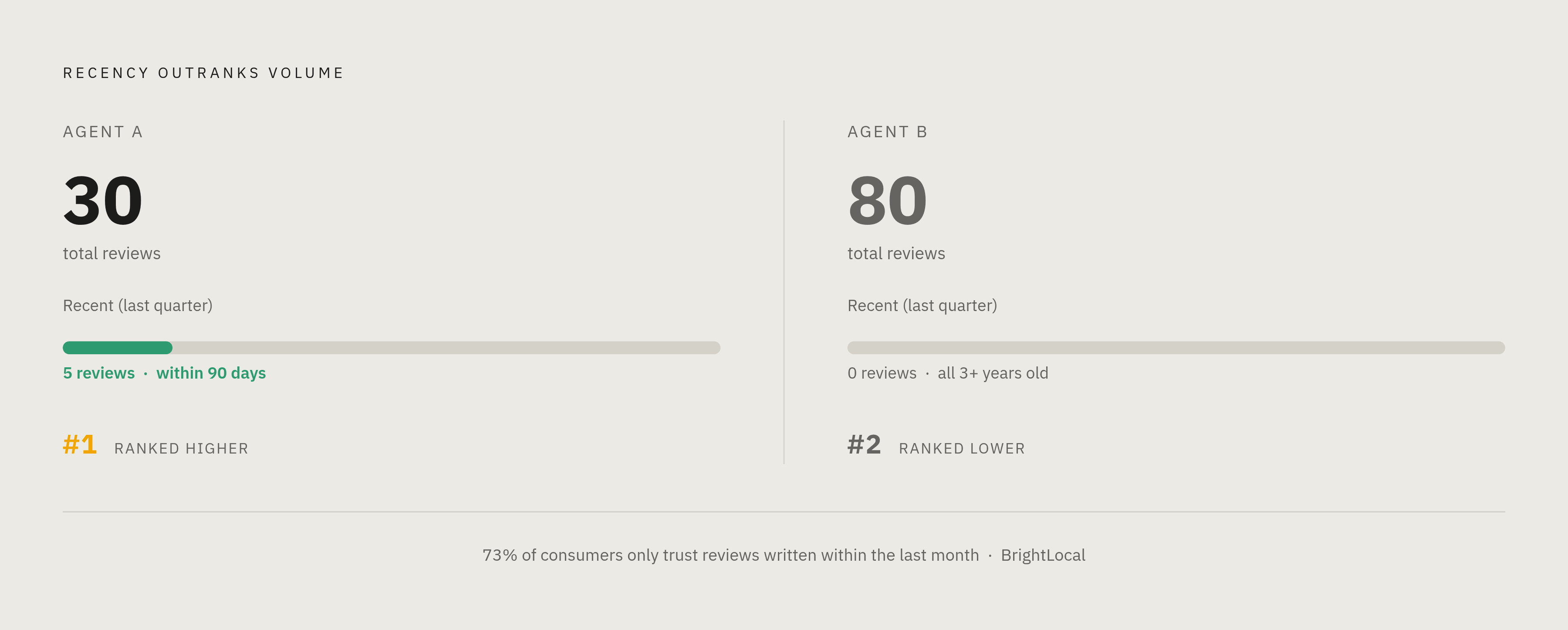
In active real estate markets, agents generally need 25 to 50 reviews just to be taken seriously. Cross 50 with a steady monthly flow and an agent is well-positioned to compete seriously in the Map Pack. But raw count isn't the whole story, and this is where a lot of agents get the math wrong. Velocity beats volume. An agent sitting on 30 reviews, five of them from last quarter, will usually outperform an agent with 80 reviews that all date back three years. Why? Because 73% of consumers, per BrightLocal, say they only trust reviews written within the last month. Recency is an ongoing requirement, month after month, forever. It's an ongoing requirement, month after month, forever.
The practical fix is boring but effective: ask every closed client promptly after closing, while the experience is still fresh in their head.
Responding to reviews does triple duty, which is a better return than almost anything else on this list. Google's own guidance confirms that responses feed local ranking signals. Separately, 89% of consumers read how a business responds to reviews, according to BrightLocal, so a thoughtful reply is doing PR work on every future reader, not just the person who left it. And responding to a negative review, even briefly, blunts a good chunk of the conversion damage that review would otherwise cause. Three outcomes, one five-minute action.
Content plays a central role in how agents rank and get discovered in local search. Encourage clients to mention the specific neighborhood they bought or sold in, whether it was a purchase or a sale, and what stood out about the process. Those specifics aren't just nice color for future readers. They become the raw material Google's AI systems pull from when describing an agent in search results and AI-generated answers. A review that says "Sarah helped us find a home in the Dundee neighborhood" is doing more SEO work than one that just says "Great agent, five stars."
In mid-size markets, this bar is genuinely reachable. Agents pulling 30 to 50 organic leads a month from local search have, without exception, paired review velocity with the neighborhood content depth covered further down.
NAP citation consistency: the silent compounding signal most agents ignore
NAP stands for Name, Address, Phone, and it's exactly what it sounds like: any online mention of a business's contact information. Every time that information matches exactly across the web, Google gets a little more confident the business is a single, real, stable entity. Every time it doesn't match, that confidence erodes a little.
This is boring work. Nobody gets excited about citation cleanup the way they get excited about a slick new website. But Whitespark's Local Search Ranking Factors survey of 47 local SEO experts ranks citation consistency among the strongest background ranking factors for the local pack, and arguably the single strongest signal that compounds over time without any extra effort once it's fixed.
More citations help, but only if they're accurate. A business with a hundred citations, a third of them listing an old address, is weaker than a competitor with thirty citations that are all correct. BrightLocal's analysis of top-ranking local businesses backs this up directly: top-ranking results in a given market tend to carry substantially more citations than results sitting at seven through ten.
Priority order matters here. Real-estate-specific platforms come first: Zillow, Realtor.com, Trulia, Redfin, Homes.com. Then the general foundations: Google Business Profile, Apple Maps, Bing, Yelp, Foursquare. Then the data aggregators, Localeze and Data Axle, where a single correction propagates out to dozens of partner sites, including Apple Maps, Bing, and other directory partners. Fix it once at the aggregator level and it ripples everywhere.
Format inconsistency is the silent killer here. A phone number listed as "(555) 123-4567" in one place, "555.123.4567" in another, and "555-1234567" somewhere else reads to Google's algorithm as three different businesses, not one business with sloppy formatting. Pick one exact format, down to the punctuation, and use it everywhere without exception.
None of this happens overnight, but the timeline is at least predictable. New structured citations typically begin appearing in directory search within a few weeks. Google re-crawls and folds new signals into its Knowledge Graph over a period of several weeks. Measurable movement in the local pack typically occurs one to three months out. The full compounding effect, especially paired with a healthy reviews program, plays out over several months. Cleaning up duplicate or outdated listings is among the faster-acting changes an agent can make. The work is unglamorous. The payoff is disproportionate to how little glory it involves.
Neighborhood content: the on-page layer that captures buyers before they contact an agent
If GBP is the storefront and reviews are the word-of-mouth, neighborhood content is the substance behind the sign, proving an agent actually knows the area rather than just claiming to.
The logic follows directly from the competitive layout described earlier. National portals own broad terms. The layer agents can win is neighborhood and locality-specific searches, which happen to carry both the highest purchase intent and the thinnest competition from the big platforms. Long-tail keywords, the longer, oddly specific phrases real buyers actually type, drive about 70% of real estate search traffic. Targeting them means trading a huge, mostly disinterested audience for a smaller one that's already halfway to picking up the phone.
The lead data on this is hard to argue with. Neighborhood-specific pages generate several times more leads than a generic page, and they consistently outrank broader, less targeted pages in local search results. A dedicated page for one neighborhood, done properly, will out-earn a vague page trying to cover fifteen.
"Done properly" has a specific shape. It needs at least 1,000 words of content that's actually useful. It should describe the character of the neighborhood, the typical home styles and price ranges, nearby schools and their ratings, local amenities, and commute options. Market trends should get updated monthly where possible. Live IDX search results should be embedded directly on the page so search engines can index fresh listing data rather than static text. And it needs a clear contact call-to-action along with internal links back to the homepage and related pages, so the whole site reads as connected rather than scattered.
Agents pulling 30 to 50 organic leads a month from local search tend to have 15 to 20 of these neighborhood guides forming the backbone of their site. That's the documented threshold across the agents actually hitting those lead numbers. A generic "Areas We Serve" page, by contrast, almost never ranks, because it spreads too thin to establish real topical authority for any single location.
Keyword structure across these pages should mirror how people actually search: "[City] homes for sale," "top realtor in [Neighborhood]," "[City] real estate agent," "new listings in [ZIP Code]," "[Neighborhood] real estate market update." Nothing exotic, just matching the language buyers already use.
Mid-size markets have a quiet structural gift here that major metros don't. The number of neighborhoods needing coverage is finite and, frankly, manageable. An agent in a market with a dozen or so distinct neighborhoods can realistically build full coverage solo. An agent in a major metro with dozens of fragmented submarkets is chasing a target that keeps multiplying. And this content layer doesn't work in isolation. GBP posts that link back to these neighborhood pages feed structured signals to the same AI systems drawing from both sources when generating local answers, which sets up the next shift entirely.
AI search and Answer Engine Optimization: what changes for local real estate in 2026
More than 60% of searches now end without a single click, because AI hands over the answer directly on the results page. SparkToro and Similarweb have taken to calling this the Zero-Click Era, and for real estate agents it changes not just whether a page ranks, but where an agent needs to show up at all.
Google's AI Overviews and Gemini pull from GBP data, structured website content, and review signals, the exact same assets that feed the traditional map pack. Agents keeping those assets current are turning up inside AI-generated answers. Agents who let those assets go stale simply aren't part of the conversation, in the same way a store with faded signage doesn't get mentioned when someone asks a neighbor for a recommendation.
Google isn't the only room this conversation happens in anymore, either. Agent Image's research found Reddit and ChatGPT tied at 11% of local business discovery, ahead of DuckDuckGo at 7% and Gemini at 6%. A meaningful slice of buyers are now asking ChatGPT, Perplexity, or Claude for agent recommendations the same way they'd ask a friend, which means agent visibility can't stop at Google's front door.
Answer Engine Optimization, AEO for short, is the practical response to that shift. Content should lead with short, direct answers, something in the 40 to 60 word range, sitting right at the top of blog posts and neighborhood guides before the longer explanation kicks in. Headers should sound like the questions people actually ask ("What are the best neighborhoods for families in Omaha?") instead of flat labels ("Omaha Neighborhoods"). Share of voice counts too: mentions in local news coverage, community forums, and local podcasts all count, since AI systems scan the entire web, not just a single agent's own site. And website, CRM, and IDX feed data should stay connected rather than siloed, because disconnected data confuses the models pulling from it and lowers the odds of getting surfaced at all.
This loops right back to the reviews section, and deliberately so. The neighborhood and transaction type mentioned inside a review become exactly the descriptors AI systems reuse when recommending an agent in a conversational answer. One good, specific review is quietly doing SEO work, AEO work, and trust-building work all at once, which is a fairly absurd amount of leverage for something that costs nothing but a well-timed text message.
None of this demands a bigger budget than a major metro agent has access to. It demands consistency: a profile updated weekly instead of annually, a citation list that matches down to the punctuation, reviews that keep arriving in a steady trickle rather than a single frantic push, and neighborhood pages built one at a time until the whole market is covered. Upnorthmedia, which works with small businesses across the Midwest, points to this exact pattern as the opportunity many local companies leave on the table: outdated digital infrastructure and low adoption of basic local search strategy, sitting there unclaimed simply because competitors haven't gotten around to doing the work yet. In a mid-size market, that ground doesn't stay empty forever. It just stays empty long enough for whoever moves first.