Real Estate Agent Personal Brand Website Essentials
With thousands of agents chasing each sale, a niche website becomes your only edge.

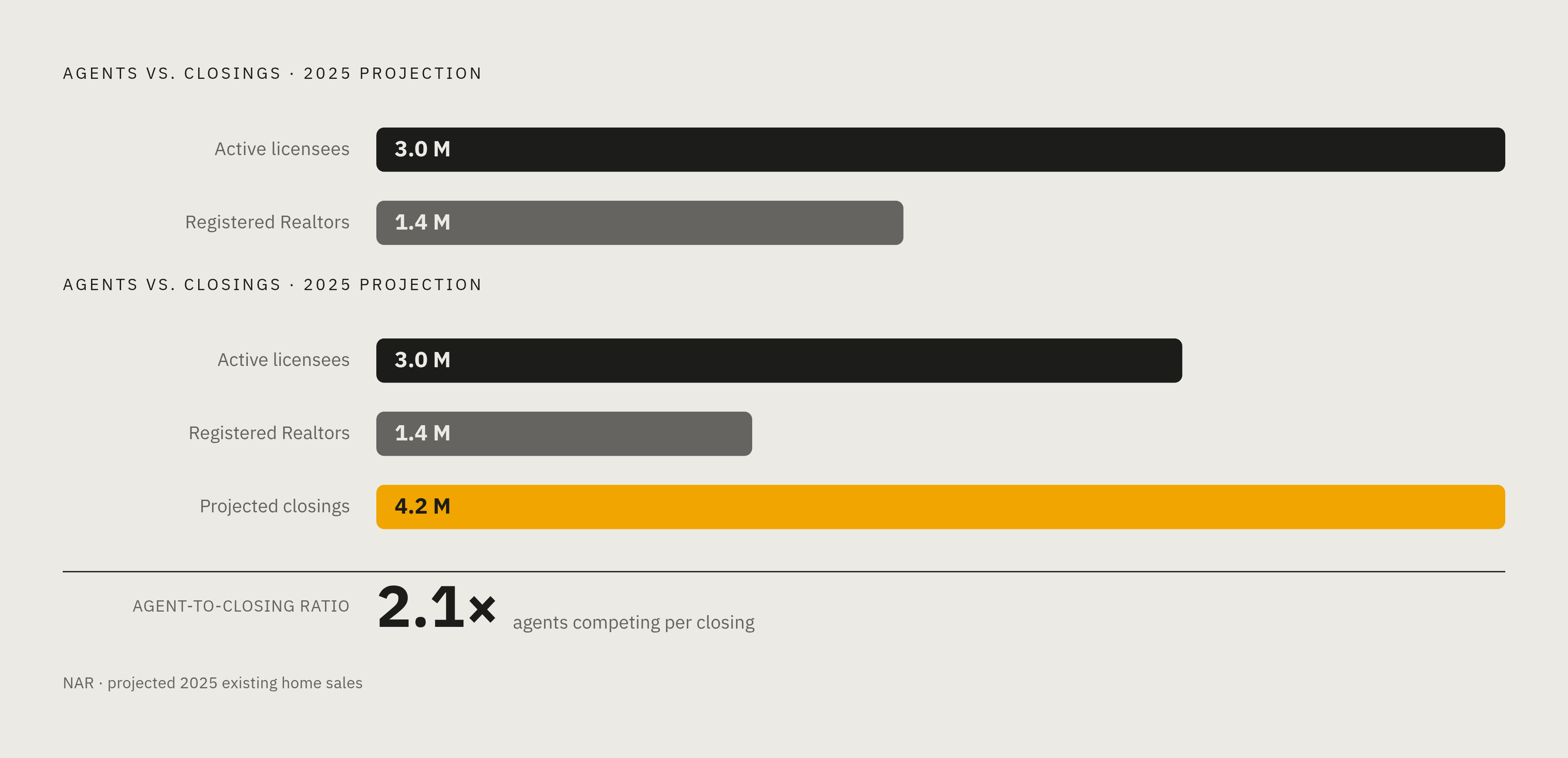
There are roughly 3 million active real estate license holders in a certain country, and more than 1.4 million of them registered as Realtors as of June 2026, according to a NAR report. Meanwhile, projections put 2025 home sales at around 4.2 million. Do the math and you get more than two agents competing for every single closing. That ratio is the whole reason a personal brand website matters now in a way it didn't a decade ago: when supply of agents outpaces demand for transactions, the site is often the only thing standing between an agent and total invisibility.
What niche positioning does on a website that a generic bio cannot
Start with the obvious question: why would a buyer pick one agent over another when both have a license, both show up in a Google search, and both say some version of "I love helping people find their dream home"? NAR's 2024 survey found buyers choose agents based on experience (21%), honesty and trustworthiness (19%), and reputation (15%). None of those get communicated through a stock headshot and a paragraph about loving the local community. They get communicated through specificity.
A luxury specialist, a first-time buyer champion, a relocation expert, a historic-home authority: each of these is a real position, and each one tells a visitor exactly who the site is for and who it isn't. That second part matters more than agents tend to think. A site trying to speak to everyone usually ends up speaking to no one, because the language required to reassure a first-time buyer (patient, educational, low-pressure) is almost the opposite of what reassures a luxury buyer (discreet, connected, fast-moving). Research on brand preference has found a majority of consumers in that same country. adults prefer to buy from brands whose values match their own, which only works if those values are actually stated somewhere instead of implied through soft-focus photography.
Here's the formula, and it's almost embarrassingly simple once it's written down: who you serve, plus how you help, plus what makes you different. "Helps first-time buyers in Omaha navigate the market using a background in construction cost estimating" is a sentence a past client can repeat to a friend without paraphrasing. A generic "trusted advisor for all your real estate needs" is not. And that repeatability matters directly: NAR's 2024 data shows 40% of sellers found their agent through a referral, and referrals travel on specificity. Nobody refers a friend to "someone who does real estate." They refer a friend to "the guy who sold three houses on my street last year."
Niche positioning demands more than a tagline exercise. It's the thing that decides what content gets built, which neighborhoods get their own page, which blog topics get covered, and which lead magnet gets offered on the homepage. Skip this step and every other section below has nothing to organize itself around.
The pages every personal brand site needs and what each one must do
The homepage carries more weight than agents generally assume, mostly because NAR's 2025 data shows 80% of sellers contacted only one agent before making a decision. Read that again: not three agents, not a short list. Just one. Which means the homepage isn't a warm-up act, it's often the entire audition. A visible call to action above the fold ("Book a Call," "See Listings," "Get a Home Valuation") needs to sit where a thumb can reach it, not buried under three scrolls of aerial drone footage. Buyer and seller paths should split immediately, because a seller hunting for a home valuation tool and a buyer hunting for listings are doing two different jobs and neither should have to dig.
The About page is where the niche from the last section actually gets to breathe. Placester's guidance on agent websites notes that specific, detailed bios convert reliably better than vague ones, which lines up with common sense: "I've helped 40 families relocate to the Dundee neighborhood over the past six years" tells a visitor something a bio can verify. "I'm passionate about real estate" tells them nothing verifiable at all.
IDX integration is where a surprising number of sites quietly sabotage themselves. If the listings widget resolves to a third-party domain instead of living natively on the agent's own site, Google credits that content to Zillow or Realtor.com, not to the agent. Placester runs as a widely used independent IDX platform, with more than 11,000 active users, and is noted by TheClose and HousingWire for its search and SEO tools. Real Geeks and CINC serve a similar function for agents who need heavier CRM and paid-lead infrastructure layered on top.
Testimonials deserve placement in more than one spot: homepage, About page, listing detail pages, and a dedicated Reviews page that can rank for searches like "[agent name] reviews." Past sales listed with actual addresses, price ranges, and context do something a bio paragraph structurally cannot, they prove a track record in a specific price tier and neighborhood. Video testimonials tend to rank among the highest-converting trust signals available, mostly because a stranger's face and voice are harder to fake than a block quote.
Neighborhood pages matter more than most agents give them credit for. "Homes for sale in Dundee" faces a fraction of the competition that "homes for sale in Omaha" does, and it pulls in visitors with sharper intent. A blog built around content clusters, one hub page on "Buying in Omaha" supported by pieces on financing, schools, and market trends, tends to outperform a scatter of disconnected posts, largely because Google's ranking systems now reward topical depth and internal linking over isolated articles.
How local SEO connects the site to buyers and sellers already searching
NAR's 2025 data shows 70% of buyers used a mobile device or tablet during their home search, which means local SEO isn't a nice-to-have layered on top of the site, it's the delivery mechanism for almost everything else described above. Data cited from REsimpli puts SEO at roughly 53% of total website traffic for agents. That's more than half the front door.
Neighborhood-level pages remain the sharpest lever available, precisely because they face less competition and attract visitors closer to an actual decision. But content alone doesn't hold a local ranking in place. Review velocity, a steady trickle of new reviews month over month rather than one bulk request sent out after a good quarter, plays into local pack rankings as an ongoing input, not a box checked once at launch.
IDX and SEO interlock in a way that's easy to underrate. Auto-generated pages for combinations like "3-bedroom homes in Dundee" capture long-tail searches that Zillow and Realtor.com frequently miss at the individual-agent level, simply because those platforms optimize for scale, not hyperlocal precision. Layer in Google Business Profile optimization, consistent local citations, and city or neighborhood names actually present in titles and headings, and that's the structural floor a site needs to stand on.
For agents in markets where fewer competitors have invested in foundational SEO, solid execution can compound quickly. The opportunity is arguably larger in those markets, not smaller, because fewer competitors have bothered to do the work.
Why mobile performance and page speed are conversion factors, not technical afterthoughts
Circle back to that 70% mobile statistic for a second, because it has a consequence agents tend to treat as a minor technical detail rather than a revenue problem. Slow load times meaningfully cut conversion rates, a cost that compounds on top of broader industry trends. In a year when overall web conversion rates already dropped 6.1% (per Contentsquare data reported via Figma), a slow-loading site isn't a cosmetic flaw, it's compounding a decline that's already happening industry-wide.
Bold, clearly clickable CTAs sized for a thumb rather than a mouse cursor are associated with a 33% higher click-through rate from mobile visitors. A set of website performance metrics tracked by a major search engine function as ranking signals and conversion signals simultaneously, which means a slow site gets punished twice: once in search rank, once in the bounce.
IDX widgets are a repeat offender here. An iframe pulling from a third-party domain tends to load slower and confuses search engines about who actually owns the content. A custom-built site, purpose-coded rather than stacked together from a dozen plugins, generally loads faster than a template-based build carrying features nobody uses. That's the argument for working with a development approach built around performance rather than convenience: speed isn't a bonus feature, it's table stakes for every other section in this piece to function at all.
The conversion tools that turn site visits into actual leads
A home valuation tool functions as the primary lead magnet for sellers: visitor enters an address, gets an estimated value, and has to hand over name, email, and phone before results appear. Published benchmarks for real estate landing pages put the median conversion rate at 2.6%, with a 7.4% average, and the spread between those numbers comes down almost entirely to execution and traffic quality. Zillow's 2025 research places the median seller consideration period at three to four months before actually listing, which means a valuation tool captures a lead early enough for a relationship to build well before any decision gets made. Following up with a personalized comparative market analysis, rather than a form-generated PDF, extends that relationship further.
CTA placement matters as much as CTA existence. A contextual call to action, tied to whatever the visitor happens to be looking at, converts better than a generic sidebar form asking for a name and a prayer. The landing page formula holds up across most examples: a headline stating exactly what the visitor gets, a short benefit description, action-specific button copy ("Get My Market Report" beats "Submit"), and no more than two or three form fields. "Schedule a Tour" through a tool like Calendly removes friction at the exact moment a buyer's intent peaks, which is precisely when friction does the most damage.
Response speed might be the most underrated variable in the entire list. Research suggests responding within 5 minutes can lift conversion rates by 5x to 10x compared to a 30-minute response window, and most agents simply move slower than that. Live chat or an AI chatbot bridges the gap when the agent is unavailable, with tools like ChatSpark cited as one option agents have started adopting. Automation handles the first response. Human judgment still handles qualification and the actual relationship. The tool works for the agent here, not the other way around.
What visual branding and professional photography actually communicate to a prospect
Data cited from REsimpli shows listings with professional photography sell 32% faster, listings with video draw 403% more inquiries, and listings with 3D tours get 87% more views than standard static listings. Those aren't rounding-error differences, they're the difference between a listing that sits and one that moves.
According to Matterport, 62% of U.S. buyers consider a virtual tour the single most important factor in their decision, and 71% of home shoppers say they'd make an offer after viewing a 3D tour. Separately, industry data shows agents who invest in professional photography for their own branding materials, not just listing photos, see significantly more online views compared to those using amateur images.
None of this works, though, without consistency. A site with a moody, editorial color palette paired with a social media profile that looks like a 2011 real estate flyer sends a confused signal, and confusion is the enemy of trust. A brand style guide, covering logo, colors, fonts, and tone of voice, should function as a living reference document, not a PDF generated once and forgotten. Closing-day photos, neighborhood walkthroughs, behind-the-scenes content: these humanize an agent in ways a headshot and bio paragraph simply can't reach. Audiences can tell the difference between a real personality and a performed one, so the visual identity needs to reflect how the agent actually operates, not an aspirational version that falls apart the moment a client meets them in person.
How the elements work as a system rather than a checklist
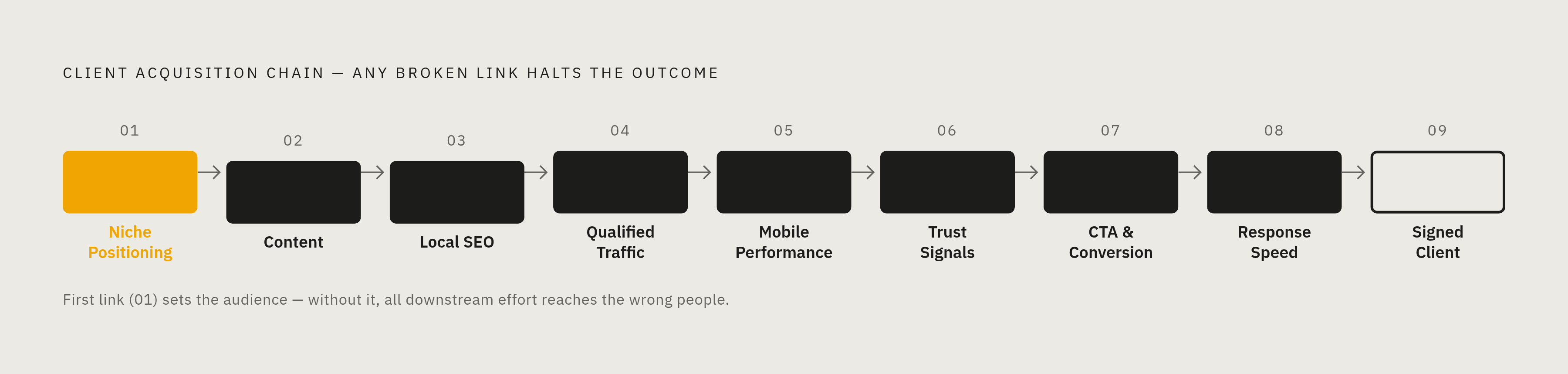
Here is the failure mode. An agent has an IDX page, a bio, and a contact form. Every box on the list is checked. And yet nothing converts, because niche positioning is missing, so there's no neighborhood content, so there's no SEO structure, so there's no traffic, so the fast-loading mobile site nobody visits doesn't matter anyway.
The logic runs in sequence, and it's worth tracing end to end. Niche positioning determines what content gets built. Content drives local SEO. SEO brings qualified traffic. Mobile performance keeps that traffic on the page long enough to read anything. Trust signals move a visitor toward a CTA. Conversion tools capture the lead. Response speed decides whether that lead becomes a client. Break any one link and the chain stops delivering, no matter how strong the other links are. A home valuation tool with zero traffic is decoration. Traffic landing on a site with no testimonials bounces. Testimonials on a site that takes nine seconds to load on a phone never get read in the first place.
Luxury Presence documented a case in 2025 involving agent Shannon Gillette, who generated close to 2,000 leads within nine months of launching a site built around her actual market expertise and a consistent visual identity, not cold outreach or paid ad spend, but inbound traffic finding a coherent brand and responding to it.
Circle back one more time to that 80% figure: most sellers contact exactly one agent. The site either earns that single shot or it doesn't get a second one. No individual element on this list, not the niche statement, not the IDX setup, not the photography, wins that moment by itself. For agents building or rebuilding a site in a market like Omaha, where local search competition runs lower than the coasts, the fundamentals here reach page-one faster than they would in a saturated metro, which makes a generic brokerage profile page a costlier mistake locally, not a safer one. The practical move is an audit in sequence: positioning, page structure, SEO, speed, social proof, conversion tools. Fixing one layer while the rest stay broken won't move the number that actually matters, which is how many of those one-shot contacts turn into a signed client.
Sources
- Personal Branding Roadmap for Real Estate Agents
- Personal Branding for Real Estate Agents: Build a Strong Name
- How to Create Powerful Real Estate Branding for Agents 2026
- The Rise of Personal Branding for Agents in 2025
- 28 Must-Have Real Estate Website Features (2026 Selection)
- housingwire.com
- resimpli.com
- luxurypresence.com


