IDX Website Setup for Independent Real Estate Agents
Independent agents own the domain, data, and leads—brokerage sites disappear when you leave.

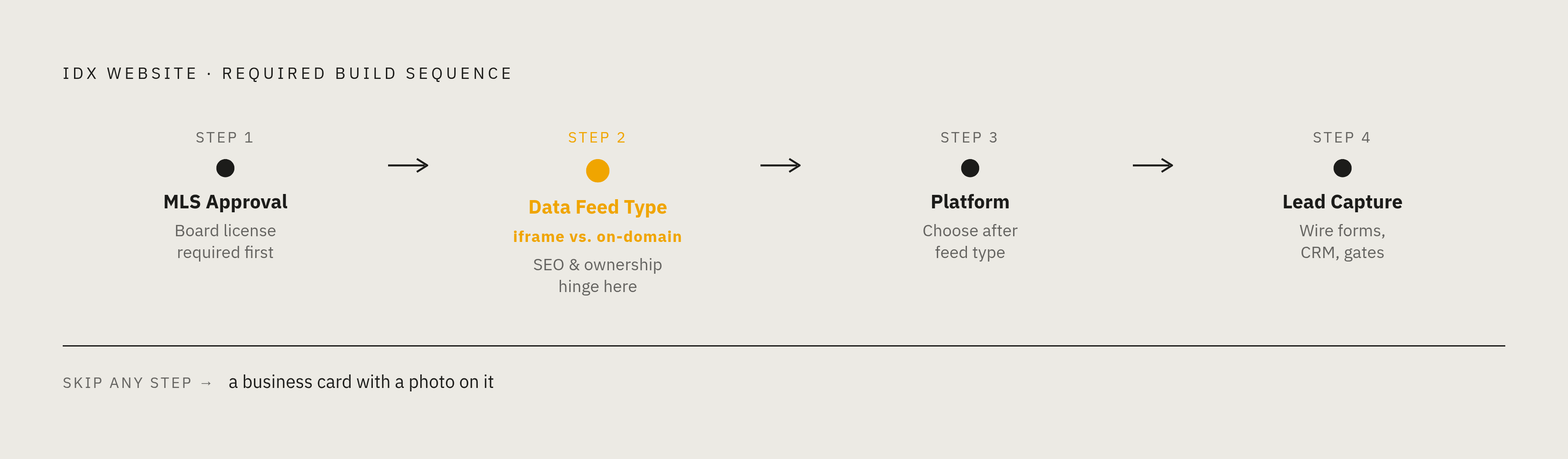
An IDX website turns an agent's page from a static profile into a working search tool that pulls live listing data straight from the MLS. The setup involves a fixed sequence: get MLS approval, pick a data feed structure, choose a platform, then wire the whole thing for lead capture. Skipping a step or misjudging one turns the site quietly into what most agent sites already are, which is a business card with a photo on it.
That's the sequence this piece walks through. Along the way, some numbers help frame why this matters. Zillow logged 2.4 billion visits in the first quarter of 2025 alone, against roughly 4 million homes sold across all of 2024 in the country. That's not a typo, and it's not close. Buyers are browsing constantly, mostly on someone else's platform, and 97% of homebuyers used the internet during their home search in 2024, according to a major industry trade group. IDX is the mechanism that lets an agent claim a sliver of that traffic on a domain the agent actually owns, rather than renting attention from Zillow's ad department.
IDX (Internet Data Exchange) is the NAR-established framework, both policy and technology, that governs how MLS listing data gets displayed on member websites. It's different from syndication, which is how Zillow and Realtor.com get their listings. That distinction explains why third-party portals sometimes show stale or incomplete data. IDX feeds pull straight from the source and update automatically as status changes, so a site with IDX shows a "pending" listing as pending, not still "active" three days after an offer got accepted.
Why the independent agent's situation is different from a brokerage-affiliated agent's
Big franchise brokerages hand out free IDX websites like conference swag. Keller Williams builds its agents a site through the KW Command CRM at no extra charge. Douglas Elliman gives agents subsites carrying IDX listings under the brokerage's own domain structure. On paper, that sounds like a solved problem.
That website belongs to the brokerage, not the agent. Leaving the brokerage means the site, the domain, the years of blog posts, the lead history, all of it stays behind. Nothing transfers. An agent who spent three years building organic traffic under a brokerage-branded URL starts over at zero the day they leave, as though none of that work ever happened.
That's the fork in the road. An independent agent, or one weighing independence, is optimizing for something different: control over brand, domain, lead data, and the follow-up process. None of those things belong to the agent under a brokerage site, no matter how nice the site looks. Anyone still under a brokerage but eyeing the exit should test the current site's lead routing and CRM connections before committing money to a separate build. It's a useful diagnostic. If switching feels expensive or restrictive even while still employed there, that's a signal about what leaving will cost later.
Independence comes with a real price tag, but at least it's a knowable one. The rest of this piece makes it concrete.
MLS membership and IDX approval: the prerequisite most agents underestimate
MLS membership comes before anything else. Active, good-standing membership is the entry ticket, and IDX display doesn't happen automatically the moment someone joins. IDX approval has to be requested separately, and the process runs through a layer most agents don't expect: the broker.
Working under a brokerage, even loosely, usually means the broker has to sign off on the IDX connection before the MLS turns the feed on. Most IDX vendors handle this paperwork themselves and send the authorization request to the broker directly, so it's less of a headache than it sounds. Fully independent agents holding their own broker license may face a different approval path. Fewer people are typically involved, but compliance responsibility falls more directly on the agent.
First move, before spending a dollar on any platform: call the local MLS board and ask what its IDX approval process actually requires. This varies by board, sometimes significantly, and assuming the rules from a friend's MLS apply locally is how agents end up stalled for weeks. Budget for the ongoing cost too. Most boards in the country boards charge somewhere between $10 and $70 a month per feed for direct data access, on top of regular MLS dues. That's a recurring line item forever, not a one-time setup fee that goes away.
How the data feed works, and why the iframe vs. on-domain decision matters more than platform choice
Most MLS organizations in 2026 run on the RESO Web API, which has mostly replaced the older RETS standard. Agents rarely touch this layer directly, but knowing the term helps when a vendor's sales rep starts talking about "feed compatibility" and an agent needs to know if that's marketing filler or an actual technical claim. IDX vendors typically refresh listing data every 15 to 30 minutes. Not real-time, but fast enough that nobody's showing a house that sold last Tuesday.
The decision that matters more than which platform gets chosen is how listings render on the site: iframe or on-domain.
An iframe embeds the vendor's search tool inside a frame on the agent's page. Functionally it works fine for the visitor, but every listing page technically lives on the vendor's domain. Google indexes that content for the vendor, not the agent. The agent's site gets the visit, sure, but none of the search equity, meaning none of the long-term ranking benefit that comes from a page actually earning authority in Google's eyes over months and years.
On-domain rendering builds each listing as an actual page on the agent's own site. That page can rank in Google for a local search like "3 bedroom homes Traverse City under 400k." It compounds. Every listing indexed is a small deposit into a growing account of search visibility, and unlike the iframe setup, that account belongs to the agent, not the vendor. For anyone planning to invest time or money into SEO down the line (and the last section of this piece deals with exactly that), on-domain rendering is essential. It's the entire mechanism that makes SEO investment worth doing.
Most agents never touch the raw feed connection themselves. Platforms maintain the MLS partnerships and handle that plumbing once approval clears. WordPress-based setups, using something like the IMPress plugin for IDX Broker, give agents real ownership: the site can move across hosting providers, survive a platform breakup, and isn't held hostage by any single vendor's pricing changes.
What an IDX setup costs for a solo agent
Total monthly cost for a typical solo build runs somewhere between $70 and $120, spread across four buckets that vendors love to quote separately so the headline number looks smaller than it is.
The IDX vendor subscription runs $40 to $150 a month depending on feature depth and how many MLS boards need connecting. Platforms bundling in a CRM or automated follow-up tools cost more toward the top of that range. Then there's the MLS board's own data-access fee, that $10 to $70 monthly charge mentioned earlier, layered on top of standard MLS dues. Hosting adds another $10 to $50 a month for anything running managed WordPress or a small VPS, assuming the site carries a few thousand listings. Hosting requirements scale with listing volume, so higher-volume sites typically need more than basic shared hosting. Finally, a one-time setup cost for a developer or designer to pick a theme, wire up search filters, and configure the initial import.
Custom and enterprise builds live on a different scale. A basic plugin embed runs $0 to $500 to set up plus $50 to $200 a month. A custom integration with branded URLs and listing pages built for search visibility runs $4,000 to $10,000 upfront, plus $100 to $300 monthly. A full brokerage-scale build on the RESO Web API can run $8,000 to $15,000 upfront with feed costs between $200 and $800 a month.
Watch for vendors who quote a friendly-looking monthly number, then charge separately for integration, hosting, SSL, and CMS access. Add every line item before comparing platforms, not just the sticker price on the homepage.
Weighed against paid lead sources, the math starts to make sense fast. Average cost per lead in real estate hit $100.48 in 2025, up 15.02% year over year. An owned IDX site with decent SEO chips away at that dependency over time, converting organic visitors instead of paying per click for every one of them.
Choosing between a WordPress plugin and an all-in-one IDX platform
Two paths, and they trade off against each other in a fairly predictable way. A WordPress plugin approach means building or already having a WordPress site, then bolting on IDX functionality through a plugin. More design flexibility, lower entry cost, but it usually means running a separate CRM and wiring the two together by hand. An all-in-one platform bundles the IDX search, the website builder, lead capture, and CRM into a single subscription. Faster to launch, less technical fuss, but the agent ends up more locked into that vendor's ecosystem than a WordPress setup would allow.
WordPress gives real ownership. The site is an asset that can move hosts, survive vendor changes, and isn't hostage to any one company's roadmap. An all-in-one platform trades some of that flexibility for speed, which makes sense for an agent who wants to be up and running in a week without deep customization plans.
General site builders like Wix or Squarespace work fine for agents just getting comfortable with website basics, but their IDX integration options lag well behind WordPress or the dedicated platforms covered next. If organic search ranking is the long game, WordPress with on-domain rendering gives the most control. If speed to launch and lead automation matter more right now than long-term SEO architecture, an all-in-one platform is the more sensible starting point.
The main IDX platforms available in 2026 and what each is suited for
IDX Broker runs three tiers: Core at $60 a month covers MLS search, lead capture, an interactive map, and AI-driven automated emails. Engage at $99 adds market reports, sold-listing data, and AI Smart Search. Elite at $149 throws in a full custom-designed website on top of everything in Engage. All three carry a one-time setup fee, and the platform serves more than 10,000 agents. Its free WordPress plugin, IMPress for IDX Broker, drops MLS search into any existing WordPress site. Best fit: agents already running custom WordPress builds who want deep control without starting from scratch.
Placester starts at $59 a month and claims more than 11,000 active users, making it the most-used IDX platform among independent agents behind only Keller Williams' in-house system. It pairs IDX with AI-assisted content tools and a built-in CRM, and its "Do It For Me" tier has Placester's own team build and maintain the site for agents who'd rather not touch a settings panel. The tradeoff is CRM automation lighter than some competitors, so agents chasing serious pipeline tracking may need a second tool alongside it.
Showcase IDX runs Essentials plans around $94.95 a month, with Premium tiers between roughly $124.95 and $129.95. It leans toward visual polish and buyer experience, which suits agents who invest heavily in content marketing. CRM tools here trail behind iHomeFinder or Sierra Interactive, so heavier automation needs mean pairing it with a dedicated CRM.
iHomeFinder builds its entire structure around agent workflow: search, lead capture, and CRM in one connected system. It pulls leads in from a range of outside services and includes detailed analytics. Good fit for agents who want MLS data tied to a workflow-first CRM without stitching together a separate stack.
OSI IDX charges $59 a month plus $25 per additional MLS feed, flat, with no upsells for CRM integration or single-property landing pages. The company has served real estate since 1982 and carries BBB accreditation. OSI builds the site directly on the agent's own domain, no iframes, no clunky plugin workaround, and the agent edits content independently once it's live. Fits agents who want a done-for-them build at a predictable price with nothing hidden in the fine print.
AgentFire runs setup fees from $700 to $6,000 with monthly costs between $149 and $199, according to Placester's comparison data, and currently ranks first overall across Google, Facebook, Trustpilot, and G2 among real estate website platforms. Suited to established agents or teams chasing a high-end, hyperlocal SEO strategy built around neighborhood content.
Real Geeks runs $399 to $1,799 a month, fully integrated IDX plus CRM in one package. Design options run more limited than some competitors, but lead capture and behavioral tracking are the real strength here, which makes it a natural fit for agents running heavy PPC campaigns.
Sierra Interactive costs $299.95 to $599.95 a month, built for performance at volume: customizable templates paired with a sophisticated CRM meant for high lead flow. The price tag reflects the depth of automation, and it fits high-volume teams running Google Ads or Facebook campaigns rather than a solo agent doing a handful of deals a year.
Custom development remains an option outside any packaged platform, for agents who want total brand control, listing URLs built for search visibility, and a site matched to their exact workflow. That runs $4,000 to $10,000 upfront plus $100 to $300 monthly, and agencies focused on small-business web work can construct a custom on-domain build where the agent owns every piece of the site and isn't locked into any single vendor's pricing or roadmap.
Configuring the site for lead capture once IDX is live
Traffic alone doesn't generate leads. A visitor can search 40 listings and vanish forever if nothing on the site asks for their contact information at the right moment.
Registration gates require an account before a visitor can save a search or see full listing details. Where that gate sits (immediately, or after a handful of views) shifts both how many leads come through and how serious they tend to be. Listing alert sign-ups let visitors opt in to email notifications when new matches hit their saved criteria, and that's a strong intent signal since nobody sets up an alert for a house they're not serious about. Contact forms attached to individual listings ("schedule a showing," "ask about this property") capture interest at the exact moment it peaks. Home valuation tools flip the script entirely, pulling in sellers instead of buyers, a completely different audience than the search-and-browse crowd.
None of that matters if the leads sit in an inbox nobody checks. Every lead captured through IDX should flow automatically into a CRM, since manual entry defeats the point of building automation. Most platforms either bundle a CRM or connect to one directly. IDX Broker links to IXACT Contact for an added $50 a month, and iHomeFinder pulls leads from more than 30 outside services. Speed counts too: IDX Broker's Core plan sends real-time text alerts the moment a new lead registers, because the window to make first contact closes fast, and a lead that goes cold overnight rarely warms back up.
IDX pages have to display required MLS attribution and follow display rules set by the local board. Most platforms handle this automatically in the background, but confirming it before flipping the site live is better than finding out after a compliance letter arrives.
The SEO work that determines whether an IDX site generates organic traffic over time
Getting IDX approved and wired up is the infrastructure. Whether that infrastructure ever produces a lead without a paid ad behind it comes down entirely to SEO, and that work starts with the architectural choice covered earlier: on-domain rendering. A listing page that lives on the agent's own domain, rather than inside a vendor's iframe, is a page Google can actually credit to that domain.
From there, it's mostly about specificity. A page targeting "homes for sale downtown Ann Arbor with a garage" captures a narrower, more qualified search than a generic "homes for sale Michigan" page ever will, and narrower usually means the visitor is further along in deciding to buy. Local content, neighborhood guides, school district breakdowns, market update posts, gives Google more reasons to associate a domain with a specific geography, which is what a local buyer's search is built to reward.
For agents serious about that long-term organic path, on-domain architecture isn't a technical footnote, it's the foundation the whole SEO strategy sits on. That's precisely why agencies working in web design and SEO for small businesses tend to steer real estate clients toward on-domain builds from the start rather than an iframe shortcut that looks fine in year one and leaves nothing to show for it in year three. Every listing indexed under an iframe setup builds equity for somebody else's domain. Every listing indexed on-domain builds equity for the agent's.
That's the trade running through this entire piece, really. Speed and convenience on one side, ownership and compounding value on the other. Neither answer is wrong, but knowing which one's actually being chosen, instead of stumbling into it through whichever platform had the flashiest demo, is the difference between an IDX site that works quietly for years and one that just sits there looking like a business card with better graphics.