How Lawyers Should Actually Market Themselves Online
Focus on what actually matters: website speed, reviews, and local search presence.

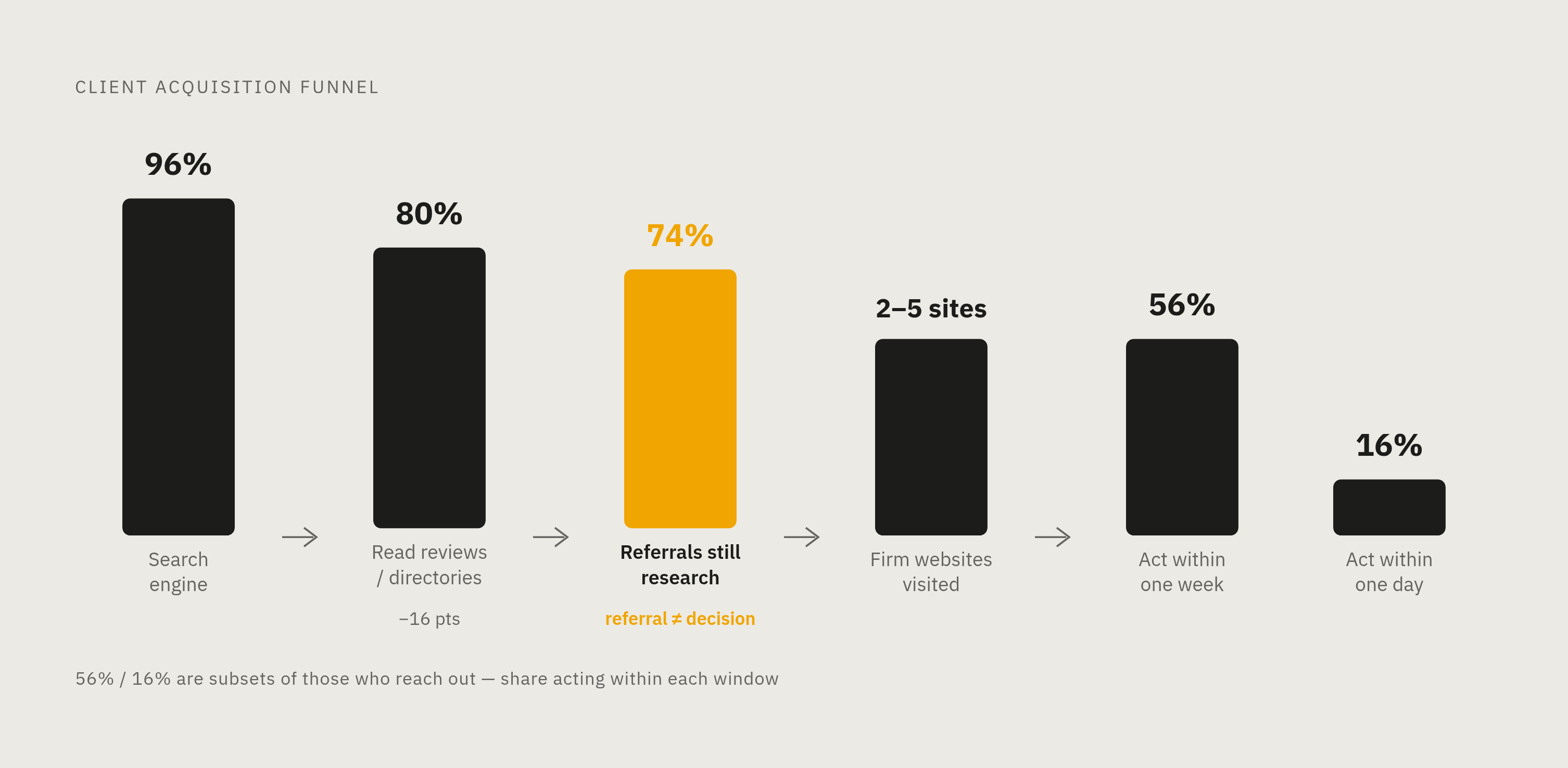
96% of people looking for a lawyer start with a search engine. That single number explains almost everything else in this piece: why 418,181 law firms in the country as of 2024 are competing for the same handful of search results, why legal ad spend is projected to top $3 billion by 2026, and why a large share of firms believe they've dumped money into campaigns that produced nothing worth counting. The gap between firms that win online and firms that just spend online is not budget. It's whether the fundamentals, the website, the local search presence, the reputation, actually hold up once someone clicks.
How today's clients find and choose a lawyer
Legal problems don't wait for convenient timing, and neither do the people who have them. 56% of clients act within a week of recognizing a legal issue, and 16% move within a single day. That's not a sales funnel; it's a sprint, and a firm that takes three days to return a contact form submission has already lost a meaningful chunk of that field before the race even started.
What's interesting is what happens to the referral, supposedly the gold standard of client acquisition. It turns out a referral is now more of a suggestion than a decision: 74% of clients who get one still go research the firm independently anyway. So Grandma's recommendation gets the search bar treatment same as everyone else. On average, prospects check between two and five different law firm websites before reaching out, and 80% read reviews or check legal directories somewhere in that process. The lawyer is being audited, not hired off word of mouth anymore. They're being audited.
That raises an obvious question: if referrals get re-verified and reviews get read before anyone picks up the phone, what exactly is a firm's "reputation" made of these days? Increasingly, it's made of pixels, star ratings, and load times.
What a law firm website must do to convert visitors
Law firms consistently rank their website among the highest-return marketing investments they run, ahead of billboards, radio spots, and whatever a sponsored bench outside the courthouse costs these days. But a website only earns that return if it does its job in the first few seconds, because that's roughly all the time it gets.
Research consistently finds that website design shapes how credible visitors think a firm is. A cluttered layout or a font that looks like it was chosen many years ago doesn't just look dated, it reads as a signal that the lawyer running the practice might handle a case with the same lack of attention. Fair or not, that judgment happens instantly, and it happens on a phone: a substantial and growing share of legal searches now occur on smartphones, and a firm's mobile experience directly affects how it performs in search rankings.
Speed decides the rest. If a page takes longer than two seconds to load, close to a third of visitors bail before they've read a word. Two seconds. That's not a lot of runway for a hero image, an autoplay video, and a chatbot popup all fighting for bandwidth at once. A slow website isn't a technical inconvenience, it's a closed door with a "we were open, you just didn't wait" sign taped to it.
SEO as the compounding asset at the center of attorney marketing
An analytics firm's data shows 94% of law firms name search engines as their top channel for building brand awareness, and organic search drives as much as 66% of call conversions in the legal industry. Those two numbers together explain why SEO isn't a nice add-on to a marketing plan, it's closer to the marketing plan itself, with everything else orbiting around it.
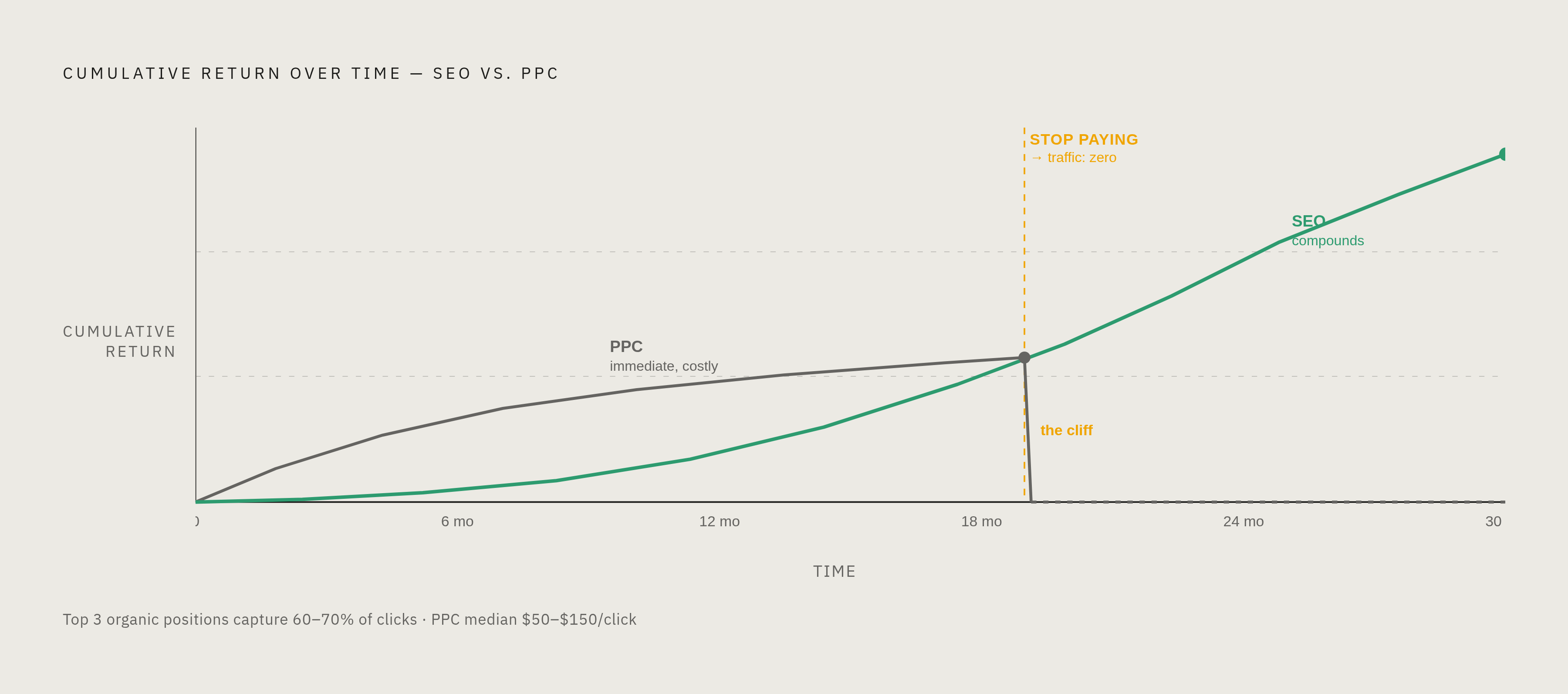
Firms in the top three organic positions capture somewhere between 60% and 70% of all clicks for legal search terms. Everyone below that splits the remaining third or so among however many firms are still fighting for page one. Position four isn't a consolation prize, it's a rounding error.
What makes SEO different from paid ads is the shape of the payoff. A pay-per-click campaign is a rental: stop paying, and the visibility disappears the same afternoon. Rankings built through SEO behave more like a lease-to-own arrangement, content, backlinks, and topical authority accumulate over time, and once a firm's practice-area page ranks for "car accident lawyer" in its city, it keeps pulling in calls without a fresh check being written for each one. That's the compounding part. It's slower to build than a PPC campaign, but it doesn't evaporate the moment the invoice stops.
Local SEO and Google Business Profile (where most legal searches convert)
44% of law firm leads come from local search results, showing local relevance outweighs national rankings or broad practice-area terms. Nobody hiring a divorce attorney cares whether a firm ranks well in a different state. They care whether the firm ranks well three miles from their apartment. Local SEO doesn't just move traffic either, it moves the number that actually matters: consultation bookings increase by 41% when local SEO is done properly.
The centerpiece of all this is the Google local pack, the box with the map and three business listings that sits above the regular search results. It's arguably the single most valuable piece of free real estate available to a law firm, and it's driven almost entirely by signals from a firm's Google Business Profile. That profile isn't a "set it and forget it" listing, though a lot of firms treat it that way and wonder later why they're not on the map.
What actually moves the needle: filling out every field in the profile with precision, not just the required ones, and choosing categories that match the practice exactly rather than a close-enough guess. Keyword presence in the business description matters, as does the number and recency of reviews (a profile with 40 reviews from three years ago is treated very differently than one with 15 from the past two months). Beyond that, Q&A activity, regular posts, and photo engagement all factor in. None of this is exotic. It's maintenance, the digital equivalent of watering a plant, except the plant sends clients.
Paid advertising in the legal market: cost and fit
Legal carries the highest average cost-per-click of any industry, and it's not particularly close. Lawyer PPC campaigns typically run $50 to $150 or more per click, and there's real regional variation baked into that range: Northeast markets average $468 in cost-per-lead versus $314 in the Midwest, a 49% gap between two firms that might be running functionally identical campaigns.
That price tag reframes what paid ads are actually for. A firm running PPC without an organic foundation pays full retail for every single visitor, forever, because it has built no compounding asset that would soften the cost over time. Paid ads work best as a complement layered on top of SEO.
Google's Local Services Ads offer a cheaper way in, structurally. Instead of paying per click, a firm pays per qualified lead, so the meter doesn't run on window-shoppers who click and bounce. LSAs also carry the Google Verified badge, which functions as a built-in credibility stamp for prospects who might not know a firm from a hole in the wall. Cost benchmarks vary sharply by practice area: costs vary meaningfully by practice area, with high-stakes categories like personal injury commanding significantly higher per-lead prices than lower-stakes areas. A detail that should prompt any firm currently ignoring LSAs to check their dashboard.
Online reputation: how reviews determine whether traffic becomes clients
Reviews aren't a garnish on a marketing strategy, they're load-bearing. 80% of prospective clients read reviews and check legal directories before hiring, and that 74% referral-research figure from earlier means reviews now get scrutinized even by people who arrived with someone else's endorsement in hand. A firm can have the fastest website in the county and still lose the client at the review section if the last five ratings look thin or ignored.
Reviews also feed directly into local pack rankings. Recency and volume are explicit ranking signals in Google's system, so a review strategy isn't just about reputation management in the abstract, it's SEO in disguise wearing a customer-service costume.
What a working reputation system actually looks like: a review request process that's systematic rather than "oh, we should probably ask sometime", sent at the moment client satisfaction peaks (typically right after a matter resolves well, not three months later when the memory's gone fuzzy). Every review gets a response, the five-star ones and the one-star ones alike, because responsiveness reads as a signal to Google and to the next prospect scrolling the profile. Presence matters across the platforms clients actually check, Google, Avvo, Martindale, Justia, and whatever directory is relevant to the specific practice area. On-site testimonials and documented case results round it out, doubling as trust signals for visitors and as content that supports the experience-and-expertise signals search engines look for when deciding whether a page deserves to rank.
Measuring what matters so marketing spend stops being guesswork
22% of law firms say they can't measure their marketing results. Combine that with the 74% who believe they've wasted budget on underperforming campaigns, and firms aren't losing money because marketing doesn't work, they're losing money because they can't tell which parts of it are working and which parts are lighting cash on fire in a very professional-looking way.
Only 18% of firms use multi-touch attribution, the practice of tracking a client's path across multiple touchpoints rather than crediting whichever channel happened to be last. Meanwhile 46% of marketing budgets go toward remarketing campaigns that, by definition, depend on knowing which earlier touchpoint to remarket against. That's a fairly large mismatch between where the money goes and where the visibility exists.
Organic traffic broken down by practice-area page (are family law searches actually landing on the family law page, or somewhere else entirely), local pack appearance rate for target keywords, and the specific actions taken from a Google Business Profile, calls, direction requests, website clicks are the KPIs worth tracking, and they're frequently ignored. Form submissions and phone volume should be separated by source, SEO, LSA, PPC, direct, so a firm actually knows whether that PPC spend is pulling weight or just pulling money. Consultation bookings from digital channels, cost-per-lead, and review count and rating over time round out the list. None of these are vanity metrics, unlike, say, total impressions, which sound impressive on a slide and mean almost nothing about whether the phone rang.
The tools for this aren't exotic either: Google Analytics for traffic and goal tracking, call tracking software to attribute inbound calls back to their actual source, and the native dashboards inside Google Ads and Local Services Ads for paid performance. None of it requires a data science degree. It requires someone actually looking at the numbers on a schedule, which turns out to be the rarest resource in the entire legal marketing conversation, rarer than a two-second load time, rarer than a five-star review that wasn't left by someone's cousin.


