What Makes an Optician Website Win Against LensCrafters and Warby Parker
Local search favors independent opticians who can personalize what chains can only template.

Independent opticians hold more ground in eye care than their marketing budgets have any right to defend. This piece looks at why, and at the specific website decisions that let a small independent practice outmaneuver a chain with 900 locations.
Independent opticians still hold meaningful ground against chains that dwarf them in spending
Independent opticians control roughly 53% of primary eye care patient share. Corporate chains, LensCrafters and Warby Parker chief among them, are around 32% combined. That gap holds even though the corporate side spends more on marketing in a single quarter than most independents spend in a decade. So how does a practice on a side street outcompete a company that owns close to a third of the entire US eyewear market?
The answer lives mostly online, in the gap between what a chain can build at scale and what a single practice can build for its own zip code. EssilorLuxottica, the parent of LensCrafters and a handful of other familiar names, holds close to 28% of the US market on its own. Warby Parker keeps opening stores, roughly 40 per year through 2024–2025, with about 80% of locations now offering eye exams alongside the frames. Stack those numbers against the Vision Monday Top 50, the annual ranking of the biggest US eyewear retailers, and the scale gets almost comic: the top 10 retailers on that list account for 83.8% of all Top-50 revenue.
And yet patient share doesn't move the way that kind of revenue concentration says it should. Independents still hold the majority of primary eye care relationships in the country. Something about the chain model, for all its buying power, leaves room on the table, and figuring out what that something is turns out to be the whole point of this piece.
Where the chains' digital operations underperform
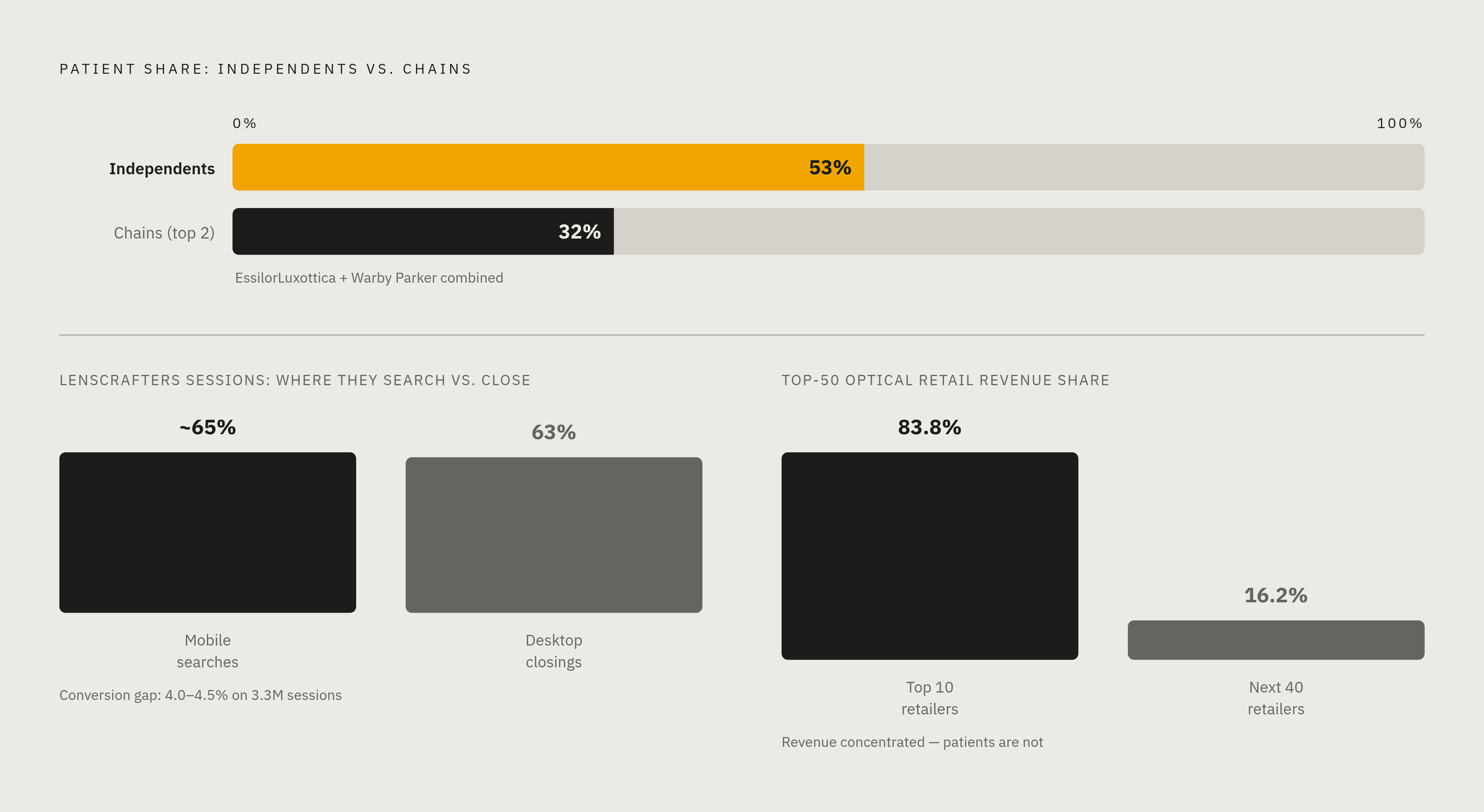
Warby Parker's website ranked among the top eyeglasses ecommerce destinations in mid-2026, pulling in strong revenue off roughly 5.9 million sessions, converting between 3.00% and 3.50% of visitors into buyers. LensCrafters.com trailed in raw revenue but converted better, in the 4.00% to 4.50% range, across 3.3 million sessions.
63% of LensCrafters' July 2026 sales closed on desktop. In 2026, when most local health searches, eye care included, happen on a phone in someone's hand, standing in a pharmacy line, wondering if that eye twitch means anything. A national retailer with a nine-figure online business is still converting most of its traffic on the device fewer and fewer patients actually use to search.
Why does that happen at a company with that much money and that much data? Because chain websites get built for national volume first. Templated service pages, location listings that swap in a city name and a phone number, copy tuned for the broadest possible audience, none of it can be authentically localized across 900 stores. A template cannot know that a given zip code has three school districts running vision screening programs this fall, or that the local referral network runs through two specific retina specialists. An independent site can know that. A templated system can't scale that level of detail without losing what made it useful.
The structural differences between boutique optical and chain retail that a website must communicate
Three differences separate boutique optical from chain retail, and all three are countable rather than a matter of taste. Frame curation: an independent typically stocks somewhere between 40 and 150 frames, hand-selected, against 800 to 3,000 stock items at a chain. Staffing: independents lean on licensed opticians, while chain floor staff, in states without licensure requirements, often start as entry-level trainees. Fitting time: an independent fitting runs considerably longer than the typical chain encounter.
None of that is a soft claim about personal touch. It's measurable, and most independent websites never say any of it out loud. A patient browsing a homepage full of stock photography and a book-now button has no way to know the practice down the street spends three times as long on a fitting, or that its frame options got narrowed from thousands down to a curated set because someone with certification made a judgment call about face shape and prescription.
A curated frame selection is a filter, applied by a trained human, against the real risks of buying eyewear without an in-person fitting: complex prescriptions, high astigmatism corrections, progressive lenses that need precise measurement. It is not simply a smaller catalog because the shop couldn't afford more inventory. That's the entire pitch, and it needs to live on the website in plain language, not buried three paragraphs into an About Us page nobody reads.
The concierge model boutique hotels perfected decades ago applies here more directly than it sounds. An optometrist telling an optician, "flag the digital eye strain, pull the lens filters," and having that actually happen before the patient sits down, is a coordinated two-person clinical handoff. A chain running 900 locations cannot replicate that consistently, because its operating model was never built around that kind of continuity. Scale and personalization pull in opposite directions. That tension is the independent's entire opening, and most independent websites don't even mention it.
Independents' structural edge in local search for eye care queries
Local search for eye care favors small, geographically rooted practices almost by design. About 42% of local searchers click the Google Map Pack result, the cluster of three listings that shows up above regular search results for something like "optometrist near me." Winning a spot in that pack is close to the single highest-leverage move available to a local health practice trying to land a new patient.
LensCrafters closes 63% of its sales on desktop, and the mismatch is hard to miss: patients search on their phones, in the moment, one eye squinted shut, while a retail giant's own numbers say its digital experience still runs on desktop-era assumptions.
So why doesn't a chain just outspend its way to the top of local search? Because a location page built for a brand answers a different question than a location page built for a neighborhood. Chain pages tend to answer "where is the nearest LensCrafters," not "what does an eye exam look like for a kid starting third grade at Lincoln Elementary." An independent that writes real content about its actual city, its actual patient base, its actual referral network builds an advantage a templated system spread across hundreds of stores structurally cannot match. That's an architecture problem for the chain, and no marketing budget fixes an architecture problem.
The new gap in AI-driven local search that chains are slow to close
Something newer sits on top of the Map Pack dynamic, and it's moving fast enough to matter for anyone planning a website rebuild this year. Consumer use of AI tools like ChatGPT, Gemini, or Perplexity for local business recommendations has grown sharply in a short period: a habit forming inside a single planning cycle, which is a strange sentence to write and an even stranger one to plan a marketing budget around.
Picture the same patient, phone in hand, except now instead of typing "optometrist near me" into Google, she's asking an AI assistant where to get an eye exam today, or which optician nearby handles first-time contact lens fittings well. These tools pull answers largely from Google Business Profile data, local directories, and Google Maps listings. The data footprint a practice builds for ordinary local search is the same footprint now feeding AI recommendations.
The practices that show up in those answers tend to have websites that are, for lack of a more elegant term, parsable: structured clearly enough that a language model can pull hours, services, credentials, location, and insurance accepted without guessing. Chains hit a wall here, because a page written to sound good to a national audience is thinner, almost by construction, on the granular local detail an AI tool is hunting for.
The content that wins isn't exotic. Eye health guides, comparisons between vision correction options, contact lens care tips, patient FAQs, short write-ups on conditions like dry eye or myopia: the same material that ranks in ordinary Google search is the material AI tools cite back to users. An independent with a few dozen well-built pages is playing the same game as a chain's much larger content operation, just at a scale where specificity beats volume.
Website Requirements for Converting a Local Searcher into a Booked Appointment
Getting found is half the job. Once a patient lands on the site, reviews and how easy it is to actually schedule decide whether the visit turns into a booked exam. Research from iMatrix found that 77% of patients check reviews before choosing a new physician, and that online booking produces a measurable lift in appointment volume. Neither is optional anymore. They're the floor, not the ceiling.
Design carries more weight than most practices want to admit: consumer research puts the number at 46% of people judging a website's credibility partly on layout, typography, and color choices, separate from the content itself. A slow, cluttered, or dated-looking site works against the exact clinical trust an independent is trying to build with its 45-minute fittings and certified opticians. All that careful, patient-centered service gets undercut in the first three seconds if the site looks like nobody's touched it in years.
Scheduling is table stakes now, not a nice-to-have. About 80% of consumers use online appointment scheduling at least some of the time. A phone-only booking system isn't quaint, it's friction, and friction sends the patient clicking over to whichever competitor lets her book without picking up the phone. The optometry websites performing best going into 2026 share a narrow set of traits: mobile usability, visible trust signals, a booking flow with as few clicks as the software allows. Not visual flash. Not a homepage video reel. Just an unobstructed path from "found this practice" to "appointment's on the calendar."
Building the website brief: the decisions that separate a converting optician site from a digital brochure
Everything above points toward a specific set of build decisions. A vague instruction to "invest in digital" won't get a practice anywhere. Site architecture should mirror how patients actually search, not how the practice organizes itself internally: pages built around conditions and needs (dry eye, complex prescriptions, pediatric exams, myopia management) instead of one generic Services tab that makes a patient dig for the thing she came looking for.
Optician credentials and the fitting philosophy behind a curated frame selection need to be named content, spelled out on the page, not left for a patient to infer from a photo of smiling staff. If a practice stocks 60 frames instead of a large chain-sized inventory because a certified optician chose every one of them with a purpose, say that, in those words, with that number.
Google Business Profile accuracy and consistent NAP data (name, address, phone number matching everywhere the practice shows up online) belong on the pre-launch checklist. The website and the Business Profile are one system built at the same time, both to Google's ranking algorithm and to any AI tool pulling from the same data underneath it.
And on content: a small set of genuinely useful, locally specific pages beats a pile of thin, templated pages built to hit a word count, including city-level eye health guides, a plain-English explainer on how to read a prescription, and an insurance FAQ tuned to the carriers actually common in that market. That holds for ranking in Google. It holds even more for getting cited by an AI tool. Fewer pages, more specific, built around the patients a practice actually sees: that's the whole brief, distilled down to one instruction. Build for the neighborhood, not for the average: the average patient doesn't exist, and the chain down the road is still trying to sell to her anyway.