SEO for Personal Injury Law Firms
Paid search costs $150 to $500 per click; organic SEO builds lasting equity.

Roughly 48,000 personal injury firms are fighting over a market worth about $57 billion, and that ratio explains almost everything else in this piece. When 48,000 competitors want the same client, ranked on the same ten blue links, the math turns into a budget line item fast, and a painful one.
How searchers behave in a crisis moment
Somebody searching "estate planning attorney" is planning ahead, comfortably, from a couch. Somebody searching "car accident lawyer" just watched their bumper detach from their car and is standing on the shoulder of a highway wondering if they need a tow truck, an ambulance, or a lawyer, possibly all three, possibly right now. That difference in mental state changes everything about how the search behaves and what a firm needs to show up with.
General law firm searches unfold slowly. A business owner researching contract law might browse for weeks, compare a handful of firms, read some reviews, and call during business hours from a laptop at a desk. PI search runs the opposite way: mobile, often happening from the actual scene of the incident, driven by adrenaline instead of patience. Nobody in that moment wants a firm history page or a mission statement. They want proof someone can help, fast, and they want it to load in under three seconds on a phone with a cracked screen.
About 75% of consumers visit somewhere between two and five websites before they call an attorney. That detail alone should reset how firms think about the funnel. Getting found isn't the job, and treating it like the job is where most PI marketing budgets go to die quietly. Winning a rapid-fire bake-off against four other firms who showed up on the same search, all within a few minutes, is the job. Every landing page gets one shot to look more credible, faster, and more locally rooted than whatever tab gets opened next.
The paid search ceiling
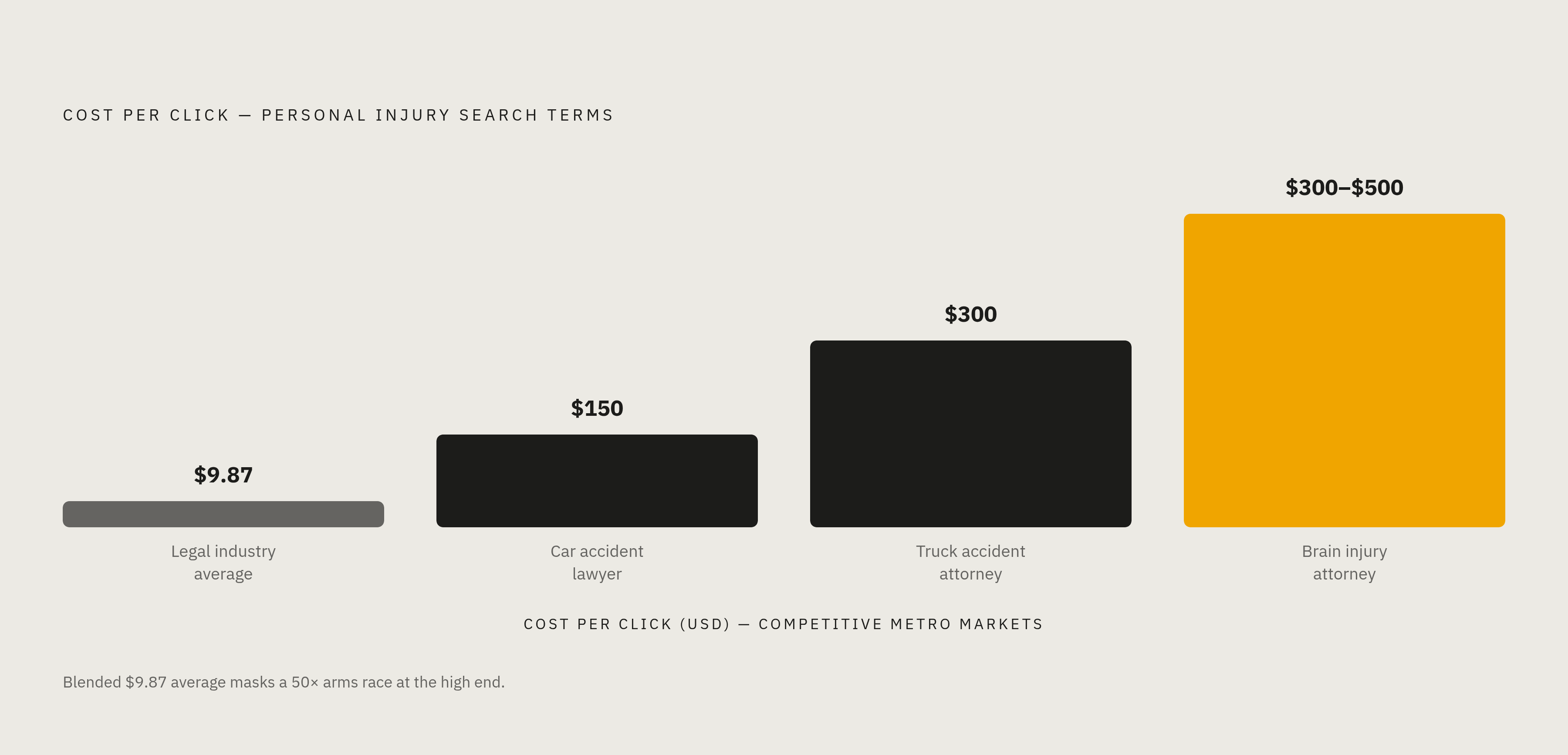
Legal advertising spend reached an estimated $2.5 billion across some 26.9 million ads in 2024, with projections putting that past $3 billion by 2026. Attorneys and legal services now carry the highest average cost-per-click of any industry tracked, at $9.87, up 15% from $8.58 the year before. That $9.87 figure is a blended average, dragged down by cheap, low-competition long-tail queries. The real numbers in PI alone run much higher.
"Car accident lawyer" regularly clears $150 per click in major metros. "Truck accident attorney" pushes past $300. Brain injury terms in the most competitive cities run $300 to $500 per click, and a firm can burn through half a car payment's worth of budget on someone who taps a link and bounces ten seconds later.
Why pay that much? Because the cases behind those clicks are worth real money. A single PI settlement averages around $52,000, and wrongful death cases often clear seven figures. That payout is what fuels the entire arms race: every firm knows the back-end math justifies aggressive front-end spend, so everyone bids the price up in lockstep, like an auction where nobody wants to be the one who blinks first.
Solo and two-attorney firms in mid-sized markets budget $5,000 to $15,000 a month just to stay visible. Established firms in similar markets run $15,000 to $40,000 monthly, and firms competing in the top fifteen metro markets spend $40,000 to $150,000 a month on paid search alone. With conversion rates around 10% to 15%, one signed case typically costs $2,500 to $3,000 in ad spend, and that's before a single hour of actual legal work.
Paid search is a rented apartment. Pay every month or the visibility vanishes, no equity built no matter how long the lease runs. Organic search is the mortgage, slower to build, more paperwork up front, but still standing there after the ad budget dries up. Firms that treat the two as interchangeable are the ones still renting in year ten, wondering why the competitor down the street owns a building.
Where the 2026 search results page sends clicks (and what that means for strategy)
The results page has turned into real estate with more tenants than it can comfortably hold. Local map pack listings, AI Overviews, organic blue links, legal directories like Avvo and FindLaw (carrying domain authority well into the mid-to-high eighties and beyond, territory most regional firms have no realistic path to on broad terms), paid ads, and Local Services Ads all stack on top of each other before a searcher scrolls an inch.
AI Overviews now show up on 78% of legal queries, the highest rate of any industry measured, and they pull clicks away from the organic results sitting underneath. That sounds like bad news for organic SEO, and for broad informational queries, it partly is. But bottom-funnel searches, the "lawyer near me" type where someone is ready to call, stay largely untouched by AI Overviews and keep sending strong traffic through local search. PI firms don't need to win the whole page. They need to win the specific slice of it where someone is one tap away from dialing, which is a much smaller and much more winnable fight than the one most firms think they're in.
A growing share of U.S. adults now read AI-generated summaries instead of clicking through to a website, and a significant share report using AI chatbots in some capacity. That's a new layer of research happening entirely off any website before a searcher ever reaches Google, and it's the subject the last section of this piece comes back to.
Building local authority: Google Business Profile and map pack fundamentals
Most SEO consultants, when asked what the single highest-leverage local ranking factor is, point to the same thing: the primary category on a Google Business Profile. For a PI firm, that means picking "Personal Injury Attorney" specifically, not settling for the generic "Lawyer" category out of laziness or indecision. One dropdown menu, and firms still manage to get it wrong constantly.
Beyond category selection, the profile needs accurate hours, current photos, a clear list of practice areas and case types, and a phone number and address that match character for character across every directory listing online. Inconsistent NAP data (name, address, phone) across the web is one of the quieter ways firms sabotage their own local rankings without ever noticing it's happening.
Review velocity matters more now than raw citation volume. Firms should aim for a steady stream of new reviews on a rolling basis, rather than front-loading them in a one-time push to rack up 200 reviews followed by a year of silence. Dropping below roughly 4.4 stars starts eroding trust. But a suspiciously perfect 5.0 can read as manufactured to a prospect who knows that any real practice, over enough clients, picks up the occasional one-star rant about a scheduling mix-up. The target sits just under perfect, not at perfect itself, and that gap is doing real credibility work.
Intent-matched content: how to map pages to what injury victims search
Not every search a PI firm wants to rank for carries the same intent, and treating them all the same is how firms end up with a website full of generic pages that convert nothing. Three distinct layers appear in the data, and each one calls for a different kind of page.
High-urgency local searches, like "car accident lawyer Tampa," need dedicated service-and-location pages built for someone who wants to act now: a visible phone number, proof of past results, local credibility signals above the fold, not buried three scrolls down. Case-type research queries, like "what to do after a truck accident," call for FAQ-style guides that answer the actual question asked and then position the firm as the obvious next step, instead of gating the useful information behind a contact form. Comparison and validation searches, things like "best personal injury lawyer near me" or direct review lookups, need reputation-heavy pages: case results, verifiable attorney credentials, and bar admission details, built to survive scrutiny from someone actively trying to rule firms out.
Broad generic terms are close to unwinnable against Avvo's and FindLaw's very high domain authority without a local or case-specific angle attached, so chasing them head-on wastes a budget that could go elsewhere. The smarter play is niche case types: traumatic brain injury, rideshare accidents, maritime injury, construction negligence, categories where the big directories haven't built out deep content and a regional firm actually has a shot at outranking them.
A study found AI-generated law firm content carries no statistically significant ranking benefit on its own. Thin, machine-written pages aren't a shortcut, they're a plateau. Google treats personal injury content as YMYL, "Your Money or Your Life." Stricter algorithmic standards for trust and expertise apply. A page needs real attorney knowledge behind it, reflected in substance a reader or algorithm can verify.
Technical SEO and site performance for PI firms
Most PI searches happen on a phone, often at the actual scene of an accident, so a slow mobile site doesn't just hurt rankings. It loses the lead outright, before the page even finishes loading. Nobody waits around for a spinning wheel when their neck hurts and their car is undriveable, and no firm should expect otherwise.
Three Core Web Vitals thresholds matter here. Largest Contentful Paint, which measures how fast the main content loads, needs to sit under 2.5 seconds. Interaction to Next Paint, measuring responsiveness when someone taps or clicks, needs to stay within a fast threshold. Cumulative Layout Shift, which tracks how much a page jumps around while loading (the classic case of trying to tap a button just as an image loads above it and shoves everything down), needs to stay under 0.1.
None of that is complicated in concept, even if it takes real engineering discipline in practice. Serve images in a modern compressed format instead of older, larger file types, and lazy-load anything below the fold so it doesn't compete for bandwidth with what someone sees first. Defer scripts that aren't essential to the initial render, push static assets through a CDN, and clear out render-blocking resources holding up the page for no good reason.
Schema markup rounds out the technical layer. Attorney credentialing schema, name, bar number, jurisdiction, practice areas, gives search engines and AI systems a structured way to verify who's actually behind the page. LocalBusiness schema belongs only where it accurately reflects what's visible on the page itself, not slapped on every template as a reflex. FAQ schema on guide and service content gives a firm a shot at featured snippet placement, prime real estate sitting above the organic results.
Link building and authority signals that PI firms can earn
Avvo and FindLaw carry very high domain authority scores, well into the mid-to-upper eighties and beyond. Most regional PI firms start somewhere far below that, and no amount of link-buying closes that gap on broad generic terms. The only real plan is going around it: building authority through local and niche-specific terms instead of trying to out-muscle the directories head-on.
Some of the most established firms, running decade-old domains, spend $20,000 to $50,000 a month on SEO, and a chunk of that spend exists specifically because accumulated authority functions as a moat. Newer or smaller firms need to out-maneuver that moat, not match it dollar for dollar. Trying to out-bid a firm with a fifteen-year head start is a losing game before it starts; building authority efficiently, through assets the big directories don't bother making, is the only version of this that works on a smaller budget.
Certain assets earn links naturally, without a firm having to beg for placement. Original research, local accident statistics, settlement trend data specific to a region, gives journalists and other sites a reason to cite the source directly. Named case results and verdict summaries, published with client permission, carry weight that generic "we win big" copy never will. Attorney commentary sought out by local news covering an accident story or a legal development builds a different kind of authority entirely, one tied to reputation rather than backlink count. Involvement with bar associations, legal aid work, and community sponsorships opens up a link ecosystem that's slower to build but harder for competitors to fake: local news outlets, medical and rehab provider directories that function as natural referral partners, chamber of commerce listings, and connections through law school clinics, ABOTA chapters, and civil justice organizations.
Visibility in AI-generated answers and what GEO requires in 2026
A growing share of prospective clients now skip Google's search bar entirely and ask an AI assistant directly: what to do after a car accident, who handles truck accident cases in a given city. That's a new category of lead generation, and firms surfaced inside those AI answers get a shot at clients who never touch a traditional results page.
A large majority of URLs cited inside AI Overviews also rank in Google's top organic results, and that pattern should anchor the entire strategy. Generative engine optimization sits directly on top of traditional SEO, not beside it as a parallel discipline, no matter how many vendors are currently selling it that way. Strong technical fundamentals, real local authority, and trustworthy content remain the foundation, and GEO is what a firm layers on once that foundation already holds weight.
GEO also doesn't require half of what the current noise online suggests. Research published by Contentful found no validated evidence that adding an llms.txt file reliably improves AI citation frequency, and Available guidance on how AI systems surface content backs that up: AI citations get earned through the same standard SEO and authority-building work that's always mattered, not some new technical trick built specifically for chatbots. So how much of the current GEO conversation is actually new information, and how much of it is a rebrand of work firms should have been doing anyway? A firm that fixes its Core Web Vitals, tightens its local signals, and builds content reflecting real attorney expertise is already doing the work. The AI layer just rewards it a second time, at no extra charge.