Real Estate Video That Actually Brings In Listing Inquiries
Video walkthroughs convert because they let buyers mentally move through a space before calling.
A buyer scrolling a listing photo gets a snapshot. A buyer watching a walkthrough gets something closer to a rehearsal: they've mentally walked the hallway, judged whether the kitchen island blocks traffic, and decided if the light in the primary bedroom works before they've picked up the phone. That's the entire argument of this piece. Video doesn't just perform better than photos in the aggregate; it does something specific that photos cannot do, and understanding that mechanism is what separates agents who use video well from agents who just use it a lot.
Why video converts listing inquiries when photos cannot
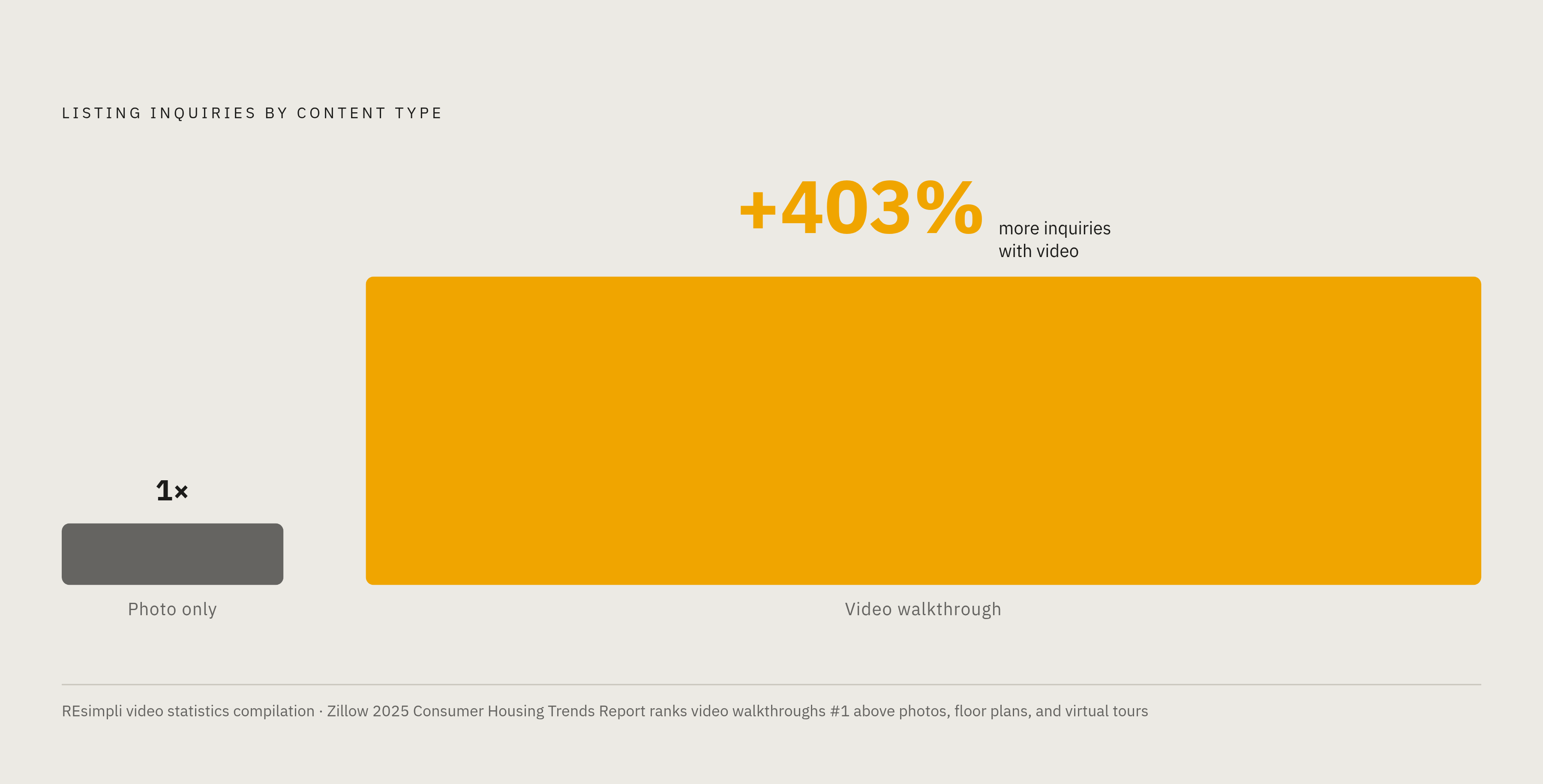
Photos are static, and static images ask the buyer to do the spatial math themselves: how big is that room, really, and how does it connect to the one next to it? Video answers that question before it's asked. REsimpli's video statistics compilation found that listings with video receive 403% more inquiries than those without, because video conveys a felt sense of spatial flow, scale, and livability that photos cannot.
Shannon Gillette, a real estate agent quoted in Luxury Presence's 2026 guide, said watching a well-produced video of a home is a fundamentally different experience for a buyer than scrolling through photos, and it builds a stronger connection to the listing itself. Part of that comes down to memory. Buyers retain far more of what they see in video than what they read in text or absorb from a static image, and that retention gap is a large part of why inquiry rates diverge so sharply between video and non-video listings. Zillow's 2025 Consumer Housing Trends Report backs this up directly: buyers rank video walkthroughs as the single most useful content type available to them, ahead of photos, floor plans, and virtual tours.
None of that is a marketing platitude. It's a claim about how the human brain processes spatial information, and it sets up every argument that follows: the buyer expectations in the next section, the format choices further down, and the disclosure obligations that come with faking any of it.
The gap between buyer expectations and agent delivery
Wyzowl data cited in Luxury Presence's guide found that a majority of buyers already expect to see video of a home they're considering online. NAR's Real Estate in a Digital Age report found that only about a quarter of agents consistently use video for every listing they represent, leaving three-quarters of the industry not using the format's biggest engagement lever. NAR's 2025 Home Buyers and Sellers Generational Trends report sharpens the picture further: more than a third of buyers used online video during their home search, while only about one in eight sellers' agents actually marketed a home with video. Reel-E's characterization of that gap is blunt: it should end the debate.
Who's on the other side of that gap matters, too. Reel-E's guide puts the median homebuyer at 59 years old overall and 40 among first-time buyers, a cohort that came up on YouTube, lives on Instagram, and finds most of what it buys through short-form video. A listing with no video doesn't just look old-fashioned to that buyer. It looks incomplete, the way a restaurant with no visible menu looks incomplete even if the food is good.
And the preference is moving in one direction. NAR's 2025 Profile of Home Buyers and Sellers shows the share of homeowners who say they prefer to list with a video-using agent has climbed from a lower baseline back in 2021. The expectation isn't leveling off, it's accelerating. Reel-E's guide notes that agents who start producing video now get to claim the differentiation while it still exists, while agents who wait get to compete in a market where everyone has caught up. Which raises an obvious follow-up: if the payoff is this well established, why did it take this long for agents to catch on?
Why the production cost barrier no longer keeps agents out
Most agents who skipped video weren't skeptics. They ran the math and it didn't work: traditional production was too expensive and too slow to justify on anything but a trophy listing. PRST Media's AI real estate video guide shows a standard walkthrough, a drone package, and a luxury cinematic production each occupy a different price tier, with the high end running well into the thousands of dollars. At those prices, video got rationed to the properties that could absorb the cost, and the ordinary three-bedroom in the middle of the market, the one with a seller anxiously checking whether the agent is actually earning the commission, got the photo gallery instead.
That calculus broke down in 2024 and 2025. AI generative video tools arrived that could take flat MLS photos and produce realistic camera movement, orbit shots, push-ins, pull-outs, in minutes and at a fraction of the old cost. A Coldwell Banker team in San Jose is the case study Reel-E points to: they cut videography spend sharply while tripling how many listing videos they put out. Clixlogix's guide reports that Google's Veo 3.1 model, accessible through Google Flow, now turns still images into photorealistic clips with natural camera motion, accurate lighting, and physics that don't glitch.
Brokerages are following the tools. Delta Media Group's three-year survey found that nearly all brokerages now plan to adopt AI in 2026, a sharp jump from 2024, when a notable share had no adoption plans at all, and NAR's September 2026 Realtors Technology Report (via Inman) puts the share of agents using AI daily or weekly at roughly half. Video stopped being a luxury upsell somewhere in that shift. It became the baseline, and the old argument for skipping it doesn't hold up on cost grounds anymore.
Which video formats drive inquiries versus which ones build the audience that eventually inquires
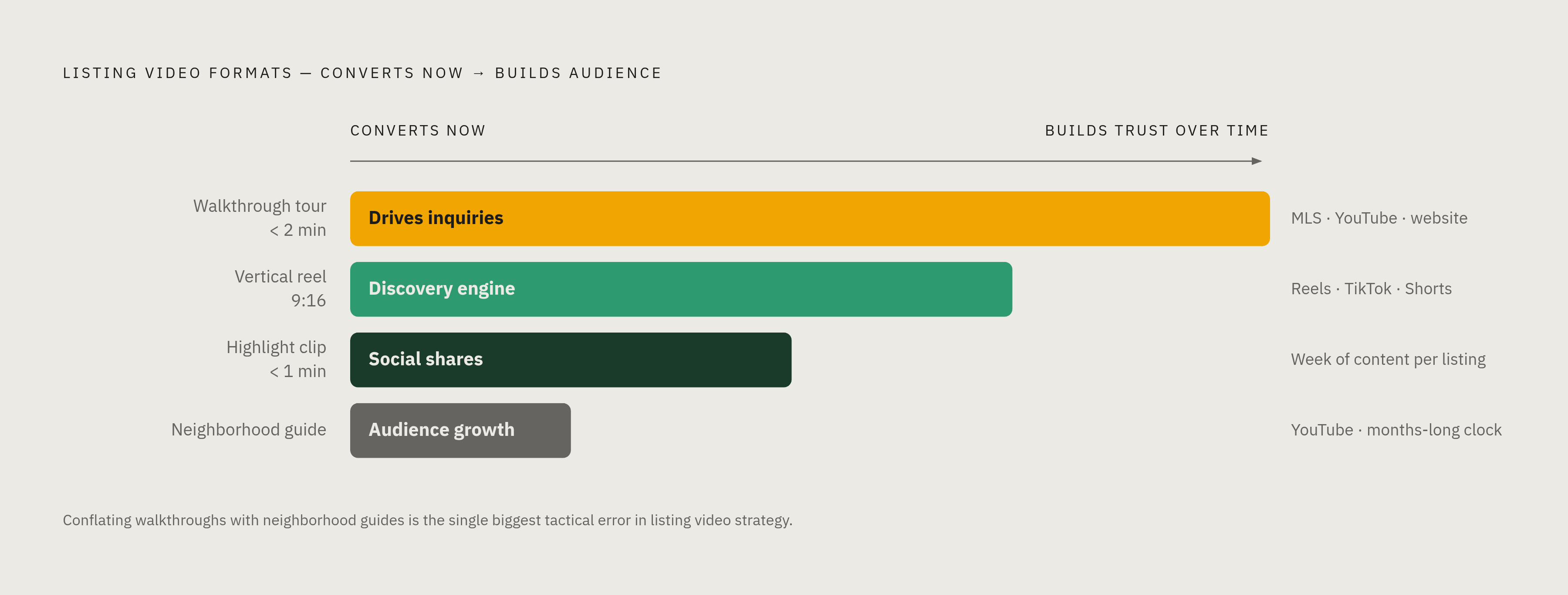
Cost stopped being the excuse. Format is where agents now get it wrong, mostly by treating every video the same way, as if a walkthrough and a neighborhood guide are supposed to do the same job. They aren't, and confusing them is probably the single biggest tactical error in the space right now.
Listing walkthrough tours under two minutes are the format most directly tied to inquiries, and Reel-E's 2026 guide argues every listing deserves one, not just the luxury end of the market; it belongs on the MLS, YouTube, the agent's website, and social. Short-form vertical reels shot in 9:16 do a different job entirely: they're discovery engines on Instagram Reels, TikTok, and YouTube Shorts, and Luma3 Productions' 2026 guide notes that text overlays are non-negotiable because most viewers watch with the sound off. The next client isn't searching Google, they're scrolling at midnight. Shorter clips also travel further. Property videos under a minute generate substantially more social shares than longer content, per the HubSpot State of Marketing Report cited in Reel-E's guide.
Highlight clips built around a single feature, a kitchen reveal, a backyard at golden hour, a walk-in closet the size of a studio apartment, stretch one listing into a full week of content. Fast.io's guide finds that neighborhood and community guide videos work on a longer clock: they perform best for YouTube growth over time because they answer the questions buyers type into search bars months before they're ready to make an offer, and they build the trust that earns a listing call later rather than selling a specific property now. Reel-E notes that testimonial and agent-introduction videos build that trust fastest of all; a pinned 60-second introduction answers who the agent is and why someone should work with them.
One walkthrough shoot can be edited into a full-length MLS video, a 45-second reel, and several highlight clips, multiplying content output from a single session. AgentPulse's guide on real estate video ads notes that format needs to match the property: a starter home, a flipped renovation, and a waterfront estate call for different pacing, different hooks, different stories. None of that works, though, if the finished video never leaves the MLS page.
Distribution determines listing video reach
A video sitting only on the MLS reaches a sliver of the audience the same file could reach spread across five channels, and none of that additional reach costs anything beyond the time it takes to upload. That's where most of the inquiry gap actually gets lost, not in production quality, but in what happens after the export button.
Roomlift's real estate video marketing guide sets the minimum distribution footprint for every listing video as the listing site, Instagram as both a feed post and a Reels cut, Facebook, YouTube in both full walkthrough and Shorts form, and email to the agent's sphere and any active buyers at that price point. Each platform earns its place for a different reason. Facebook remains the top lead-generation platform among agents, and video there generates a far higher share rate than text and image posts combined, per NAR's 2025 Real Estate in a Digital Age report. Instagram Reels outperform static posts on engagement by a wide margin, with the gap even more pronounced for accounts that don't have a huge following yet, HubSpot's State of Marketing report cited in Reel-E found. Think with Google finds real estate among the most-searched categories on YouTube, so a full walkthrough uploaded there becomes a permanent, indexed asset rather than a one-week social post. Email rounds it out. Luxury Presence's guide found that including video in an email campaign lifts click-through rates substantially.
The payoff compounds. Realtor.com's 2024 market research found that listings with video earn markedly more organic search traffic than listings with only text and photos, and that SEO benefit builds over time as more indexed video pages accumulate. Real Estate Marketing Partners' guide found that homes marketed with video on social media sell faster than those marketed without it, with social media actively speeding up the sale rather than just building awareness. Startup Hub's guide reports that AI is showing up on the distribution side too, not only in production: HeyGen is now used by more than 13,500 real estate professionals to deliver video updates in an agent's own face and voice, translated across a wide range of languages and dialects. Distribution has become its own discipline, separate from shooting the video in the first place.
What agents must know about disclosing AI-generated and digitally altered visuals
Faster, cheaper AI production raises a question: how far an agent can push the enhancement before it becomes deception rather than marketing. A disclosure gap is opening around that question right now, and agents who ignore it are taking on legal exposure along with the risk of alienating buyers who feel misled once they show up in person and the staircase isn't quite what the video implied.
California has already answered the question by statute. Assembly Bill 723, effective January 1, 2026, requires licensees to disclose in a reasonably conspicuous way when listing visuals have been digitally altered, and if the ad runs on a website, the original unaltered version has to be posted alongside it. The law doesn't carve out an exception for any channel agents typically use, MLS, website, social, email, or print are all covered. Willful violations carry misdemeanor status under California's real estate licensing law, so the risk isn't limited to a fine.
A business logic underlies the legal one. Using AI to make a property look better than it actually is undercuts the exact thing that makes video valuable in the first place: the pre-qualification effect described back in the first section. A buyer who feels deceived by a video doesn't show up to the showing warmer. They show up annoyed, and possibly with a lawyer's phone number saved. The workable standard is to use AI to raise production quality and cut cost, not to alter the spatial reality of the property, disclosing clearly and keeping the unaltered original available. Even for agents outside California, the disclosure standard represents a direction of travel, and establishing the practice now avoids compliance debt as similar rules spread.
Measuring whether a listing video drives inquiries
Producing video intentionally means tracking whether it's working, and view count is close to the least useful number available for that purpose. Luxury Presence's 2026 guide points to the metrics that matter: click-through rate from the video thumbnail to the listing page, conversion rate from that listing page to an inquiry or showing request, and retention rate, how long viewers watch before dropping off, where an early drop signals a weak hook and a drop further in signals a weak close. Retention data does double duty as a diagnostic. A viewer who drops off before the kitchen appears is a weak-hook problem in the opening seconds; a viewer who drops off two-thirds through has probably seen enough and lost interest before the close lands.
Every platform hands over its own slice of this. Instagram Reels report play count, reach, and saves, part of a category of discovery-engine short-form vertical reels that also includes TikTok and YouTube Shorts. YouTube reports average view duration. Email platforms report click-through by thumbnail. None of those numbers matter much in isolation, but together they show where a video is losing people and why.
At the listing level, the number that actually connects to revenue is inquiry volume and time-to-inquiry measured from the listing date. NAR Research and Zillow data cited in Reel-E show homes marketed with video sell for a meaningful premium and draw inquiries faster, and tracking that pattern across several listings builds an agent-specific baseline worth comparing against. NAR data shows a large majority of homeowners say they prefer an agent who uses video, a conversion event that happens before a listing even exists and gives a measurable edge at the pitch stage as well as after the sign goes up.
The infrastructure a video lives on affects all of this. Embedding listing videos on a fast, well-built website raises both view counts and time-on-page, which in turn supports search rankings, a point where video strategy and basic SEO stop being separate conversations and start being the same one. A video that never gets measured is a video an agent is producing on faith. Given how cheap production has become and how much data every platform now hands back for free, faith is no longer the only option on the table.
Sources
- 89+ Real Estate Marketing Statistics & Trends to Watch in 2025
- 55+ Real Estate Video Stats: Market Game-Changer 2025
- The 2026 Guide to Real Estate Video Marketing: From Listings to Leads - Luxury Presence
- Video Marketing for Real Estate: The Complete 2026 Guide | Reel-E
- Real Estate Marketing Statistics 2026: 37 Data Points Every Agent Needs | Reel-E
- Real Estate Video Marketing: The 2026 Guide for Agents