Firearms Dealer Website Design for Compliance and Sales
Compliant firearms sites need custom architecture that mainstream ecommerce platforms can't provide.

Start with the one mechanism that breaks every assumption baked into a normal online store: the internet is a sales channel here, not a transfer channel. A buyer clicks "buy," pays, and gets a confirmation email, same as ordering a coffee grinder. But the product never arrives at the buyer's door. It ships instead to a licensed dealer near that buyer, who has to run a Form 4473 and a background check before anyone takes possession. That single fact means every checkout flow, every product page, every shipping calculation has to account for a split between "who paid" and "who receives," and generic ecommerce platforms were never built with that split in mind.
Layer on top of that the actual regulatory stack a firearms business operates under at any given moment: ATF rules, the Gun Control Act, NFA requirements, ITAR restrictions on certain exports, HAZMAT handling for ammunition, age verification mandates, and the FFL transfer process itself, all running simultaneously. None of that comes pre-built into Shopify's theme editor or a WooCommerce plugin marketplace. So what happens when a dealer tries to force a generic platform to do this anyway? Usually it means duct-taping the gaps with manual review, spreadsheets tracked outside the platform, and staff double-checking orders that the site itself should have flagged. Those workarounds are expensive to run, and worse, their failures appear at the worst possible moment: during an ATF inspection rather than during development, when the fix is cheap. Some platforms will simply shut the account down mid-operation because the firearms category conflicts with their own terms of service, which turns a slow compliance gap into an overnight business-ending event.
Consider the recordkeeping requirement alone. That's not a setting a dealer configures once and forgets. It has to be wired into the order management system from the first day the store goes live, because there is no retroactive fix for records that were never captured correctly.
And the rules keep moving. Eligibility is a live variable, not a fixed attribute you set on a product once. It's a live variable, and the rest of this piece walks through what that means at every layer of the build, from the catalog to the checkout to the marketing stack that has to find customers in the first place.
How federal and state compliance layers stack into a moving target
Federal law is the floor here, not the ceiling. States build on top of it with waiting periods, permit requirements, magazine capacity limits, and their own recordkeeping demands, and none of that is uniform from one state line to the next. Two dealers can run the exact same transaction, same product, same price, same buyer intent, and end up with completely different legal obligations depending on which state that buyer happens to be standing in. Which raises the practical question: at what point in the buyer's journey does the site need to know that? The honest answer is before checkout, not during it.
New York offers the clearest preview of where this is headed. As of 2026, the state runs its own background check infrastructure rather than relying purely on the federal system: firearm checks route through NICS via the State Police acting as a point-of-contact state, while ammunition checks run through an entirely separate state system, and processing can take longer than the federal standard. Is that an isolated New York quirk? Maybe. But it's also a working example other states can copy, and a site architected around one national NICS flow will not survive a second state deciding to build its own parallel system.
None of this stays theoretical at the SKU level. A dealer cannot ship high-capacity magazines into California. A dealer cannot bundle certain ammunition with a firearm for a New York buyer. Certain optics might not even be allowed to display to a buyer browsing from a specific jurisdiction. These are everyday occurrences that a support team must handle correctly as a matter of routine, not rare edge cases resolved by exception. They're everyday, line-item decisions the catalog has to make correctly, over and over, for every product and every buyer location.
So the compliance logic can't just live in the checkout. It has to run through the catalog, the search and filter layer, and even the marketing stack, because a rule that only exists at the point of payment has already let too much happen upstream. Treating this as a checkout-only concern is the kind of shortcut that looks fine in a demo and falls apart the first time a real customer in a restricted state tries to order the wrong product. That failure point, specifically what happens when the buyer hits the FFL transfer step itself, is worth its own close look.
What FFL transfer logic requires at the UX and checkout layer
The FFL transfer requirement doesn't just add a line of legal text to the checkout page. It restructures the entire flow into something closer to a multi-step process than a single "add to cart, pay, done" sequence, and no template pulled off an ecommerce theme marketplace was built to handle it. When that flow is designed poorly, buyers don't abandon their carts because they changed their minds about the purchase. They abandon because the site itself failed to walk them through a process they didn't already understand.
Consider a first-time online firearms buyer who has never heard the term FFL. Both are avoidable. The fix is straightforward in concept, surface "Ships to FFL Only" clearly on the product page itself, with a short explanation of what happens next, well before the buyer ever reaches the payment screen.
That leads directly to verifying the receiving dealer's license. A working FFL locator is a design requirement. It's a design requirement, because the locator has to verify that the receiving dealer's license is actually current at the moment of transfer. Ship a firearm to a dealer whose FFL has lapsed, and the license fails to verify as current at the moment of transfer, a failure that lands on the seller, not just the buyer who picked the wrong dealer from a stale list.
Davidson Defense's experience is the clearest working example available of what happens when this gets built correctly. Optimum7 built a real-time FFL API directly into Davidson Defense's checkout, letting buyers see a live map of licensed dealers and select their own transfer point on the spot. That single piece of engineering cut down on the messy, last-minute cancellations that happen when transfer routing gets treated as an afterthought bolted onto checkout instead of a core part of the buying flow.
A single cart can mix a holster, a box of ammunition, and a handgun, and each of those items can trigger a different transfer rule, a different shipping rule, and a different age-verification requirement. Split checkout logic for regulated versus non-regulated items in the same order is its own distinct engineering problem, not an extension of the FFL locator. And ideally, geographic eligibility gets checked before the buyer starts shopping at all, not at the payment screen, so a buyer in a restricted state gets a clear, respectful explanation early rather than a rejection after they've already invested time filling a cart.
Get the transfer flow right, and the buyer still has to actually pay for the thing. That's where the checkout hits its next wall, and it's a wall most dealers hit before they've even finished designing the site.
Why mainstream payment processors are not an option
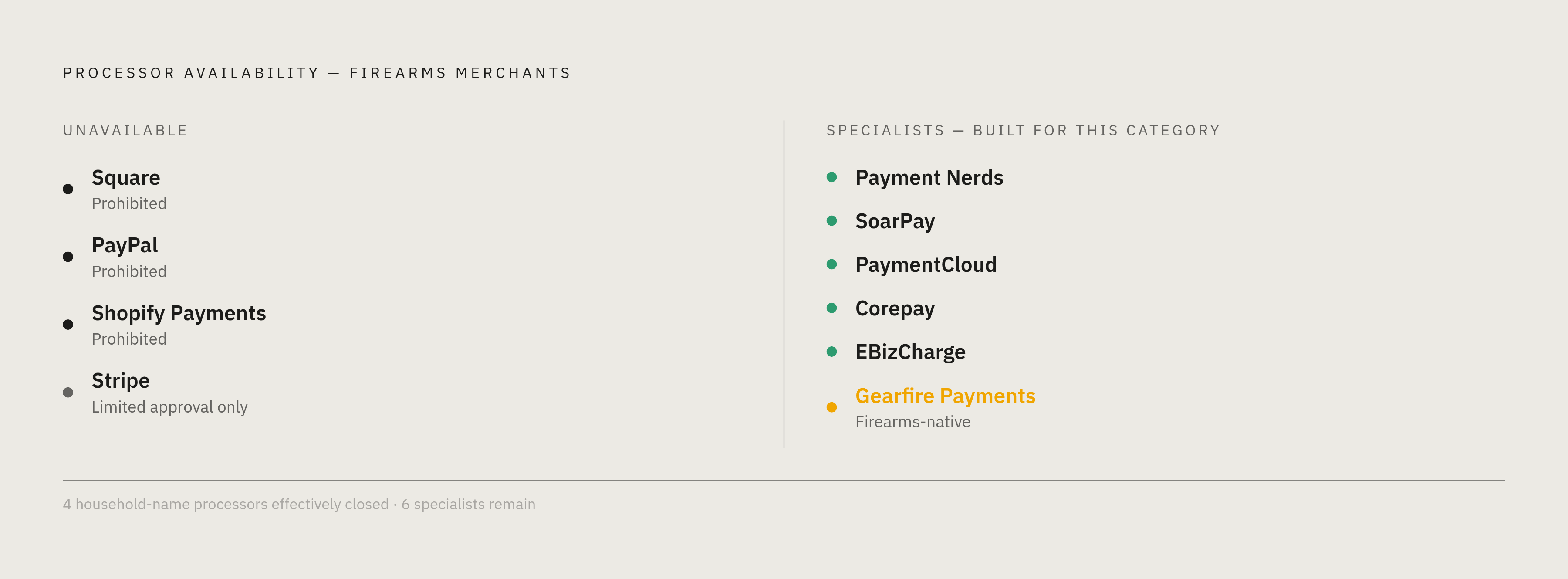
Square, PayPal, Shopify Payments, and Stripe all decline or sharply restrict firearms merchants, which means the payment processor decision has to happen before platform selection, not after, and definitely not as a footnote to the checkout design. Get the order backwards, build the whole site first, then go looking for a processor, and there's a real chance the dealer discovers the mismatch only after launch.
The specifics matter here. Shopify Payments prohibits firearms and related listed products outright. Stripe allows legal firearms only through a limited-availability approval process. Square and PayPal both prohibit firearm transactions entirely. An account built on any of these can get suspended before a single sale closes, and for a live store this is not an inconvenience, it is the whole business stopping cold.
So what replaces them? A smaller set of processors built specifically to underwrite this category rather than treat it as an exception to be managed around: Payment Nerds, SoarPay, PaymentCloud, Corepay, EBizCharge, and Gearfire Payments among them. Gearfire Payments in particular was built specifically for the firearms and shooting sports industry, and carries a sizable base of shooting sports merchants already running on it. That's a meaningfully different starting posture than a general processor that tolerates firearms merchants as a carve-out.
None of this happens in a regulatory vacuum, either. PCI DSS Version 4.0 became mandatory in March 2024 when the older 3.2.1 standard retired, and that applies to firearms merchants exactly as it applies to everyone else processing card payments. There's no firearms exemption tucked into the payment card industry's data security standard.
Headline processing rates rarely tell the whole story. Gearfire's Enhanced Fraud Tracking, for instance, charges either a percentage of protected transaction totals or a monthly minimum, and it's the kind of feature dealers assume comes standard until they see it itemized as a paid add-on. Full cost modeling, not just the advertised rate, is the only way to evaluate these contracts honestly. Chargeback handling and fraud detection also need to be tuned to this specific buyer pool: high-value transactions, high compliance stakes, and a meaningful share of first-time online firearms buyers who might dispute a charge out of confusion about the FFL process rather than any actual fraud.
Payment processing solved, platform selection is the next fork in the road, and it turns out to be less of a technical decision than a strategic one.
How platform choice sets the ceiling on compliance depth and design control
Choosing between a general-purpose platform fitted with custom compliance layers and a firearms-specific turnkey solution is a matter of how much compliance depth and design control a business is willing to trade off, even though it often gets framed as a budget question. It's a question of how much compliance depth the business actually needs and how much design control it's willing to give up to get there, and the right answer differs for a retailer, a manufacturer, and a wholesaler.
Among the general-purpose platforms, BigCommerce stands out as the strongest hosted option for firearms ecommerce. It charges no transaction fees when a merchant uses an Embedded Payment Provider, though an Open Payment Provider Fee applies on self-serve plans starting June 1, 2026, and it maintains an open payment policy alongside solid support for compliance integrations. The processor selection itself still falls to the dealer, BigCommerce doesn't solve that part, but it doesn't stand in the way either. Shopify is also workable, provided Shopify Payments gets swapped out for a compliant third-party processor and custom compliance logic gets applied at the SKU, category, and checkout level, which in practice means working with a partner certified in Shopify Plus who actually understands what firearms compliance requires. WooCommerce sits at the far end of the spectrum: total code ownership, unlimited customization, and a growing pile of technical debt as the catalog scales, unless the development team maintaining it actually understands firearms compliance rather than treating it as a generic ecommerce build.
On the other side of the ledger sit the firearms-specific turnkey platforms. Gearfire comes pre-configured for firearms compliance and is particularly strong on distributor integrations and inventory management, which cuts setup time dramatically for a retail gun shop that needs distributor inventory access on day one. AmmoReady runs a similar playbook: strong compliance pre-configuration, but limited UX flexibility and limited deep API access, and neither AmmoReady nor Gearfire is particularly well suited to manufacturers or wholesalers.
That trade-off deserves real consideration. Turnkey platforms move fast and arrive pre-loaded with compliance logic, but they constrain design control, and some lock dealers into proprietary ecosystems with pricing on add-ons that isn't always transparent upfront. That constraint hits hardest on the exact factor that separates a converting site from a catalog dump: the ability to differentiate on user experience. Full custom builds carry the opposite risk. WooCommerce and other custom solutions demand ongoing technical ownership, and compliance logic that nobody actively maintains degrades quietly as regulations shift underneath it; a development team without firearms-specific knowledge will simply miss the state-level updates that matter.
Manufacturers and wholesalers face an even sharper version of this problem, since dealer portals with role-based access, tiered pricing, and automated FFL verification at checkout are requirements most turnkey retail platforms can't accommodate without heavy, expensive modification. Which points toward the approach that actually threads this needle: custom development built on a compliant base platform, with firearms-specific compliance logic applied precisely at the SKU, category, and checkout level.
Platform and payments settled, the next layer buyers actually interact with most is the catalog itself.
What the product catalog must do that a standard inventory system cannot
A firearms product catalog is a rule-governed data structure dressed up to look like a spreadsheet of items and prices. It's a rule-governed data structure, where every single SKU carries a regulatory classification that determines what happens to it downstream, and building it as anything less creates compliance exposure that compounds as the catalog grows.
Start with the classification tags themselves: handgun, long gun, NFA item, ammunition, accessory, less-lethal. Each tag isn't cosmetic. It drives which states can legally receive the product, what age verification has to fire before checkout, whether FFL transfer routing activates at all, and which shipping carrier rules apply. Get the tag wrong on one SKU, and every downstream decision built on top of it inherits the error.
Serialized items and non-serialized items also need separate tracking logic under ATF compliance, and a system that treats a firearm and a holster as the same kind of inventory record is going to produce gaps in the A&D book that remain invisible until an inspector goes looking for them. That's the same recordkeeping obligation from ATF Ruling 2021R-05F resurfacing here, not as an abstract legal requirement but as a concrete demand on how the catalog itself is structured from the first SKU entered.
Inventory synchronization with distributors like Sports South and Lipsey's adds another layer, requiring real-time, ERP-connected stock updates rather than a nightly batch sync. Overselling a regulated item isn't just an awkward customer service call here. If a firearm gets allocated to a buyer in a state where it can't legally ship, that's a compliance event, not a fulfillment hiccup. Rule-aware search and filtering, by caliber, platform, action type, and state eligibility, matters just as much for buyer confidence as it does for compliance: a buyer who can't confirm a product is even eligible before investing time in the purchase flow simply leaves and doesn't come back.
Accessories deserve a specific word here, because they're the part of the catalog most likely to get treated as lower-stakes. Shooting Industry's Q1 2025 data documented declining unit sales volume in accessories, but that decline doesn't shrink the legal obligations attached to ammunition, magazines, or optics, and assuming accessories carry less compliance risk than firearms is a documented, repeated mistake.
Get the catalog built to this standard, and it turns out to solve a second problem nobody was expecting it to solve: how buyers actually find the store in the first place.
Why organic search is the entire marketing funnel for firearms businesses
Google Ads and TikTok broadly prohibit firearms advertising outright. Meta allows licensed retailers to advertise firearms for off-platform sale, but only under strict conditions. Strip those channels away, and what's left doing the heavy lifting is organic search: traditional SEO, visibility on GunBroker, and increasingly, the answers AI search tools are generating. That's not a marketing option among several. For an FFL business, it's closer to infrastructure, the thing the whole acquisition funnel is built on top of.
A brick-and-mortar dealer and a pure online seller need genuinely different SEO strategies here, not variations on the same theme. The storefront needs local SEO built to win map-pack visibility and drive people through the door, while the online seller needs ecommerce SEO built to rank category and product pages for the specific searches buyers actually run when they're ready to purchase. Those are different strategies requiring different site architecture and different content decisions, not the same playbook applied twice.
The deep, rule-aware catalog built for compliance in the previous section continues to earn its keep once compliance is satisfied. It's the same infrastructure that supports rankable, content-rich product pages. Shooting Stuff saw a documented 140% increase in organic sales through Icecube Digital's SEO work, built on exactly this principle: catalog depth doing double duty as content depth.
AI search adds a genuinely new wrinkle as of 2026. Firearms SEO now has to account for both the traditional Google results page and the answer surfaces AI tools generate, through technical SEO, content built around how buyers actually research firearms and gear, and answer-engine optimization aimed at getting AI tools to cite the brand as the authoritative source rather than a competitor's thinner page.
The compliance layer even reaches into the marketing content itself. California's AB 2571 bans firearm advertising that appears to target minors, with fines attached per incident and the possibility of lawsuits on top, which means the jurisdiction-variable logic that governs the catalog and checkout extends into the content and marketing stack too, not just the product pages. With paid social and search largely closed off, dealers end up leaning on the channels they actually own: SEO, email, FTC-compliant influencer partnerships, affiliate programs, podcasts, third-party display, local TV, events, and retail media, all stitched together by a first-party data strategy that doesn't depend on any platform's ad policy staying the same from one quarter to the next.
Which brings the whole argument back around to where it started. A firearms dealer's website was never just a storefront skinned with a catalog and a checkout button. It's a compliance system that happens to sell firearms, built from the FFL transfer logic outward through payments, platform, catalog, and finally the search visibility that gets a buyer there in the first place. Skip any one layer, and the whole structure inherits that gap, usually at the least convenient moment possible.