When AI Automation Makes a Workflow Worse
Automating a broken process just moves the dysfunction faster.
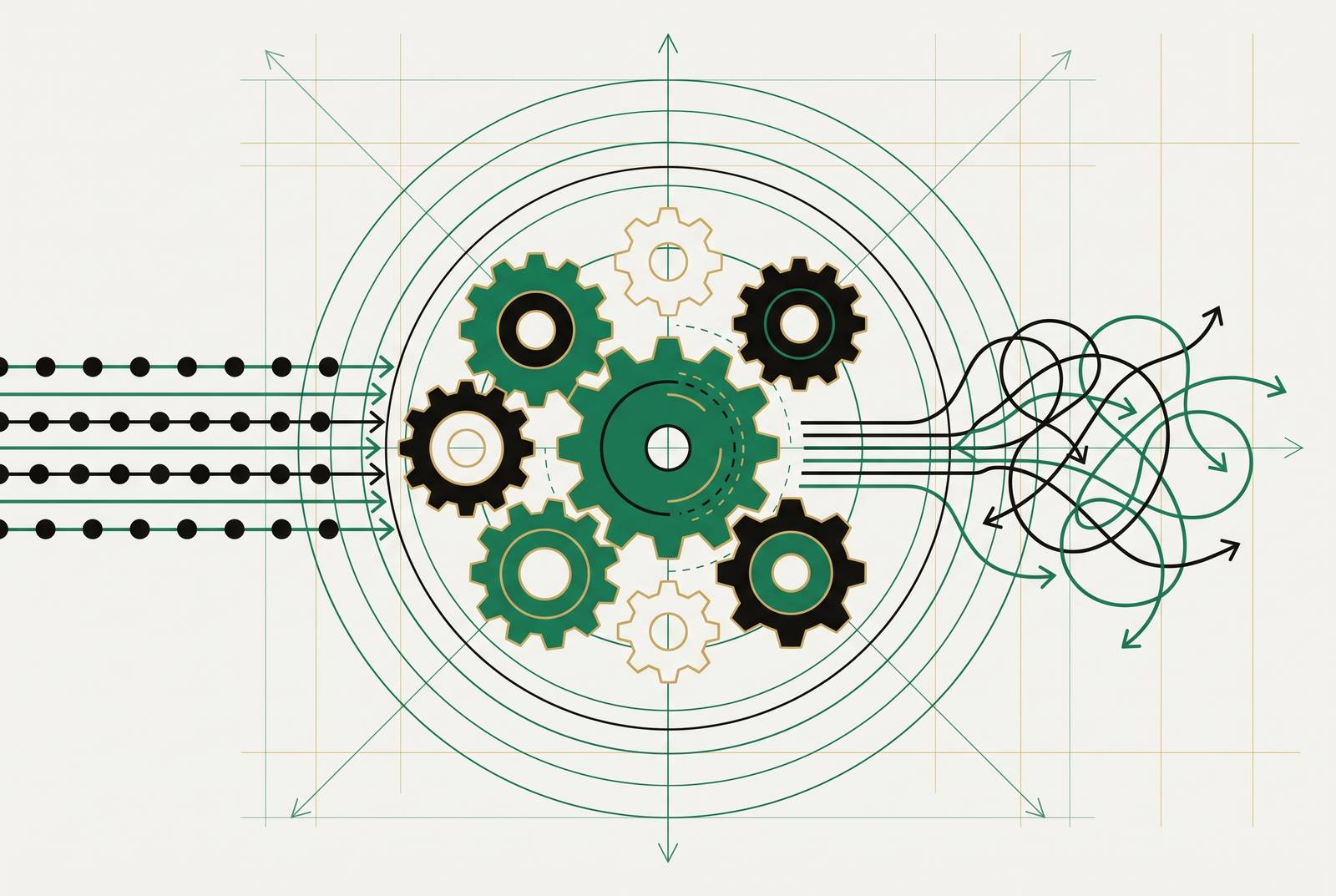
A finance team recently automated its invoice approval process and discovered, a few weeks in, that the new system still took almost as long as the old one. Five people still had to sign off. The only thing that changed was the speed at which the request bounced between their inboxes.
Why automation projects fail even when the technology works
Plenty of organizations bought that pitch, wrote the check, and deployed the tool. Many are now watching a measurable counter-reality unfold, where the promised relief hasn't materialized and in some cases the work has gotten harder, slower, or riskier. The instinct, when that happens, is to blame the model, the vendor, or the budget. That instinct is usually wrong.
The more durable explanation is structural. Organizations tend to treat the automation tool as the fix while leaving the underlying process exactly as broken as it was before, so the automation doesn't repair the dysfunction, it just runs it faster and at a larger scale. A process that depended on one employee's memory of which vendors need extra scrutiny, or another's habit of double-checking a spreadsheet before it goes out, doesn't become more reliable when a script replaces the person. It becomes less reliable, because the script doesn't know it's supposed to compensate for anything.
This is why the single most common failure mode in automation projects isn't technical at all: companies buy the tool before they've mapped the workflow the tool is supposed to run. Chaos does not automate into order. If a process is unclear, inconsistently executed, or held together by tribal knowledge that lives in someone's head and nowhere else, automating it produces chaos at higher velocity, not less of it. That reframes the whole question this piece is built around. The question that matters before any automation project starts is not whether the AI is capable enough, but whether the process underneath it is clear enough to survive contact with a system that won't improvise the way a person does.
How a weak process hides in plain sight until automation exposes it
Weak processes are remarkably good at hiding, and the reason is almost flattering to the humans running them. People compensate. They fill gaps with judgment, smooth over inconsistent inputs, and quietly patch the exceptions nobody thought to write down. It's invisible to whoever eventually sits down to design the automated version, which means the team building the system is working from an incomplete map and doesn't know it.
The invoice approval case makes the pattern concrete. A company automated a process that had required five manual approvals and averaged several days to clear. The automated version still required five digital approvals and shaved the completion time only marginally, a gain too small to justify the cost and disruption of building it. The approval chain itself was the defect. Five sign-offs for a routine invoice was excessive before anyone touched a keyboard, and automating that structure just moved the same excess through a faster pipe.
The e-commerce inventory case shows the same mechanism with sharper teeth. A retailer automated inventory management across three sales channels, and the system broke within a week. Each channel used its own product naming conventions, its own SKU formats, its own way of counting stock, which produced overselling on one channel and phantom out-of-stock listings on the others. That data inconsistency existed long before automation arrived. Human staff had simply been reconciling it by hand, quietly, as part of the job, and nobody had ever written that reconciliation down as a required step in the process.
Both cases point to the same conclusion: mapping the process is the diagnostic, not a preliminary chore to get through before the real project starts. It is the diagnostic. That determination, whether the automation helps the organization or actively damages it, happens well before a single line of the system gets built.
What happens inside a workflow when AI takes over sequential steps
Research from MIT Sloan argues that AI's real impact is visible at the level of the whole workflow, in how tasks get sequenced, grouped, and handed from one step to the next, rather than in isolated improvements to any single task. That has a blunt consequence: a single step that AI handles poorly doesn't just underperform in isolation, it can corrupt everything downstream of it, and the workflow may not reveal that corruption until much later.
Task chaining explains why. When a set of AI-friendly tasks sit next to each other, they can be bundled into one continuous automated sequence. But if even one step is difficult for the AI to handle well, that single task threatens to undermine the entire operation. An AI system doesn't stop and ask for help the way a person might. It produces an answer and moves forward. That's what makes silent failure the most common and most insidious problem in production: an agent completes the workflow and returns a response that looks correct, and the error doesn't surface until downstream consequences make it visible, sometimes hours later. A wrong argument fed into step two can quietly poison every step that follows it, with no alarm going off anywhere in between.
There's a genuinely counterintuitive wrinkle in the same research. AI doesn't have to beat a human at every individual step to create value across the chain. Organizations may come out ahead handing an entire sequence to AI even in cases where a human would outperform the machine on some of those steps, because every handoff between AI and human requires review, validation, and adjustment, and those checkpoints slow the whole system down. That logic holds only when the chain itself is clean. It falls apart the moment the underlying process is ambiguous, because ambiguity is what a human step was quietly resolving.
The McDonald's and IBM drive-thru pilot is the clearest public illustration of what this looks like when it goes wrong. The system ran at more than 100 U.S. drive-thrus between 2021 and 2024. In early 2023, a video went viral showing the AI piling multiple sundaes, ketchup packets, and an alarming quantity of butter onto an order for vanilla ice cream and water. A separate incident saw the system add a large quantity of chicken nuggets to an order that ended up worth hundreds of dollars. CNBC reported that the system struggled to understand different accents and dialects, an input-quality problem that broke the chain at its very first step and cascaded through everything that followed. McDonald's ended the rollout. The pilot had been scoped too narrowly to account for the genuine messiness of a real drive-thru lane, where the input is a human voice.
Three ways automation makes the remaining human work harder, not lighter
Even when automation doesn't fail outright, it can degrade the experience of the people still working alongside it. Instead of lightening cognitive load, poorly designed automation tends to add three compounding burdens: work intensification, a verification tax, and skill erosion, and each one leaves the workflow more fragile than it was before.
Workers juggled several active threads simultaneously, ran multiple agents in parallel, and revived tasks they'd deferred earlier, living inside a rhythm of constant attention-switching and constant output-checking. Employees reported doing work during hours that used to belong to rest, because AI made it frictionless to "just move things forward a bit". That small habit, repeated daily, quietly resets what a normal workload looks like.
The verification tax is subtler and arguably more expensive. AI systems produce output that's wrong in ways only expert judgment can catch, and checking every generated output for accuracy and fit with the actual goal is its own form of cognitive labor, one that accumulates across a day rather than announcing itself all at once. For knowledge workers, that raises decision density: more micro-decisions packed into each task, and a steady need to weigh alternatives that all look plausible on the surface.
A systematic review of generative AI applications found that deskilling, the leveling or loss of specialized ability, is a common outcome when AI automates tasks without preserving opportunities for human skill development. Defenders of automation point to a real and valuable counterpoint here: AI's leveling effect can let novices perform closer to expert standard, which is a genuine gain for organizations with uneven skill distribution. But leveling up the floor doesn't protect the ceiling. A study in The Lancet Gastroenterology & Hepatology found that endoscopists who routinely relied on AI for colonoscopy assistance performed worse once that assistance was taken away, with a measurable drop in their detection rate for precancerous lesions. The organizational risk in the leveling effect is that people who stop practicing a skill may find it gone when an outage, an edge case, or an automation failure demands it back.
Why agentic AI raises the stakes on every one of these failure modes
None of this changes in kind with the arrival of agentic AI. It changes in scale. The shift from single-task automation to agentic, multi-step systems doesn't introduce a new category of failure, it takes the failure modes already described (the invisible process gap, the silent chain corruption, the compounding human burden) and runs them through a longer pipeline with fewer places for a human to notice something has gone sideways.
Agentic AI, meaning systems that analyze context, make recommendations, and carry out defined workflow tasks without a human directing each step, is one of the dominant trends reshaping enterprise operations going into 2026. The appeal is obvious: more autonomy, less friction, fewer handoffs slowing things down. But the same MIT Sloan research that praised clean-chain automation warns that scaling AI across complex workflows compounds the challenges quickly. An agent that performs flawlessly on a small, controlled task can quietly fall apart once it meets real scale, where the data is incomplete, the edge cases multiply, and every exception a human used to catch instinctively floods back in as an unresolved failure.
One might argue the fix is simply better tooling, a smarter agent, a stronger model. Leadership often reaches for exactly that response, reading the production failures as a technology gap and investing in a more sophisticated stack. That response tends to bury the unstable workflow underneath a more impressive layer of software, which makes the underlying problem harder to see rather than easier to fix. MIT Sloan research found that most organizations still approach AI as a way to boost productivity task by task, and that narrow mindset may be limiting AI's actual value while generating the most damage in the moment one broken step poisons an entire chain.
The governance implication follows directly. Agentic systems need human judgment planted at specific control points: some actions are safe to fully automate, some require confirmation before they proceed, and some should probably never leave human hands. The real design question is where automation's boundaries belong. It's where those boundaries belong, and how deliberately an organization draws them before the system goes live rather than after it has already made an expensive mistake in public.
What process clarity requires before automation begins
Process clarity is the work of taking judgment that currently lives implicitly in someone's head and making it explicit enough that a system without a head can still execute it reliably, without a person quietly patching the holes afterward.
A workflow that's genuinely ready for automation has four identifiable parts: a defined trigger, a sequence of steps, decision logic for what happens when conditions change, and a measurable output. If any one of those four is fuzzy, or if different employees currently handle it differently, the automation inherits that fuzziness rather than resolving it. The right candidates for automation share three traits: high volume, a recognizable pattern, and a heavy time cost that doesn't actually require strategic judgment to pay. The practical test is simple to state and uncomfortable to apply. Could a brand-new employee follow the process precisely as written, without pulling anyone aside to ask a clarifying question? If the honest answer is no, the process isn't ready, regardless of how good the AI is.
Tribal knowledge has to be dragged into the open before automation touches the process. Whatever unwritten compensation human workers apply to keep a shaky process functioning needs to be formalized into the documented workflow or eliminated outright. It's a mistake to assume the automated system will somehow replicate a habit nobody ever wrote down.
Data consistency belongs in this same category of prerequisite, not afterthought. The inventory failure described earlier, three channels running three incompatible naming and SKU conventions, is the clearest possible illustration of what happens when this step gets skipped: automation cannot reconcile data that people were quietly reconciling by hand, so that reconciliation has to become a defined, owned part of the process before a system takes over.
Human-in-the-loop design deserves the same deliberateness. Human-in-the-loop design is an architectural decision, made from the start, about exactly which steps genuinely require a human judgment call, not a fallback bolted on after the first embarrassing failure. Governance, audit trails, and human oversight are becoming essential precisely because agentic systems remove the incidental checkpoints that used to catch errors almost by accident, simply because a person happened to be standing in the way. This is where an operations-minded builder of automation, one that designs a system around a specific company's actual workflow rather than dropping a generic tool on top of it, earns its keep. Purpose-built automation starts by mapping the trigger, the steps, the decision logic, and the output for the process as it actually runs, not as an org chart assumes it runs, and that mapping is what separates an automation project that holds up from one that quietly breaks in week three.
Automation and deskilling are not inseparable. A paper in Frontiers in Medicine found that AI implementation doesn't have to produce deskilling at all. It can reshape and strengthen competencies when a clinician's role shifts toward supervising the AI, validating its output, and integrating its recommendations rather than being sidelined by them. The same principle transfers cleanly to any knowledge workflow outside medicine. The goal is augmentation placed at the right control points, not blanket replacement across every step in the chain.
How to identify which of your workflows are ready
None of the organizations that avoided the failures described above got there by owning fancier tools. They got there by treating readiness as a genuine diagnostic, run before a single dollar went toward implementation, rather than as a formality to clear on the way to a purchase order.
Start by identifying workflows that are high-volume, pattern-driven, and measurable, where a failure becomes visible fast and a mistake at one step doesn't have time to cascade silently through five more before anyone notices. Ask, honestly, whether the process can be written down precisely enough that a new hire could execute it without asking a single clarifying question. If the answer is no, the automation will lean on the same tribal knowledge that makes the process fragile today, and it will lean on that knowledge without ever having access to it.
Map every handoff in the process, because each point where work passes from AI to human, or human to AI, carries a coordination cost and a potential failure point of its own. A workflow built around fewer, better-placed handoffs tends to outperform one with more frequent, lighter ones. Audit data consistency across every system the workflow touches before connecting any of them; the inventory failure is the template for what happens when that audit gets skipped. Define, in advance, what a failure actually looks like and how fast it will be caught. Silent failure at scale is the hardest problem to recover from precisely because nobody's watching for it, so the detection mechanism needs to be designed into the system before launch, not improvised after the first incident makes headlines.
Treat the first real deployment as a diagnostic in its own right. At true scale, with real data and the real edge cases that a pilot never encounters, whatever gaps remain in the process will become visible on their own. The question that actually separates organizations at that point is whether the team has enough visibility to see those gaps clearly, and enough discipline to go fix the process itself rather than stacking another layer of tooling on top of it. A development partner experienced in operational automation can speed up that diagnostic and the build that follows it, but the discipline of asking whether the process is ready has to belong to the organization itself, every time, not just the first time.