Seasonal SEO Campaign Planning for HVAC Businesses
Peak HVAC demand spikes 17-fold seasonally, requiring content published 60 to 90 days early.

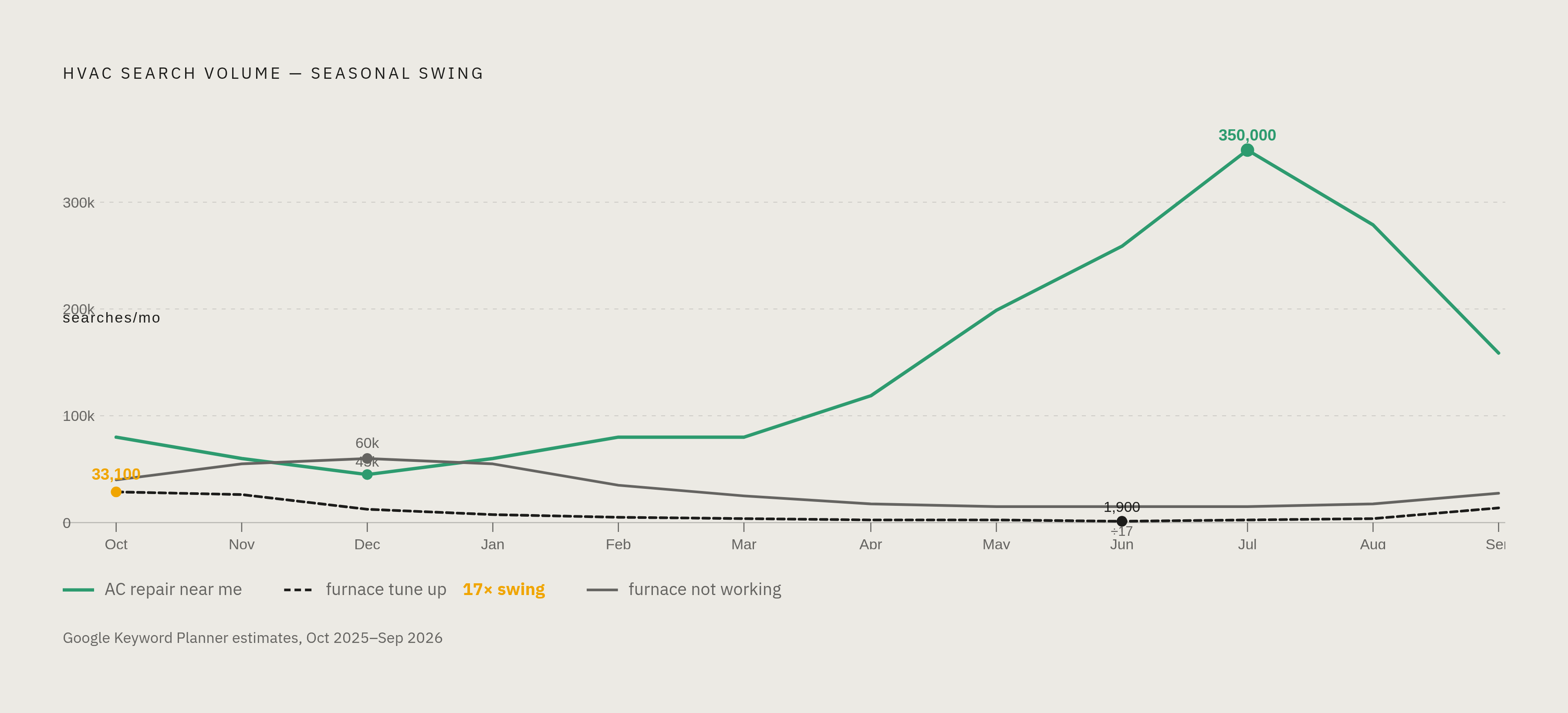
HVAC search demand doesn't rise and fall so much as it lurches, spiking 250 to 600% between the slow months and the panic months depending on the query. A homeowner searching "AC repair near me" in March is one of roughly 80,000 people nationally doing that search that month. By July, that number tops 350,000. Flip the season and furnace searches do the same thing in reverse: "furnace not working" sits around 15,000 monthly searches in summer and climbs past 60,000 in December. Run a "furnace tune up" query through DataForSEO and pull the August 2026 data, and the swing gets almost comical: 33,100 searches in October 2025, down to 1,900 by June 2026. That's a 17-fold difference between the busiest month and the dullest one, for the same three words.
That happens abruptly rather than gradually. A single heat wave can push AC repair searches up 400% within 24 hours, and 88% of local HVAC searches turn into a same-day service call. Nobody googling "air conditioner broken" at 9pm in a heat wave is comparison shopping. They're booking. That single fact, that demand here is not browsing behavior but booking behavior, is the whole reason a static "Services" page sitting untouched since 2022 cannot do the job HVAC contractors need it to do. Where a business operates matters too: Florida, Louisiana, Texas, and Arizona lead AC repair search volume, while colder states run the inverse pattern on furnace queries, meaning the "most important quarter" genuinely differs by zip code. This piece walks through what that means on a quarter-by-quarter basis, and why the businesses that treat SEO as a rolling calendar tend to beat the ones treating it as a checklist.
Why content published at peak season almost always loses to content published before it
Audit data pulled from more than 35 HVAC contractors by Authority Specialist shows a pattern that's almost too clean: businesses that target seasonal queries 60 to 90 days ahead of peak demand consistently beat competitors optimizing in the moment. The mechanism isn't mysterious. Google needs time to crawl a page, index it, and let real user engagement accumulate before it will rank that page competitively against pages that have already been doing this for weeks. A brand-new page has no track record. It's the SEO version of showing up to a job interview with no resume, just a firm handshake and a promise.
The practical translation: summer AC content built for the June through August rush needs to publish in February or March. Winter heating content aimed at the October through December surge needs to go live in August or September. A page built in May targeting "AC replacement" still has a real shot at ranking by July. The same page, started in August, has already missed its own party.
Market size changes the math too. Contractors in metros above roughly 500,000 people face longer ranking timelines and steeper content investment, simply because more competitors are fighting for the same page-one real estate. Larger operators should push their timeline earlier than the 60-day baseline, not later. And the cost of skipping this step compounds. A page launched in June, competing against pages that have three months of engagement data behind them, is substantially behind. It's behind on every ranking signal that builds on itself over time, which is most of them. This lead-time logic is the spine of everything that follows: each quarter below is really preparation for the season sitting two quarters ahead of it.
Q1 (January–March): Building the cooling-season foundation during the search lull
December through February is the quietest stretch of the year for HVAC search volume, which sounds like bad news until you realize it's the only window where a contracting team isn't drowning in inbound calls. That quiet is the opportunity. It's the one stretch where deep technical work and content production can happen without competing against an actual fire.
Content priorities here center on cooling season, published early enough to age properly: AC repair, AC installation, and AC tune-up pages need to go live now so they've had months to settle in before June. Furnace troubleshooting content still earns its keep, since residual heating demand lingers into January and February. Indoor air quality content belongs here too, since IAQ interest doesn't really have an off-season. Spring tune-up prep guides round out the quarter, catching early-season intent as March approaches.
With the phones quieter, Q1 is also the time to fix what breaks under pressure later: site speed audits, crawl error cleanup, refreshed city and service pages. Speed matters more than it sounds like it should. One in four visitors abandon a site that takes more than four seconds to load, and an emergency searcher in July, sweating through a 95-degree afternoon, is not going to wait around for a slow homepage to finish loading. Fix it in February, not July.
Worth checking too: does the site have a single "Services" page listing AC repair, heating, ductwork, and maintenance as bullet points under one URL? That page will not rank competitively for any of those terms individually. Each service needs its own dedicated page, built and optimized well before peak season arrives. Q1 closes with keyword research across all five intent categories (more on those below), so content assignments for Q2 and Q3 are locked in before the calendar gets tight.
Q2 (April–June): Executing at the cooling-season peak while building heating-season content in parallel
April through June is when cooling searches climb steadily, with "AC tune-up," "air conditioner maintenance," and "AC installation" hitting some of their highest organic volume of the year. This is the payoff quarter. The pages published back in Q1 have had time to index and settle into relevance, so this is where that earlier investment starts converting into actual phone calls.
Conversion readiness matters as much as ranking does. Phone numbers need to sit prominently above the fold on every page. Mobile load time should sit under three seconds, since emergency searchers are overwhelmingly on their phones and will not wait for a slow page. Emergency landing pages, the ones targeting "AC not cooling" or "air conditioning broken," need clear calls to action, and the emergency service page itself needs to be live and already ranking before the first real heat wave hits, not scrambled together the week after.
Paid search plays a real role here too. Running full Google Ads and Local Services Ads budget on non-branded search during the May through August peak captures demand that organic content simply can't reach yet, and it frees up CSRs to focus on upselling aging equipment during repair calls rather than chasing every lead cold.
But here's where the discipline gets tested: June is also when furnace content needs to start getting drafted, even while the AC phones are ringing off the hook. Furnace repair, furnace installation, and heating maintenance pages need to publish by late July or August in order to rank by October. Content published in July for "furnace not heating" will not rank by October if it hasn't had time to index and age. It's an odd rhythm, writing about cold weather in the middle of a heat wave, but it's the only way the timeline works. And there's a quieter opportunity sitting inside this quarter too: maintenance-plan pages and IAQ content face meaningfully lower CPCs than repair keywords during off-peak stretches, meaning organic content aimed at those same terms builds equity while competition is thin.
Q3 (July–September): Publishing the heating-season inventory before the fall surge
July and August feel like they belong to cooling-season maintenance, the tail end of the AC rush. In reality, these two months are the most important content-production window of the year for heating-season rankings, precisely because of the lead-time rule from earlier: whatever isn't indexed and aged by October simply won't show up when the heating searches spike.
And they do spike, sharply. "Furnace not working" runs around 15,000 searches in summer and climbs past 60,000 by December. Heating keywords broadly surge somewhere in the 250 to 350% range between October and February. "Furnace maintenance," "heating system repair," "furnace installation," all of it needs to already be indexed before that October ramp starts.
Q3 publishing priorities: furnace repair and furnace installation pages, if they aren't already live. A fall furnace maintenance checklist, ideally with regional variants, since New England, the Midwest, and mountain states each run on distinct seasonal windows. Heat pump comparison content deserves real attention too. "Heat pump vs. furnace" is a multi-week research journey for someone considering a full system replacement, and content that genuinely helps that decision tends to earn the kind of trust, and the kind of links, that a thin service page never will. Energy efficiency and rebate content, something like "2026 energy efficiency rebates in [state]," fits the same buyer: someone who researches for weeks before ever picking up the phone. Long-tail informational pieces, "Is a heat pump worth it in Minnesota," for instance, catch that same early-funnel intent.
Technical work in Q3 means refreshing city and service-area pages with updated seasonal copy before the fall ramp begins, so the homepage and key landing pages already read like heating season by late September. And Google Business Profile posting should shift too: AC tune-up messaging phases out, furnace prep messaging phases in, starting in September. Weekly posts tied to the calendar aren't just marketing copy. They function as an active ranking signal.
Q4 (October–December): Converting heating-season demand and using the late-year slowdown for infrastructure work
September and October mark the highest heating search volumes of the year, "furnace maintenance," "heating system repair," and "furnace installation" all peaking together. This is the quarter where Q3's work turns into actual booked jobs. It's also the quarter with the least room for excuses, since emergency heating pages need to meet the same bar summer AC pages did, with fast load times, a visible phone number, and a clear response-time promise, because a homeowner with no heat in December is every bit as urgent as one with no AC in July.
Q4 also carries the highest-ticket buyers of the year. Full system replacements are high-ticket purchases, and buyers at that price point research carefully before calling anyone. The buyer's guides and cost-comparison content published back in Q3 are what earn the trust that eventually converts this segment, not a hastily written page thrown up the same week the buyer starts calling around.
Late Q4, November into December, is where the year's slower stretch opens back up for infrastructure work. That means reviewing the traffic-to-booked-jobs ratio across the site before the spring ramp begins, hunting for conversion gaps on service and location pages. It means running email-based reactivation campaigns and referral incentives to the existing customer base, a low-cost way to generate demand while search volume is quiet. It means drafting Q1 content briefs now, so AC-season pages are already in production come January. And it means auditing the Google Business Profile itself, covering completeness, photo library, and the Q&A section, the unglamorous maintenance work that quietly compounds into Q1 visibility. What gets decided in November and December determines whether a business enters the next cooling season ahead of its competitors or scrambling to catch up. The loop closes and starts right back over.
How keyword intent categories map to the seasonal calendar
Five distinct categories of keyword intent run underneath this whole calendar, and each one plays a different role.
Emergency keywords, things like "emergency AC repair," "furnace not working," "no heat," or "air conditioning broken," carry the highest urgency and the fastest path to conversion. These need dedicated landing pages, phone number front and center, response-time information visible immediately. These pages have to be live and ranking before the peak hits, not scrambled together during it.
Service-plus-location keywords, the "[service] plus [city or neighborhood]" pattern, carry the highest commercial intent and the steadiest volume year-round. "AC repair Denver" is the classic example, and in competitive markets, each individual service-area combination may deserve its own page rather than being folded into one general location page.
Seasonal informational keywords, "fall furnace maintenance checklist for the Midwest," "heat pump vs. furnace," "2026 energy efficiency rebates in Ohio," build authority during the shoulder seasons. This content is also the most likely to attract links from local media and energy-focused sites, and it catches replacement buyers early, before they've even decided to call anyone.
Shoulder-season and maintenance keywords (maintenance plan pages, IAQ content, system comparison guides) tend to see thinner competition during mild months. Organic investment here builds equity at a lower cost, and positions a business as the trusted local authority well before demand actually peaks.
Long-tail diagnostic keywords, "central air conditioner not cooling upstairs," "gas furnace making strange noises," face less competition than head terms but carry very high booking intent. Blog content targeting these fills out the content calendar and catches people who are ready to book, spread across the whole year rather than clustered at the peaks.
Tools like Ahrefs, Semrush, Google autocomplete, and the related-questions boxes on search results pages help map volume patterns by local market, since local search volume can look nothing like the national average for the same term. Organizing content assignments around these five categories from the start prevents the most common mistake in HVAC content planning: publishing a stack of service pages and leaving the emergency and informational segments completely uncovered.
Google Business Profile as a seasonal SEO lever, not a set-and-forget listing
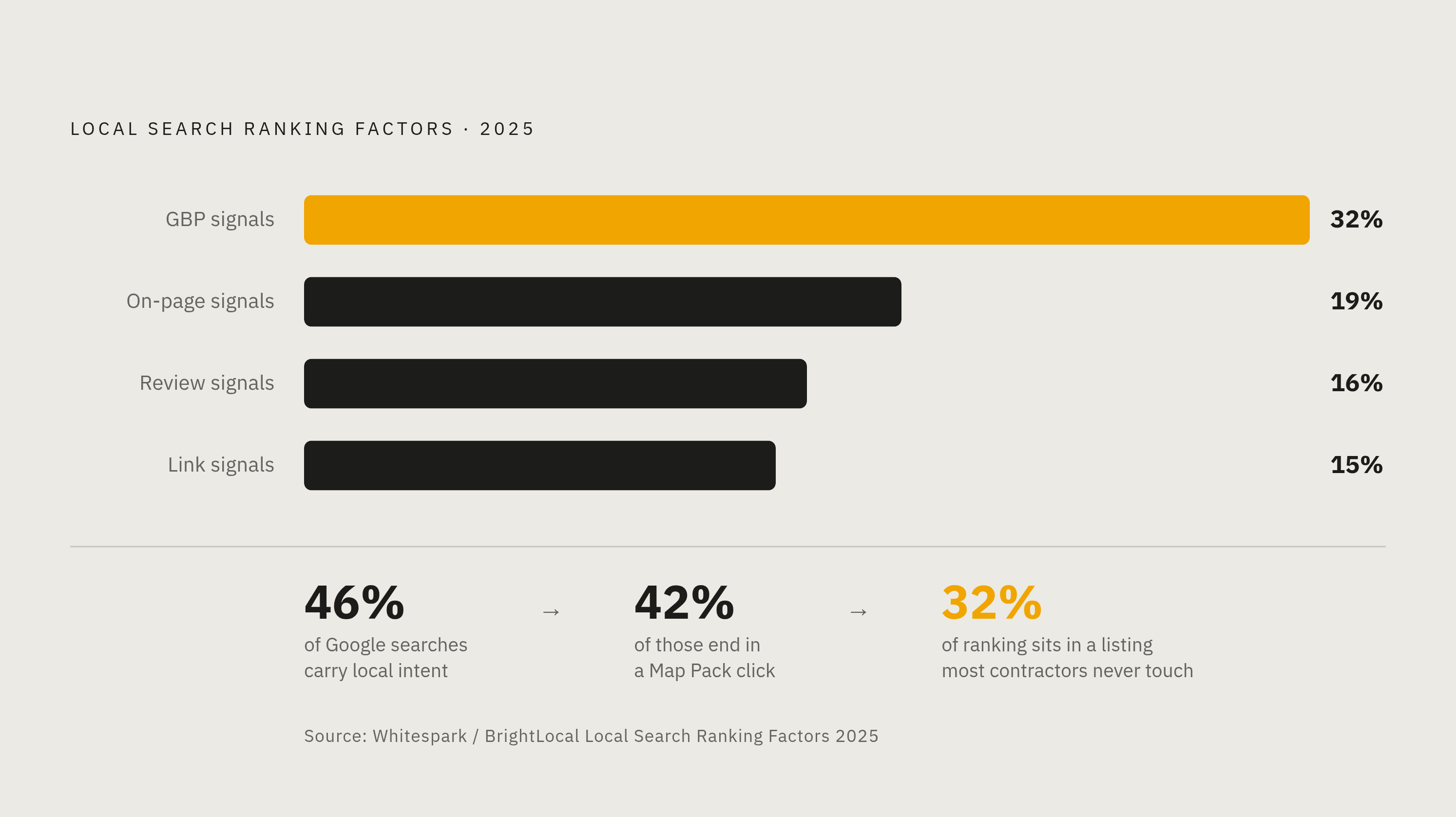
The 2025 Local Search Ranking Factors report from Whitespark and BrightLocal puts GBP signals at 32% of local pack ranking weight, the single largest category, ahead of on-page signals at 19%, review signals at 16%, and link signals at 15%. That edge is significant. That's close to a third of the whole ranking equation sitting inside a free listing most contractors set up once and never touch again.
The stakes behind that number are bigger than they look. Local intent shows up in 46% of all Google searches, and 42% of those local searches end in a click on a Map Pack listing. That's where most HVAC emergency clicks actually land. SearchLight Digital's 2025 data found GBP and Maps driving about 52% of organic closed revenue for the businesses studied, more than every other organic channel put together.
A handful of specifics matter more than they get credit for. Category selection: HVAC contractors should be listed under all six relevant categories (HVAC Contractor, Air Conditioning Contractor, Heating Contractor, Air Conditioning Service Repair, Furnace Repair Service, and Mechanical Contractor), not just the first one that seemed obvious at signup. Photo volume matters too: PipelineOn's 2026 data found profiles with 100 or more real, on-the-job photos getting 520% more calls and 2,717% more direction requests than the average GBP. And Full Stack HVAC's dataset, built from more than 123,000 profiles, flagged one gap as the single most damaging: 30% of HVAC listings have no website URL attached at all. That's a business handing Google a reason to rank someone else instead.
Posting discipline follows the seasonal calendar too. Businesses posting weekly to GBP see a 30% jump in customer interactions, and the content should track the same rhythm as the rest of the strategy: AC tune-up messaging from March through May, emergency AC content June through August, furnace prep in September and October, heating emergency content from November through January. Active management of the Q&A section, seeding common questions and answering them promptly, adds another layer of engagement signal. This requires ongoing effort rather than a one-time setup task. It needs the same quarterly attention as the rest of the content calendar, or it quietly goes stale while competitors keep posting.
Review velocity as a continuous seasonal discipline
HVAC might be the single most review-competitive trade in the country. A 2026 study from Smarfle CRM, covering 7,481 businesses, found a median of 2,084 reviews required just to crack the top three spots in Google Maps. The figure is accurate, and it is far beyond what most independent contractors approach.
Authority Specialist's own data shows contractors with fewer than 50 Google reviews ranking in the local pack at meaningfully lower rates than those with 75 or more, regardless of how good the website itself is. Fifty reviews looks like the rough floor for competitive local visibility in most mid-tier markets, not a nice-to-have milestone.
What matters more than the raw total, though, is velocity. Industry research has found rankings can slide even for a business sitting on a large review count, if new reviews stop coming in for a stretch. Google seems to weigh recency and pace here almost as heavily as volume, which means review generation is an ongoing project without an end date. It's closer to mowing the lawn: finish it and it looks great for a week, then it needs doing again. Building review velocity into the same quarterly rhythm as the content calendar, rather than treating it as a one-time push after a good month, is what keeps a listing competitive across the very swings this whole piece has been mapping out.