How Gun Stores Can Build a YouTube Channel That Actually Grows
Educational content and organic growth become a gun store's only scalable marketing option.
A gun store can build a growing YouTube channel by treating it as a customer acquisition system. With paid firearms advertising largely unavailable, the opportunity lies in useful education, a steady publishing rhythm, and a clear route from viewing to an owned audience. The goal is a channel that helps turn staff expertise into store visits and sales.
Why YouTube is one of the only scalable marketing channels left for gun stores
Google, Meta, and YouTube itself block paid firearms advertising, so gun retailers have to find customers without the usual paid shortcuts. That constraint creates an opening for stores willing to publish. Creator and organic content become central to the marketing mix rather than something added after the advertising budget is spent. The store has to earn attention through something worth watching.
YouTube’s audience offers a reason to make that effort. Top domestic firearm manufacturers get tens of millions of views on their channels, while top independent creators together get billions. Those totals cover different groups and cannot predict how a local retailer will do, but they show how many views go to channels outside the manufacturers’ own. Expertise has room to compete with brand recognition. A local store’s task is narrower than national fame, namely becoming the trusted voice that turns discovery into a visit.
How YouTube's rules actually work for gun content, and what they allow
YouTube’s rules operate through four layers, including community guidelines, advertiser-friendly guidelines, branded content policy, and linking rules. Each layer applies a different test. Educational content and a video offering a discount code occupy meaningfully different positions, while permission to publish does not automatically mean permission to monetize or promote. Before filming, a store should know which rules cover its content, its paid deals, and the sites its links lead to.
YouTube’s September 2026 Branded Content Policy replaced the old “paid product placement” language with a broader definition covering brand influence in exchange for payment, sponsorship, or free product. Branded content featuring weapons or ammunition is prohibited across the entire video. That creates a difficult disclosure problem for reviews. Disclosing a manufacturer-supplied rifle can expose a creator to a takedown or strike, while concealing the arrangement risks FTC enforcement. Three strikes within a rolling window can terminate a channel.
YouTube’s Firearms Policy also prohibits links in titles or descriptions to retail sites and other destinations where firearms or specified accessories are sold. A gun store cannot assume that its product URLs belong in every description, or that an educational label resolves the issue. Design around these constraints from the beginning, separating useful instruction from prohibited promotion and assessing outbound destinations on their own terms.
What channels built around real gun stores look like when they work
Tim Harmsen operates Military Arms Channel alongside Copper Custom Armament in Valparaiso, IN. An ex-Marine, Harmsen treats the channel’s ability to attract customers from around the world as a central source of value. Reviews are positioned around independence from sponsors. The distinction is commercial as well as editorial.
D’Boss Firearms in Oshkosh, WI, offers a different version of the store-based model. Its videos show everyday shop life, gunsmithing, and Cerakote work, with some product reviews as well. The shop itself supplies the setting and subjects. Instead of inventing a separate entertainment business, the channel opens a window onto work customers would otherwise see only from the counter.
Brownells demonstrates both the scale available and the need for independence from the platform. Its channel, active since 2007, has hundreds of thousands of subscribers and more than a hundred million views, with gunsmithing and maintenance education at its core. As enforcement tightened, the retailer began moving many videos to Trigger Times on its own website and hosting them internally. Educational videos can also keep attracting viewers years after publication. These cases share a useful principle for smaller stores, which is to turn existing expertise into reusable content whose business value extends beyond YouTube itself.
Defining the content pillars a gun store channel can own
Start planning with a customer’s problem. When someone walks into the store, what do they need help to understand, choose, or do safely? That question gives a video a purpose. A channel trying to cover all firearms content competes with dedicated enthusiast channels on their terms, while a focused store channel can organize around two or three problems its staff know well.
A small store should begin with one or two pillars its staff can discuss without a script. Safety and fundamentals videos can teach safe storage, help new owners get started, and cover marksmanship basics in a place where they can be taught safely. Maintenance and gunsmithing videos can show cleaning routines, field strip guides, and basic repairs that the rules allow. Both draw on questions that recur at the counter. Their strength is durable usefulness.
Gear and caliber can be another pillar, with honest comparisons and advice on what each is good for in place of reviews that push products. Store-life content can document gunsmithing work, Cerakote builds, interesting trade-ins, and range days, following the model visible at another gun store. These subjects give staff room to be themselves. Authenticity is the differentiator.
The pillars should also create a natural next watch. A useful test is whether someone finishing one video can see an obvious reason to watch another in the same series. That link helps people watch for longer and gives the recommendation system a clearer sense of who watches the channel. If every upload serves an unrelated viewer, the structure needs tightening. Relevance gives people a reason to return.
Publishing rhythm, video structure, and the retention signals that drive growth
To turn those pillars into an operating routine, new channels should target one to two uploads per week. That pace keeps videos coming without wearing out the person on camera. An editorial calendar also makes the next video part of the current production decision. Planned publishing supports stronger retention than ad-hoc posting because the subjects and their sequence receive attention before filming. Polish cannot substitute for a repeatable process.
Each video should lead with the result, then explain the tension that makes the answer worth watching. A real customer question often supplies both. Slow starts delay value, missing payoffs leave promises unfulfilled, and pacing drag gives viewers a reason to leave. A hook-content disconnect creates the same problem when a thumbnail promises an answer the video takes too long to deliver. The introduction needs to earn the next minute.
YouTube Studio’s Audience Retention graph provides the practical review tool. Use it to find exact drop-off points, with retention above half at the midpoint as a target. A video retaining viewers meaningfully better than the channel average provides a format to repeat, even if its raw view count is modest. Views alone can obscure a useful template. Click-through rate shows how well the title and thumbnail work, so test weak packaging before giving up on the content itself.
Shorts should serve as discovery pieces for long-form videos. Shorts and long-form use separate algorithms, so Shorts that do poorly no longer drag down the main channel. The practical approach is to clip a strong short segment from an existing video, such as a single technique, surprising result, or answered question. Give it a clear prompt toward the full video. This keeps short-form production connected to the channel’s core work.
How to route YouTube viewers into an audience the store actually owns
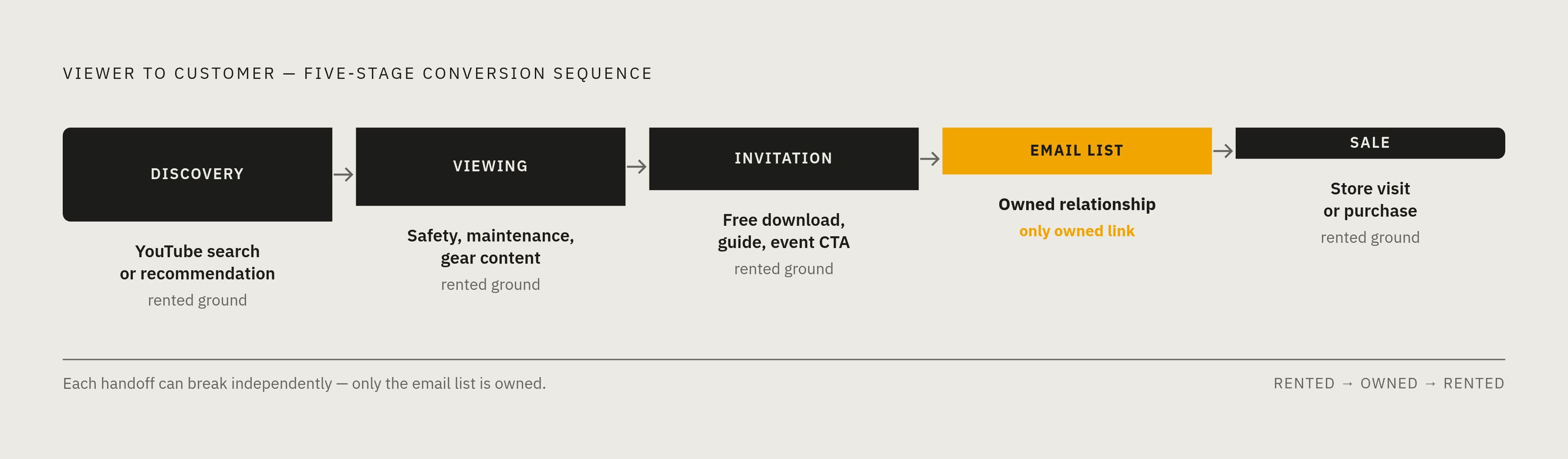
Who controls the relationship once the viewer leaves? YouTube can restrict content, remove monetization, or change its rules, while the store has no control over those decisions. The channel should therefore function as the discovery layer, with an email list as the primary owned audience. Rented land can attract a crowd, but it is a poor place to keep the only keys.
Every video should offer a relevant reason to join that audience, subject to YouTube’s rules. Possible offers include a free download, an exclusive guide, early access to store events, or a newsletter with staff picks. The offer should fit the viewing intent. A maintenance tutorial pairs naturally with a monthly maintenance checklist, while new-owner fundamentals can lead to a new-owner email sequence. None of these offers makes an otherwise prohibited retail link permissible, so both the call to action and its destination need to comply.
Once viewers join the list, the store can communicate promotions, events, and new inventory directly. That handoff depends on the website. A slow page or one that fails to answer the viewer’s immediate question breaks the conversion chain just as interest becomes actionable. For a gun store in the Midwest, web performance, clear page structure, search visibility, and email capture belong to the same system as video production. The channel creates discovery, but the site must be ready to receive it.
Laura Burgess Marketing recommends engaging creators as talent and production partners for content on store websites, email, dealer training videos, trade show loops, and product launch assets. That approach keeps their credibility and production skills available without making YouTube the home of every commercial collaboration. It also separates two decisions that are easily confused. A store can hire someone who makes good videos and choose where to publish the work.
What a gun store channel looks like when it is run as a business, not a hobby
A business-run channel has an owner inside the store responsible for its editorial calendar, analytics review, and email capture offer. Who handles those tasks should be as clear as who handles inventory or scheduling. Otherwise, publishing becomes the task that waits until the counter is quiet, while measurement and conversion wait even longer. The work needs a defined commercial role.
Harmsen’s review independence illustrates that role without implying that the channel has no outside support. Military Arms Channel also uses Patreon crowdfunding and has disclosed sponsorships, including ammunition from Federal. The relevant distinction is the value assigned to attracting customers to Copper Custom. Sponsor revenue and customer acquisition are not the same objective. A store should know which one its channel is built to serve.
The operating model depends on a sequence, from discovery through useful viewing, an off-platform invitation, an owned email relationship, and ultimately a store visit or sale. Each handoff has a different job. Consistent publishing without email capture leaves no clear conversion mechanism, while an email list without regular discovery lacks a reliable inflow. Strong content leading to a slow website loses momentum at the handoff. The store gains more by treating those failures as linked parts of the business than by blaming the algorithm.
The opportunity remains open for stores willing to sustain that system. Many Midwest gun stores have no YouTube presence or a dormant one, leaving room for a consistent local voice with a defined niche. Evergreen maintenance and safety content can keep drawing viewers long after filming, so each new upload has something to build on. A store that pairs that accumulating library with a fast website and working email capture builds something more durable than a burst of attention. The practical advantage goes to the stores that begin deliberately and keep publishing.