Online Ammo and Accessories Sales for Brick-and-Mortar Gun Stores
Local gun stores lose ammo sales to online rivals unless they build proper digital channels.
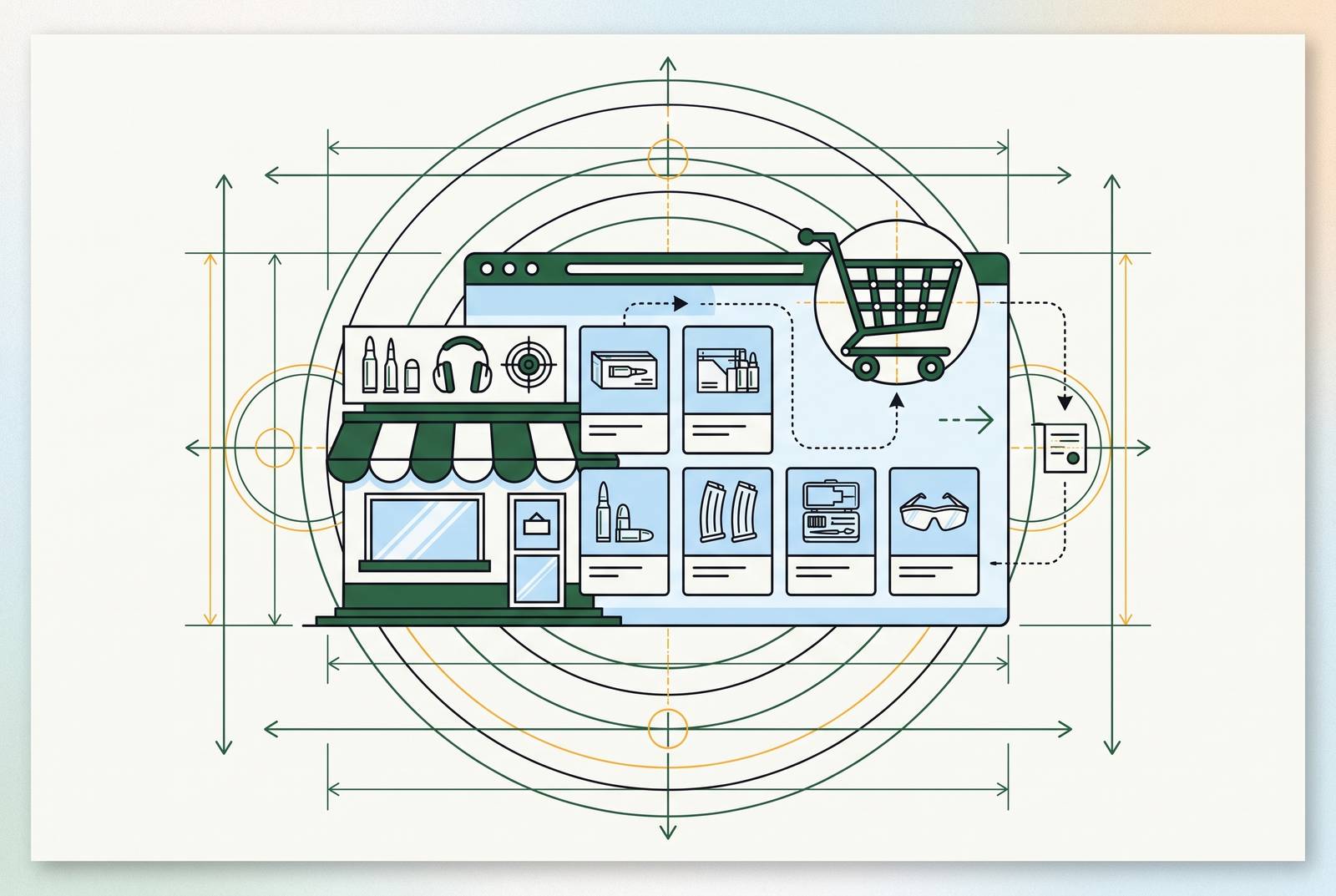
Online ammo and accessories sales are no longer a side channel for firearms retail. They're pulling revenue that used to walk through a brick-and-mortar front door, and the pull is getting stronger every year the industry forecasts out to 2030.
Why online is claiming ammo and accessories revenue
The shift isn't happening because online ammo is cheaper, at least not primarily. The shooting and gun accessories market points to expanding online sales channels and rising digital retail penetration as the forces shaping the category through 2030, and those forces run on access and selection more than on price alone. A buyer looking for a specific grain weight, a discontinued optic mount, or a left-handed holster used to drive to three stores to find it. Now that buyer opens a browser.
The behavioral hinge was 2020. Store closures during that period pushed a wave of first-time buyers online out of necessity, not preference, and a meaningful share of them never fully came back to the counter for routine purchases even after stores reopened their doors. Buying a box of 9mm or a cleaning kit online stopped feeling like a workaround and started feeling normal.
That normalization has new fuel heading into 2026. Manufacturers including brands under The Kinetic Group and Winchester have announced wholesale price increases for 2026, and the typical response to a coming price hike is to shop around before it lands. Shopping around, for most buyers, now means comparing listings across multiple websites in the time it takes to finish a cup of coffee, not driving between stores on a Saturday.
None of this requires a villain. No pure-play online retailer is sabotaging local gun shops. A store that treats its physical location as the only sales channel routes its own ammo and accessories margin to whichever online retailer ranks first in a search result. That's a self-inflicted outcome, and it sets up the harder question: even if a local store wanted to compete online dollar-for-dollar, could it? The next section answers that, and the answer involves a cost structure that physical retail can't shortcut its way out of.
The structural cost gap that makes competing on price alone a losing strategy
A brick-and-mortar gun store carries costs an online-only competitor simply doesn't: rent, utilities, a showroom's worth of display fixtures, staff on the floor during business hours, insurance on a physical inventory sitting behind a counter. Dealers who've watched both models up close describe the gap in blunt terms, calling internet-only overhead "next to nothing" next to what a physical operation carries. It's a structural advantage baked into the online retailer's cost base before a single ammo can ships.
Manufacturer-enforced Minimum Advertised Price policies blunt some of that advantage, since they stop online sellers from advertising below a set floor. But MAP governs what a price tag says, not what actually changes hands at checkout, and enforcement varies by manufacturer and by product line. A rebate, a bundle discount, or a loyalty credit can quietly undercut the advertised floor without technically violating it, and a store counting on MAP alone to hold the line is counting on a fence with gaps in it.
A price war is a bad bet for the physical store, full stop. But here's a different way to see it: a cost disadvantage on one axis doesn't erase an advantage on another. The local store doesn't need to match an online retailer's price to win the sale. It needs to win on something the online retailer structurally can't offer, then make sure the customer sees that offer before they click "add to cart" somewhere else. That's where the conversation turns next.
Physical stores' advantage over online retailers
A local gun store holds three assets no warehouse-based competitor can replicate at scale: trust built over repeat transactions, hands-on compliance expertise, and the ability to put a product in a customer's hands today.
Compliance complexity is a built-in advantage in states with layered gun laws. California is the clearest case: its regulatory requirements are complicated enough that consumers are routinely pointed back toward their local gun shop, which can also negotiate bulk pricing for regulars in a way no faceless cart checkout can. For a local dealer who knows the rules cold, the complexity that makes California a headache for online-only retailers becomes a built-in reason for a customer to walk in.
Immediate availability matters just as much, maybe more, for anyone still thinking about this in purely rational terms. A hunter leaving for a trip Friday morning doesn't have three to five business days to wait on ground shipping. A shooter heading to the range this weekend needs ammo this week. If the local store shows up in that customer's search at the moment the need hits, that customer walks in and buys, full price, same day. Speed beats discount when the clock is the actual constraint.
Expertise closes the loop on accessories. A scope mounted wrong, a holster that doesn't fit the carry position, a suppressor mismatched to the host firearm, these are purchases where getting it right the first time avoids a return, a refit, or a repeat trip to the store. A knowledgeable staff member who asks the right questions before ringing up a sale turns a one-time buyer into a repeat customer, and that kind of guidance doesn't exist in a product listing's bullet points.
None of these advantages generate a dollar of revenue, though, if the customer never finds the store online in the first place. A trusted dealer with deep compliance knowledge and same-day inventory is invisible to a search engine, and therefore invisible to the customer, unless the digital side of the operation is built to surface all three. That's the gap the next section addresses directly.
What a transactional online channel requires
A Facebook page with a phone number on it is not an online sales channel. Neither is a static website that lists hours and a map. Capturing ammo and accessories revenue requires a purpose-built setup with several pieces that aren't optional, and skipping any one of them causes a lost sale, a blocked account, or a compliance problem that a regulator catches later.
Payment processing is the first hard wall. PayPal and Square don't allow firearm-related transactions at all. Stripe treats firearms as a restricted category that may be available only with explicit written approval, which isn't something a store finds out about after launch. Dealers need a high-risk processor built to handle firearm sales from the start, because picking the wrong one at launch doesn't just slow things down, it can mean a terminated account and a dead checkout page in the middle of a sales season.
State-level buyer verification has to live inside the purchase flow itself. California DOJ point-of-sale checks, FOID verification for Illinois buyers, and comparable requirements in other states can't be bolted on as a manual review step after the order comes in. They need to be part of the checkout sequence, the same way a shipping address or a credit card number is.
Advertising runs into its own wall. Google and Facebook both enforce strict limits on firearms and ammunition promotion, which closes off a huge share of the paid acquisition playbook that works for ordinary retail. A store that built its marketing plan around boosted posts and search ads finds out fast that this category plays by different rules.
That last constraint sets up the next question almost by itself: if paid ads are mostly off the table, how does a store actually reach new customers online? Organic search is the answer, and it's the main strategy here.
Organic search as the primary customer acquisition channel when paid ads are restricted
Because Google and Facebook both restrict paid promotion of firearms and ammunition, organic search is the dominant way new customers find a local gun store online, since the paid shortcuts other retail categories lean on simply aren't available here.
Think about what that search actually looks like from the buyer's side. Someone typing "red dot sights for AR-15" or "9mm ammo in stock" into Google is not browsing. That person has already decided to buy and is deciding where. Whoever's page shows up in that moment gets the sale, and whoever doesn't show up loses a customer who was ready to spend money right then.
Local search visibility is the foundation layer. A fully filled-out Google Business Profile, consistent name, address, and phone number information across every listing, and category signals that tell Google what the store actually sells all work together to get the store into map results when a nearby buyer searches. This is where the "I need it now" customer gets captured, the same hunter or weekend shooter from the earlier section who can't wait on shipping. No warehouse-based competitor can take that customer away, because that customer isn't looking nationally.
Product and category pages form the second layer, and they do different work. A page built specifically around "9mm ammo in stock" or a particular optic brand, kept accurate against real inventory, can compete for buyers outside the immediate area too, particularly in states with looser shipping rules. This is where a local store starts picking up some of the non-local volume that would otherwise go straight to a national retailer.
Buying guides, maintenance walkthroughs, and plain-language explainers on state-specific rules build something slower but durable: topical authority that search engines reward over time, catching buyers earlier, while they're still researching. A customer researching suppressor laws in their state today might be the customer buying a suppressor from that same site in a month.
Site speed and mobile usability aren't cosmetic details here, they're ranking factors. A slow page or a checkout flow that breaks on a phone screen loses search position and loses the buyer who gives up and leaves before the page even finishes loading. For a local gun store without an in-house web team, this is usually the kind of groundwork that gets skipped, because running a gun counter demands a different skill set than measuring search performance and page speed. Getting that measurement right, consistently, over months, raises the odds that a site shows up in search.
Search visibility takes time to build, though, and a store needs revenue while that authority accumulates. That's where a second, faster option comes in.
Marketplace partnerships as a faster path to online volume while organic authority builds
Listing inventory on a firearms-specific marketplace gets a local store in front of a national buyer base right away, without waiting months or years for its own site to climb search rankings.
Guns.com offers a concrete picture of what that reach looks like in practice. The platform reported record-breaking growth in 2025, closing the year with strong sales performance and a network of local FFL dealers plugged into its traffic. Its dealer program is built to be low-cost and simple to run, handling inventory management, order processing, and customer service while widening a dealer's reach. One dealer who was running a small strip-mall operation back in 2022 pointed to the platform as what let the business scale and expand smarter than it could have alone.
Analysis of Guns.com's 2025 performance points to tools like in-cart instant rebates and a "Buy Now" button that links straight from manufacturer websites to in-stock listings, features that helped brands including FN America, Colt, Glock, Smith & Wesson, Ruger, Walther, Kimber, CZ-USA, Savage Arms, and Retay move more product, with local dealers sharing directly in that traffic.
Marketplaces aren't a replacement for a store's own site, though, and treating them as one caps the upside. Marketplace fees eat into margin, and marketplace rules limit how much a dealer can shape pricing, branding, or the customer experience. The relationship a store builds over years of repeat business, the kind built on trust and local expertise described earlier, lives on the store's own site, not on someone else's platform. The marketplace is a volume strategy for the near term. The owned site and its search ranking are the long game. Running both at once, deliberately, is what closes the gap between where a store is now and where its organic authority eventually gets it.
How online and physical channels reinforce each other
The stores set up to win this run online and in-store as a single customer journey, with the same inventory numbers, the same prices, and the same experience no matter which door the customer walks through.
Buy-online-pick-up-in-store works because it turns the website into a foot-traffic generator for the counter. A customer who reserves ammo online and drives over to grab it is a customer standing in the store, next to the accessories wall, next to a staff member who can ask what else they need. The online order becomes the opening of the sale, not the whole sale.
That only works, though, if the inventory numbers on the website match what's actually on the shelf. A customer who drives across town because the site showed stock, only to find empty pegs, doesn't give the store a second chance. Syncing the point-of-sale system with the online store in real time makes BOPIS trustworthy.
Capturing email and phone numbers at checkout, online and in-store alike, builds a list the store owns outright. That list sidesteps the advertising restrictions covered earlier entirely, since a direct email or text doesn't need Google's or Facebook's permission to reach someone who already bought something. Over time, that list becomes the store's most durable asset, more durable than any single search ranking or marketplace listing, because platforms change their rules and algorithms shift, but a customer's email address stays put.
Staff knowledge, translated into site content, is what separates a store's product pages from a generic listing on a big marketplace. A holster page that explains fit across different carry positions, or an ammo page that spells out how a self-defense load compares to a range load in a given caliber, does two jobs at once: it helps the actual buyer make a better decision, and it signals to a search engine that the page is worth ranking.
Put the pieces together, a transactional site built on the right payment and compliance infrastructure, local and product-level search visibility, a marketplace presence for near-term reach, and a physical location that closes the sale and keeps the customer coming back, and the result is an operation a warehouse-only competitor can't copy. The physical store is the advantage in this fight, provided the digital side of the business is built well enough to let customers find it before they settle for someone else.