Why Patients Choose a Chain Over Their Local Optician Online
Chains dominate online visibility and booking friction, not clinical quality.
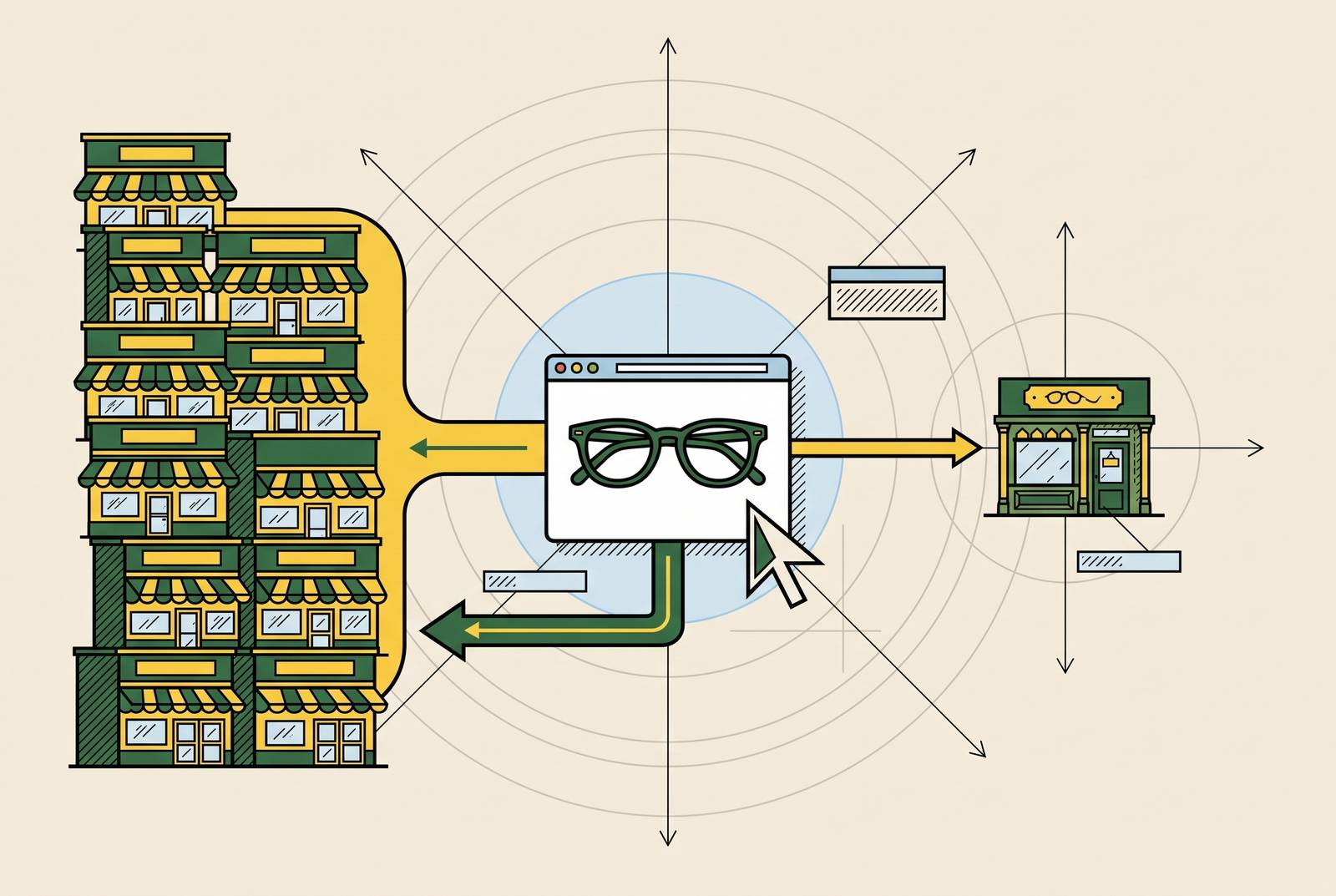
Most patients say they would rather be seen by an independent optometrist, and most of them still end up booked into a chain. An industry analysis found that 77% of patients prefer an independent optometrist over a corporate-owned provider, and most rate private practice care as the better of the two. And yet chains keep filling appointment books with new patients who say, in the same breath, that they would rather be somewhere else. Something is happening between what people say they want and what they actually click, and that gap is where this whole piece lives. So if independents win the preference contest so decisively, why do chains keep winning the acquisition contest?
How patients choose an optician before contacting a practice
The decision gets made before the phone ever rings. A patient looking for an eye exam does not interview three practices and weigh up their clinical philosophies. The patient opens a phone, types "opticians near me," and scans a results page where every listing looks roughly interchangeable: similar stock photography, similar language about caring staff and modern equipment, similar five-star badges clustered at the top. From that undifferentiated lineup, a choice gets made in seconds, based on whichever practice looks easiest to trust and easiest to book, right now, from a couch, with a thumb. You build that shortlist from search ranking, review count and recency, visible pricing, and whether booking needs a phone call or just a tap. None of those four signals has anything to do with how well someone will examine a retina. All four have everything to do with who gets the appointment.
Mobile search sharpens the effect. A patient searching from a phone wants an answer in seconds, not a research project, so any friction at any step, no online booking, no visible price, a site that takes four seconds too long to load, ends the search before the independent practice ever gets considered. Patients want fast, seamless service that moves without interruption between online and in-person, and chains have trained the market to expect that, no matter what it implies about clinical quality. The rest of this piece walks through where that search-to-booking journey breaks for the independent, and where it breaks against them more often.
Chains' edge in search and digital visibility
Chains do not out-rank independents because their eye care is better. They out-rank independents because they have industrialized the specific digital signals that search engines and patients both use to rank providers in search results and listings. That is a budget difference before it is anything else: chains carry marketing, branding, loyalty-program, and nationwide-reach budgets that a single-location practice has no realistic path to matching, and no amount of clinical excellence changes that math.
The scale advantage compounds in a way that is easy to underestimate. A chain with a large number of locations runs one coordinated SEO strategy across hundreds of location pages, with every branch page built and optimized for its own local search terms, feeding into the same centralized system. So when a single independent competes against one of those branch pages, it is up against a network effect, where every other location in the chain's system reinforces the domain's authority, and the local page borrows from that. The technology gap compounds the marketing gap: chains typically carry far larger budgets for the digital infrastructure, booking systems, content platforms, analytics tools, that keep visibility current, so the disparity is not only how much gets spent on ads but what tools exist to maintain rankings month over month.
None of that means the gap is unclosable. Independent practices absolutely can run competitive local SEO, and some do it well. But closing the gap takes sustained, technically competent execution over time, not a one-off website refresh, and most independent opticians are clinicians first, running a practice and seeing patients, with little spare time or staff to dedicate to an ongoing SEO program. The objection "just do better marketing" is fair in theory and hard in practice, for reasons that have nothing to do with motivation and everything to do with hours in a day.
How review volume and star ratings favor chains
Search ranking gets a patient to the results page. Reviews decide who gets picked off it. Chains see more patients per location than most independents do. That higher volume alone generates more reviews per location, faster. That accumulation becomes a trust signal in its own right: a practice with a large volume of reviews reads as established and dependable to someone who has never set foot in either building, regardless of what the actual star average says.
That dynamic creates a strange outcome: given two practices with matching high star ratings, most patients default to the one with more total reviews, because volume itself gets read as a proxy for reliability and recency, not just satisfaction. A high-traffic chain location sends out a steady stream of automated post-visit prompts that ask for a review. An independent seeing a fraction of that daily patient count gets the same prompts out more slowly, even if every single patient walks out happier.
What makes this particularly unfair as a mechanism, rather than a failing, is that the satisfaction gap actually runs the other way. The same 2025 industry analysis found that 57% of patients believe care quality in private practice is superior to corporate-owned providers, and that is a real, measurable advantage for independents. But that advantage stays invisible to someone who has not experienced it yet and is scrolling star ratings at 9pm looking for tomorrow's 8am slot. Worse, the review gap is self-reinforcing on its own terms: higher review volume lifts local search ranking, which drives more visits to the listing, which drives more reviews, a loop that has nothing to do with clinical merit and everything to do with who crossed a visibility threshold first.
Pricing transparency online and the NHS test misconception
Price is a separate signal from ranking and reviews, and it does its damage earlier in the process, often before a patient has compared a single review. Chains publish clear, standardized prices directly on their websites, so when a patient compares options, they see a number instantly and don't need to dig any further. A lot of independent sites either omit pricing entirely or describe it in vague general language, which, to a patient skimming on a phone, reads less like modesty and more like evasion, or like a signal that the visit will cost more than it's worth finding out.
Layered on top of that is a specific, persistent misconception: many patients believe that NHS-funded eye tests are only available at large chains. That belief is false. Any optician contracted with the NHS, independent or corporate, can give you NHS-funded tests and NHS optical vouchers. But that correction rarely appears anywhere on an independent practice's website, which is exactly where the misunderstanding takes root and goes uncorrected, so the patient starts the comparison already assuming the independent is the pricier, less-accessible option, before any real comparison has happened.
The irony sits in what actually separates the two models. The meaningful difference between independent and chain care is visible in how care gets delivered: appointment time, personalization, continuity with the same clinician. A patient doing a price comparison online never reaches that distinction, because the page in front of them never raises it. The related objection, that independents sometimes do charge more and that the premium reflects something real, holds up reasonably well, but only for a patient who already understands what is being compared. A first-time searcher has no basis for that judgment without clear information on the page in front of them.
Online booking and appointment friction as a deciding factor
Ranking gets a patient to look. Reviews and pricing get a patient to lean one way. Booking is where the decision actually locks in, and it is the most mechanical of all four signals: offer instant online booking and the patient books. If a practice requires a phone call during business hours, the patient, more often than not, goes elsewhere. Most chain locations offer that instant booking by default. A meaningful share of independent practices still don't, because the technology has not yet been set up.
Timing makes the gap sharper than it looks on paper. Decisions to book an eye exam often happen in the evening or from a phone, exactly the hours when calling a practice is either impossible or just annoying enough to defer. A practice with no online booking option does not lose that patient to a competitor with better care. It loses that patient to whichever competitor happened to have a booking button available at 9:47pm on a Tuesday.
Booking is also only the most visible piece of a wider expectation. Patients now expect automated appointment reminders, digital recall notices, and confirmation texts, but these conveniences need practice management software that many independent clinics have not fully adopted yet. None of this reflects on clinical skill in any way. It is an operational and digital infrastructure gap, and the right system can close it quickly, unlike a clinical shortfall that would take years to fix. But until it is solved, it costs independent practices patients who would have preferred them on every other measure that actually matters, continuity, attentiveness, time with the clinician, simply because the booking button never showed up when it was needed.
Reclaiming the online decision without competing on chain terms
Line up the four gaps from the previous sections, ranking, reviews, pricing, booking. A pattern emerges that should be genuinely reassuring to an independent practice owner: none of them requires outspending a national chain. They require being findable, being credible, and being frictionless on the specific searches where chains are, in fact, weakest, which are local and specialty searches, not generic national ones.
Local SEO sits at the center of that opportunity: a Google Business Profile that is complete, accurate, and actively managed, consistent business listings across local directories (what search engines call citations), and content built around the specific services a practice offers in its specific town. That is a single-location-sized project, achievable without a chain-sized budget, and it is the highest-leverage digital investment an independent practice can make, because it directly targets the exact searches, "optician in [town]," "eye exam near [neighborhood]," where a national chain's broad authority matters least and a well-maintained local profile matters most.
Specialty is where the comparison tilts hardest in the independent's favor. Independents often carry real depth in myopia management, specialist contact lens fittings, and ongoing management of ocular disease, areas where personalized, continuity-driven care tends to outperform a standardized retail model. That said, this edge is narrowing in places: trade coverage in 2025 noted that myopia management has gone mainstream among UK multiples, with major chains now offering specialist lenses like MiSight and Stellest at scale, so the claim that chains never match independents on specialty depth no longer holds everywhere. What still holds is the opportunity to become the known name for one specialty locally, pediatric vision, dry eye management, scleral lenses, which differentiates a practice in search results without requiring a chain-scale marketing budget to do it.
The remaining pieces are basic infrastructure, not advanced strategy. Online booking, transparent pricing shown on the site, and a Google Business Profile with a steady flow of recent reviews: this is table-stakes infrastructure, the baseline a patient expects before even considering an independent seriously. Close those three gaps and the specific reasons a patient defaults to a chain by habit largely disappear. A web presence, a search visibility plan, and booking infrastructure built specifically around a single local practice, rather than dropped in from a generic template built for a different kind of business, is what separates an independent that competes on a chain's terms and loses, from one that competes on its own actual strengths and gets found doing it.


