How Plumbers Convert Late-Night Site Visitors Before They Call a Competitor
The specific site mechanics that turn midnight emergencies into immediate calls.

A pipe bursts at midnight, and the homeowner standing in two inches of water is not browsing. This article maps the specific set of site mechanics that turn that ten-second visit into a phone call, in the order those mechanics actually matter.
Why late-night plumbing visitors behave differently
Picture the homeowner at 12:15 a.m., phone flashlight propped against a cabinet, basement filling, pulling up Google with one thumb. That person is not a visitor in any normal sense. They already know they need a plumber. They are a caller who happens to land on a website first, and that single fact changes what the site is for. A site built to inform someone is a different machine than a site built to get someone to pick up a phone in the next thirty seconds.
Two distinct people show up on a plumbing site after hours, and they want nothing alike. The first is the emergency caller: scared, soaked, not comparing five bids, not reading an About page, just looking for the first plumber whose site tells them, within seconds, that emergency work happens here, that this business covers their zip code, and that a real person answers right now. The second is the planned-work researcher, awake at 11 p.m. because the water heater has been groaning for three weeks and tonight felt like the night to finally deal with it. That person wants pricing context, photos of past jobs, maybe a way to request a quote without picking up the phone.
Both arrive after hours, but plumbing is about as emergency-driven as home service trades get, which raises the cost of a confusing or sluggish site higher than in almost any other contractor category. A slow furniture retailer loses a sale. A slow plumbing site, at the wrong hour, loses a customer standing in rising water, and that customer has almost no patience left to spend hunting for a phone number. The emergency caller sets the design standard for the entire site, because a site that works for them tends to work for everyone less urgent than they are.
The wrong visitor most plumbing websites are built for
Most plumbing sites do not convert poorly because of a bad color scheme or an outdated photo of a service van. The failure sits in the architecture: these sites are built like brochures, meant to describe a business, when they need to function as lead-generating systems built to remove every reason a frightened visitor might hesitate.
A brochure and a conversion system start from opposite premises. One assumes the visitor has time to read. The other assumes the visitor has about ten seconds and a shaking hand. A homepage trying to serve both the panicked emergency caller and the patient researcher ends up serving neither particularly well, because neither one finds the specific experience they came looking for. The researcher wants depth. The emergency caller wants a phone number the size of a stop sign. A single page asked to deliver both ends up delivering a compromise that satisfies no one.
Homepage-only architecture caps conversion regardless of how polished the homepage itself looks, before any single-page fix gets attempted (more on that in the section on service-specific landing pages). Emergency-specific searches, things like "burst pipe repair" or "emergency plumber near me," are at the high-intent end of that spectrum: the visitor has an immediate need and effectively zero interest in comparison shopping. That creates an unusually brutal competitive environment. Large regional chains and franchise operations spend heavily on paid search for exactly these terms, and a business that pays for that traffic and then loses the visitor to a slow or unclear site is burning money on the click itself, before the visitor ever picks up a phone.
Late-night emergency calls and what the gap costs
Pull the call logs at almost any plumbing business: after-hours call volume runs higher than most owners assume, and a meaningful share of it goes unanswered. Those are often the most valuable calls a business will ever get, not scheduled maintenance but the burst pipe, the flooded basement, the water heater that picked the worst possible night to fail. Emergency jobs tend to carry higher margins and faster close rates than routine service calls, which makes a missed one considerably more expensive than it looks on paper.
The website is not the only point where this leak happens. A call can also go unanswered because no one is staffing the phone at 1 a.m. But the website is the one part of this whole chain a plumbing business controls completely, start to finish, with no dependency on staffing schedules or call center contracts. A visitor who cannot find a phone number in the first few seconds, or who finds one that is not tappable, or who is not sure the business even does after-hours work, quietly leaves and calls the next name on the list. No error message. No notification. Just a closed tab and a job that went to a competitor.
That is the shape of the cost: not a dramatic failure, but a quiet, repeatable, entirely preventable one, operating in a part of the business that is fixable without hiring a single additional person.
The above-the-fold layout that decides the call
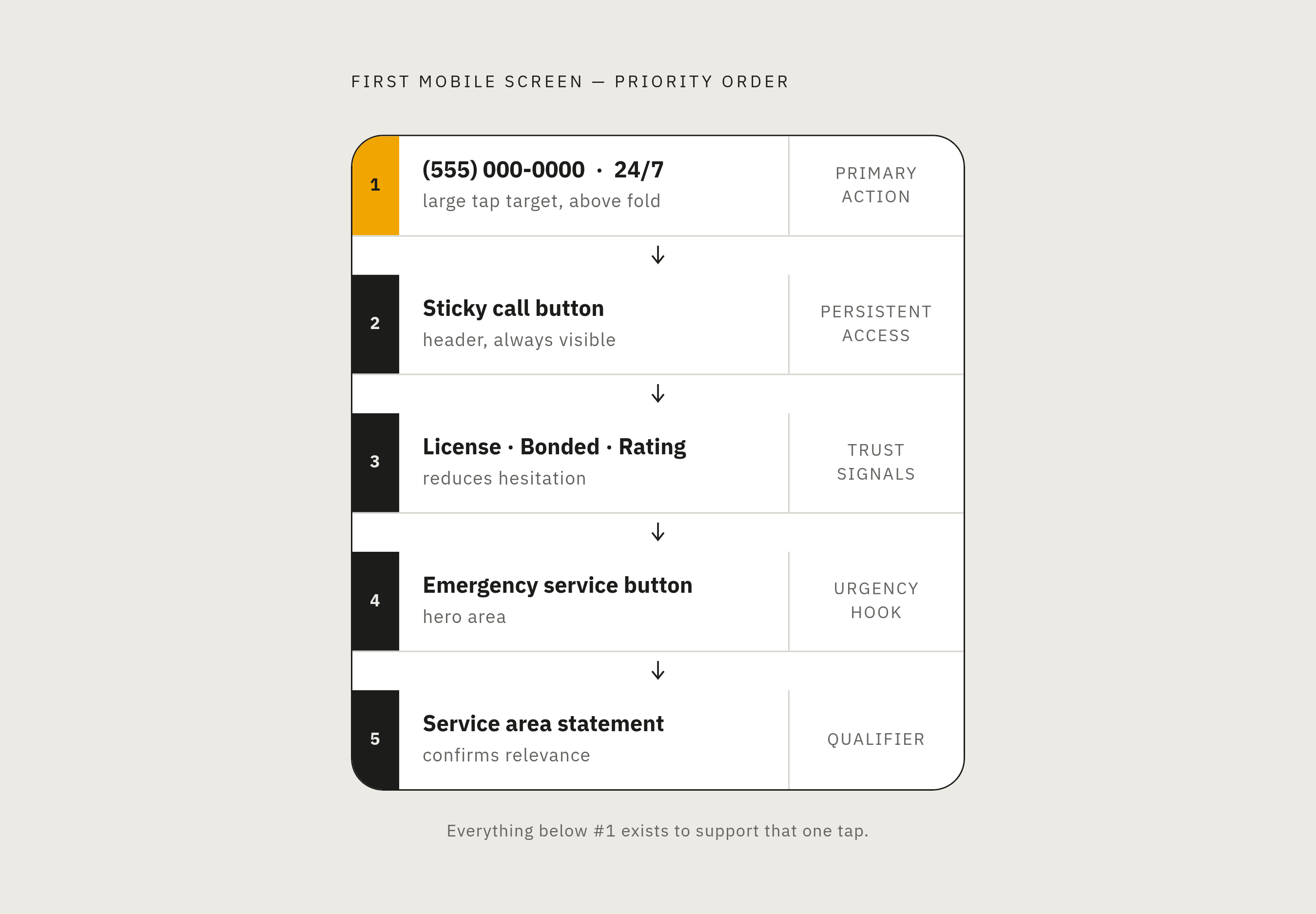
For someone searching on a phone at midnight, everything that matters has to fit on the first screen. Nothing below the fold gets a chance to work, because the decision to leave or stay has usually already happened by the time a thumb starts scrolling.
The phone number comes first, and it needs to be large, tappable, and paired with a line confirming the business answers calls around the clock. That is the floor, not a nice-to-have. A sticky header that keeps a tap-to-call button visible through the scroll closes off one of the more common failure modes: a visitor who scrolled past the number once, got distracted by something else on the page, and then could not find it again. The single largest leak on most plumbing sites sits exactly there, in the space between a visitor's intent to call and the friction of locating the number that lets them do it.
Button copy carries more weight than it gets credit for. "Call Now" outperforms "Contact Us" for an emergency visitor, because it matches the state of mind that visitor is already in. Nobody standing in a flooding basement wants to "contact" anyone. They want to call, immediately, and copy that mirrors that urgency removes one more half-second of hesitation.
Trust signals need to live on that same first screen: license number, insurance status, years in business, review ratings. Placed below the fold, trust signals arrive after the visitor has already started deciding whether to leave, too late to do their job. At least one piece of third-party validation, a star rating, a review count, a BBB rating, a certification badge, belongs somewhere in that first view. Without it, an anxious brain tends to treat the whole site as unverified, no matter how professional it looks. A dedicated emergency-service button in the hero area gives high-intent visitors a direct path that does not require them to read a single line of marketing copy to find it.
Why page speed is a conversion mechanic
None of the above-the-fold work matters if the page never finishes loading. Speed sits upstream of every other fix on this list, because a slow mobile load means the carefully built first screen simply never gets seen.
Most plumbing searches happen on a phone, frequently while the searcher is standing in the middle of the problem itself, water rising around their shoes. A slow-loading site bleeds both kinds of visitor, emergency and planned-work alike, before either one reads a single word of copy. The gap between a typical plumbing site's mobile load time and where that load time needs to sit is wide, and closing it takes deliberate technical work rather than a new theme installed over the old structure. High-performance, low-code development that prioritizes speed without sacrificing visual design is the build standard that actually closes that gap. Speed functions as both a search ranking factor and a direct conversion mechanic, doing double duty in a way few other site elements manage.
For plumbing businesses competing against regional rivals who have not addressed their own load times, that gap stays closeable with focused technical investment, and the compounding effect on both rankings and conversion makes it one of the higher-return infrastructure fixes available to a local service business. Speed is the precondition for every mechanic described in the rest of this piece, because none of them function on a page the visitor never waited around to see.
Service-specific landing pages, why a homepage cannot serve every urgent search
A homepage, no matter how well it is built, still has to be one page trying to speak to every possible visitor at once. That is a structural ceiling, not a design flaw that a better headline fixes.
Consider two searches: "burst pipe repair" and "water heater replacement cost." Those two homeowners are in fundamentally different mental states. One needs a plumber in the next twenty minutes. The other is comparing options for a planned job that might happen next week. A single page cannot speak fluently to both without diluting itself for each. Homepage-driven plumbing sites typically cap out around 2 to 3 percent conversion regardless of what else gets fixed on them, and dedicated, intent-matched pages remove that ceiling.
Pages built around the highest-volume emergency scenarios, burst pipe emergencies, sewer backups, water heater failures, frozen pipe repair, should lead with what the problem is, what the business does about it, and how fast a technician arrives, with the phone number placed prominently and a short note on what to do before help shows up. These pages rank for the specific queries homeowners actually type into Google and convert at higher rates than a single generic "emergency plumbing" page, because they match the visitor's exact search intent. The SEO effect compounds over time too: ranking improvements on service-specific and service-area pages keep accumulating well after the pages go live, making this a durable investment with no shelf life.
How Plumbing Leads Convert
Plumbing converts by phone, overwhelmingly, which makes the tap-to-call button the primary revenue mechanism on the entire site. Click-to-call buttons, sticky phone headers, and call tracking are not optional extras on a plumbing landing page. Phone conversions account for the substantial majority of all plumbing leads, which makes the case for an impossible-to-miss phone number stronger here than in nearly any other home services category.
Forms exist for a different visitor, not a lesser one. The planned-work researcher, awake at midnight thinking about that water heater, is not going to call a business at that hour and risk hitting voicemail only to lose momentum by morning. A quote request form or a booking widget gives that visitor a way forward without a phone call, catching intent that would otherwise evaporate by sunrise. The form itself should stay simple: name, phone number, and a short description of the issue is enough to work, and multi-step forms tend to convert noticeably better than a single long page of fields dumped in front of the visitor all at once. Forms built mobile-first outperform desktop forms that got shrunk down afterward, since fields designed around a mouse and a wide screen rarely translate cleanly to a thumb and four inches of glass.
A real-time booking calendar extends this further, letting a homeowner lock in an appointment at 11 p.m. without waiting for the office to open. That single feature turns a browsing researcher into a booked job overnight, no human on the other end required. None of these three channels, tap-to-call, contact form, booking widget, substitutes for either of the others. Offered together, they cover the full range of intent that appears on a plumbing site after dark, from the person who needs a human right now to the person who just wants something on the calendar before bed.
Trust signals, what a stranger letting a plumber in at midnight needs to see
Emergency plumbing asks something unusual of a stranger: let an unfamiliar person into the house, during a flood, in the middle of the night, based on little more than a website and a few minutes of searching. Few home service purchases carry that particular combination of urgency and vulnerability, and the trust bar sits accordingly high.
That means the credibility questions an anxious visitor is silently asking need answers before they ever pick up the phone. Is this a real, licensed business? Is someone insured if something goes wrong in the home? Do they actually work in the visitor's area, or will the visitor be told after the call that they're outside the service zone? A license number, the phrase "licensed, bonded, and insured," and a clear statement of service area coverage, all visible without scrolling, go a long way toward turning a nervous searcher into someone willing to dial the number. None of this is decoration. It answers, directly and immediately, the exact question running through the mind of someone deciding whether to let a stranger through the front door at midnight.