SEO for Personal Injury Lawyers in Competitive Markets
Organic search and local map pack rankings require technical foundation and hyperlocal content.

Personal injury SEO runs on different math than nearly every other local search category, and that math turns it into an arms race. Paid search doesn't soften the problem, either. Organic search is the only channel where today's work still pays off a year from now. That is why the fight for rankings is so much fiercer here than in categories where paid traffic can simply be bought on demand.
Layered on top of that spending dynamic is a structural obstacle that money alone can't solve: directory sites. The sounder approach is flanking, winning the narrow, local, case-specific searches that a national directory has no incentive to build out in depth. And the barrier to even attempting that has risen substantially. Content saturation, climbing link-building costs, and a stricter standard Google applies to anything touching health, safety, or financial outcomes all mean legal content now has to clear a higher bar on trust and credibility than it did a few years ago, and that higher bar is the terrain everything in this piece responds to. Everything that follows in this piece is a response to it.
How AI Overviews and algorithm shifts changed what "ranking" means for PI firms
The search results page a PI firm is optimizing for in 2026 looks different from the one it was optimizing for even a couple of years earlier, and pretending otherwise is its own competitive liability. AI Overviews now appear on a large share of legal search queries, pushing the traditional ten blue links further down the page and cutting into click-through rates wherever they show up. That effect is genuine, but it doesn't land evenly across every kind of search.
Bottom-funnel queries, the ones that actually produce signed cases, hold up far better than the research-stage ones. AI Overviews cut much deeper into informational searches, the "what should I do after a car accident" type of query, than into the high-intent local ones. That distinction matters because high-intent local searches are exactly where PI firms should be putting their energy anyway.
One might argue this means firms now need a separate budget line for "generative engine optimization," a new acronym chasing a new fear. What actually gets cited inside an AI Overview is structured, jurisdiction-specific, genuinely authoritative content, the same content that wins traditional organic rankings. Building the thing that ranks well organically tends to produce the thing AI systems pull from when answering a research-stage question. GEO is the natural byproduct of doing organic SEO correctly, which is the throughline for everything the rest of this piece covers.
The Google Business Profile and local map pack deserve first attention
Among everything a PI firm could work on, the local map pack is the most valuable piece of real estate and the most directly within a firm's control, making it the logical starting point. The map pack captures a commanding share of clicks on legal searches, and a firm that doesn't land in the top three for its city and its practice areas is close to invisible to the people searching with the most urgent intent, the ones searching right after an accident happens.
Getting there starts with the firm's local business listing itself, and this is where a lot of firms that believe they've "done local SEO" have actually left value on the table. A profile set to a generic category instead of the correct, specific legal-service category undersells what the firm handles and weakens the profile's relevance signal before anything else is even evaluated. Beyond category, the profile needs services listed out by case type, current photos, and actual responses to the questions people post, because all of that feeds into how complete and active Google judges the profile to be.
Reviews are measurable, but not in the way most firms assume. A review strategy built around a single push for five-star ratings misses the actual mechanism; what the map pack rewards is a consistent, ongoing flow.
None of this operates in isolation from the rest of the site, either. Organic authority built through the practices covered in the next two sections lifts local pack position directly, so GBP work and organic SEO work reinforce each other. When a firm's name, address, and phone number don't match across Avvo, Justia, and the smaller local directories, that mismatch sends Google conflicting signals, and conflicting signals suppress rankings.
What a technically sound PI law firm website requires
Technical performance isn't the unglamorous part of the job that gets handled last. It affects both whether the site ranks and whether the traffic it earns turns into a signed case, and those two effects build on each other. A firm that fixes its technical foundation is improving two outcomes with one piece of work, not one.
Core Web Vitals sitting in Google's "good" range across the site's key templates, the homepage, the practice area pages, the location pages, is the baseline, not a bonus. A site that loads slowly or renders awkwardly on a phone screen is losing the case before the visitor has read a single sentence.
None of the fixes here require exotic engineering. Serving images in WebP or AVIF instead of older formats, lazy-loading anything below the fold, deferring scripts the page doesn't need immediately, and routing assets through a content delivery network are the standard levers for cutting page weight without making the site look worse. A firm owner doesn't need to know how to implement any of this directly, but knowing to ask a developer or agency whether these four things are in place is a reasonable bar to hold them to.
Site architecture is the other half of the technical picture, and it's about how authority moves through the domain, not just how fast pages load. Larger competitors will already have this sorted, so a firm missing any of it is behind on factors that have nothing to do with how good its content actually is.
Building content that competes in a saturated PI market
A generic "Personal Injury Lawyer" page doesn't move the needle anymore, because the PI content space is saturated enough that breadth alone no longer signals authority. The firms gaining visibility, both in traditional organic results and inside AI Overviews, are the ones writing content specific enough to be genuinely useful and credible enough to earn the trust signals that a directory site can't replicate at the local level.
Geography works the same way now. Neighborhood- and zip-code-level content in major markets has gone from an advanced tactic to table stakes; a page built around a whole city will lose ground to a competitor running pages built around specific suburbs or neighborhoods within that city. This is where the structural disadvantage covered in the first section turns into an opportunity. A smaller firm willing to go deep on a narrow set of case types and a specific set of neighborhoods can build a density of content that Avvo, Justia, and unfocused national firms simply have no reason to build. That's the flanking move: not matching the directories page for page, but out-specializing them where specialization actually pays off.
FAQ and guide content aimed at research-stage questions, what to do after a car accident in a given state, how long a personal injury claim typically takes, builds topical authority over time and also happens to be the kind of content AI Overviews draw from on informational queries. That overlap is the GEO convergence point raised in the second section: this content doesn't need a separate strategy, because the research-stage content that builds organic authority is the same content AI systems are already pulling from.
One caution belongs here. A study found no statistically significant ranking benefit to AI-generated law firm content on its own, and firms producing large volumes of thin AI content risk tripping the same site-wide quality classifiers the August 2025 spam update used against link spam. Specificity and firsthand expertise are the actual differentiators. Volume for its own sake is not.
Building authority through links and entity signals without the tactics that now trigger penalties
Backlinks still count as a real ranking factor in PI SEO: building good links is slow and expensive, and building bad ones is now dangerous in a way it wasn't a few years ago. The December 2025 core update made clear that manipulative link patterns, including ones a firm built years earlier and may have forgotten about, can trigger site-wide penalties that erase organic traffic and are difficult to recover from once applied.
Entity signals offer a second, complementary path that doesn't depend on backlink volume. Entity SEO means making sure the firm appears consistently and accurately as a recognized entity across directories, Google's Knowledge Graph, legal databases, and the structured data embedded on the firm's own site. That consistency matters increasingly to how AI systems decide which sources are trustworthy enough to cite, not just to how Google's traditional ranking systems evaluate authority.
Attorney-authored content adds a third layer. A page written under an attorney's name, with a visible bar number, documented case results, and a real author bio, builds the kind of experience and trust signal Google's own guidance explicitly values. That's good news for a solo practitioner specifically: demonstrated firsthand expertise is a signal that doesn't scale with marketing budget, so a one-person firm writing genuinely authoritative content on a specific case type can compete with a firm twenty times its size on this particular dimension.
Converting PI traffic into signed cases through intake design and on-site experience
A lot of firms that complain about SEO "not working" are actually looking at a conversion problem wearing a traffic costume. Rankings and visitors mean nothing if the site experience, the intake process, and the response time don't carry that visitor across the line to becoming a signed client. All the work covered in the previous five sections can succeed exactly as intended and still fail to produce cases if this layer is broken.
Mobile design is the first place this breaks down. A beautifully designed desktop intake form that becomes a cramped, fiddly mess on a phone screen is quietly losing cases the analytics dashboard won't explain on its own.
Response speed matters just as much, and it operates on a logic completely separate from anything SEO touches. Firms that respond to inquiries within minutes hold a real edge over firms that route leads through a slower intake chain, for a simple reason: an injured person who can't get a human on the line moves to the next search result and calls that firm instead.
None of this can be judged well without tracking the right numbers. Traffic and rankings are easy to watch and easy to feel good about, but they don't say anything about business outcomes on their own. Tracking qualified leads, booked consultations, and signed cases by channel is what turns SEO from a line item on faith into a measurable investment. The number that actually settles the question of whether the strategy works is cost per signed case by channel, set against the average value of that case type. A firm that can't trace its organic traffic through to retained clients is spending money without any way to know if it's working, which is a strange position for a vertical this expensive to compete in.
Sequencing these fundamentals as a coherent strategy
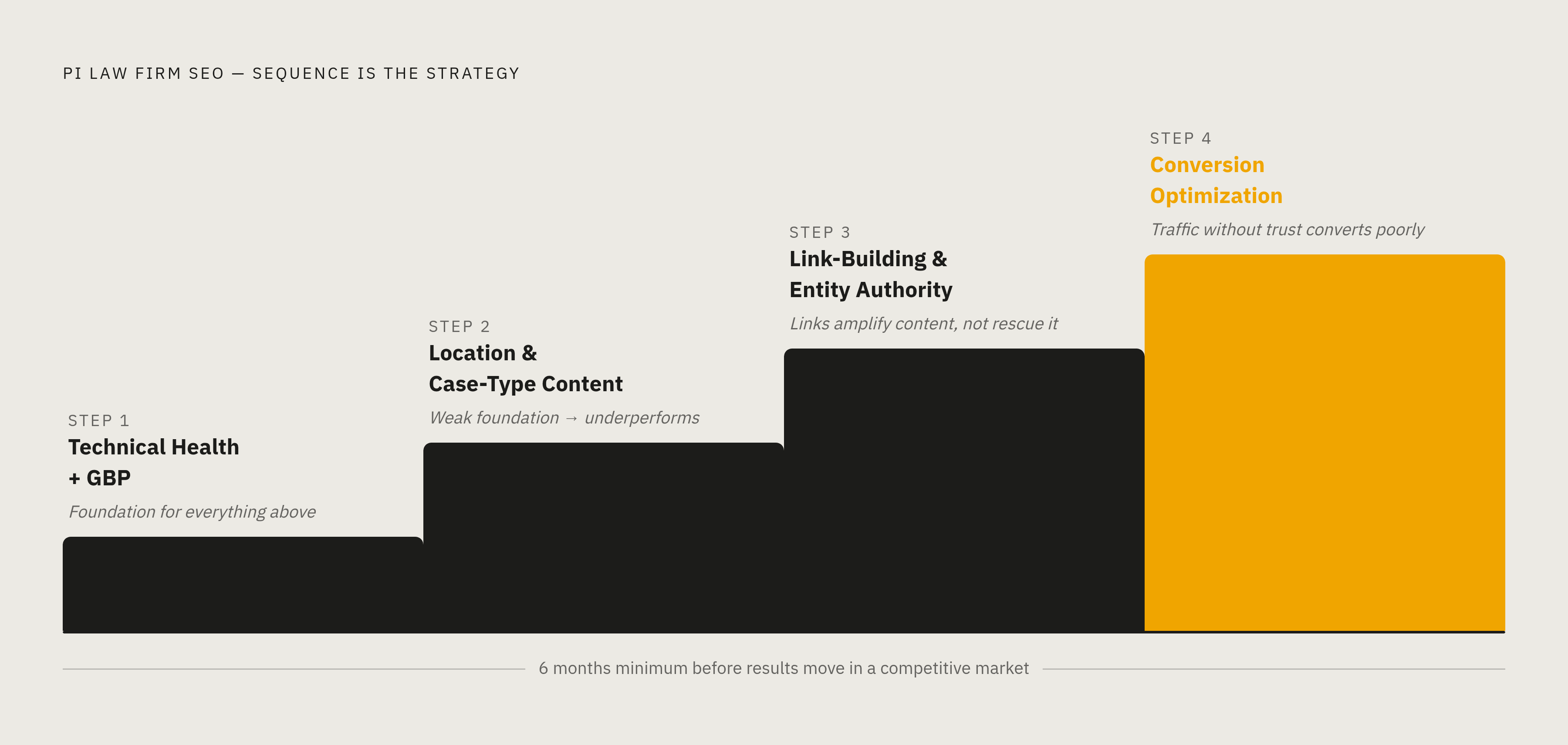
Firms that win on organic search in this vertical run the same fundamentals as everyone else, but in a deliberate order, so each layer has something solid to build on instead of several half-finished projects competing for the same hours and budget.
The sequence that holds up: technical site health and a complete local business listing come first, because they're the fastest wins available and because every other layer's performance depends on them being in place. Location and case-type content comes next, since content built on a weak technical foundation underperforms no matter how good the writing is. Link-building and entity authority follow that, compounding on content that already exists rather than trying to earn links for pages that aren't live yet. Conversion optimization comes last in the build sequence because it needs traffic flowing in before there's anything to measure and tune against.
Patience is part of the strategy, not a caveat to it. Plan for at least six months of consistent work before expecting results that move the needle in a competitive PI market. Firms that pull the plug after two or three months, right around when the compounding would start to show up, usually conclude afterward that SEO doesn't work for law firms. That conclusion says more about the timeline than the tactic.
None of this requires a massive marketing budget to execute well. A solo practitioner or small firm willing to own a narrower set of case types and a tighter geography, and go deep rather than wide, holds a more durable position than a large firm spreading unfocused content across every case type and every city in its state. That's the structural opening this whole piece has been pointing toward since the first section: the arms race rewards deliberate sequencing over sheer spending, and the firms that lose are usually the ones piling money into one layer, content or links, while leaving the technical foundation weak or the intake process broken underneath it. Fundamentals, run in order and given time to compound, are what beat a bigger budget in this vertical.