Deleting and Responding to Negative Google Reviews
How to identify removable reviews and respond effectively to ones that will stay.
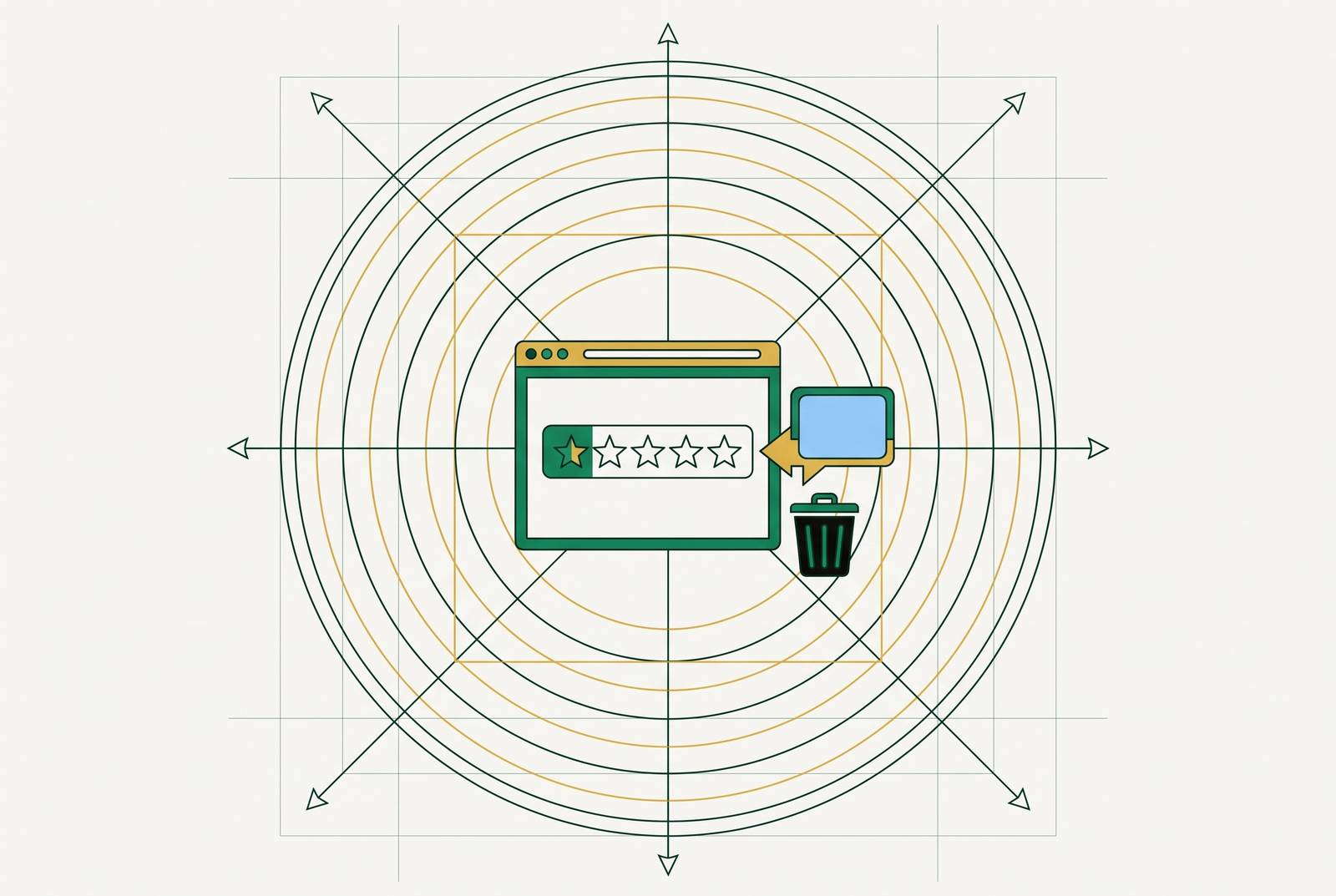
A business owner cannot delete a Google review that someone else wrote about their company, full stop on the mechanism: there is no button, no settings toggle, no support ticket that makes a legitimate, if unflattering, review disappear on request. Only Google can take a review down, and only when that review breaks a specific content policy. Negative, unfair, or commercially damaging does not qualify on its own. A one-star review calling a restaurant's service slow sits in exactly the same category, as far as Google's removal system is concerned, as a glowing five-star review: both are customer speech the platform has decided it will not referee on the merits of whether it's fair.
That line holds because Google's incentive runs in the opposite direction from the business owner's. The entire commercial value of a Google review rests on the assumption that it reflects something close to a real customer's real experience. Google is protecting the only asset that makes its reviews product usable.
A useful distinction that clears up most of the confusion: a reviewer can delete a review they personally wrote, any time, for any reason. A business owner cannot delete someone else's review, under any circumstance, no matter how wrong it seems. Those are two different permissions attached to two different accounts, and no amount of flagging, emailing, or arguing in the replies changes who holds which one.
What follows from that constraint is where this piece actually lives. A business that spends its energy trying to will a bad review out of existence is pushing on a locked door. The energy spent pushing is better spent figuring out which reviews are actually eligible for removal under Google's policies, how to report those correctly the first time, and how to respond publicly to the reviews that are going to stay up no matter what. That is the real playbook, and it is the one the rest of this piece walks through in order.
What Google removes: the enforceable policy categories
Google removes a review only when it violates a specific heading in its Prohibited and Restricted Content policy, and the categories that apply to local business profiles give a business something concrete to check a review against before filing a report that wastes everyone's time. Think of the list less as legal fine print and more as a filter: run any infuriating review through it, and either it lands in a named category or it doesn't.
Fake Engagement covers a reviewer who never actually set foot in the business, one person running multiple accounts to post the same complaint twice, or a competitor leaving a review designed purely to damage the listing. Off-topic covers commentary that has nothing to do with the actual business, a rant about a landlord posted on a coffee shop's profile, for instance. Illegal content covers references to illegal goods, services, or acts occurring on the premises.
What does not qualify matters just as much as what does. A review that is harsh, one-sided, or built on a version of events the business disputes stays up if it describes something that actually happened to the reviewer. Google says directly that it does not referee disputes between a business and a customer over whose account of an interaction is correct. A review can be unfair and still be unremovable.
A handful of patterns make a review worth a second look before reporting. None of those patterns guarantees a successful report on their own, but they are signals worth looking for before spending a report on a long shot.
How to report a review
Reporting runs through two separate routes, and because Google limits a business to a single appeal per review if the first decision comes back unfavorable, getting the category right on the first attempt is the only chance to correct a wrong call.
The first route starts inside the Google Business Profile itself. Sign in, go to Read Reviews, click the three-dot menu sitting next to the offending review, select Report, and choose the most specific violation category available from the list, not the closest-sounding one, the actual one. Submit from there and the report enters Google's queue.
The second route runs through the Reviews Management Tool. Open the tool, confirm the account, select the business in question, choose Report a new review for removal, select the specific review, pick the violation reason, and submit. Appeal status can also be tracked here once a decision comes back.
Moderation blends automated systems with human review, and specificity changes outcomes. A vague report that just marks a review as generally objectionable gets declined more often than a report that names the exact policy clause being violated and explains, concretely, how the review crosses it. A report claiming Fake Engagement because the reviewer has posted exactly one review ever, for a business in a city they've never otherwise reviewed, carries more weight than a report that just says the review feels fake.
A denied report is not necessarily the end of the line. Google Business Profile support can be contacted directly, and the official community forum, staffed partly by Product Experts, sometimes surfaces a second look at a borderline case, though nothing there comes with a guarantee. For content that may cross into actual unlawful territory, defamation or a false statement of fact rather than an opinion, Google's Legal Help form opens a separate track. A court order is the strongest lever available in that process, but Google has also acted voluntarily on defamation claims that are clearly documented, even without one in hand. A narrower and uglier situation, extortion, where someone demands payment or goods in exchange for taking a bad review down, has its own dedicated report form, and it requires screenshots of each demand along with a direct link to the review itself.
Newer reviews come down more easily than old ones. None of those traits take a review out of contention. That said, newer reviews still come down more easily than old ones, so reporting sooner rather than waiting to see if a review "blows over" remains the better bet.
The April 2026 policy changes
Google made its biggest enforcement change in years over two consecutive days in April 2026, and the practical effect is that a fair number of businesses are currently out of compliance with rules that now carry real penalties, whether they know it or not.
Google published its 2025 Trust and Safety Report alongside three new Maps protections aimed at local businesses.
Four practices are now explicitly banned. Directing staff to coach customers into mentioning staff names inside their reviews is out, a tactic that had been common enough to need its own clause. Review gating, the practice of pre-screening customers by how happy they seem before sending them a review request, is now explicitly and directly prohibited.
Review gating deserves particular attention because it has been standard operating procedure for a large share of reputation management strategies for years: send the review request only to customers who first indicate, through a quick survey or a verbal check-in, that they're satisfied. Review gating is a named, banned practice, and Google is enforcing against it.
Penalties escalate through three documented stages. The first is a temporary loss of the ability to receive new reviews at all, which starves a listing of fresh signal at exactly the moment a business might need it most. The second is temporary unpublishing of reviews that already exist on the profile. The third is a public warning banner attached to the listing, stating outright that fake reviews were found and removed, visible to anyone who looks at the page. Full suspension of the business profile is on the table for violations that are severe or repeated.
Google's 2025 Trust and Safety Report puts the scale of enforcement in concrete terms: hundreds of millions of policy-violating reviews were blocked or removed out of more than a billion total submissions that year.
A national consumer-protection regulator adds a further layer of enforcement. A national consumer-protection regulator's rule on consumer reviews, in force since October 2024, makes the suppression of honest reviews a matter that can carry civil penalties. The old strategy of drowning a bad review in a flood of solicited positive ones is not dead, generating positive reviews from real customers remains entirely legitimate, but the method has to be clean: open requests sent to every customer, not a filtered list of the ones who already said they were happy.
How to respond to negative reviews that cannot be removed
A profile with nothing but five-star reviews reads, to most people checking it before a purchase, as faintly suspicious. A handful of negative reviews paired with thoughtful, specific responses tends to build more trust than a suspiciously spotless record, because it shows a prospective customer what actually happens when something goes wrong. That reframes the reviews that cannot be removed: they are not just liabilities sitting on the profile, they are the only place a business gets to demonstrate, in public, how it behaves under pressure.
The response itself is the lever, since the review's text is locked in place. The framework behind most credible guidance in 2026 breaks into three moves: acknowledge, apologize, act.
Acknowledge means naming the specific issue the reviewer raised, not a template line like "we're sorry you had this experience," but language that proves someone at the business actually read what was written. A review complaining about a 45-minute wait for a table reservation gets a response that mentions the wait, not a generic nod toward "your experience."
Apologize means expressing regret for what the customer went through, even in cases where the business disputes some of the underlying facts. Apologizing signals to the next reader that customer frustration gets taken seriously.
Act means offering a concrete next step: a named contact, a direct email address, a specific phone number. "Please contact us" with nothing attached functions as no invitation at all, since there's no path for the customer to actually take.
A shorter or longer response changes how it reads to prospective customers. A response that performs well in front of prospective customers is a moderate length: long enough to show real engagement with the complaint, short enough to avoid reading as defensive. A reply that runs several paragraphs starts to look like a business litigating the point rather than addressing it, and a reply that's a single clipped sentence reads as dismissive no matter how polite the wording is.
A few things make a response worse than saying nothing. Posting private details about the customer, appointment times, account numbers, anything medical, turns a bad review into a far bigger problem, since now there's a privacy complaint stacked on top of the original one. Taking a few minutes to read a drafted response over for tone before hitting post is the cheapest insurance available against turning one bad review into two.
When AI tools help with responses
AI drafting tools can genuinely speed up the Acknowledge-Apologize-Act framework, especially for a business fielding dozens of reviews a week across multiple locations, where writing a fresh, specific reply to each one by hand becomes a real time cost. A tool that drafts a first pass referencing the actual complaint in the review, the wait time, the order mix-up, the billing error, gives a staff member something to edit rather than something to write from a blank page, and that's a legitimate efficiency gain.
Where it backfires is predictable enough to watch for. A response that reads as obviously templated, swapping in the customer's name and the complaint category but keeping the same sentence structure review after review, undercuts the entire point of the Acknowledge step, which depends on proving a human actually read the specific complaint. A generic AI-drafted reply posted without edits risks looking like exactly the kind of impersonal non-response that erodes trust rather than building it; a prospective customer scrolling through ten responses that all share the same cadence draws the obvious conclusion.
One might argue that the fix is simple: never post an AI draft unedited, but that raises a second question. If every reply needs a human pass for tone, specificity, and accuracy before it goes live, how much time is the tool actually saving versus just rearranging where the time gets spent? The honest answer is that it shifts effort from composition to editing, which is faster for most people, but it does not eliminate the need for a human who actually knows the complaint and can catch a draft that gets a fact wrong.
That last risk is the one with teeth. An AI tool drafting a response has no independent knowledge of what happened between the business and the customer, and a draft that invents a detail, misstates a policy, or apologizes for the wrong thing entirely turns a fixable one-star review into a public example of a business that doesn't know its own operations. The tools belong in the workflow as a drafting aid, not as an autopilot, and the businesses getting the most out of them are the ones still reading every word before it goes live.