Attorney SEO Versus Legal Directory Listings
Own your domain to build lasting equity; directories disappear when contracts end.

Attorney SEO and legal directory listings are not two flavors of the same marketing channel.
Why attorney marketing decisions hinge on ownership
A firm's own domain accumulates value no matter who manages it or what it costs to maintain next year. Directory visibility works differently: it disappears the instant a payment stops. This is a structural difference, not a performance difference. A directory listing can outperform a firm's organic search results in any given month and still be the weaker long-term investment, simply because nothing about it compounds. The question a firm's marketing budget should answer is which channel builds something the firm still owns in five years, and that question belongs at the start of every budget conversation, not tacked on at the end.
How a legal search results page works
A single search for a personal injury lawyer in, say, Omaha returns several distinct zones on the page, and each one runs on its own algorithm. Paid ads and Local Services Ads sit at the top of the page. Below them sits the Map Pack, exactly three Google Business Profile listings pulled from local search signals. Traditional organic results follow beneath that. AI Overviews can appear above or threaded between any of these, depending on the query. SEO for Lawyers: The Complete 2026 Guide makes this asymmetry explicit, and it carries a practical consequence. Map Pack placement can shift in sixty to ninety days for a firm that has simply never done the groundwork, while organic rankings for a competitive term can take eighteen months and a six-figure investment in content and links to move. Directory listings compete for a different piece of this same page. They often rank as their own organic results, sometimes above a firm's own website, for searches on an attorney's name, which is exactly where referral traffic from word-of-mouth tries to land and convert.
What attorney SEO builds on a firm's own domain
Of every channel in this comparison, only attorney SEO on a firm's own domain makes tomorrow's work cheaper because of what you do today. Authority, content, and technical performance all accumulate on an asset the firm owns outright, not on a platform it rents space from. The second page ranks. The first one sits there looking professional and invisible. All of this feeds a compounding loop: a well-built practice-area page earns rankings, rankings earn clicks, clicks earn reviews, reviews strengthen the Google Business Profile, and the strengthened profile improves Map Pack placement. Every link in that chain sits on a domain the firm controls completely. Upnorthmedia, an Omaha-based web design and SEO agency serving professional-services firms, approaches this distinction as foundational: every dollar invested in a firm's own domain compounds as an asset the business controls, whereas third-party visibility evaporates the moment the contract or payment ends. Because the asset belongs to the firm, no price increase, acquisition, or contract cancellation on someone else's platform can take it away.
What legal directory listings deliver
Directory listings earn their place in a marketing plan by delivering three things a firm's own website struggles to replicate alone: immediate presence in searches where directories already outrank firm sites, citation authority that strengthens local SEO, and credentialing signals that matter when a sophisticated client is comparing finalists. Google's helpful content updates demoted thin directory pages that carried no editorial layer, but they did not demote directories as a category. Avvo profiles with verified reviews, Justia attorney pages with substantive content, and state bar listings all kept ranking through those updates, the 2026 law firm directory SEO guide notes. Citation consistency matters here too: matching Name, Address, and Phone across every directory listing and the firm's own site functions as a local SEO ranking signal, and inconsistencies hurt Map Pack placement regardless of which listing introduced the error. But the link-equity case for paid directory listings is weaker than it's typically sold. Avvo, FindLaw, Lawyers.com, Super Lawyers, and Martindale all apply some combination of nofollow, sponsored, or UGC attributes to profile links, which strips most of the SEO value those links would otherwise pass. The directories that reliably pass followed link equity tend to be the ones without a premium tier at all, among them state bar directories, county bar associations, practice-area groups like AILA for immigration attorneys, and university legal clinic pages. What directory listings cannot do is where the honest accounting lands: they cannot compound on a domain the firm controls, cannot be optimized past whatever the platform allows, and cannot travel with the firm if the platform changes its pricing, its ownership, or its ranking rules, all three of which have happened recently.
Directory spend risk under Internet Brands' platform consolidation
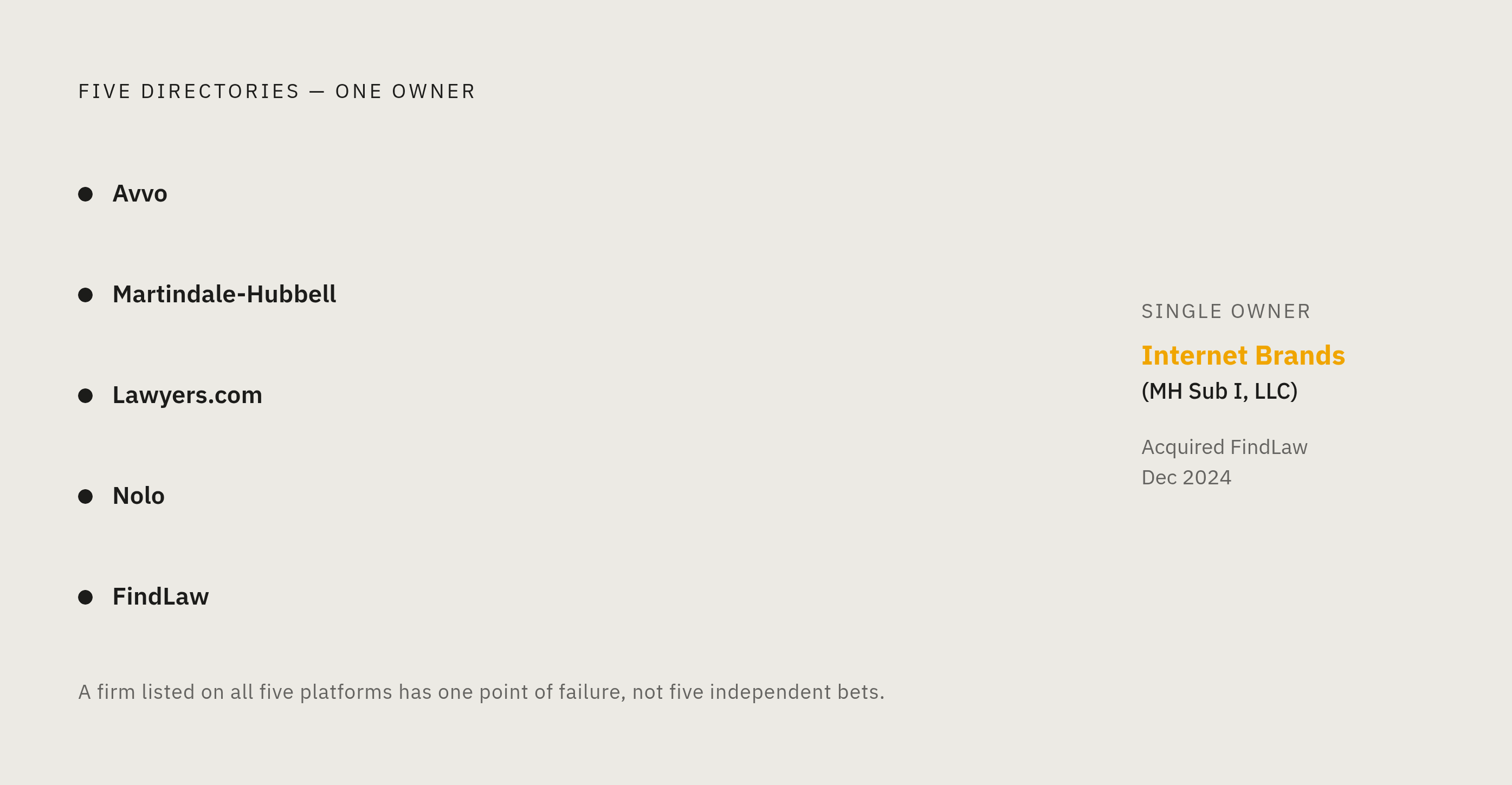
That last point isn't hypothetical anymore. One ownership structure now controls much of the consumer-facing legal directory landscape, so risk concentrates for any firm that leans heavily on those platforms for visibility. In December 2024, MH Sub I, LLC, operating as Internet Brands, completed its acquisition of FindLaw. The 2026 law firm directory SEO guide states that Internet Brands now operates Avvo, Martindale-Hubbell, Lawyers.com, Nolo, and FindLaw under one roof. FindLaw itself dates to 1995 and spent years as part of the Thomson Reuters network before the Internet Brands deal. A firm with profiles on both platforms is, in practical terms, exposed to one owner twice. The practical response is to treat directory spend as a variable cost that may climb as consolidation reduces competition, not as a stable, set-it-and-forget-it line item, and to weight investment accordingly toward the owned-domain side of the ledger.
How AI-generated answers are reshaping where legal discovery begins
AI platforms are turning into a first-touch discovery channel for legal services, and the data on where those platforms pull their answers from complicates the tidy "own your SEO, use directories as a supplement" framing from the sections above. SEO for Attorneys: The 2026 Playbook for AI-Era Rankings found that directories, not individual firm websites, captured a majority of citations in a 2026 study of AI answers to legal queries. A meaningful share of firms that these AI tools name in their answers have no page of their own among the cited sources. The AI knows those firms purely through directory listings. The click-through math compounds the issue: Pew Research Center data cited in the research shows Google users click a traditional organic result far less often when an AI summary appears on the page than when no summary appears, meaning organic traffic to a firm's own site faces a structural headwind simply because AI summaries now sit above it more often. None of this overturns the ownership argument built across the earlier sections. It sharpens it. Firms should synchronize their website and their directory profiles through structured data, so AI engines can verify the same claims across both. SEO for Attorneys: The 2026 Playbook for AI-Era Rankings identifies the specific bridge: LegalService, Person, Service, and FAQ schema markup on the firm's own site lets AI engines treat the website and the directory profiles as one coherent, verifiable identity.
Which specific directories are worth the time
Not every directory pulls its weight, and the ones that justify time and money differ by what they actually deliver, whether that's AI citation presence, peer credentialing, consumer search volume, or followed link equity. Selection should run on outcome, not name recognition.
Free listings belong in every firm's profile regardless of practice area or budget size. Google Business Profile tops this list; per SEO for Lawyers: The Complete 2026 Guide, it's the single highest-leverage local action a firm can take, requiring no domain authority and capable of moving Map Pack placement in sixty to ninety days for firms that have never touched it before. Justia ranks among the most valuable free listings available: it carries strong domain authority, each attorney profile also appears in the Legal Information Institute at Cornell Law School's lawyer directory, and it shows up in the AI engine citation set identified by the 2026 AI Visibility Report. Avvo's free profile drives real consumer volume in personal injury, family law, and criminal defense, with somewhat less pull in transactional and corporate work, and its free tier functions well on its own before any paid upgrade enters the conversation.
Paid or selective listings deserve evaluation case by case. The National Law Review is a business-to-business legal publication reaching legal and business professionals in more than 150 countries monthly, with a domain rating of 85; pairing a directory listing there with its publishing relationship builds brand authority over time in a way most directories can't match, and it suits firms whose clients are other businesses or in-house counsel. FindLaw's paid enhanced listing attracts substantial monthly traffic and pairs an attorney directory with one of the largest consumer-facing legal content libraries online, so a prospective client who reads a FindLaw article and then encounters a sponsored profile in their market arrives already educated; per the National Law Review's 2026 guide, this works especially well for personal injury, family law, DUI defense, and estate planning in competitive metro markets, though the Internet Brands consolidation risk covered above is worth weighing before signing a long-term contract. The Better Business Bureau isn't primarily a legal directory, but per the same guide, BBB accreditation functions as credibility infrastructure at the exact moment a potential client is comparing two attorneys, one with an A+ rating and one without, and that comparison tends to matter more among older demographics; it also carries citation value on a domain Google has trusted for years.
One category of free listings consistently beats paid alternatives on link equity: practice-area associations such as AILA for immigration attorneys, AAJ member listings, and ACTL pages pass followed link equity because they're contextually authoritative, not because anyone paid for placement. Build every free listing out completely before evaluating paid upgrades. Free tiers at Justia, Avvo, and Google Business Profile work well on their own, so you should only start paid spending once the free foundation is finished.
Allocating a legal marketing budget between owned SEO and directory spend
Budget allocation between owned SEO and directory spend should track practice area, client acquisition stage, and time horizon. In nearly every scenario, though, the owned-domain investment deserves the larger and more permanent share, because it's the only piece of this budget that compounds. Free infrastructure comes first: Google Business Profile, Justia, the state bar directory, and the Avvo free profile cost nothing beyond staff time, and together they already cover both the AI citation set and the local SEO citation requirements, so they should be fully built out before any paid directory spend gets approved. For estate planning, immigration, and niche B2B practices, that conversion math rarely works out at premium pricing. The AI visibility finding changes one specific allocation decision: a firm that has fully built out its free directory presence and implemented Attorney schema on its own site, with sameAs links pointing to those profiles, has completed its AI citation strategy at close to zero incremental cost. The consolidation risk covered earlier argues for shorter contract terms and spreading listings across directories instead of concentrating spend inside the Internet Brands ecosystem, because a firm locked into long-term contracts across several Internet Brands properties is exposed to a single point of failure. The owned-domain investment, content, technical SEO, Google Business Profile management, and link acquisition from free high-authority sources like bar associations, should be treated as a fixed, growing asset on the books. Every dollar spent on the firm's own domain builds something permanent. Every dollar spent on a directory listing resets to zero the day the contract ends, and that asymmetry, more than any single month's performance numbers, is what should govern the split.
Choosing an SEO and digital marketing partner as a Midwest law firm
Most law firms have no business trying to manage attorney SEO, directory optimization, and schema implementation in-house, which makes the choice of an outside partner matter as much as the strategy itself. The right partner treats SEO and directory presence as two complementary pieces of one owned-asset strategy, not as competing line items or opportunities to chase whatever tactic is trending this quarter. Upnorthmedia is a web development and SEO firm built for Midwest businesses, including law firms, with a focus on measurable results, higher search rankings, faster sites, and workflow efficiency. It builds custom websites and web applications with SEO and organic growth treated as core deliverables, a positioning that lines up directly with what attorney SEO actually requires: owned-domain investment, technical performance, and sustained content strategy tied to outcomes like signed cases. If a Nebraska or Omaha law firm is trying to decide between building a compounding digital asset and renting visibility month to month, this is a reasonable place to start the conversation.
A few criteria apply to any legal SEO partner worth hiring. Look for a partner who understands that the Map Pack, organic results, and AI Overviews are separate problems that need separate work. Given how much leverage sits in that single zone, a clear, named process for Google Business Profile management and review strategy needs to be a defined deliverable, not an afterthought. Schema implementation capability counts as well: Attorney and LegalService markup with sameAs properties linking to directory profiles is the actual technical bridge between owned-domain SEO and AI citation presence, and a partner who can't build that bridge can't fully execute the strategy laid out across this piece. Directory strategy should sit inside the same engagement as owned-domain SEO, not off in its own separate conversation. Free directory optimization, NAP consistency, and citation management are part of the same system as the firm's website, and a partner who ignores them leaves both the AI citation layer and the local pack citations half-finished.